
铝合金电缆

Search documents
铜价高位震荡 “以铝节铜”应用提速
Xin Hua She· 2026-02-05 13:00
Group 1 - In January 2026, domestic copper prices surged significantly compared to both year-on-year and month-on-month figures, following a historical high in 2025, with high volatility observed in early February [1] - The recent increase in copper prices is attributed to a combination of supply disruptions, rising demand, and favorable policy expectations [1] - Global copper mines are facing long-term constraints due to declining resource quality, rising extraction costs, and increased supply vulnerabilities, with copper grades dropping from 1.3% in 2005 to 0.65% in 2025, and extraction costs rising over 40% since 2015 [1] Group 2 - The demand for copper is significantly driven by "green energy" and "artificial intelligence," with electric vehicles using 3 to 5 times more copper than traditional fuel vehicles, leading to a demand increase of hundreds of thousands of tons [1] - AI data centers have a higher copper density compared to traditional data centers, with the explosion of computing power and the construction of supporting power systems driving demand for high-purity copper foil and precision copper cables [1] - The global liquidity and geopolitical environment have also created favorable conditions for rising copper prices, with abundant liquidity and a strong equity market since the beginning of 2026 [1] Group 3 - The rise in copper prices has resulted in increased cost pressures for downstream companies, affecting various sectors from household items to industrial applications [4] - Companies like Anhui Meibo Intelligent Electric Group and Jiangjun Air Conditioning have issued price adjustment notices, citing rising copper prices as a significant reason [4] Group 4 - Some companies are focusing on technological upgrades to mitigate cost pressures, employing advanced technologies such as AI dynamic energy-saving techniques to enhance efficiency without increasing raw material usage [5] - Industry players are accelerating innovation, with companies like Nord Technology producing ultra-thin lithium battery copper foil and Jintian Copper upgrading recycling processes to achieve 99.99% purity for high-tech applications [5] - Long-term strategies include intelligent mining, low-grade utilization, and high-end material research to address cost pressures and achieve excess profits through technological innovation [5] Group 5 - The strategy of "using aluminum to save copper" is emerging as a significant exploration path, involving the development of aluminum alloy cables and copper-aluminum composite materials to conserve copper resources while ensuring performance [6] - The Ministry of Industry and Information Technology has identified key areas for aluminum development, including aluminum conductors for photovoltaic and wind power stations [6] - The application of copper-aluminum composite materials has shown promising results, with copper usage in air conditioning units decreasing from 12 kg per unit in 2000 to 4 kg currently, and in electric vehicles from 80 kg to 60 kg [6] Group 6 - The value of high-quality copper-aluminum composite materials extends beyond cost savings, offering green value with aluminum recycling energy consumption being only 5% of that for primary aluminum, which is lower than copper recycling energy consumption [8] - The adoption of "using aluminum to save copper" technologies enhances resource conservation and may reduce dependence on imported copper materials, particularly copper concentrates [8]

别只盯着铜,铝时代可能要来了
阿尔法工场研究院· 2026-01-19 02:02
Core Viewpoint - The shift from copper to aluminum is not merely a cost-cutting tactic but a strategic response to global resource changes, geopolitical tensions, and technological advancements, fundamentally altering the supply-demand dynamics and long-term pricing logic of copper and aluminum [4][24]. Group 1: Supply Chain and Market Dynamics - Recent months have seen a dramatic surge in copper prices driven by a global supply chain crisis, with a current supply-demand gap of 500,000 tons in the copper market [5]. - The copper industry faces significant challenges, including a high dependency on foreign resources, with over 80% of copper ore being imported, which poses risks to supply chain security [9][10]. - In contrast, China dominates the aluminum sector, with projected electrolytic aluminum production reaching 44.0046 million tons in 2024, accounting for 58% of global output [12]. Group 2: Strategic Shift to Aluminum - The transition to aluminum from copper has evolved into a national strategy aimed at ensuring industrial security, as highlighted by government initiatives promoting aluminum consumption in various applications [13]. - The copper-aluminum price ratio has reached a 20-year high, with the current ratio at 4.21, significantly exceeding the traditional economic threshold of 3.5, making aluminum a more attractive alternative [17][20]. - The cost advantages of using aluminum over copper are substantial, with potential savings of 20%-25% in air conditioning and 30%-40% in electric vehicles [20][34]. Group 3: Technological Advancements - The evolution of aluminum as a substitute for copper has progressed through four key phases: from early exploration (2015-2018) to technological breakthroughs (2019-2022), followed by large-scale validation (2023-2025), and finally to widespread adoption in the future [25][28][30]. - Innovations in aluminum processing, such as the introduction of silicon-sulfur neutralization technology, are expected to significantly reduce China's reliance on imported bauxite from 90% to below 50% [21][22]. Group 4: Capital Market Implications - The disparity in price movements between copper and aluminum suggests that the aluminum sector is poised for growth, while copper may face a demand ceiling due to the rise of aluminum as a substitute [35][37]. - The shift towards aluminum is expected to attract more global capital, as the supply-demand balance for aluminum transitions from loose to tight, enhancing its financial attributes [38]. Group 5: Future Outlook - The transition from copper to aluminum reflects broader changes in global resource dynamics and energy transitions, with aluminum's lightweight and recyclable properties making it essential in green industries [39]. - The future landscape will likely see copper and aluminum coexisting, each serving distinct roles in high-performance and cost-sensitive applications, thereby reshaping the competitive dynamics of the manufacturing sector [39][40].
供需格局失衡,铝代铜成为产业必然?
Hua Er Jie Jian Wen· 2026-01-14 10:41
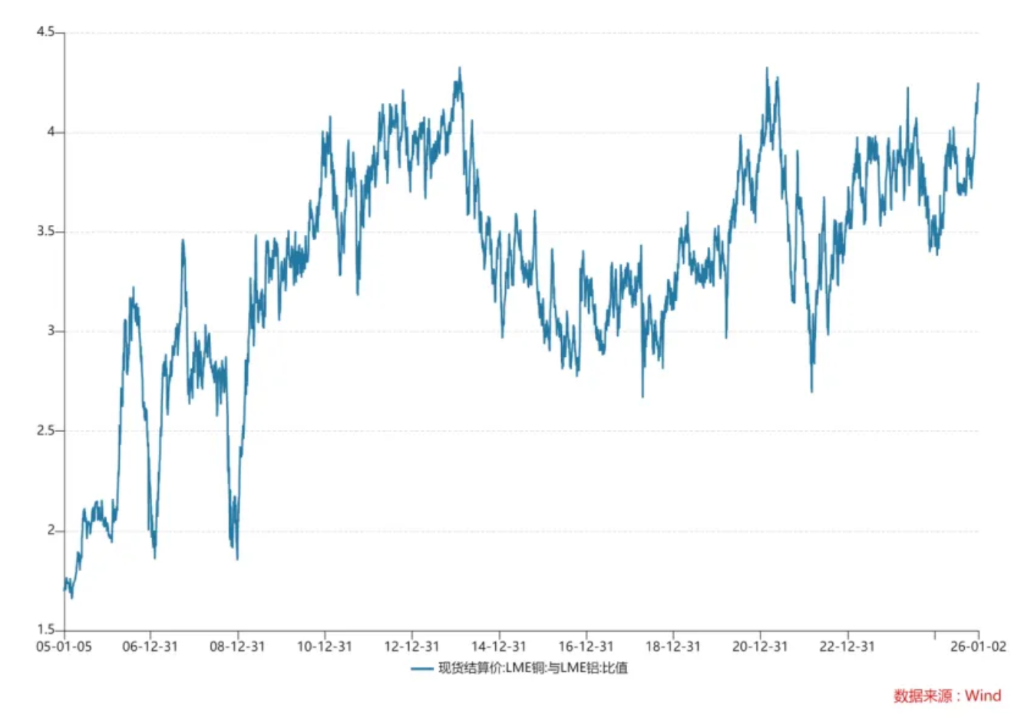
Core Viewpoint - The trend of "aluminum replacing copper" is becoming an inevitable choice in the industry due to rising copper prices and imbalances in market supply and demand, indicating a long-term technological revolution rather than a short-term speculation [1] Group 1: Price Dynamics - The current copper-aluminum price ratio is at a historical high, reaching 4.21 times, up from a low of 1.7 times in 2005, driven by differences in supply and demand dynamics for both metals [2] - The widening price ratio is pushing aluminum from a technical alternative to a real necessity [6] Group 2: Supply Constraints - Copper's supply lacks elasticity, primarily due to long development cycles of 7-10 years for new mines and low approval rates for environmental assessments [6][7] - In contrast, aluminum's supply constraints are mainly at the smelting stage, influenced by energy supply and water resource availability [8][10] Group 3: Technological Innovations - Systematic technological innovations in new materials, processes, and structures are making large-scale production of aluminum as a substitute for copper feasible [12] - Key technological breakthroughs expected by 2025-2026 include addressing issues like creep and electrochemical corrosion, enhancing aluminum's viability in various applications [13] Group 4: Industry Applications - In the power transmission sector, aluminum has already replaced copper in long-distance transmission lines, and its use in 5G base stations and data centers is increasing due to cost and weight considerations [15] - The air conditioning industry is moving towards standards that favor aluminum, with major companies like Daikin already using over 50% aluminum in their products by 2024 [15][16] Group 5: Market Dynamics - The aluminum sector is experiencing a restructuring phase, with companies that can secure stable, cheap, and green energy resources gaining competitive advantages [9] - China's electrolytic aluminum production capacity is capped at 45 million tons, with utilization rates nearing full capacity, indicating limited growth potential [19][21] Group 6: Financial Performance - Major players in the aluminum industry, such as China Aluminum and China Hongqiao, are positioned well in terms of production capacity and profitability, with China Aluminum holding a 17.5% domestic market share [22][23] - The financial metrics indicate that companies like China Hongqiao and Nanshan Aluminum are relatively undervalued compared to their peers, suggesting potential investment opportunities [25][26]
铝代铜僵
投中网· 2026-01-14 06:35
Core Viewpoint - The article discusses the rising trend of "aluminum replacing copper" in various industries due to the increasing copper prices and supply-demand imbalances, indicating a long-term technological shift rather than a short-term market speculation [6][7][8]. Group 1: Copper-Aluminum Price Ratio - The current copper-aluminum price ratio is at a historical high of 4.21 times, up from a low of 1.7 times in 2005, reflecting significant supply-demand differences and elasticities between the two metals [10][12]. - The widening price ratio is driving the shift from aluminum as a technical alternative to a real necessity in various applications [16]. Group 2: Supply-Demand Dynamics - Copper demand is increasing due to its role in the new energy era, while supply is constrained by long development cycles of 7-10 years and low environmental approval rates [17][18]. - In contrast, aluminum supply constraints are primarily at the smelting stage, with the industry undergoing a restructuring phase where companies with stable, low-cost, and green power resources will have competitive advantages [19][20]. - Both metals face supply elasticities, but the core constraints differ significantly, with aluminum becoming a feasible alternative in specific scenarios as technology advances [22]. Group 3: Technological Innovations - Systematic technological innovations in new materials, processes, and structures are making large-scale aluminum replacement of copper feasible [24]. - Key technological breakthroughs expected by 2025-2026 include solutions for creep, electrochemical corrosion, and improved conductivity, which will address traditional aluminum material pain points [25][26]. Group 4: Industry Applications - In the power transmission sector, aluminum has already replaced copper in long-distance transmission lines, and its use in 5G base stations and data centers is increasing due to weight and cost considerations [27]. - The air conditioning industry is moving towards aluminum, with major players like Daikin already using over 50% aluminum in their products by 2024 [28]. - The automotive sector is rapidly advancing in aluminum applications, with new aluminum alloy materials developed to solve corrosion issues and optimize creep performance, expected to be implemented by 2026 [30]. Group 5: Investment Logic - The current investment logic in the aluminum sector revolves around the "aluminum replacing copper" trend and the strategic value driven by resource nationalism [33]. - The electrolytic aluminum capacity utilization rate is nearing full capacity, with major companies like China Aluminum and China Hongqiao leading in production [34][36]. - Companies with aluminum ore and energy resources are expected to have more elastic performance in the face of price increases, with a focus on optimizing resource combinations [38]. Group 6: Financial Performance and Valuation - Financial performance metrics indicate that companies like China Hongqiao and Nanshan Aluminum International have lower P/E ratios, while ROE is high for companies like Nanshan Aluminum and Huafeng Aluminum [39][40]. - The overall aluminum sector is not undervalued, but individual stock differentiation is evident, with some companies like Nanshan International Aluminum and China Hongqiao appearing relatively undervalued [41][42].


青海西宁:废弃物“浴火重生” 电解铝绿色转型
Ke Ji Ri Bao· 2025-07-03 06:12
Group 1: Environmental Initiatives in Xining - Xining has made significant progress in ecological improvement, with forest coverage in the core area of the South-North Mountain Greening Project increasing from 7.2% to 79% since 1989, enhancing carbon sequestration [1] - As a second batch national carbon peak pilot city, Xining is implementing actions targeting major emission sources and promoting green transformations in urban construction, industry, and energy sectors [1] - The city has achieved a 100% resource utilization rate for municipal solid waste, effectively realizing waste reduction, resource recovery, and harmless treatment [3] Group 2: Waste Management and Recycling - Sheneng Huangshui Company specializes in waste incineration power generation, processing approximately 400 trucks of municipal waste daily, converting 1 ton of waste into 500 kWh of electricity [2] - The company employs advanced technologies for waste treatment, ensuring emissions meet standards while generating energy for sale [2] - Xining has closed or ecologically capped all 15 municipal waste landfills, becoming the first city in the Tibetan Plateau to achieve zero landfill for raw waste [3] Group 3: Aluminum Industry Transformation - China's electrolytic aluminum production accounts for half of the global output, with significant carbon emissions associated with traditional production methods [4] - Xining's Ganhua Industrial Park is recognized as a core production base for green electricity aluminum, with companies like Huanghe Xinye focusing on low-carbon transformation and green energy utilization [5][6] - By 2027, Xining aims for a 90% conversion rate of primary electrolytic aluminum products and a 75% share of clean energy in aluminum production [7]