分红型增额寿险

Search documents
投资收益率和偿付能力又下滑,中邮人寿的分红险还能买吗?
Sou Hu Cai Jing· 2025-12-29 03:25
Group 1 - The core viewpoint of the article highlights that the impact of the recent data release on the dividend insurance policies of China Post Life Insurance remains limited, primarily due to the volatility in investment returns across the insurance industry [2][8] - The net profit fluctuations of insurance companies have increased since the implementation of new financial accounting standards, with significant profit growth observed in the third quarter of 2024 for major insurers like China Life and China Pacific Insurance [2][8] - China Post Life Insurance experienced a notable turnaround from a loss of 11.4 billion in 2023 to substantial profits in the following year, indicating that early fluctuations in data were influenced by the timing of accounting standard changes [2][8] Group 2 - The overall solvency performance of life insurance companies declined in the third quarter compared to the first half of the year, with only a few companies showing an increase in solvency ratios [3][5] - The decline in solvency ratios is attributed to the new second phase of solvency regulations, which increased risk factors and capital requirements, leading to a compression of reported solvency [5][8] - Non-listed insurance companies' full implementation of new standards has also impacted solvency, with China Post Life Insurance being significantly affected but not to a critical extent [8] Group 3 - Investment returns for life insurance companies saw a general decline in the third quarter, primarily due to falling bond prices [9][12] - The comprehensive investment return rates for insurance companies in the third quarter were mostly in the range of -3% to 2%, with China Post Life Insurance reporting -1.9%, which is slightly below the overall average but still competitive [13] - The average financial investment return rate for China Post Life Insurance was 1.26%, surpassing many competitors, and the company has maintained a three-year average investment return rate of 3.80% [14][18] Group 4 - The dividend insurance policies of China Post Life Insurance remain attractive, with a high demonstration benefit compared to similar products, achieving an average realization rate of 70-80% [18] - The current dividend-type increasing life insurance products from China Post Life Insurance offer higher long-term demonstration benefits than those from other companies with the same predetermined interest rate [18]


人身险产品预定利率将下调 部分产品“闪电”停售
Zheng Quan Ri Bao· 2025-08-12 07:27
Core Viewpoint - The recent comprehensive reduction in the predetermined interest rates for life insurance products is leading to a wave of product discontinuations in the market, with companies proactively switching to lower-rate products to optimize their liabilities [1][2][3] Group 1: Product Discontinuation - Many insurance products have been discontinued recently, with some experiencing "lightning" stoppages, such as a dividend-type life insurance with a guaranteed rate of 2.0% being pulled from the market within two hours of notification [2] - Several insurance companies have announced the discontinuation of multiple products and adjustments to the maximum predetermined interest rates for new products, with ordinary insurance products set at 2.0%, dividend products at 1.75%, and universal insurance products at 1.0% [2] - The recent adjustment in predetermined interest rates has triggered a regulatory mechanism requiring insurance companies to lower the maximum rates for new products and complete the transition from old to new products within two months [2] Group 2: Market Dynamics - The current market environment is relatively calm compared to previous instances of interest rate reductions, with fewer signs of speculative behavior around product discontinuation [3] - Regulatory measures have been strictly enforced to control sales misguidance, contributing to a more rational consumer behavior and reducing anxiety around product discontinuation [3] Group 3: Product Strategy - Insurance companies are actively launching new products with lower predetermined interest rates while promoting dividend-type insurance products, which are seen as advantageous in the current environment [4][5] - The asymmetric strategy in rate adjustments favors dividend products, which have a guaranteed rate of 1.75% plus floating returns, potentially offering higher actual returns compared to traditional products [4] - The risk-sharing mechanism of dividend products helps insurance companies reduce rigid costs and alleviates pressure from interest rate differentials, allowing for greater investment flexibility [5] Group 4: Diversification Opportunities - While dividend products are currently favored, there is a call for insurance companies to avoid product homogeneity and consider diversification to mitigate excessive competition [5] - Potential areas for diversification include health insurance products that align with aging demographics, integration with the pension industry, and developing specialized insurance products in collaboration with public resources [5]
预定利率下调引发人身险产品批量停售
Zheng Quan Ri Bao· 2025-08-11 16:48
Core Viewpoint - The recent comprehensive reduction of the predetermined interest rates for life insurance products is leading to a wave of product discontinuations in the market, with companies proactively switching to lower-rate products to optimize their liabilities [1][2][3]. Group 1: Product Discontinuation - Many insurance products have been discontinued recently, with some experiencing "lightning" stoppages, such as a dividend-type life insurance with a guaranteed rate of 2.0% being pulled from the market within two hours of notification [2]. - Several insurance companies have announced the discontinuation of multiple products and adjustments to the maximum predetermined interest rates for new filings, with ordinary insurance products set at 2.0%, dividend products at 1.75%, and universal insurance products at 1.0% [2]. - The recent adjustments reflect a non-symmetrical reduction in predetermined interest rates, with ordinary and universal products down by 50 basis points and dividend products down by 25 basis points [2]. Group 2: Market Dynamics - The insurance market has shown a relatively calm atmosphere prior to the recent rate reductions, contrasting with previous instances where speculation around product discontinuation was rampant [3]. - Regulatory measures have been strictly enforced to control sales misguidance, contributing to a more rational consumer behavior and reducing the anxiety surrounding product discontinuation [3]. Group 3: Product Strategy - Insurance companies are actively promoting the transformation towards dividend insurance products, with many updating a significant number of their offerings to highlight the advantages of these products in the new interest rate environment [4]. - The predetermined interest rate for dividend products is strategically set lower than that of other types, enhancing their relative appeal, especially as the potential investment returns could exceed those of traditional products [4][5]. - The risk-sharing mechanism of dividend products helps alleviate the pressure of interest rate differentials for insurance companies, allowing for greater investment flexibility [5]. Group 4: Diversification Opportunities - While dividend insurance is currently favored, there is a call for product diversification to avoid excessive competition in a single market segment [5]. - Companies are encouraged to explore three areas for diversification: health insurance products that align with aging demographics, integration with the pension industry, and the development of specialized insurance products in collaboration with public resources [5].
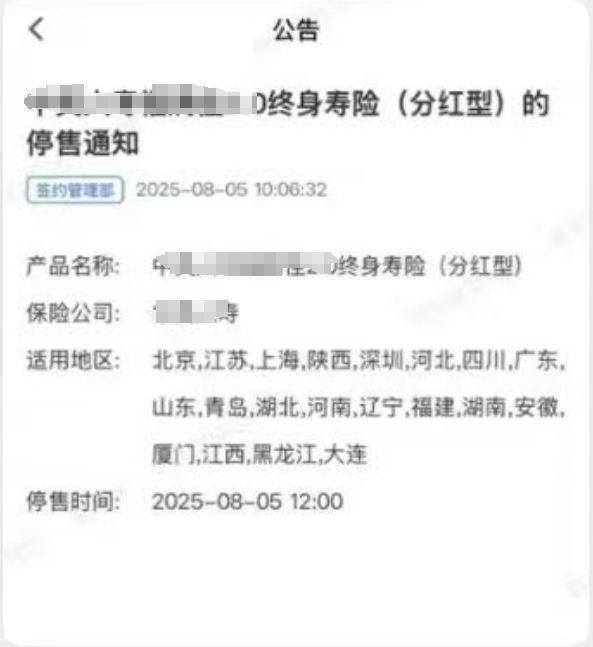
刚通知两小时就下架,2.0%分红险上演“闪电停售”
Mei Ri Jing Ji Xin Wen· 2025-08-06 11:26
Core Viewpoint - The insurance market is experiencing a wave of product suspensions ahead of the upcoming adjustment in predetermined interest rates, with significant implications for sales dynamics and consumer behavior [1][2][4]. Group 1: Product Suspension - Several insurance companies have rapidly suspended existing products, with some notifications given only two hours in advance, raising concerns in the market [2][4]. - A specific dividend-type endowment life insurance product with a guaranteed interest rate of 2.0% was abruptly taken off the market on August 5, 2023, just two hours after the notice was issued [1][2]. - The suspension affects various types of life insurance products, including critical illness insurance and endowment insurance, with many products marked for potential immediate suspension [2][4]. Group 2: Rate Adjustment and Market Response - The China Insurance Industry Association announced a predetermined interest rate of 1.99% on July 25, triggering a mechanism for adjusting life insurance rates and products [1]. - The maximum predetermined rates for different product types will be adjusted to 2.0% for ordinary and dividend-type products, 1.75% for universal products, and 1.0% for others, effective August 31 [1][9]. - The current market sentiment indicates that the demand for life insurance products has been exhausted due to previous "suspension speculation," leading to a muted response to the recent product suspensions [4][8]. Group 3: Product Popularity and Consumer Behavior - Dividend-type endowment life insurance has gained popularity in a declining interest rate environment, outperforming traditional products in sales rankings [5][6]. - The competitive edge of dividend-type products lies in their potential for higher returns beyond the guaranteed interest, appealing to consumers seeking both protection and investment [6][9]. - The sales dynamics are shifting, with insurance companies needing to adapt their sales strategies and agent training to align with the changing product landscape and consumer expectations [10]. Group 4: Future Outlook - The insurance industry is expected to see continued growth in dividend-type products as they offer a combination of protection and potential returns, especially in a low-interest-rate environment [8][9]. - The non-symmetric adjustment of interest rates, where dividend products see a smaller reduction compared to traditional products, enhances their market competitiveness [9]. - The overall insurance premium income is projected to maintain a growth trajectory, with significant increases noted in the first half of 2025 [8].
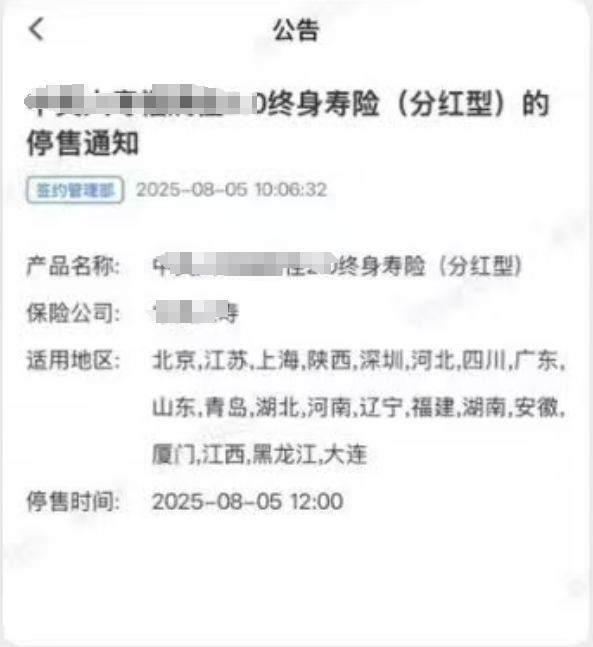
刚通知就下架 购买窗口仅两小时!2.0%分红险上演“闪电停售”
Mei Ri Jing Ji Xin Wen· 2025-08-06 11:13
Core Viewpoint - The insurance market is experiencing a wave of product suspensions ahead of the upcoming adjustment in predetermined interest rates, with significant implications for sales dynamics and consumer behavior [1][2][4]. Group 1: Product Suspension - Several insurance companies have rapidly suspended various life insurance products, with some notifications given only two hours in advance, raising concerns in the market [2][4]. - A specific dividend-type life insurance product with a guaranteed interest rate of 2.0% was abruptly taken off the market on August 5, 2023, just two hours after the notification was issued [1][2]. - The suspension affects a range of products, including critical illness insurance, increasing death benefit insurance, and annuity insurance, with many products marked for potential immediate suspension [2][4]. Group 2: Market Dynamics - The current wave of product suspensions has not triggered a buying frenzy among consumers, contrasting with previous instances where suspensions led to significant sales spikes [4]. - Analysts suggest that consumer demand has been exhausted in prior "suspension hype" cycles, indicating that the current product suspensions may not lead to renewed sales surges [4][8]. - The upcoming adjustment in predetermined interest rates is set for August 31, 2023, which coincides with the anniversary of the previous product suspension, further complicating market expectations [1][2]. Group 3: Product Preferences - Dividend-type life insurance products are gaining popularity in the current market, attributed to their unique attributes that appeal to consumers seeking both protection and potential returns [5][9]. - Despite traditional products offering a fixed return of 2.5%, the 2.0% guaranteed rate of dividend products is still favored due to their potential for additional returns through dividends [6][9]. - The competitive edge of dividend products is significantly influenced by the insurance companies' investment capabilities and historical dividend performance [6][7]. Group 4: Regulatory Environment - The regulatory environment has prompted insurance companies to adjust their product offerings, with predetermined interest rates for various product types being lowered [9][10]. - The recent adjustments show a "non-symmetrical" characteristic, where traditional and universal life insurance rates were reduced more significantly than dividend products, enhancing the latter's market competitiveness [9]. - The anticipated changes in the market are expected to support the sales of dividend products, aligning with regulatory guidance aimed at promoting their distribution [9][10].