投资收益率

Search documents
最高6.6%,最低4.04%:不一致的披露口径,难掩险企高下立现的投资水平
第一财经· 2026-03-29 15:15
Core Viewpoint - The investment performance of life insurance products has been significantly highlighted in the low interest rate environment, with floating income products becoming the mainstay, heavily reliant on the investment capabilities of insurance companies [3][4]. Investment Yield Disparity - In the 2025 annual reports of seven major listed life insurance companies, total investment assets reached 22.9 trillion yuan, a year-on-year increase of 12.8%, accounting for 60% of the industry [4][5]. - Total investment yield varied among companies, with Xinhua Insurance at the highest yield of 6.6% and China Pacific at the lowest of 4.04%. Six companies reported year-on-year increases in total investment yield, while only China Pacific saw a decline of 0.53 percentage points [5][6]. - The absolute values of total investment yield showed that Xinhua Insurance led with 6.6%, followed by China Life over 6%, while China Pacific and China Property & Casualty both stood at 5.7% [6]. Disclosure Discrepancies - The significant differences in comprehensive investment yield among listed insurance companies stem from variations in disclosure standards. Some companies include fair value changes of FVOCI bonds in their calculations, while others do not [9][10]. - For instance, if Xinhua Insurance excluded FVOCI amounts, its comprehensive investment yield would rise to 6.9%, while China Pacific's would increase to 4.29% [10][11]. - The lack of uniformity in disclosure standards creates challenges for investors and consumers, leading to potential misunderstandings regarding investment performance [11]. Regulatory Context - The insurance industry is under scrutiny, with regulatory bodies emphasizing the need for consistent reporting standards. The solvency reports of insurance companies have more standardized formulas for calculating investment yields compared to annual reports [12]. - In the fourth quarter solvency reports, China Life reported the highest investment yield at 5.2%, while China Property & Casualty and China Pacific reported lower yields of 3.74% and 3.76%, respectively [12][13]. Asset Management Competition and Compliance - The competition in the insurance sector is intensifying, with companies focusing on enhancing their asset management capabilities. Many large insurers are entrusting their investment assets to in-house asset management firms [14]. - Regulatory compliance remains a critical issue, as evidenced by the 130 penalties issued to insurance asset management institutions in 2025 for various violations, including improper use of insurance funds [15][16].


中国平安(601318)点评:业绩表现稳健 股息率亮眼
Ge Long Hui· 2026-03-28 07:30
Core Viewpoint - The company reported a slight profit exceeding expectations, with a notable dividend yield, indicating strong core business performance and growth in key metrics [1][2][3] Financial Performance - In 2025, the company achieved a net operating profit and net profit attributable to shareholders of 134.41 billion and 134.78 billion yuan, respectively, representing year-on-year increases of 10.3% and 6.5%, slightly above the expected 5.3% growth [1] - The company plans to distribute a dividend of 2.7 yuan per share, a year-on-year increase of 5.9%, with a payout ratio of 36.4% for operating profit and 36.3% for net profit [1] New Business Value (NBV) Growth - The company reported a 29.3% year-on-year increase in NBV, reaching 36.897 billion yuan, driven by both volume and price increases [1] - The new business and NBV margin (NBVM) saw year-on-year growth of 3.7% and 4.9 percentage points, respectively, reaching 196.084 billion yuan and 23.4% [1] Individual Insurance Performance - In 2025, individual insurance NBV and new business decreased by 9.6% to 132.345 billion yuan, while NBVM increased by 6.4 percentage points to 30.8% [2] - The number of agents decreased by 0.8% quarter-on-quarter to 351,000, with a year-on-year increase in per capita NBV of 17.2% [2] Bancassurance Growth - Bancassurance showed remarkable growth, with NBV and new business increasing by 138.0% and 92.2%, respectively, and NBVM rising by 4.4 percentage points to 24.5% [2] - The company has been expanding its external quality bank channels, significantly enhancing its network capacity [2] Property and Casualty Insurance Performance - In 2025, the insurance service revenue for property and casualty insurance increased by 3.3% to 338.912 billion yuan, with a combined ratio (COR) improving by 1.5 percentage points to 96.8% [2] - The underwriting profit surged by 96.2% to 10.717 billion yuan, driven by cost optimization in auto insurance and stable performance in non-auto insurance [2] Investment Performance - The company’s investment assets reached 6.5 trillion yuan, a year-on-year increase of 13.2%, with equity allocation in the secondary market rising by 670.8 billion yuan to 1.24 trillion yuan, accounting for 19.1% of total assets [3] - The net and comprehensive investment returns were 3.7% and 6.3%, respectively, with a slight year-on-year decline in net return [3] Investment Outlook - The company has adjusted its profit forecast downward due to geopolitical risks but maintains a "buy" rating, highlighting the potential for continued growth in NBV from bancassurance channel expansion [3]

中国平安(601318):业绩表现稳健,股息率亮眼:中国平安(601318):
Shenwan Hongyuan Securities· 2026-03-27 11:52
Investment Rating - The investment rating for Ping An Insurance (601318) is "Buy" (maintained) [1] Core Insights - The company's performance is stable, with a notable dividend yield of 4.51% based on the latest announced dividend [1] - In 2025, the company achieved a net profit of 1347.78 billion yuan, representing a year-on-year increase of 6.5%, slightly exceeding expectations [4] - The core business remains robust, with year-on-year growth in life insurance, property insurance, and banking operating profit of 2.9%, 13.2%, and -4.2% respectively [4] - The company plans to distribute a dividend of 2.7 yuan per share, a 5.9% increase year-on-year, with a payout ratio of 36.4% of operating profit after tax [4] Financial Performance - The company reported a year-on-year increase in new business value (NBV) of 29.3% to 368.97 billion yuan, driven by growth in both volume and price [5] - The property insurance segment showed a year-on-year increase in insurance service revenue of 3.3% to 3389.12 billion yuan, with a combined ratio (COR) improvement of 1.5 percentage points to 96.8% [6] - The investment asset scale reached 6.5 trillion yuan, a year-on-year increase of 13.2%, with equity allocation in the secondary market increasing by 670.8 billion yuan [7] Profit Forecasts - The profit forecast for 2026-2028 has been adjusted downwards, with expected net profits of 1505 billion yuan, 1705 billion yuan, and 2017 billion yuan respectively [7] - The company maintains a price-to-embedded value (P/EV) ratio of 0.63x for 2026, indicating a favorable long-term investment outlook [7] Market Comparison - The company's stock price closed at 56.95 yuan, with a market capitalization of 607.09 billion yuan [1] - The stock has a price-to-net asset value (P/NAV) ratio of 1.0, reflecting its valuation relative to its net assets [1]
阳光保险(06963.HK)2025年报点评:业绩稳增,保证险拖累COR
Huachuang Securities· 2026-03-17 07:30
Investment Rating - The report maintains a "Recommended" rating for Sunshine Insurance (06963.HK) [1] Core Views - The company achieved a net profit attributable to shareholders of 6.31 billion yuan in 2025, representing a year-on-year increase of 15.7%. The embedded value reached 120.78 billion yuan, up 4.3% year-on-year, while the new business value surged by 48.2% to 7.64 billion yuan. The combined ratio (COR) for property and casualty insurance was 102.1%, an increase of 2.4 percentage points year-on-year. The net, total, and comprehensive investment returns were 3.7%, 4.8%, and 6.1%, respectively, with year-on-year changes of -0.5 percentage points, +0.5 percentage points, and -0.4 percentage points [1][3][7] Financial Performance Summary - In 2025, the company reported total revenue of 94.81 billion yuan, with a year-on-year growth rate of 5.03%. The net profit attributable to shareholders is projected to grow to 6.54 billion yuan in 2026, reflecting a 3.7% increase [3][8] - Earnings per share (EPS) for 2025 is estimated at 0.55 yuan, with a price-to-earnings (P/E) ratio of 6.3 times. The price-to-book (P/B) ratio stands at 0.7 times [3][8] Business Segment Insights - Sunshine Life achieved total premiums of 102.6 billion yuan in 2025, a year-on-year increase of 27.5%. New business premiums rose by 47.3% to 45.1 billion yuan, primarily driven by a 69% increase in bank insurance new business [7] - The property and casualty insurance segment reported original premiums of 47.9 billion yuan, with a slight year-on-year increase of 0.1%. Non-auto insurance contributed significantly with a 4.5% growth [7] Investment Strategy - The report suggests that despite a decline in pre-tax profit due to underwriting financial losses, the company benefited from a one-time impact of tax policy changes, leading to stable net profit growth. The outlook for 2026 remains positive, with expectations for continued flow from bank insurance channels and improved profitability in the property and casualty segment following the cessation of financing guarantee business [7][8]
阳光保险:利润稳健增长,NBV强劲增长-20260317
HTSC· 2026-03-17 02:45
Investment Rating - The report maintains a "Buy" rating for the company with a target price of HKD 5.20 [6][8]. Core Insights - The company reported a robust growth in profit and a strong increase in New Business Value (NBV), with EPS at RMB 0.55, reflecting a year-on-year growth of 15.7% [1]. - The NBV for life insurance grew by 48.2% year-on-year, driven by a significant increase in new single premiums, which rose by 47.3% [2]. - The comprehensive cost ratio (COR) for property insurance increased by 2.4 percentage points to 102.1%, primarily due to guaranteed insurance business, although it improved to 98.9% when excluding this segment [3]. - The net investment yield decreased by 0.5 percentage points to 3.7%, while total investment yield increased by 0.5 percentage points to 4.8% [4]. - The solvency ratio decreased to 196%, down 31 percentage points, mainly due to a decline in the solvency of the life insurance business [5]. Summary by Sections Profitability and Growth - The company achieved a net profit of RMB 6.307 billion in 2025, with a year-on-year growth of 15.75% [12]. - The projected EPS for 2026, 2027, and 2028 are RMB 0.47, RMB 0.51, and RMB 0.54 respectively, indicating a slight adjustment in growth expectations [6]. New Business Value (NBV) - The NBV for 2025 showed a strong growth of 48.2%, with the agent and bancassurance channels contributing significantly, the latter growing by 64.6% [2]. - The company expects a 30% year-on-year growth in NBV for 2026, supported by resilient growth in participating insurance [2]. Property Insurance Performance - The property insurance segment's COR was adversely affected, but excluding guaranteed insurance, it showed improvement [3]. - The company plans to cease new financing-type guaranteed insurance business starting in 2026 [3]. Investment Performance - The company’s investment strategy has led to a stable performance, with a notable increase in equity asset allocation [4]. - The total investment income is projected to grow significantly, with a forecast of RMB 29.954 billion for 2026 [12]. Solvency and Financial Health - The solvency ratio decline indicates a need for improved asset-liability matching, despite a slight increase in total net assets [5]. - The company’s net assets increased by 2.1%, but the attributable net assets decreased by 6.3% [5].
新会计准则切换 人身险公司迎来盈利大年
Xin Lang Cai Jing· 2026-02-09 00:10
Core Viewpoint - The insurance industry is experiencing a significant profit increase, with 57 non-listed life insurance companies reporting a combined net profit of 66.6 billion yuan in 2025, a year-on-year increase of over 150%, marking a record high for the sector [2][9]. Group 1: Profit Performance - Among the 57 non-listed life insurance companies, 47 reported profits, with 33 showing year-on-year net profit growth, while 6 turned losses into profits and 7 reduced their losses [2][9]. - Leading companies in profitability include Taikang Life and China Post Insurance, with net profits of approximately 27.2 billion yuan and 8.3 billion yuan, respectively [2][9]. - The industry saw a notable reduction in losses, with the highest loss in 2024 being 2.2 billion yuan, down to 500 million yuan in 2025 [3][10]. Group 2: Accounting Standards Impact - The shift to new accounting standards has been a key factor in the profit turnaround for many insurance companies, with the new standards allowing for more favorable asset classification and profit recognition [3][10]. - The new financial instrument standards have changed the classification of financial assets, enabling quicker reflection of asset price increases in current profits [3][10]. Group 3: Investment Performance - Investment returns have significantly contributed to the profit increase, with the average investment yield for the 57 companies reaching 4.65% in 2025, up from 4.26% in 2024 [4][11]. - Taikang Life reported a net profit of approximately 27.2 billion yuan in 2025, with an investment yield of 4.11%, an increase of 0.9 percentage points from 2024 [5][11]. Group 4: Premium Income Growth - The total premium income for the 57 non-listed life insurance companies reached 1.2 trillion yuan in 2025, reflecting a year-on-year growth of about 11% [6][13]. - Despite the overall growth, many smaller companies face challenges due to product transitions and competition, leading to a focus on maintaining cash flow stability rather than aggressive premium growth [6][13][14]. - Foreign and bank-affiliated insurance companies have achieved premium growth rates exceeding 20%, attributed to their strategic positioning and lower historical burdens [14].
重庆国资入局的2025年,招商仁和人寿净利“翻两番”
Hua Er Jie Jian Wen· 2026-01-30 10:16
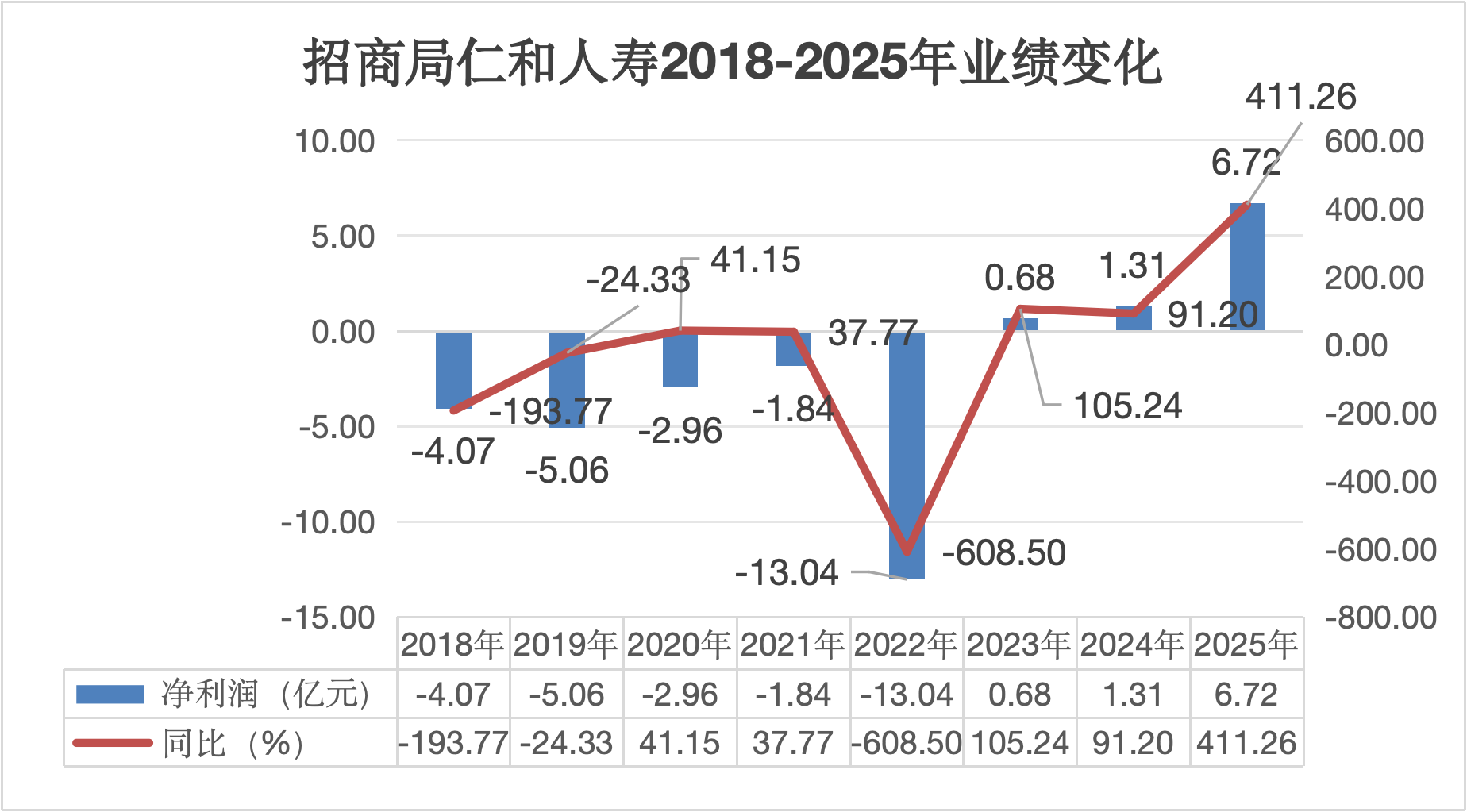
Core Viewpoint - In a low-interest-rate environment and industry transformation, China Merchants Jinhe Life Insurance, backed by China Merchants Group and China Mobile, has achieved significant growth, entering the "trillion club" with total assets reaching 108.1 billion yuan by the end of 2025, marking an 18.4% increase year-on-year [1]. Financial Performance - The company reported a cumulative net profit of 672 million yuan in 2025, a staggering increase of 411% year-on-year, with the return on equity (ROE) rising from 2.24% to 8.69% [1][3]. - The company appears to have exited its initial loss-making phase and is now on a path of profit generation [3]. Capital Adequacy - By the end of 2025, the core solvency adequacy ratio dropped to 96.18%, down from 128.47% at the end of 2024, primarily due to rapid accumulation of business liabilities, which increased from 7.65 billion yuan to 9.53 billion yuan [3]. - The future surplus of policies included in core Tier 1 capital decreased from 1.17 billion yuan to 520 million yuan, indicating some erosion of the capital base [3]. Financial Strategy - In response to capital pressure, the company issued 1.3 billion yuan in capital supplement bonds at a low interest rate of 2.40% and redeemed 800 million yuan of old debt with a higher interest rate of 4.95%, resulting in a net increase of 500 million yuan in supplementary capital and annual interest savings of approximately 20 million yuan [3]. - The investment yield for 2025 was 5.22%, slightly lower than the previous year's 5.47%, with a clear asset allocation strategy favoring government bonds, which increased to 31.05 billion yuan [3][4]. Shareholder Changes - Beijing Zaichuan Technology Co., Ltd. plans to transfer its 3.79% stake to Chongqing Yufu Holdings Group and Chongqing Linkong Development Investment Group, introducing strong state-owned enterprise backing from Chongqing into the shareholder structure [4]. Future Challenges - Despite achieving over 100 billion yuan in assets, the company anticipates a further decline in the core solvency adequacy ratio to 83.55% in the next quarter, raising concerns about future capital pressures and the potential need for shareholder capital increases [5]. - The company is attempting to find a sustainable balance between expansion ambitions and capital constraints [5].
戴德梁行:REITs底层资产中零售物业关注度显著回升
Zhong Zheng Wang· 2026-01-15 13:03
Group 1 - The report highlights that Beijing and Shanghai are the top cities attracting investor interest, indicating a strong investment preference for these core cities [1] - Non-first-tier cities like Hangzhou, Chengdu, Suzhou, and Nanjing are emerging as new investment focal points due to their economic growth, industrial upgrades, and relatively high investment returns [1] - Long-term rental apartments and serviced apartments are becoming investment hotspots, with 61% and 64% of investors in Beijing and Shanghai considering these assets, significantly higher than in Guangzhou and Shenzhen [1] Group 2 - Retail property interest has notably rebounded, with shopping centers, outlets, and community commerce becoming core segments; shopping centers are favored for their high operational standardization and liquidity [2] - Industrial asset interest shows significant differentiation, with a decline in warehouse logistics attention, while data centers and industrial plants are rapidly gaining popularity due to increased demand from cloud computing and REITs development [2] - As of December 2025, 78 public REITs have been listed in China, with a total scale of 210 billion yuan, indicating a robust growth in the public REITs market [3]
吴世春:一个人要发财的顺序,我总结了4步
创业家· 2026-01-09 10:13
Group 1 - The article emphasizes the importance of a four-step process for personal wealth accumulation: starting with small tasks, gaining a modest reputation, networking with influential circles, and ultimately meeting benefactors [3] - It highlights that making money should be within one's cognitive range, suggesting that understanding market dynamics is crucial for investment success [4] - The article discusses the need to improve investment returns to consistently outperform private lending rates, which are significantly higher than bank lending rates [5][8] Group 2 - It states that entrepreneurship is a form of investment, where time and talent are the primary currencies [6] - The article outlines the two main lines of money flow: private lending rates (12%) and bank lending rates (3-4%), indicating that individuals whose investment returns fall below bank rates risk financial decline [7][9] - It mentions that maintaining an investment return above 15% can lead to wealth accumulation, even without initial capital [13] Group 3 - The article advises using profits from secondary ventures to secure primary business interests, particularly in hard technology sectors, to ensure long-term financial stability [14][15][16] - It stresses the importance of earning money before increasing personal value, warning against the pursuit of easy wealth without effort [17][18][19] - It identifies four ways to earn money: through skills, knowledge, capital, and networks, emphasizing the need to refine personal capabilities to generate initial income [21][22] Group 4 - The article encourages recognizing trends and value opportunities while avoiding pitfalls in investment decisions, which is essential for making informed choices [23] - It suggests establishing a competitive advantage in specific investment stages and sectors, aligning with personal values for sustainable financial growth [24][25] - The author mentions managing over 100 billion in funds and investing in over 600 companies, with many approaching A-share listing standards, indicating a successful investment track record [25][26][27] Group 5 - The article promotes an upcoming event led by a notable mentor, focusing on technology manufacturing and exploring vast market opportunities [28][34] - It outlines the event's itinerary, which includes networking, cultural exploration, and discussions on industry challenges and opportunities [40][42] - The event aims to connect entrepreneurs with investors and industry leaders, fostering collaboration and knowledge sharing [35][39]

投资收益率和偿付能力又下滑,中邮人寿的分红险还能买吗?
Sou Hu Cai Jing· 2025-12-29 03:25
Group 1 - The core viewpoint of the article highlights that the impact of the recent data release on the dividend insurance policies of China Post Life Insurance remains limited, primarily due to the volatility in investment returns across the insurance industry [2][8] - The net profit fluctuations of insurance companies have increased since the implementation of new financial accounting standards, with significant profit growth observed in the third quarter of 2024 for major insurers like China Life and China Pacific Insurance [2][8] - China Post Life Insurance experienced a notable turnaround from a loss of 11.4 billion in 2023 to substantial profits in the following year, indicating that early fluctuations in data were influenced by the timing of accounting standard changes [2][8] Group 2 - The overall solvency performance of life insurance companies declined in the third quarter compared to the first half of the year, with only a few companies showing an increase in solvency ratios [3][5] - The decline in solvency ratios is attributed to the new second phase of solvency regulations, which increased risk factors and capital requirements, leading to a compression of reported solvency [5][8] - Non-listed insurance companies' full implementation of new standards has also impacted solvency, with China Post Life Insurance being significantly affected but not to a critical extent [8] Group 3 - Investment returns for life insurance companies saw a general decline in the third quarter, primarily due to falling bond prices [9][12] - The comprehensive investment return rates for insurance companies in the third quarter were mostly in the range of -3% to 2%, with China Post Life Insurance reporting -1.9%, which is slightly below the overall average but still competitive [13] - The average financial investment return rate for China Post Life Insurance was 1.26%, surpassing many competitors, and the company has maintained a three-year average investment return rate of 3.80% [14][18] Group 4 - The dividend insurance policies of China Post Life Insurance remain attractive, with a high demonstration benefit compared to similar products, achieving an average realization rate of 70-80% [18] - The current dividend-type increasing life insurance products from China Post Life Insurance offer higher long-term demonstration benefits than those from other companies with the same predetermined interest rate [18]