重疾险

Search documents
中国平安郭晓涛回应低利率时代保险应对之策:关注投资收益率与负债成本差值
Di Yi Cai Jing· 2026-03-30 13:53
Core Insights - China Ping An's Chairman, Ma Mingzhe, sets annual strategic focuses, with 2024 targeting new business growth, 2025 emphasizing "reform and innovation" for full digitalization, and 2026 designated as "Ping An Service Year" to upgrade service systems [1] Strategic Focus and Adjustments - The company maintains its core strategy of "comprehensive finance + healthcare and elderly care" while dynamically adjusting based on macro trends, industry changes, and customer needs [1] - In 2026, the strategic focus will include product, investment, and service dimensions, as detailed by Co-CEO Guo Xiaotao [1] AI Integration - "AI in ALL" is a strategic direction aimed at cost reduction, customer experience optimization, and business growth [2] - AI will help reduce risk costs in finance, such as credit defaults and insurance fraud, which is more impactful than optimizing labor costs [2] - The "Nine to One" plan will integrate multiple customer apps for a seamless service experience, addressing healthcare access issues in remote areas [2] Investment Performance - As of the end of 2025, China Ping An's investment portfolio reached 6.49 trillion yuan, with a comprehensive investment return rate of 6.3%, the highest in five years [2] - The stock allocation in the investment portfolio increased significantly from 7.6% to 14.8% [2] Long-term Investment Strategy - The company adopts a "long-term capital, patient capital" approach, focusing on the difference between investment returns and liability costs rather than absolute values [3] - Over the past decade, the average net investment return rate was 4.8%, and the average comprehensive investment return rate was 4.9%, both exceeding the 4% long-term investment return assumption [3] Product Structure and Specialization - In response to low interest rates, the company is diversifying its product offerings, with a significant increase in the share of participating insurance [4] - In 2026, the company plans to enhance its focus on protection-type products, including specialized insurance for chronic diseases like Alzheimer's and diabetes [4] Health Insurance Development - The core competitiveness of Ping An's insurance products lies in their accompanying healthcare, elderly care, and health benefits [5] - The restructuring of life and health insurance channels aims to align with regulatory trends and enhance competitive advantages in the health insurance market [5] Elderly Care and Medical Services - The government report emphasizes high-quality development in elderly care, aligning with demographic trends of an aging population [6] - In 2026, Ping An will launch an upgraded version of home care services, focusing on multi-disease management and cost reduction for medications [6] - The company aims to enhance emergency response for elderly individuals living alone through advanced monitoring technologies [6] Medical Resource Integration - Ping An has established a four-tier network for medical services, integrating local hospitals and national top-tier medical facilities [7] - The company is working towards a win-win model for clients, hospitals, and itself, facilitating seamless payment processes between public health insurance and commercial insurance [7]

价值增值强劲 中国太保寿险加速构筑高质量发展新格局
和讯· 2026-03-28 08:34
Core Viewpoint - China Pacific Insurance (CPIC) demonstrates strong core operating performance in its life insurance segment for 2025, with significant value growth and effective high-quality transformation [1] Group 1: Financial Performance - In 2025, CPIC's life insurance achieved a total premium income of 295.855 billion yuan, a year-on-year increase of 12.7% [1] - The embedded value reached 465.479 billion yuan, growing by 10.2% compared to the previous year [1] - New business value amounted to 18.609 billion yuan, reflecting a 40.1% year-on-year growth, with a new business value rate of 19.8%, up by 3.2 percentage points [1] - Net profit for the year was 42.165 billion yuan, representing a 17.7% increase [1] Group 2: Multi-Channel Strategy - CPIC established a "2+N" multi-channel structure focusing on agent and bancassurance channels to expand diverse value growth paths [2] - The agent channel generated a premium income of 211.606 billion yuan, up 4.5% year-on-year, with a focus on building a professional, digital, and youthful workforce [2] - The bancassurance channel achieved a premium income of 61.618 billion yuan, a significant increase of 46.4%, with new policy premium income reaching 16.956 billion yuan, up 43.2% [2] Group 3: Group and Government Channels - In the group and government channels, CPIC focused on key industry benchmark projects and refined management models, achieving a premium income of 17.543 billion yuan, a 10.7% increase [3] - The domain business within group channels saw new policy premium income of 1.12 billion yuan, growing by 22.9% [3] - The inclusive insurance initiative reached over 230 million people [3] Group 4: Customer-Centric Approach - CPIC emphasized customer segmentation and classification management, optimizing customer structure while aligning insurance supply with national strategies like elderly finance and health [4] - The company launched various dividend annuity products, achieving a new policy premium income of 43.042 billion yuan, a remarkable 93.4% increase [4][5] - CPIC enhanced its "insurance + service" model by introducing critical illness and high-end medical insurance products [5] Group 5: Service System Development - CPIC improved its health management and medical green channel services, covering over 28 million customers [5] - The company established rehabilitation hospitals in Xiamen, Jinan, and Guangzhou, with two already operational [5] - CPIC's high-quality elderly care community, "Taibao Home," expanded to 15 locations across 13 cities, serving over 3,000 elderly residents [5]


政府工作报告首次“点题”!万亿商业健康保险,走向哪里?
券商中国· 2026-03-16 03:32
Core Viewpoint - The government work report emphasizes the acceleration of commercial health insurance development, aiming to better meet the diverse medical and medication needs of the public, marking the first time commercial health insurance has been specifically addressed in such a report [1]. Group 1: Background and Current Status - The inclusion of "accelerating the development of commercial health insurance" in the government work report reflects the growing recognition of its importance. The commercial health insurance market has been developing for years, but it still has a long way to go to meet the targets set by regulatory bodies [2][3]. - In 2020, the health insurance sector generated a premium income of 817.3 billion yuan, with a target of exceeding 2 trillion yuan by 2025. However, by 2025, the combined premium income from life and property insurance companies is projected to be only 997.3 billion yuan, which is half of the target [3]. Group 2: Structural Changes in the Market - The commercial health insurance market has undergone structural changes, with significant contributions from property insurance companies, which saw a 104% increase in health insurance premiums from 111.4 billion yuan to 227.4 billion yuan, while life insurance companies only saw a 9% increase [4]. - The focus of health insurance has shifted from critical illness insurance to medical insurance, with the latter experiencing robust growth due to various product innovations and market demands [4][5]. Group 3: Policy and Regulatory Environment - The development of commercial health insurance is increasingly integrated into the national multi-level medical security system, with regulatory bodies emphasizing its role in enhancing healthcare coverage and supporting the development of innovative drugs and medical devices [6][7]. - The introduction of the commercial health insurance innovative drug directory is expected to reshape the insurance product system, encouraging the development of specialized products and clearer terms for coverage [9]. Group 4: Future Development Directions - The focus for future development includes product innovation, expanding coverage to include individuals with pre-existing conditions, and providing comprehensive health solutions that address the entire lifecycle of health risks [10][11]. - Insurers are encouraged to break down industry barriers and actively integrate into the healthcare ecosystem, which involves collaboration with medical institutions and leveraging data to enhance risk management and product offerings [12].

近百家保险机构客户信息遭泄露,最低仅卖0.2元一条
21世纪经济报道· 2026-03-15 08:35
Core Viewpoint - The article highlights the severe issue of personal information leakage in the insurance industry, revealing a growing black market for selling sensitive consumer data, which poses significant risks to consumer rights and privacy [1][3][10]. Group 1: Information Leakage and Black Market - Nearly a hundred insurance institutions have experienced customer information leaks, affecting major insurance products such as life insurance, annuities, and health insurance, with detailed data including policy names, signing dates, and premium amounts readily available [6][7]. - A complete black market chain for selling personal insurance information has been uncovered, with prices as low as 0.2 yuan per car insurance record and up to 10 yuan for more sensitive life insurance data [3][5]. - Internal personnel and technical vulnerabilities are the two main pathways leading to the exposure of policy information, with cases of employees illegally exporting and selling customer data being documented [7][8]. Group 2: Impact on Consumers - The leakage of insurance consumer information has led to targeted scams, such as "agent refund" schemes, where fraudsters exploit leaked data to mislead consumers into signing agreements that result in financial loss [11][12]. - The black market for personal information allows criminals to conduct precise marketing strategies, posing as official representatives to manipulate consumers into providing sensitive information [11][12]. Group 3: Regulatory Response and Recommendations - The Chinese government has implemented laws such as the Data Security Law and the Personal Information Protection Law to combat data leaks and enhance consumer protection, but enforcement remains inconsistent [14][15]. - Recommendations for improving data governance in the insurance industry include establishing detailed data management guidelines, creating a whitelist for information sharing, and utilizing technologies like blockchain to prevent data leaks [16].

低至两毛一条!你的保单信息被公然叫卖
21世纪经济报道· 2026-03-14 13:40
Core Viewpoint - The article reveals a significant issue regarding the illegal sale of insurance policy information, highlighting a black market that involves multiple parties, including information sellers, intermediaries, and buyers, which poses serious risks to consumer privacy and safety [1][30]. Group 1: Information Leakage and Market Dynamics - Many consumers experience unsolicited marketing calls related to their insurance policies, indicating a breach of privacy where personal information is being sold [2][4]. - The investigation found that personal data, including names, ID numbers, and vehicle details, can be purchased for as little as 0.2 yuan per entry, with sellers offering detailed information about insurance policies [4][9]. - The data sellers operate on social media platforms, using coded language to evade regulatory scrutiny, and transactions are often conducted through encrypted communication channels [2][17]. Group 2: Types of Information Sold - The article details that both vehicle insurance and personal insurance data are being sold, with personal insurance data being more expensive due to its complexity and the variety of products involved [12][13]. - Sellers provide comprehensive samples of personal insurance data, including policy types, expiration dates, and premium amounts, covering a wide range of insurance companies [15][26]. Group 3: Buyer Profiles and Intentions - Buyers of this information include individuals claiming to be insurance company employees, indicating that the data may be used for marketing or potentially fraudulent purposes [20][29]. - The lack of scrutiny in the purchasing process allows anyone with sufficient funds to acquire sensitive personal information without any verification of their intentions [23][29]. Group 4: Responsibility and Legal Implications - The article discusses the potential legal responsibilities of various parties involved in the information leak, including the information sellers, intermediaries, buyers, and insurance companies themselves [26][29]. - Insurance companies are expected to safeguard consumer data, and failure to do so could result in legal consequences, including fines and loss of business licenses [29][30]. Group 5: Industry Response and Regulatory Actions - The article emphasizes the need for insurance companies to take responsibility for data security and for regulatory bodies to intensify efforts to combat the illegal trade of personal information [30]. - Recent law enforcement actions have targeted the illegal sale of personal information, with thousands of cases being investigated, highlighting the urgency of addressing this issue [28][30].

“压岁钱理财”不能只是搞营销
Xin Lang Cai Jing· 2026-02-26 21:46
Group 1 - The core idea of the articles revolves around the marketing opportunities for financial institutions to promote "lucky money" investment products during the Lunar New Year, emphasizing the need for these products to genuinely meet children's diverse financial needs rather than just serving as a performance boost for the institutions [1] - Financial institutions are encouraged to optimize products like dedicated debit cards and "parent-child" linked cards to help children establish sound financial management concepts, allowing parents to guide their children in understanding account management and cash flow [2] - There is a focus on enhancing the variety of financial products, including savings, investment, and insurance products, to cater to children's different growth stages and educational funding needs, ensuring that these products provide both economic security and support for higher education [3] Group 2 - The articles highlight the importance of considering parents' risk protection alongside children's financial education, as many parents from the "80s" and "90s" generations are becoming more aware of financial management but still need to address their own risk transfer and protection needs [4] - Financial institutions are advised to offer diversified investment products and professional insurance recommendations tailored to parents' family structures, income, expenses, and educational costs, ensuring a stable financial foundation for children's growth [4]
压岁钱理财需分年龄段,攒金攒股等多元规划成趋势丨经济周刊·理财
Guang Zhou Ri Bao· 2026-02-26 16:26
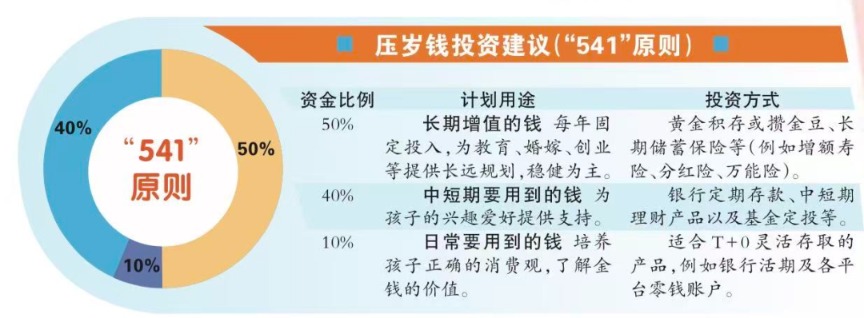
Core Insights - The article discusses the increasing trend among parents to manage their children's New Year's money (lucky money) as a means of financial education, emphasizing the importance of age-appropriate financial planning [1][3]. Age-Based Planning - Financial management of lucky money should be tailored to different growth stages of children, with a focus on the relationship between money and time [3]. - A suggested approach is to divide the lucky money into three parts using the "541 principle": 50% for long-term growth, 40% for foreseeable goals (like education and travel), and 10% for daily expenses [3][4]. - Financial education should be gradual, adapting to children's varying levels of understanding and self-control as they age [3][4]. Specific Age Stages - For children aged 3-6, the focus is on establishing a basic understanding of money, using savings accounts or cash to illustrate wealth accumulation [4]. - For ages 7-12, the emphasis shifts to developing saving habits and low-risk investment practices, allowing children to manage small amounts for daily spending [4]. - For those aged 13 and above, the focus is on fostering independent planning and diversified investment thinking, encouraging the use of low-risk investment options like mutual funds and gold accumulation [4]. Diverse Investment Trends - Parents are increasingly looking to invest lucky money in gold, high-yield stocks, and insurance products, reflecting a shift in financial perspectives among new-generation parents [5]. - The article highlights that many families are now investing in gold as a tangible asset, with some parents purchasing gold beans for their children as a way to teach saving and investment [5]. - The rising interest in capital markets has led some parents to invest in stocks and funds for their children's future education and marriage expenses, focusing on long-term holding strategies [5]. Insurance as a Financial Tool - Financial professionals recommend using long-term savings insurance products for managing lucky money, which can provide stable and continuous growth [6]. - Current market rates for universal life insurance products show guaranteed rates around 1%, with many products offering settlement rates above 2%, and some reaching up to 3.5% [6]. Investment Cautions - The article advises that lucky money management should prioritize stable investments, with common choices including fixed deposits, low-risk financial products, gold, and insurance [8]. - For families considering stock investments, it is suggested to use a dollar-cost averaging approach to mitigate risks associated with market volatility [8].
从头部险企健康险理赔“结构”,看实际保障力度被低估
Xin Lang Cai Jing· 2026-02-26 10:27
Core Insights - The article discusses the current state and challenges of commercial health insurance in China, highlighting the impact of policy and technology on the industry's growth and the perception of its value [1][2]. Group 1: Business Growth and Challenges - In 2025, the total premium for commercial health insurance reached 997.3 billion yuan, with a year-on-year growth of 2.04%, falling short of the expected trillion-yuan mark [2][13]. - The decline in health insurance premiums from life insurance companies, which saw a 5.9% drop in December 2025, has contributed to the overall negative growth in the sector [2][14]. - Life insurance companies reported a slight decrease in health insurance premiums for the entire year of 2025, totaling 769.9 billion yuan, down 0.41% from the previous year [2][14]. Group 2: Claims and Payouts - Despite the challenges faced by life insurance companies, the value of health insurance claims remains significant, with "medical + critical illness" claims accounting for about 80% of total payouts among leading insurers [5][16]. - For instance, China Life reported over 788 billion yuan in health insurance claims, representing 78.5% of its total claims in 2025 [6][17]. - The trend shows that medical insurance continues to have the highest number of claims, while critical illness insurance has the highest payout amounts [7][18]. Group 3: Underestimated Actual Payout Rates - There is a prevailing belief that the payout rate for commercial health insurance in China is low, around 40%, which is significantly below the 70%-85% range seen in developed countries [8][19]. - Recent analyses suggest that this perception is misleading, as the payout rate for medical insurance, excluding critical illness insurance, is approximately 75% [8][19]. - The actual payout rates for long-term medical insurance range from 55% to 80%, while short-term health insurance shows a payout rate of 50% to 70% for individual policies and 100% to 120% for group policies [8][19]. Group 4: Strategies for Growth and Risk Management - The industry needs to address the dual challenge of scaling growth while managing risks effectively to unlock the full value of health insurance [9][20]. - Expanding coverage for individuals with pre-existing conditions and chronic diseases is seen as a viable strategy to tap into new market segments [9][20]. - Insurers are encouraged to innovate products tailored to specific demographics, such as high-end consumers and the elderly, to better meet diverse needs [10][21].

方正证券:定期寿险征收增值税或提价 1.25%预定利率分红险预热
智通财经网· 2026-02-26 01:45
Group 1 - The insurance industry maintains a recommended rating, with A-share insurance companies' average static/dynamic PEV at 0.80x/0.66x, indicating low historical levels and limited downside risk [1] - The investment outlook is improving due to a recovering equity market and gradual rise in long-term interest rates, which are expected to enhance investment returns for insurance companies [1] - Factors such as the recovery in savings insurance sales, the release of demand for high-end medical insurance due to medical reform, and adjustments in preset interest rates are anticipated to drive NBV growth [1] Group 2 - The introduction of a 6% VAT on term life insurance premiums starting in 2026 is expected to increase prices by 5%-10% as companies adjust their pricing strategies to account for this new cost [2] - The aging population, advancements in medical technology, and tax policy adjustments are projected to lead to a continuous increase in premiums for protection-type products [3] - The market has seen the launch of dividend insurance products with a guaranteed interest rate of 1.25%, indicating a trend towards lower preset interest rates in the insurance market [4] Group 3 - The shift towards dividend insurance and the reduction in preset interest rates are likely to encourage insurance companies to increase their allocation to equity assets [5] - The growth in premium income is expected to enhance the willingness of insurance funds to invest in equities, supported by a sustained bull market in equities that will improve investment returns [5] - The insurance sector's profitability is anticipated to improve, driving valuations towards a historical PEV of 1.0x [5]

上市险企2025业绩前瞻:Q4净利或受投资波动影响,人身险NBV有望高增
Huan Qiu Wang· 2026-02-24 05:27
Core Viewpoint - The A-share listed insurance companies are experiencing a positive trend in stock prices, with the insurance sector showing robust fundamentals and a significant increase in premium income and net profits in 2025 [1][3]. Group 1: Industry Performance - In 2025, the insurance industry's original premium income exceeded 6.12 trillion yuan, marking a 7.4% year-on-year growth [1]. - The five major listed insurance companies achieved a total net profit of 426 billion yuan in the first three quarters of 2025, reflecting a 33.5% increase year-on-year, setting a historical record [1]. - The life insurance sector's original premium income is projected to grow by 8.9% in 2025, with total assets increasing from 19.98 trillion yuan at the end of 2020 to 36.39 trillion yuan by 2025, an 82% increase [4]. Group 2: Business Growth Drivers - The growth in new business value (NBV) for listed insurance companies is expected to remain high in 2025, driven by strong insurance demand and the transformation of the bancassurance channel [4]. - The bancassurance channel is identified as a key driver for new single premium growth, with China Pacific Insurance reporting an 11.7% year-on-year increase in new single premiums, while agent channel new premiums decreased by 9.9% [4]. - The demand for savings-type insurance products is expected to remain strong, with the bancassurance channel continuing to be the main growth driver into 2026 [5][6]. Group 3: Property Insurance Insights - In 2025, property insurance companies achieved original premium income of 1.76 trillion yuan, a 3.92% increase year-on-year, with auto insurance contributing 940.9 billion yuan and non-auto insurance 816.1 billion yuan [7]. - The combined cost ratio (COR) for listed insurance companies is anticipated to improve in 2025 due to reduced external claims and enhanced cost control measures [7]. - The outlook for 2026 suggests that the competitive edge of leading companies will strengthen, with expectations of stable premium growth and a decrease in the combined cost ratio [7]. Group 4: Future Industry Trends - The insurance industry is expected to focus on high-quality development and structural optimization over the next 1-2 years, consolidating the achievements of 2025 [8]. - The core support for life insurance development will hinge on the effectiveness of channel transformation and product structure optimization, enhancing customer service and product supply [8]. - Property insurance will benefit from ongoing improvements in the combined cost ratio, with a focus on refined management to enhance underwriting quality and optimize claims processes [8].