医保电子凭证

Search documents
点点手机,也能刷码购药了
Xin Lang Cai Jing· 2026-02-02 16:59
Core Viewpoint - The article highlights the successful resolution of a unique case where a foreign resident in Jining, Malaysia-born Zhang Zhenhan, was able to use the medical insurance electronic voucher for the first time in Shandong Province, showcasing the extension of medical insurance services to a broader demographic [2][6]. Group 1: Case Background - Zhang Zhenhan, a Malaysian national living in Jining for over ten years, faced difficulties using his medical insurance electronic voucher at a pharmacy due to mismatched identity information in the system [3][4]. - Despite having paid into the medical insurance system for years, Zhang encountered issues when attempting to use the electronic voucher for medication, which he found convenient compared to traditional methods [3][6]. Group 2: Problem Resolution - The staff at the medical insurance window, including Li Shuai, coordinated with various stakeholders, including the National Medical Insurance Center and a third-party technical company, to address the issue [4][5]. - A WeChat group was created to facilitate communication among all parties involved, allowing for real-time updates and problem-solving [5][6]. - After identifying that the issue stemmed from the standardization of Zhang's name in the system, adjustments were made, but further complications arose due to the pharmacy's electronic prescription system not recognizing foreign identification types [6][7]. Group 3: Successful Outcome - Ultimately, the issues were resolved by mid-December 2025, allowing Zhang to successfully use the electronic voucher for a medication purchase, marking a significant milestone as the first case of a foreigner using the medical insurance electronic voucher in Shandong [6][8]. - Zhang expressed gratitude for the attentive service provided by the medical insurance staff, highlighting the importance of such services for foreign residents [6][8]. Group 4: Broader Implications - The case illustrates the ongoing efforts to create a more inclusive medical insurance network in China, extending services to foreign residents and enhancing their sense of belonging in the community [7][8]. - Zhang's commitment to promoting a more civilized and convenient environment in Jining reflects the broader goals of the local government to improve public services and integrate foreign residents into the community [8].


威海医保推出系列便民举措,推动服务“高效办成一件事”
Qi Lu Wan Bao· 2026-01-20 12:11
Core Insights - The article discusses the efforts of Weihai's Medical Insurance Bureau to enhance the convenience and coverage of medical insurance services, aligning with the State Council's directive for efficient service delivery. Group 1: Service Optimization - The implementation of a "one-stop" service model in the medical insurance sector includes a list of 25 key services, enabling integrated processing of related matters, such as automatic approval of retirement medical insurance benefits through data sharing with the provincial social security system [1] - The "immediate enjoyment" of medical insurance benefits is facilitated through data analysis that matches eligible insured individuals and enterprises, allowing over 60,000 people to benefit without needing to apply actively during the 14th Five-Year Plan period [1] Group 2: Digital Transformation - The introduction of online channels, including the "Love Shandong" app and "Weihai Medical Insurance" mini-program, allows for the online processing of 27 medical insurance service items, promoting the use of electronic medical insurance certificates for seamless hospital visits [2] - The expansion of cross-province direct settlement services for medical insurance enables residents to register online and settle medical expenses directly at designated medical institutions without upfront payments [2] Group 3: Localized Service Delivery - The establishment of a "15-minute medical insurance service circle" aims to meet the demand for convenient local services, integrating a system that connects various service points from city to village levels, ensuring comprehensive coverage [3] - The creation of 293 medical insurance workstations and 565 service points allows for the provision of 18 high-frequency medical insurance services within close proximity to residents, facilitating over 100,000 transactions annually [3]
各地不断提高政务服务信息化、智能化、精准化、便利化水平——让数字红利释放治理效能(法治头条)
Ren Min Ri Bao· 2026-01-14 23:04
Core Viewpoint - The article highlights the rapid advancement of digital governance in China, emphasizing the integration of technology to enhance public service efficiency and accessibility, ultimately improving citizens' experiences in administrative processes [2][15]. Group 1: Digital Governance Development - Various regions in China are accelerating the construction of a unified digital governance platform, achieving significant progress in online service capabilities, with over 10.8 billion registered users on the national platform [6]. - The online service index of China ranks 11th globally in 2024, reflecting the country's contributions to global e-governance development [2]. Group 2: Efficiency in Public Services - The "Zheli Ban" app in Zhejiang has streamlined administrative processes, allowing users to complete multiple tasks online that previously required visits to multiple departments [5][6]. - Citizens can now handle cross-province administrative tasks efficiently, as demonstrated by a resident in Shanxi who completed property registration for a home purchased in Tianjin without traveling [6]. Group 3: Data Sharing and Integration - Efforts to break down data barriers are evident, with initiatives like the integration of public data platforms in Chongqing and the establishment of health records in Hainan [7]. - The implementation of data sharing mechanisms among provinces has facilitated the completion of high-frequency administrative tasks across regions, enhancing service efficiency [6][7]. Group 4: Smart Governance and Technology Integration - The integration of big data and AI in governance is transforming traditional methods, enabling proactive risk management and improving urban traffic conditions in cities like Guiyang [9][10]. - New technologies, such as AI-driven self-service machines in Guangdong, are enhancing user experience by simplifying processes for the elderly and those less familiar with technology [12][13]. Group 5: Sustainable Development of Digital Governance - The article emphasizes the importance of institutional support and technological innovation for the long-term sustainability of digital governance [12][14]. - Mechanisms like data sharing and standardized service processes are being developed to ensure efficient and equitable public service delivery across different regions [14][15].
六省市携手推进社保卡跨省通用
Xin Lang Cai Jing· 2026-01-08 19:02
Group 1 - The core viewpoint of the news is the collaboration among six provinces and cities in the Beijing-Tianjin-Hebei and Shanxi-Lu provinces to develop a unified social security card system, marking a significant step towards integrated regional public services [1] - Shanxi has initiated the pilot run of the "three-in-one" project, which combines the electronic social security card, medical insurance electronic certificate, and electronic health card [1] - The collaboration aims to standardize social security card application services and technical specifications, establishing a regular coordination mechanism to enhance public services across various sectors [1] Group 2 - Shanxi province has set up 23,100 employment social security service points across towns and communities, achieving full coverage of employment social security services [2] - The province has introduced the "Minsheng Shanxi" app, enabling 110 types of human resources and social security services to be accessed online, while also promoting the integration of electronic social security cards and medical insurance certificates [2] - The introduction of the "Gathering Talent Card" for foreign personnel integrates work permits with social security cards, enhancing the card's functionality for various public services [2]
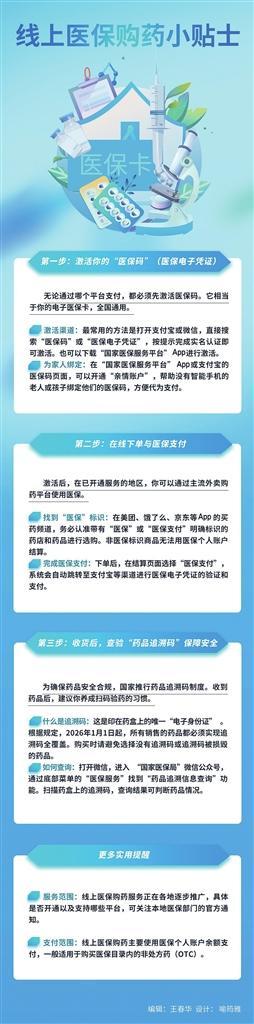
线上医保购药小贴士
Xin Lang Cai Jing· 2026-01-05 01:12
Group 1 - The article provides a guide on how to activate and use the online medical insurance (医保) for purchasing medications, emphasizing the importance of activating the electronic medical insurance certificate [2][3]. - It outlines the steps for online ordering and payment using medical insurance, highlighting the necessity to select products marked with "医保" or "医保支付" to ensure eligibility for insurance payment [4]. - The article stresses the implementation of a drug traceability code system to ensure the safety and compliance of purchased medications, with a requirement for all sold drugs to have traceability codes by January 1, 2026 [5]. Group 2 - The online medical insurance purchasing service is gradually being promoted across various regions, and users are advised to check local announcements for specific platform support [6]. - The payment for online medical purchases primarily utilizes the balance in personal medical insurance accounts, generally applicable for purchasing over-the-counter (OTC) medications listed in the medical insurance directory [6].
山西“三码融合”试点运行 实现数据互通
Xin Lang Cai Jing· 2026-01-03 00:40
Core Viewpoint - The article emphasizes the importance of the social security card as a fundamental tool for public service, highlighting the collaborative development of social security cards across regions as a key initiative to implement national strategies for coordinated regional development and to meet public demand for cross-province services [1] Group 1: Regional Collaboration - The meeting held on December 23, 2025, in Shanxi Province resulted in a cooperation agreement among the human resources and social security departments of six provinces (Beijing, Tianjin, Hebei, Shanxi, Shandong, and Henan) to develop a unified social security card system [1] - During the 14th Five-Year Plan period, there will be a dynamic review of the social security card application directory to expand its use in various sectors such as human resources, healthcare, transportation, tourism, cultural experiences, and government services [1] Group 2: Technological Integration - The launch of the "three-code integration" project, which combines the electronic social security card, medical insurance electronic certificate, and electronic health card, aims to simplify the process for citizens by eliminating the need to switch between multiple cards and codes [1] - This integration is not merely a functional addition but involves overcoming technical challenges to connect information systems across human resources, health, and medical insurance sectors, enabling data sharing and service recognition [1] Group 3: Pilot Implementation - The project will initially be piloted at the provincial people's hospital, with plans for broader promotion by the provincial human resources department, health commission, and medical insurance bureau once the trial run stabilizes [1] - The goal is to gradually extend the convenience of "one-code access" to benefit more citizens in Shanxi Province [1]
【省医保局】陕西不断增强参保群众获得感
Shan Xi Ri Bao· 2025-11-05 23:13
Core Viewpoint - The provincial government is implementing reforms to enhance the medical insurance system, focusing on inclusivity for various employment groups and improving benefits for continuous participants in the insurance scheme [1][2][3]. Group 1: Policy Changes - The removal of household registration restrictions allows flexible employment workers, migrant workers, and new economy personnel to participate in employee medical insurance at their place of employment [1][2]. - Special policies for specific groups include allowing out-of-town students and preschool children to enroll in medical insurance at their place of residence, and newborns can be enrolled immediately upon birth [2]. - A continuous insurance incentive policy has been introduced, where individuals who maintain continuous insurance for four years can increase their major illness insurance payment limit by up to 20% [2]. Group 2: Financial Contributions and Benefits - By 2025, the annual financial subsidy per person will increase by 30 yuan, reaching no less than 700 yuan, while the personal contribution remains unchanged at 400 yuan [3]. - The concentrated payment period is set from October to December 25, with continuous contributions during this period ensuring coverage for the entire year of 2026 [3]. Group 3: Special Provisions and Digital Services - A "green channel" for enrollment has been established for special groups such as the spouses and minor children of veterans, allowing them to receive benefits immediately even outside the concentrated payment period [4]. - The introduction of an "insurance wallet" for online and inter-provincial payment services aims to enhance convenience for participants [4]. - Digital initiatives include the establishment of a comprehensive database for enrollment, facilitating precise service delivery and making it easier for individuals to register and pay for insurance [4].
数字中国蓬勃脉动!9图带你“数”览最新成就
Yang Shi Xin Wen· 2025-08-15 18:35
Group 1 - The internet penetration rate in China has reached 79.7%, with the number of internet users totaling 1.123 billion [4][6][3] - China's computing power ranks second globally, with a total scale expected to grow significantly by 2025 [7][6] - The number of 5G base stations in China has reached 4.55 million, and the number of gigabit broadband users has reached 226 million [7][6] Group 2 - China has built over 10,000 smart factories, covering more than 80% of major manufacturing sectors, with smart home and wearable technology becoming new consumer trends [12][6] - The number of online courses (MOOCs) and their application scale in China ranks first globally, indicating a robust development in smart education [19][6] Group 3 - By 2024, China's data production volume is expected to reach 41.06 ZB, accounting for 26.67% of the global total, with per capita data production being 2.2 times that of the end of the 13th Five-Year Plan [23][6] - The number of data circulation node cities has reached 25, including major cities like Beijing, Shanghai, Guangzhou, and Shenzhen, with plans to expand to around 50 cities by the end of the year [25][6]