半导体生产设备

Search documents
Jim Cramer Suggests Buying Semiconductor Capital Equipment Makers Like Applied Materials “If We See the $120 Oil”
Yahoo Finance· 2026-03-13 15:16
Group 1 - Applied Materials, Inc. (NASDAQ:AMAT) is recognized as a significant player in the semiconductor capital equipment sector, with potential benefits from a memory shortage driving business growth [1][3] - Jim Cramer suggested that AMAT, along with other semiconductor equipment makers like Lam Research and KLA, could be less risky investment options compared to oil stocks, especially if oil prices reach $120 [1] - Cramer indicated that while AMAT has shown substantial gains, there may be a need to take some profits due to its parabolic chart, suggesting a cautious approach to further investment [3] Group 2 - The company provides essential equipment, software, and services for semiconductor and electronic device manufacturing, highlighting its critical role in the tech supply chain [3] - There is a belief that certain AI stocks may offer greater upside potential compared to AMAT, indicating a competitive landscape in the investment space [4]

【招商电子】东京电子FY26Q3跟踪报告:AI驱动DRAM与逻辑资本开支高增,中国投资重心向逻辑芯片切换
招商电子· 2026-02-11 15:57
Core Viewpoint - Tokyo Electron (TEL) reported FY2026 Q3 revenue of 552 billion JPY, down 15.7% year-on-year and 12.4% quarter-on-quarter, meeting expectations. The decline in revenue is attributed to increased fixed costs and changes in product mix, leading to a decrease in profit margins [2][4]. Financial Performance - FY26 Q3 revenue was 552 billion JPY, with a gross margin of 42.7%, down 4.9 percentage points year-on-year and 2.5 percentage points quarter-on-quarter. Operating profit margin was 21%, down 9.5 percentage points year-on-year and 4.1 percentage points quarter-on-quarter. Net profit attributable to shareholders was 118.5 billion JPY, down 24.6% year-on-year and 4.3% quarter-on-quarter [2][12]. - The semiconductor production equipment segment generated revenue of 385.1 billion JPY, down 24.6% year-on-year and 15.4% quarter-on-quarter. The DRAM segment accounted for 36% of revenue, while non-storage chips made up 56% [3][13]. Business Segments - After-sales service revenue was 161.6 billion JPY, up 14.2% year-on-year and 0.8% quarter-on-quarter, driven by increased customer utilization rates and strong spare parts sales [3][19]. - Revenue from the China market was 175.5 billion JPY, down 37.2% year-on-year and 30.9% quarter-on-quarter, accounting for 31.8% of total revenue [3][12]. Market Outlook - The company raised its FY2026 full-year guidance, expecting the WFE market to exceed 130 billion USD, driven by strong demand for AI servers and increased investments in advanced processes and DRAM [4][16]. - The company anticipates FY26 Q4 revenue for the semiconductor production equipment segment to reach 514.8 billion JPY, a quarter-on-quarter increase of over 30% [4][22]. Investment and Returns - The company plans to invest 240 billion JPY in capital expenditures for R&D and production capacity expansion. The annual dividend per share has been raised to a historical high of 601 JPY, with total shareholder returns expected to reach 426.2 billion JPY, a record high [4][24]. - The company has initiated a stock buyback plan with a limit of 150 billion JPY, aimed at optimizing capital structure and enhancing shareholder returns [4][29]. Technological Advancements - The company has introduced new equipment with high productivity and environmental friendliness, maintaining a leading position in the semiconductor manufacturing equipment industry with over 26,000 patents [20][21]. - The demand for advanced semiconductor manufacturing equipment is expected to grow at a compound annual growth rate (CAGR) of 10% by 2030, driven by AI applications and technological innovations [18][20].



东京电子FY26Q3跟踪报告:AI驱动DRAM与逻辑资本开支高增,中国投资重心向逻辑芯片切换
CMS· 2026-02-11 13:19
Investment Rating - The report maintains a positive outlook on the semiconductor manufacturing equipment industry, with expectations for the industry index to outperform the benchmark index [57]. Core Insights - Tokyo Electron (TEL) reported FY26Q3 revenue of 552 billion yen, down 15.7% year-on-year and 12.4% quarter-on-quarter, with a gross margin of 42.7% [1][19]. - The semiconductor production equipment segment generated revenue of 385.1 billion yen, with DRAM, NVM, and non-storage chips contributing 36%, 8%, and 56% respectively [2]. - The company raised its FY2026 full-year guidance, projecting a revenue of 2.41 trillion yen, with a gross margin of 45.3% and operating margin of 24.6% [3][34]. Summary by Sections Financial Performance - FY26Q3 revenue was 552 billion yen, with a gross profit margin of 42.7%, reflecting a decrease due to changes in product mix and increased fixed costs [1][19]. - The net profit attributable to owners was 118.5 billion yen, down 24.6% year-on-year [1]. Business Segments - The semiconductor production equipment segment saw a revenue decline of 24.6% year-on-year, while the after-sales service segment grew by 14.2% year-on-year [2]. - DRAM revenue was 138.6 billion yen, showing resilience despite overall segment declines [2][22]. Market Outlook - The global wafer front-end (WFE) market is expected to exceed 130 billion USD in 2026, driven by strong demand for AI servers and advanced semiconductor investments [3][27]. - The report anticipates a 20% growth rate in the WFE market, with significant investments in DRAM and logic chips [28][39]. Investment and Returns - The company plans to increase its capital expenditure to 240 billion yen, focusing on R&D and production capacity expansion [3][36]. - The dividend per share is projected to rise to a historical high of 601 yen, with total shareholder returns expected to reach 426.2 billion yen [38].

强劲势头:东京电子
citic securities· 2026-02-09 08:24
Group 1: Company Performance - Tokyo Electron's Q3 operating profit was 116.1 billion JPY, below the IBES consensus estimate of 156.1 billion JPY due to shipment timing issues[6] - The company raised its FY2026 operating profit guidance from 586 billion JPY to 593 billion JPY, driven by increased sales of new DRAM equipment[6] - Management is confident about a recovery in Q4 earnings and plans to implement a stock buyback of up to 150 billion JPY (0.8% of market cap) by the end of March 2026[6] Group 2: Market Outlook - The wafer fabrication equipment (WFE) market is expected to grow by at least 15% year-on-year in 2026, primarily driven by DRAM (+20%) and logic/foundry (+15-20%) segments[7] - The Chinese WFE market is projected to remain flat, with a shift in investment focus from storage to logic/foundry[7] - Management indicated that growth in cleanroom space and supplier inquiries suggests potential growth exceeding 20%[7] Group 3: Investment Risks - Downside risks include weaker-than-expected end-user demand, a slowdown in AI-related investments, and increased competition[9] - The company is reducing strategic holdings, which may impact its market position[6] Group 4: Company Overview - Tokyo Electron operates two core business segments: semiconductor production equipment (SPE) and flat panel display (FPD) production equipment[10] - Revenue breakdown shows 76.6% from new equipment and 23.4% from on-site solutions[11]
Screen:迟来总比不到好
citic securities· 2026-02-02 13:12
Investment Rating - The report maintains a positive outlook on the company, indicating a stable performance with a V-shaped recovery expected in fiscal year 2027 [4][5]. Core Insights - The company, Screen, reported third-quarter operating profit of 31 billion yen, slightly below the consensus estimate of 32.1 billion yen, but in line with internal targets. The company has postponed the recognition of approximately 20 billion yen in revenue from Chinese customers to fiscal year 2027, which is expected to be offset by demand from foundries and AI-driven DRAM orders [4][5]. - Management anticipates a 10-20% growth in the global wafer fabrication equipment market in 2026, driven primarily by advanced foundries and DRAM manufacturers. The company expects its business, including backend equipment, to achieve similar market growth [5][6]. Summary by Sections Company Overview - Screen's reportable segments include SE (semiconductor production equipment), FT (flat panel display production equipment), GA (graphic arts equipment), and PE (printed circuit board-related equipment) [8]. Financial Performance - The company’s semiconductor production equipment accounts for 82.7% of its revenue, with significant contributions from the Asian market, which represents 74.9% of total revenue [10]. Market Position - The company is well-positioned to benefit from robust customer capital expenditure outlooks and plans to enhance shareholder return policies through a healthier balance sheet [6].
广东五位市长一起谈“新”谈“未来”
Xin Lang Cai Jing· 2026-01-29 01:49
Core Insights - The five cities in the Guangdong-Hong Kong-Macao Greater Bay Area aim to enhance new productivity and cultivate future industries, focusing on artificial intelligence and robotics as key growth areas [1][7]. Economic Overview - The combined GDP of Guangzhou, Shenzhen, Zhuhai, Dongguan, and Huizhou is projected to exceed 9 trillion yuan in 2024, accounting for over 60% of Guangdong Province's GDP [2][8]. Industry Development Focus - Guangzhou has identified artificial intelligence and low-altitude economy as strategic emerging industries, integrating them into its modern industrial system to drive traditional industry transformation [3][9]. - Shenzhen has made significant advancements in semiconductor production equipment and related technologies, breaking foreign monopolies and beginning mass production [4][10]. - Zhuhai plans to develop new industries and models, targeting over 20% growth in artificial intelligence and robotics by 2025, while also focusing on RISC-V ecosystems and other future industries [5][12]. - Dongguan emphasizes a technology-driven approach to innovation, particularly in artificial intelligence and robotics, to enhance high-quality development [6][12]. - Huizhou aims to establish an Artificial Intelligence and Robotics Bureau to consolidate resources and focus on future industry development, with significant growth already seen in smart terminals and new energy storage [6][13]. Investment and Innovation - Shenzhen's R&D investment is projected to reach 245.31 billion yuan in 2024, with a growth rate of 9.7%, making it the second highest in the country [4][10]. - By 2025, Shenzhen expects double-digit growth in its strategic emerging industries, including semiconductors and artificial intelligence, while also increasing the number of specialized small and medium enterprises [4][10]. - The establishment of the APEC summit in Shenzhen in 2026 is seen as an opportunity to enhance international cooperation and attract global investment [4][11].
荷兰半导体,最新版图
半导体行业观察· 2025-11-30 04:53
Core Insights - The article highlights that the Dutch semiconductor industry has maintained a leading position globally for decades, with a robust foundation dating back to the 1950s when Philips established a complete value chain from chip design to system integration [1] - The High Tech NL association's white paper reveals that the Netherlands still possesses a complete and diverse semiconductor ecosystem, concentrated in three main regions: Brainport in Eindhoven, Lifeport in Arnhem-Nijmegen, and Twente as the semiconductor hub [1] Value Chain Composition - The semiconductor value chain consists of several layers, starting from chip design, followed by front-end manufacturing (fabricating chips on wafers), back-end manufacturing (packaging, assembly, and testing), and finally, system integration [3] - The second layer includes industrial infrastructure activities necessary for chip production, such as equipment design and manufacturing [4] - The third layer provides supporting services and module supply for the upper layers, including design and testing services [4] - The foundational layer focuses on knowledge and research, emphasizing basic R&D in the semiconductor and production equipment fields [5] Geographic Distribution of the Semiconductor Ecosystem - A geographic distribution map of semiconductor institutions in the Netherlands shows three core hotspots: Eindhoven (focused on equipment manufacturing), Nijmegen (covering front-end and back-end chip production and equipment manufacturing), and Enschede (centered on chip design) [11][12] - The analysis indicates that Eindhoven and Enschede have distinct industrial focus characteristics, with Eindhoven emphasizing equipment manufacturing and Enschede focusing on chip design, while Nijmegen maintains a balanced development in semiconductor chip production and equipment manufacturing [24] Regional Analysis - The analysis of the North Brabant region (Eindhoven) shows a high concentration of equipment manufacturing and related services, with design, front-end manufacturing, and knowledge and research forming a complete ecosystem [17] - The Gelderland region (Nijmegen) exhibits a balanced industrial structure, encompassing chip design, front-end and back-end manufacturing, and equipment and system module supply [20] - The Overijssel region (Enschede) is characterized by a relatively high proportion of chip design and service/module supply activities [21] Provincial Distribution of Semiconductor Activities - The distribution of specific semiconductor activities across provinces indicates that most provinces have relevant research institutions in the knowledge and research field, with Gelderland and Overijssel being core areas for chip design [27] - North Brabant stands out in the service and module supply sector, while it is also the core hotspot for production equipment [27] - Front-end manufacturing is concentrated in Gelderland, while back-end manufacturing is primarily found in Gelderland and Overijssel, with system integration activities also based in these provinces [27]


Is This the Best Stock to Own for the Next Decade of AI Expansion?
The Motley Fool· 2025-11-09 18:45
Core Viewpoint - Applied Materials is positioned as a key player in the AI chipmaking supply chain, providing essential equipment for semiconductor manufacturing, which is expected to see significant growth driven by AI advancements [1][4][12]. Company Overview - Applied Materials does not manufacture AI chips or provide AI services but supplies the systems necessary for producing advanced chips and displays globally [2][4]. - The company is the largest U.S. manufacturer of semiconductor equipment, with a market share of 17.4% in 2024, competing closely with Lam Research [6][7]. Market Position - Major semiconductor manufacturers, including Nvidia, Intel, and Samsung, are customers of Applied Materials, highlighting its critical role in the industry [5]. - The company’s market cap is approximately $183 billion, with a stock price of $230.07, reflecting a 48% increase this year and a 245% increase over the past five years [3][13]. Industry Outlook - Semiconductor sales are projected to reach $697 billion in 2024, with expectations of hitting $1 trillion by 2030 and doubling to $2 trillion by 2040, indicating a robust growth trajectory for the industry [12]. - Analysts anticipate a 4% revenue increase and an 8.1% growth in earnings per share for fiscal 2025 [12]. Challenges - A significant portion of Applied Materials' revenue (over one-third) comes from the Chinese market, making it vulnerable to geopolitical and trade tensions [8]. - The company has warned of potential revenue impacts due to ongoing trade issues, estimating a $600 million reduction in fiscal 2026 revenues [9]. - Planned layoffs of 4% of its workforce are aimed at enhancing competitiveness and productivity amid changing workforce needs [10].
台湾8月制造业景气维持“衰退” 逾六成产业低迷
Zhong Guo Xin Wen Wang· 2025-10-02 01:21
Group 1: Manufacturing Industry Overview - Taiwan's manufacturing industry maintained a "recession" signal in August, with over 60% of industries experiencing sluggishness [1] - The manufacturing sentiment index for August was 9.24, an increase of 0.88 from July, but still indicated recession with a blue light [1] - The improvement in the index was attributed to strong shipments of technology products, sustained order momentum, and a depreciating New Taiwan Dollar [1] Group 2: Sector-Specific Insights - The semiconductor industry benefited from strong demand for artificial intelligence applications and increased stocking of consumer electronics, resulting in a shift from a low mood yellow-blue light to a stable green light in August [1] - The machinery sector saw increased production due to demand from the semiconductor industry, but faced challenges from weak performance in overseas markets, leading to a negative year-on-year production index [1] - Despite a slight improvement from over 80% in July, the proportion of industries in recession (blue light) remained above 60%, highlighting an M-shaped development phenomenon in the industry [1] Group 3: Employment and Economic Impact - A report indicated that 398 companies and 8,505 individuals implemented reduced working hours, the highest number in a year and a half, with manufacturing being the most affected sector [2] - Among those affected, 8,070 individuals in the manufacturing sector accounted for approximately 95% of the total [2] - The upcoming Mid-Autumn Festival saw a decline in companies planning to issue bonuses, with only 41.7% of surveyed companies indicating they would provide bonuses, the lowest in 12 years [2]
芯片股狂飙之后 半导体设备商成AI“淘金热”新风口
智通财经网· 2025-09-30 13:19
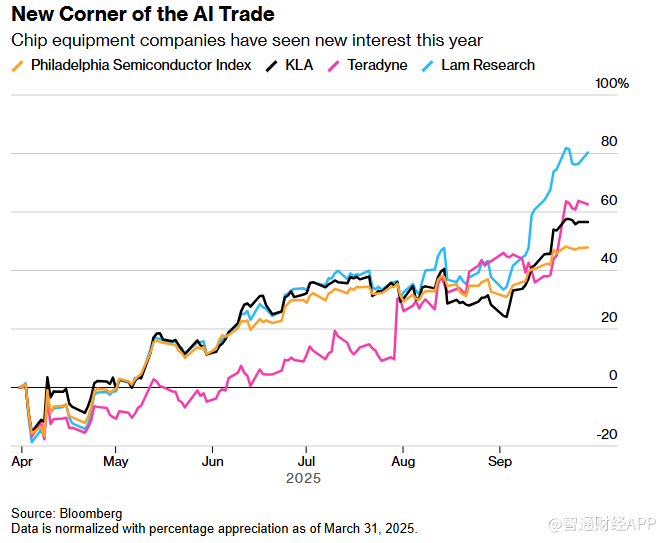
Group 1 - Semiconductor stocks have become a popular choice for investors betting on the AI sector, with a notable shift towards semiconductor equipment suppliers like Teradyne (TER.US) [1] - Teradyne's stock has nearly doubled since its low in April, rising over 40% since the end of July, while major semiconductor equipment manufacturers Lam Research (LRCX.US) and KLA (KLAC.US) have seen stock increases of over 68% this year [1][3] - Lam Research recently achieved a record of 14 consecutive trading days of gains, with a 36% increase during that period, while Applied Materials (AMAT.US) also recorded an 8-day winning streak with a 20% rise [1] Group 2 - Companies like Microsoft (MSFT.US) and Alphabet (GOOGL.US) are increasing investments in AI, making equipment suppliers attractive to investors despite their valuations becoming less appealing [3] - Micron Technology (MU.US) has seen its stock rise over 90% this year due to increased demand for high-bandwidth memory critical for AI computing, with Lam Research and KLA as suppliers [3] Group 3 - Analysts have raised Teradyne's target price from $133 to $200, indicating a potential upside of 49%, citing strong demand for testing equipment in the memory market [4] - Despite the positive outlook for semiconductor equipment, concerns arise as valuations become high, with potential risks if investment slows down [4] - Lam Research and KLA's expected price-to-earnings ratios have increased from around 20 times at the beginning of the year to nearly 30 times, while Teradyne's expected P/E ratio is at 32 times, higher than Nvidia [4] Group 4 - The current surge in semiconductor stocks may not be sustainable, as the explosive growth in AI investment appears to be the only factor supporting the rally, which may not last [5]