
高带宽内存

Search documents
美光考虑收购
半导体行业观察· 2026-03-27 00:52
Core Viewpoint - Japan Display Inc. (JDI) is negotiating with Micron Technology to sell a large LCD panel manufacturing plant in Japan, aiming to improve its financial situation amid ongoing structural reforms and factory closures [1][2]. Group 1: JDI's Financial Situation and Plant Sale - JDI is in talks with multiple companies, including Micron, regarding the sale of its factory, with an expected price in the hundreds of billions of yen (approximately $627 million) [1]. - The company has been facing financial difficulties, leading to the closure of its domestic factories, including one in Chiba Prefecture last November [1]. - The sale of the Mobara factory is seen as a potential way to enhance JDI's financial health, as the company plans to concentrate panel production in Ishikawa Prefecture to reduce fixed costs [1]. Group 2: Micron's Plans and Market Context - Micron intends to use the acquired factory for semiconductor assembly and testing, reflecting the growing demand for high-bandwidth memory driven by the rise of artificial intelligence [1][2]. - The company is investing ¥1.5 trillion to build a new facility in Japan, expected to start production around 2028, as part of its global expansion strategy [2]. - Micron's expansion plans are in line with similar initiatives by other major memory manufacturers, including Samsung and SK Hynix, driven by the increasing demand for HBM in AI server deployments [4]. Group 3: Industry Challenges and Supply Chain Issues - The semiconductor industry is facing significant challenges, including a shortage of heavy electrical equipment, which is crucial for new manufacturing facilities [4][5]. - Major suppliers have raised prices by 20% to 30% due to increased demand and rising raw material costs, complicating the supply chain for semiconductor projects [5]. - Transformer manufacturers are struggling to meet the high demand from both semiconductor and AI data center projects, leading to potential delays in production timelines [6].



733亿美元,三星投资计划曝光
半导体芯闻· 2026-03-23 10:24
Core Viewpoint - Samsung Electronics plans to invest over $73.3 billion by 2026 for new production lines and R&D, reflecting its expansion in memory chip capacity and exploration in fields like artificial intelligence [1] Group 1: Investment Plans - The investment will solidify Samsung's leading position in AI technology, representing a 22% increase compared to 2025 [1] - This move aims to reclaim market dominance from SK Hynix, which has become a major supplier of high-bandwidth memory for NVIDIA [1] Group 2: Strategic Vision - Samsung's vision is to become the only global company providing integrated solutions covering memory, chip manufacturing, and advanced packaging [1] - This strategy aims to enhance its technological advantage and demonstrates the company's ambition to control all aspects of semiconductor manufacturing [1] Group 3: Future Growth Areas - The company plans to continue mergers and acquisitions in growth areas such as advanced robotics, medical technology, automotive electronics, and HVAC systems [1] - This initiative is intended to restructure its business to align with these industries and ensure sustainable growth in the medium to long term [1] Group 4: R&D Focus - Samsung's R&D investments will focus on developing new technologies to support the semiconductor industry and enhance AI solutions, maintaining its technological leadership [1] - The announcement comes amid increasing global competition among leading companies in the microelectronics industry [1]

英伟达“交卷”缓解AI担忧,日韩科技股走强,韩国股指再创新高,美元疲软
Hua Er Jie Jian Wen· 2026-02-26 03:01
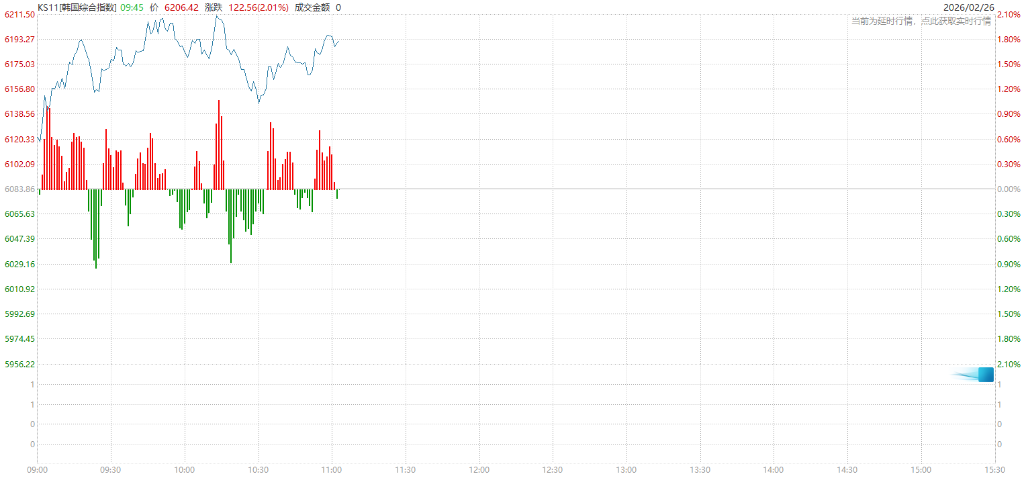
Group 1 - Nvidia's strong earnings report boosts market confidence, leading to a rise in Asian tech stocks, particularly in South Korea and Japan [1][4] - The MSCI Asia-Pacific index increased by 1%, reaching a historical high, while the South Korean Composite Index rose by 1.77%, also setting a new record [3][2] - Analysts highlight the positive impact of Nvidia's performance on the Asian AI supply chain, with significant gains for key suppliers like SK Hynix and Samsung [5][4] Group 2 - Investment in AI-related stocks is expected to continue, with a focus on companies in the gallium nitride and silicon carbide sectors in Japan, such as Fuji Electric [7] - Despite Nvidia's solid performance, some analysts express disappointment over the lack of detailed guidance on future prospects, indicating ongoing concerns about competition and sustainability of infrastructure investments [7][8] - The broader market is experiencing a softening of the dollar, with the Bloomberg Dollar Spot Index down by 0.2% [8]

SOXQ Holds $1 Billion in AI Chip Stocks as Hyperscaler Capex Dictates What Happen Next
247Wallst· 2026-02-12 13:41
Core Insights - The semiconductor sector is central to the AI boom, with the Invesco PHLX Semiconductor ETF (SOXQ) experiencing a 64% increase over the past year and a 15% year-to-date gain as of February 9, 2026, driven by AI infrastructure spending [1][3] Group 1: Fund Performance and Structure - SOXQ has rapidly grown to $1 billion in assets since its 2021 launch, providing concentrated exposure to the semiconductor sector during the AI buildout [2] - The fund tracks the entire chip value chain, offering broad sector exposure at a competitive cost structure [2] - The top 10 holdings account for 59% of SOXQ's assets, with NVIDIA representing over 10% alone, indicating a high concentration risk [6] Group 2: Market Dynamics - The pace of AI infrastructure spending by major hyperscalers like Microsoft, Amazon, and Google is crucial for SOXQ, as these companies are investing hundreds of billions in data centers, which drives demand for semiconductors [3] - When capital expenditure (capex) budgets expand, demand for GPUs, high bandwidth memory, and advanced packaging increases, while tightening budgets can quickly flatten chip orders [3][4] Group 3: Monitoring and Risks - Quarterly earnings calls from cloud providers should be monitored for insights on capital intensity and AI workload growth, as any moderation in spending plans could impact semiconductor suppliers [5] - The fund's performance is closely tied to the capex cycles of data centers, making it sensitive to fluctuations in AI spending [4][8] - The fund includes exposure to equipment makers like Lam Research and Applied Materials, which are also cyclical and sensitive to fab spending cycles [7]

韩国芯片,不可或缺
半导体行业观察· 2026-02-09 01:18
Core Viewpoint - Taiwan's dominance in the semiconductor manufacturing sector is being challenged by South Korea, which is rapidly advancing, particularly in high-performance memory chips [2] Group 1: Market Dynamics - South Korea is one of only three countries capable of producing advanced high-bandwidth memory chips, alongside Taiwan and the USA, giving it a strategic advantage [2] - Samsung Electronics and SK Hynix together hold over 50% of the global memory market share, making it difficult for other suppliers like Micron and Western Digital to match their scale and technology [2] - There is a significant shortage of memory chips, with prices for certain types increasing by over 300% in the past three months due to panic buying [2] Group 2: Investment and Production Capacity - Samsung plans to invest approximately $310 billion over the next five years in semiconductor manufacturing and related fields [3] - The construction of Samsung's Pyeongtaek plant will utilize over 50,000 NVIDIA GPUs for AI workloads, with production expected to start in 2028 [3] - The South Korean government is supporting a massive chip industry cluster with a commitment of around $456 billion in private investment [3] Group 3: Value Chain and Diversification - South Korea is shifting from a memory-centric focus to a diversified product portfolio that includes AI accelerators, automotive chips, and defense semiconductors [4] - Samsung is the second-largest foundry globally, following TSMC, and is advancing into the 3nm chip space [4] - A proposed public-private partnership for a 12-inch 40nm "national foundry" aims to provide local manufacturing opportunities for semiconductor startups [4] Group 4: Challenges and Government Actions - The semiconductor industry in South Korea faces challenges such as water and electricity shortages, with the planned Yongin chip cluster requiring approximately 13 to 15 gigawatts of power [4] - There is a projected shortage of about 56,000 semiconductor engineers in South Korea by 2031 [4] - The South Korean government is taking steps to address these issues through the Semiconductor Special Act, which will provide legal frameworks for direct subsidies and infrastructure spending [5]
新思CEO:存储芯片缺货到2027年
半导体行业观察· 2026-01-27 01:26
Core Viewpoint - The semiconductor industry is facing a prolonged memory chip shortage, potentially lasting until 2027, driven by the surge in demand from AI infrastructure and data centers [1][2]. Group 1: Memory Chip Demand and Supply - A semiconductor industry executive indicated that the memory shortage crisis, exacerbated by the AI infrastructure boom, may last longer than expected [1]. - High bandwidth memory demand is particularly strong, with significant investments flowing into data center infrastructure, leading to unprecedented price increases for memory chips [1]. - Synopsys CEO Sassine Ghazi stated that the chip shortage will persist until at least 2026 or 2027, as major manufacturers like Samsung, SK Hynix, and Micron struggle to ramp up production capacity [1][2]. Group 2: Price Trends and Market Impact - Analysts describe the current memory market conditions as a "super cycle," indicating a golden period for memory companies due to high demand and low supply [2]. - The rising memory prices may force consumer electronics companies to consider price increases, with Xiaomi predicting smartphone price hikes by 2026 [4]. - Lenovo's CFO Winston Cheng expressed confidence that the current cycle will allow the company to pass costs onto consumers, despite some impact on demand for electronic devices [4].

未来智造局|一盒内存条堪比一套房.?AI大潮驱动存储芯片持续涨价
Zhong Guo Jin Rong Xin Xi Wang· 2026-01-13 10:40
Group 1: Market Trends - The global storage market has been experiencing a price surge since 2025, with expectations for continued increases into 2026 due to high demand for AI applications and a shift in production capacity towards high-margin products [2][3] - In Q1 2026, contract prices for general memory products are projected to rise by 55% to 60%, while flash memory prices are expected to increase by 33% to 38% due to supply constraints [2] - The main suppliers in the global memory market, including Samsung, SK Hynix, and Micron, dominate over 90% of the market share, with AI infrastructure demands leading to exponential growth in memory consumption [2][3] Group 2: Supply Chain Dynamics - The transition of storage manufacturers to high-margin products has led to a significant supply shortage for traditional electronic products, causing memory prices to rise sharply [3][5] - The demand for high-bandwidth memory and DDR5 has surged, driven by AI workloads, resulting in a tight supply situation that is expected to persist until 2027-2028 [3][4] - The rising costs of storage products are impacting downstream server manufacturers and traditional consumer electronics producers, leading to increased pricing pressures throughout the supply chain [5][6] Group 3: Domestic Industry Developments - The ongoing price increases in the memory market are expected to provide a significant boost to domestic storage manufacturers in China, who are accelerating technological advancements and market share growth [6][8] - Companies like Zhaoyi Innovation and Changxin Technology are actively pursuing IPOs to fund expansion and technological upgrades, with Changxin Technology aiming to raise 29.5 billion yuan for various projects [7][8] - The domestic storage industry is focusing on new storage technologies and integrated solutions to meet the differentiated demands of AI applications, which is expected to enhance the competitiveness of Chinese semiconductor firms [8]


内存价格飙升,引发产业巨震
半导体行业观察· 2025-12-30 01:45
Core Insights - The global PC market is projected to decline significantly, with a potential drop of up to 9% by 2026 under a pessimistic scenario, a revision from the previously estimated 2.5% decline [1] - The memory shortage has worsened beyond initial predictions, impacting the production focus from consumer-grade to enterprise-grade components, which may lead to prolonged effects rather than a typical cyclical downturn [1] Group 1: PC Market Outlook - The decline in PC shipments is exacerbated by the end of the Windows 10 lifecycle and the rise of "AI PCs," with average prices expected to increase by 6% to 8% due to rising DRAM and SSD costs [2] - Major OEMs like Dell, HP, Lenovo, and Asus are better positioned to withstand market pressures compared to smaller brands, particularly in the gaming PC segment where high memory configurations are common [3] - The anticipated growth in AI PCs is hindered by high memory requirements, which are currently scarce and expensive, leading to a mismatch between consumer demand and product pricing [3] Group 2: Market Dynamics and Historical Context - A 9% decline in the PC market is significant, comparable to the 11.9% drop during the 2009 financial crisis and the nearly 15% decline post-pandemic, indicating a serious market contraction [4] - The current situation is particularly concerning as it occurs during a period that should ideally see growth due to the end of Windows 10 support and the emergence of AI PCs, highlighting a fundamental shift in consumer hardware dynamics [4]
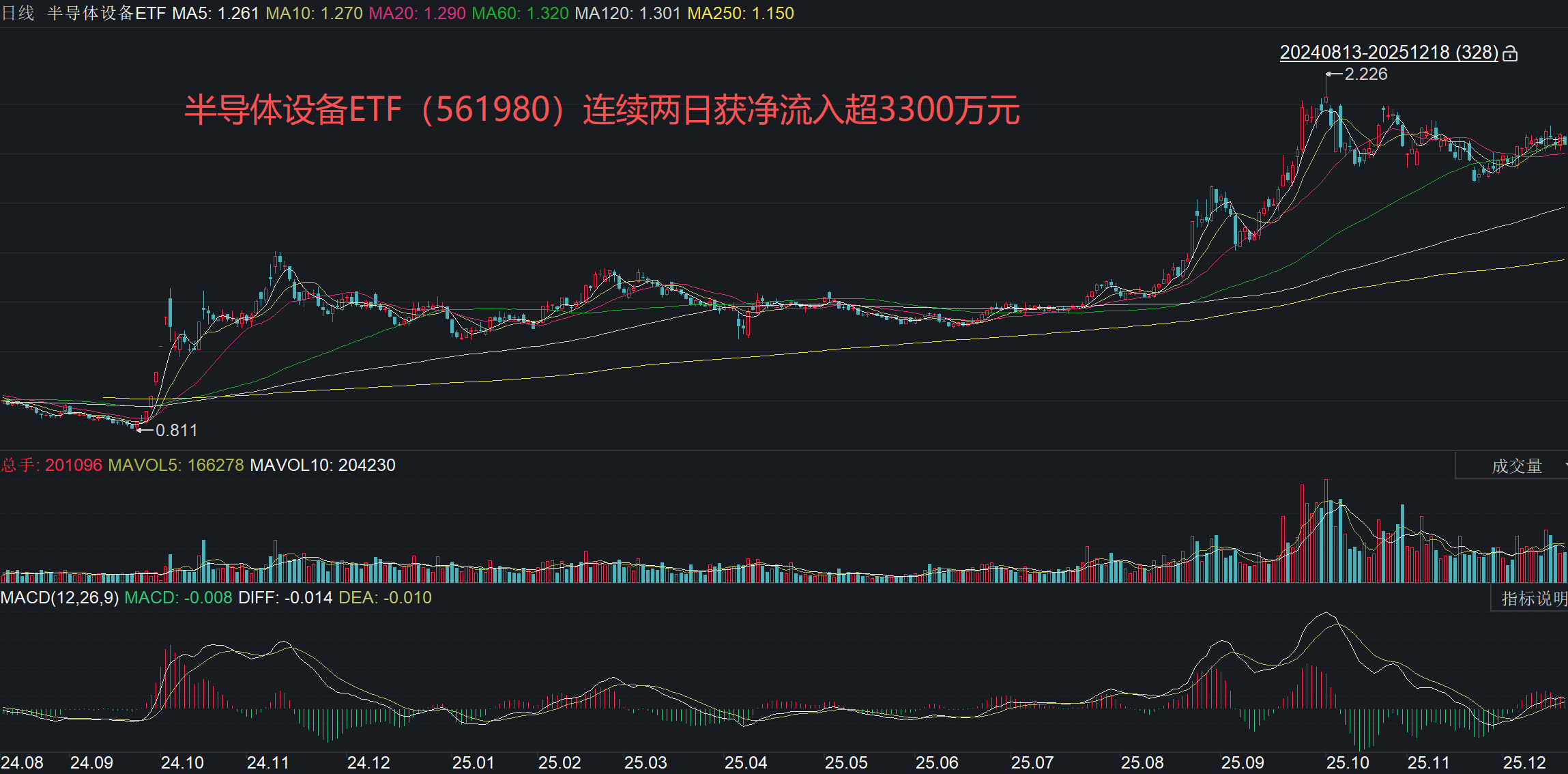
半导体设备ETF(561980)单日吸金超2700万,大摩、美银:AI建设+先进扩产+产能扩张或驱动半导体设备长牛
Jin Rong Jie· 2025-12-24 16:26
Group 1 - The core viewpoint of the articles indicates that the semiconductor industry is still in an upward cycle, driven by unprecedented demand for AI computing capabilities and strong inventory adjustments in traditional chips [3][4] - Morgan Stanley's report highlights that the long-term bull market logic for chip stocks remains intact, supported by the rapid expansion of AI infrastructure and advanced chip manufacturing processes [4] - Omdia forecasts that the semiconductor market will reach a record revenue of $216.3 billion by Q3 2025, with a quarter-on-quarter growth of 14.5%, and the annual revenue for 2025 is expected to exceed $800 billion [5] Group 2 - The growth in the semiconductor sector is primarily driven by investments related to artificial intelligence, particularly in advanced logic, storage, and packaging technologies [6] - The semiconductor foundry market is projected to reach $171 billion by 2025, reflecting a year-on-year growth of 26%, indicating a shift from cyclical growth to AI-driven structural growth [9] - The semiconductor equipment sector is expected to see a total sales revenue of $133 billion by 2025, marking a 13.7% increase year-on-year, with further growth anticipated in 2026 and 2027 [5] Group 3 - The semiconductor equipment market is characterized by strong certainty and resilience, driven by domestic production trends and the expansion of advanced manufacturing capacities [10] - The semiconductor equipment ETF (561980) has shown a year-to-date increase of over 55%, indicating high elasticity and strong performance compared to other semiconductor indices [13] - The ETF tracks a diverse range of semiconductor equipment companies, with a concentration of nearly 80% in its top ten holdings, including major players like Zhongwei Company and North Huachuang [12]





资产配置周报:商品走势分化,中美的高科技投资持续增长-20251221
Donghai Securities· 2025-12-21 11:56
Core Viewpoints - The report highlights the divergence in commodity trends and the continuous growth of high-tech investments in China and the US, with significant performance variations in global stock markets and commodities [8][11]. Global Asset Review - As of December 19, global stock markets showed mixed results, with European markets performing better; major commodities like gold, copper, and aluminum saw price increases, while oil prices declined [11][12]. - The report notes that the UK FTSE 100 outperformed other indices, while the Hang Seng Tech Index and Nikkei 225 faced pressure [11]. - The report indicates that gold prices rose slightly due to expectations of interest rate cuts and geopolitical risks, while oil prices fell due to concerns over oversupply [12]. Domestic Equity Market Review - In the domestic equity market, financials outperformed other sectors, with an average daily trading volume of 17,410 billion yuan, down from 19,359 billion yuan [18]. - Among the 31 sectors tracked, 19 sectors saw gains, with retail trade (+6.66%), non-bank financials (+2.90%), and beauty care (+2.87%) leading the way, while electronics (-3.28%) and power equipment (-3.12%) lagged [18][19]. Interest Rate and Exchange Rate Tracking - The report notes a continued loose monetary environment, with the central bank conducting reverse repos to maintain liquidity, while the bond market is expected to remain stable amid weak recovery signals [20][22]. - The US bond market showed a cautious decline in yields, with the 10-year Treasury yield at 4.16%, reflecting mixed signals from employment and inflation data [26][28]. - The report highlights the strong performance of the renminbi, supported by domestic economic resilience and favorable external conditions, with the currency appreciating against the US dollar [30][31]. Commodity Tracking - The report tracks energy commodities, noting that WTI crude oil prices fluctuated around $56.52 per barrel, with US crude oil production increasing year-on-year [32]. - It also highlights the significant drop in liquefied natural gas prices in China, attributed to high inventory levels and weak demand [36].