华夏中证全指食品ETF

Search documents
1月以来公告上市股票型ETF平均仓位21.95%
Zheng Quan Shi Bao Wang· 2026-01-20 02:38
Core Insights - Two stock ETFs have recently announced their listing, with the Southern CSI Battery Theme ETF holding a stock position of 19.92% and the Tianhong SSE Sci-Tech Innovation Board Chip Design Theme ETF holding a stock position of 0.24% [1] ETF Listings and Positions - A total of 20 stock ETFs have announced listings since January, with an average stock position of 21.95%. The highest position is held by the Penghua CSI General Aviation Theme ETF at 65.79%, followed by the Xingquan CSI 300 Quality ETF at 62.01%, the Jianxin Growth Enterprise Board Comprehensive Enhanced Strategy ETF at 40.68%, and the Growth Enterprise Board New Energy ETF at 39.69%. The lowest positions are held by the Tianhong SSE Sci-Tech Innovation Board Chip Design Theme ETF at 0.24%, the Penghua CSI All-Index Food ETF at 0.40%, and the E Fund CSI Hong Kong Stock Connect Medical Theme ETF at 4.78% [1] Fundraising and Share Statistics - The average fundraising for the ETFs announced in January is 367 million shares, with the largest being the Xingquan CSI 300 Quality ETF at 1.157 billion shares, followed by the Huabao CSI All-Index Electric Utility ETF at 719 million shares, and the Tianhong SSE Sci-Tech Innovation Board Chip Design Theme ETF at 607 million shares [1] Institutional Investor Holdings - Institutional investors hold an average of 9.32% of the shares in these ETFs, with the highest proportions in the Ping An Hang Seng China Central Enterprise Dividend ETF at 25.59%, the Penghua CSI General Aviation Theme ETF at 21.34%, and the Jianxin Growth Enterprise Board Comprehensive Enhanced Strategy ETF at 20.28%. The lowest proportions are in the Huabao CSI All-Index Electric Utility ETF at 1.35%, the E Fund SSE Sci-Tech Innovation Board Chip Design Theme ETF at 1.73%, and the Tianhong SSE Sci-Tech Innovation Board Chip Design Theme ETF at 1.78% [2]
ETF市场跟踪与配置周报-20260117
Xiangcai Securities· 2026-01-17 12:21
Report Industry Investment Rating No relevant content provided. Core Views - PB-ROE framework's ETF rotation strategy recommends next week to focus on the communication, agriculture, forestry, animal husbandry, and transportation industries, corresponding to their industry ETFs; the ETF redemption sentiment indicator model suggests focusing on the Science and Technology Innovation 50 ETF, SSE 50 ETF, Medical ETF, Photovoltaic ETF, and Robot ETF [9][40] - Combining PB and ROE for industry configuration may be a better choice; the third quadrant's high PB high ROE and the fifth quadrant's low PB medium ROE are key focus areas; combining the third and fifth quadrants to construct a comprehensive PB-ROE strategy has an annualized return of 11.93% and an annualized excess return of 13.22% [32][33] Summary by Directory 1. Recent Market Overview (January 12 - January 16, 2026) - Index performance: Shanghai Composite Index closed at 4101.91, down 0.45% for the week; Shenzhen Component Index closed at 14281.08, up 1.14%; ChiNext Index closed at 3361.02, up 1.00%; Beijing Stock Exchange 50 closed at 1548.33, up 1.58%; Hang Seng Index closed at 26844.96, up 2.34%. The average daily trading volume of the Shanghai and Shenzhen stock markets was 34250.96 billion yuan, and the total trading volume for the week was 17.13 trillion yuan [12] - Industry performance: Among 31 Shenwan primary industries, 13 industries rose and 18 fell. The top three gainers were computer (up 3.82%), electronics (up 3.77%), and non-ferrous metals (up 3.03%); the top three losers were national defense and military industry (down 4.92%), real estate (down 3.52%), and agriculture, forestry, animal husbandry, and fishery (down 3.27%) [5][12] - Main funds: Main funds had net outflows for 5 trading days and no net inflows, with a total net outflow of 2752.39 billion yuan for the week. The industries with more net inflows were banks, public utilities, and coal; the industries with more net outflows were national defense and military industry, power equipment, and computer [5][13] 2. Recent ETF Market Performance (January 12 - January 16, 2026) - Overall situation: As of January 16, 2026, there were 1411 ETFs in the Shanghai and Shenzhen stock markets, with a total asset management scale of 60766.01 billion yuan. There were 1101 equity ETFs (38892.41 billion yuan), 53 bond ETFs (7479.66 billion yuan), 27 money market ETFs (1529.88 billion yuan), 17 commodity ETFs (2751.84 billion yuan), 207 cross-border ETFs (10070.46 billion yuan), and 6 unlisted ETFs (41.76 billion yuan) [20] - Newly listed and established ETFs: 8 ETFs were newly listed, all equity ETFs; 7 ETFs were newly established, with a total issuance scale of 51.24 billion yuan [21] - Equity ETFs: The median weekly increase or decrease was 0.59%. Science and technology semiconductor ETFs and semiconductor equipment ETFs performed well, with the Science and Technology Semiconductor ETF Peng Hua rising the most at 12.46%; aerospace and high-end equipment ETFs performed poorly, with the Aerospace ETF falling the most at 6.88%. The average weekly share change was a decrease of 19.4716 million shares. Software ETFs and media ETFs had more share increases, while the Science and Technology Innovation 50 ETF and CSI 300 ETF had more share decreases [24] - Bond ETFs: The median weekly increase or decrease of 53 bond ETFs was 0.12%. The convertible bond ETF had the highest increase of 0.91%, while the science and technology innovation bond ETF had the highest decrease of 0.00%. As of January 16, 2026, the Haifutong CSI Short-term Financing ETF had the largest scale of 631.50 billion yuan [27] - Cross-border ETFs: The median weekly increase or decrease was 1.18%. The China-South Korea Semiconductor ETF and Hong Kong Stock Connect Internet ETF had the highest increases, with the China-South Korea Semiconductor ETF rising 6.11%; the Hong Kong Securities ETF and Nasdaq Biotechnology ETF had the highest decreases, with the Hong Kong Securities ETF falling 2.28%. Since the beginning of the year, the median increase or decrease was 3.82%, with the China-South Korea Semiconductor ETF and Hong Kong Medical ETF having higher increases, and the Nasdaq ETF and Nasdaq Technology ETF having higher decreases [29] 3. PB-ROE Framework's ETF Rotation Strategy Tracking - Factor effectiveness: PB factor and PB quantile factor show certain stratification ability, and PB quantile factor is more effective; ROE factor's effectiveness declined after 2018; using ROE factor is better than ROE quantile factor; expected ROE factor is better than expected ROE year-on-year factor. Combining PB and ROE for industry configuration may be a better choice [32] - Key quadrants: The third quadrant's high PB high ROE and the fifth quadrant's low PB medium ROE are key focus areas. From 2017 to February 2024, the compound annualized excess returns of the third and fifth quadrant portfolios were 4.27% and 1.55% respectively [32] - Strategy improvement: After supplementing the PB-ROE framework with four dimensions, the annualized excess returns of the third and fifth quadrant strategies were 4.78% and 3.94% respectively. Combining the two strategies, the annualized return was 11.93% and the annualized excess return was 13.22% [33] - Recent performance: This week, the strategy focused on the communication, agriculture, forestry, animal husbandry, and transportation industries, with a cumulative return of -0.86%, and an excess return of -0.29% compared to the CSI 300 Index [8][34] - Performance since 2023: The cumulative return was 26.03%, with an excess return of 3.81% compared to the CSI 300 Index [8][36] - Performance since 2022: The cumulative return was 7.77%, with an excess return of 11.99% compared to the CSI 300 Index [39] 4. Investment Recommendations - PB-ROE framework: Focus on the communication, agriculture, forestry, animal husbandry, and transportation industries next week, corresponding to their industry ETFs [9][40] - ETF redemption sentiment indicator model: Focus on the Science and Technology Innovation 50 ETF, SSE 50 ETF, Medical ETF, Photovoltaic ETF, and Robot ETF next week [9][40]
17只ETF公告上市,最高仓位65.79%
Zheng Quan Shi Bao Wang· 2026-01-15 02:42
Core Viewpoint - Two stock ETFs have announced their listing, with the latest positions showing that the ICBC New Energy ETF has a stock position of 39.69% and the Huabao CSI All Share Utilities ETF has a stock position of 20.33% [1] Group 1: ETF Listings and Positions - A total of 17 stock ETFs have announced listings since January, with an average position of 23.34%. The highest position is held by the Penghua CSI General Aviation Theme ETF at 65.79% [1] - Other ETFs with significant positions include the Xingquan CSI 300 Quality ETF at 62.01%, the Jianxin ChiNext Composite Enhanced Strategy ETF at 40.68%, and the ICBC New Energy ETF at 39.69% [1] - The lowest positions are seen in the Penghua CSI All Share Food ETF at 0.40%, the E Fund CSI Hong Kong Stock Connect Medical Theme ETF at 4.78%, and the Guotai CSI Hong Kong Stock Connect Internet ETF at 4.80% [1] Group 2: Fundraising and Institutional Holdings - The average fundraising for the ETFs listed in January is 351 million shares, with the largest being the Xingquan CSI 300 Quality ETF at 1.157 billion shares, followed by the Huabao CSI All Share Utilities ETF at 719 million shares and the Ping An Hang Seng China Central Enterprises Dividend ETF at 514 million shares [1] - Institutional investors hold an average of 10.48% of the shares, with the highest proportions in the Ping An Hang Seng China Central Enterprises Dividend ETF at 25.59%, the Penghua CSI General Aviation Theme ETF at 21.34%, and the Jianxin ChiNext Composite Enhanced Strategy ETF at 20.28% [2] - ETFs with lower institutional holdings include the Huabao CSI All Share Utilities ETF at 1.35%, the E Fund Shanghai Stock Exchange Sci-Tech Innovation Board Chip Design Theme ETF at 1.73%, and the Huabao CSI Hong Kong Stock Connect Medical Theme ETF at 4.46% [2]
1月以来公告上市股票型ETF平均仓位22.45%
Zheng Quan Shi Bao Wang· 2026-01-14 04:41
Core Viewpoint - Three stock ETFs have recently published listing announcements, with varying stock positions indicating different investment strategies and market conditions [1] Group 1: ETF Stock Positions - The stock position of the GF Guozhen Industrial Software Theme ETF is 31.04% [1] - The stock position of the E Fund Shanghai Stock Exchange Science and Technology Innovation Board Chip Design Theme ETF is 5.36% [1] - The stock position of the E Fund CSI Hong Kong Stock Connect Medical Theme ETF is 4.78% [1] - The highest stock position among newly listed ETFs is 65.79% for the Penghua CSI General Aviation Theme ETF [1] - Other notable stock positions include 62.01% for the Xingquan CSI 300 Quality ETF, 40.68% for the Jianxin Growth Enterprise Board Comprehensive Enhanced Strategy ETF, and 35.10% for the Huaxia CSI All-Share Food ETF [1] Group 2: ETF Fundraising and Investor Structure - Since January, 15 stock ETFs have announced listings, with an average fundraising of 333 million shares [2] - The largest fundraising amounts are 1.157 billion shares for the Xingquan CSI 300 Quality ETF, 514 million shares for the Ping An Hang Seng China Central Enterprise Dividend ETF, and 300 million shares for the E Fund CSI Engineering Machinery Theme ETF [2] - Institutional investors hold an average of 11.17% of the shares, with the highest proportions being 25.59% for the Ping An Hang Seng China Central Enterprise Dividend ETF, 21.34% for the Penghua CSI General Aviation Theme ETF, and 20.28% for the Jianxin Growth Enterprise Board Comprehensive Enhanced Strategy ETF [2]
两类权益基金发力 超450亿元资金新年入市
Zheng Quan Shi Bao· 2026-01-11 16:55
Core Viewpoint - The public fund market is experiencing a significant influx of capital at the beginning of the year, with over 45 billion yuan expected to enter the market, driven by new ETF listings and active funds entering their investment phases [1][4]. Group 1: Public Fund Inflows - As of January 9, 2026, the public funds entering the market include 22 newly listed stock ETFs with a total scale of 6.345 billion yuan and approximately 40 billion yuan from actively managed funds that have recently been established [1][2]. - The trend of "deposit migration" is evident, with individual investors becoming the main force in ETF investments, holding over 90% of shares in many products [1][3]. - The rapid increase in stock positions is notable, with ETFs like the Guotai Zhongzheng Hong Kong Stock Connect Internet ETF increasing their stock holdings from 4.8% to 96.59% shortly after listing [3]. Group 2: Active Fund Developments - Since November 2025, 72 new actively managed funds have been established, raising approximately 39.208 billion yuan, with 14 of these funds exceeding 1 billion yuan in size [4][5]. - The fundraising success of these funds is attributed to favorable market conditions and the reputation of well-known fund managers [4]. - The average return of these newly established funds is 3.08%, indicating a stable early-stage performance as they begin to deploy their capital [5]. Group 3: Future Capital Inflows - There is potential for a significant influx of capital into the investment market, estimated to be in the trillions, as excess savings from residents are poised to enter the market [6][7]. - The projected maturity of a substantial amount of fixed-term deposits in 2026 suggests that a portion of these funds may transition into equity markets, particularly in a low-interest-rate environment [6]. - The overall trend indicates a shift in investor confidence towards equity investments, with expectations of continued growth in the stock market driven by improving corporate earnings and valuation recovery [7].
指数基金产品研究系列报告之二百六十五:政策受益、估值企稳,关注食品方向投资机会:华夏中证全指食品ETF
Shenwan Hongyuan Securities· 2025-12-26 03:42
Report Industry Investment Rating - The report does not explicitly mention the industry investment rating [1][2] Core Viewpoints of the Report - The government has increased its emphasis on boosting consumption and expanding domestic demand, with multiple policies coordinated to promote the construction of the domestic economic cycle and the domestic demand system [2][7][8] - It is expected that the year-on-year pork price will gradually turn positive in the second half of 2026, which will support the CPI, especially the food CPI [2][14][20] - The CSI All-China Food Index selects leading companies in the food industry, with high price elasticity, strong offensive ability, and long - term stable excess return potential. Currently, the valuation of the food sector has bottomed out, and the medium - to - long - term allocation cost - effectiveness is prominent [2][22][50] - The Huaxia CSI All - China Food ETF closely tracks the CSI All - China Food Index, aiming to minimize tracking deviation and tracking error [2][52] Summary According to the Directory 1. Policy Emphasizes Expanding Domestic Demand and Boosting Consumption, Focus on Investment Opportunities in the Food Sector - **Policy Attention Increased: Boosting Consumption and Expanding Domestic Demand** - Multiple policies are coordinated to promote the domestic economic cycle and the construction of the domestic demand system. Since December, authoritative media and high - level authorities have continuously emphasized the importance of domestic demand and the significance of boosting consumption [2][7][8] - The "Qiushi" magazine pointed out that expanding domestic demand is a strategic move related to economic stability and security. The Central Financial and Economic Affairs Office stated that expanding domestic demand is the top priority for next year, and the National Development and Reform Commission emphasized the firm implementation of the strategy to expand domestic demand [2][9][13] - **Expected Gradual Recovery of Pork Prices, Focus on Food CPI Changes in 2026** - Since the second half of 2022, the CPI has been continuously declining and has been hovering at a low level since 2025, suppressing the contribution of prices to the profits of mass consumer goods [2][14] - Although the CPI was at a low level in 2025, the demand for dairy products showed signs of stabilization. The retail prices of milk and yogurt ended a three - year decline in the second half of 2025 [17][19] - Due to the structural surplus of production capacity and low breeding costs, the year - on - year decline in pork prices has widened since the second half of 2025. It is expected that the year - on - year pork price will gradually turn positive in the second half of next year, supporting the CPI, especially the food CPI [20][21] 2. CSI All - China Food Index - **Index Compilation: Selecting Leading Food Industry Companies** - The CSI All - China Food Index was released on July 15, 2013. It selects all listed company securities belonging to the tertiary "Food" industry from the CSI All - China sample space, aiming to comprehensively reflect the overall performance of A - share food industry listed company securities [22][25][26] - The index samples are adjusted semi - annually, with a single sample weight limit of 10% [26] - **Industry Market Value Characteristics: Industry Concentrated in the Primary Consumption Sector, with a Market Value Pattern Dominated by Leading Companies** - As of December 18, 2025, the index has 79 constituent stocks, with an average total market value of 1.6575 billion yuan. There are 3 stocks with a market value exceeding 10 billion yuan, and more than half of the constituent stocks have a total market value of less than 1 billion yuan [27][30][33] - The top ten constituent stocks have a total weight of 50.4%, and the top three weighted stocks are Inner Mongolia Yili Industrial Group Co., Ltd., Haitian Flavoring & Food Co., Ltd., and Shuanghui Development Co., Ltd., with weights of 10.52%, 9.05%, and 6.05% respectively [30][31][33] - The index is concentrated in the food sub - industries, especially in the seasoning fermentation products II, food processing, and beverage dairy sectors, with a combined proportion of over 64%, highly focusing on the food field directly facing consumers [33][34][39] - **High Index Volatility and Strong Offensive Ability** - Historically, the index has shown a clear offensive ability, especially in the market driven by the consumption sector, with long - term stable excess return potential. It also has significant high elasticity, with higher volatility and drawdown than the market broad - based index [40][42][45] - In the long run, the index has shown stable income growth ability, with a cumulative return and annualized return of 256.10% and 8.87% respectively, exceeding the performance of the CSI 300 Index and the CSI All - China Index during the same period, reflecting the long - term allocation value of the core assets in the consumption industry [42][43] - **The Valuation of the Food Sector has Bottomed Out, and the Medium - to - Long - Term Allocation Cost - Effectiveness is Prominent** - As of December 18, 2025, the price - to - earnings ratio of the index is 31.52, with a historical quantile of 22.26%, and the price - to - book ratio is 2.85, with a historical quantile of 5.32% [50][51][52] - The index has experienced an adjustment since the high in late 2020, and recently shows signs of stabilization, with limited downside risk [50] 3. Huaxia CSI All - China Food ETF - The Huaxia CSI All - China Food ETF (fund code: 159151) closely tracks the CSI All - China Food Index, aiming to minimize tracking deviation and tracking error. The fund started raising funds on December 22, 2025, and ended on December 26, 2025, with fund manager Wang Xinwei [2][52][55]



基金早班车丨公募基金新发数量创近4年新高,QDII高溢价警报不断
Jin Rong Jie· 2025-12-23 00:45
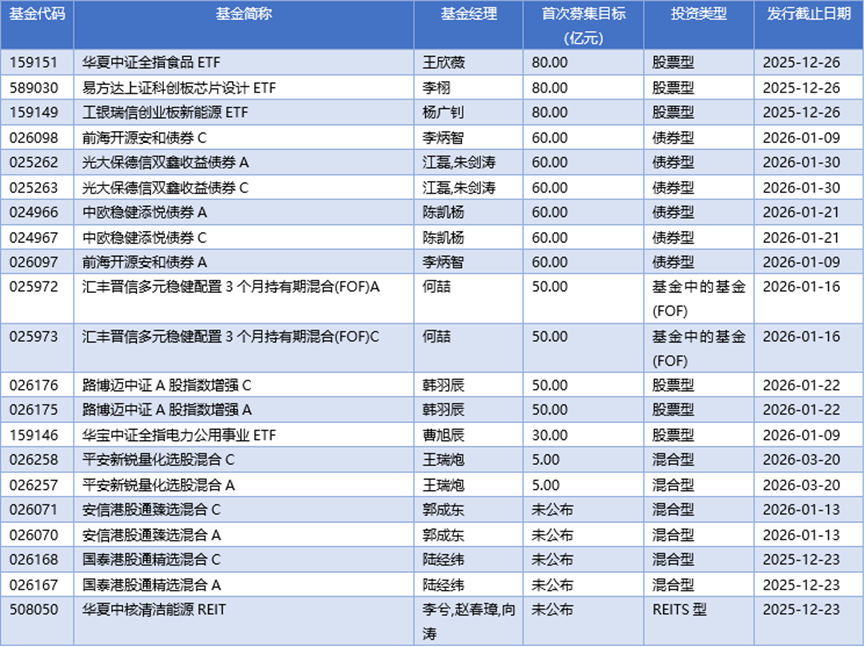
Group 1 - The core point of the article highlights a significant increase in the establishment of new public funds, with 1,468 funds launched in 2024, marking a 29.3% growth compared to the previous year, setting a record for the past four years [1] - The A-share market showed positive performance on December 22, with major indices rising: Shanghai Composite Index up 0.69% to 3,917.36 points, Shenzhen Component Index up 1.47% to 13,332.73 points, and ChiNext Index up 2.23% to 3,191.98 points, with total trading volume reaching 1.86 trillion yuan [1] - The tightening of QDII quotas has led to several products reducing the RMB subscription limit to 10 yuan, with some market premiums exceeding 20%, indicating potential risks for investors [1] Group 2 - On December 22, 21 new funds were launched, primarily focusing on bond and equity funds, with the Huaxia CSI All-Share Food ETF aiming to raise 8 billion yuan [2] - Public funds have invested a total of 34.088 billion yuan in 85 A-share companies in 2025, reflecting a year-on-year increase of over 14%, with the electronics sector being a key focus [2] - The public fund management scale is expected to reach new records in 2025, with a shift towards quality over quantity, driven by fee reforms and a diverse range of ETF offerings [2] Group 3 - A detailed list of new funds launched on December 22 includes various ETFs and bond funds, with several funds targeting 6 billion yuan or more [3] - The list of funds also includes specific details such as fund codes, managers, and investment types, indicating a broad range of investment strategies being employed [3] Group 4 - A summary of fund dividends on December 22 shows that 38 funds distributed dividends, with the highest payout being 3.1 yuan per 10 shares for the Huabao CSI 300 Index Enhanced Fund [4] - The dividend distribution reflects a growing trend in fund payouts, enhancing the perceived value for fund holders [4]