华夏布拉德斯科巴西伊博维斯帕股票交易型开放式指数证券投资基金(QDII)

Search documents
蓝小康、金梓才等名将“上新”;ETF创新品类持续推出丨天赐良基早参
Mei Ri Jing Ji Xin Wen· 2025-10-15 01:04
Group 1 - Fund companies are increasingly dissolving their supervisory boards, with Fangzheng Fubang Fund and Yingda Fund being recent examples, aiming to enhance oversight efficiency by consolidating functions within the board's audit committee [1] - The average return for public fund managers in the first three quarters of the year is reported at 19.77%, with a median of 14.97%, indicating strong performance in the industry [2] - Two ETFs focused on the Brazilian market have been submitted for approval, namely the "Huaxia Bradesco Brazil IBOVESPA ETF" and the "E Fund Itaú Brazil IBOVESPA ETF" [3] Group 2 - The ETF market has seen significant innovation and expansion, with various new products launched this year, including broad-based and thematic ETFs, as well as a rapid growth in bond ETFs [4] - A total of 16 actively managed equity funds are set to launch, featuring well-known fund managers, including a new fund from Zhongou Fund's Lan Xiaokang, which marks his return to fund issuance after over two years [5] - The market experienced fluctuations on October 14, with the Shanghai Composite Index down 0.62% and the Shenzhen Component Index down 2.54%, while trading volume increased significantly [7]
跨境ETF再添新贵,拉美地区也将纳入投资版图
Sou Hu Cai Jing· 2025-10-14 08:49
Core Insights - The article discusses the growing interest in cross-border ETF investments, particularly focusing on the recent submissions of Brazilian ETFs by Huaxia Fund and E Fund, highlighting the diversification of investment opportunities in overseas markets [1][8]. Group 1: Cross-Border ETF Landscape - The current trend in cross-border ETF investments shows a diverse range of options, with significant attention on the Saudi ETF and the French CAC40 ETF [1]. - The recent submissions of Brazilian ETFs indicate a new addition to the cross-border ETF family, enhancing the investment landscape for Chinese investors [1]. Group 2: Brazilian Market Insights - The Ibovespa index is a key indicator of the Brazilian economy, characterized by its resource-oriented nature, with major components including Vale and Petrobras, linking its performance closely to international commodity prices and Chinese economic demand [1][2]. - Brazil's stock market is heavily weighted towards the commodities sector, followed by a significant representation of the financial sector, reflecting its status as an emerging market [2]. Group 3: Performance and Valuation - The Ibovespa index has shown a 12% annualized return over the past decade, with a year-to-date return of 21.6% as of September, outperforming the Chinese stock market [5]. - The valuation of the Ibovespa index remains relatively low compared to other emerging markets, making it an attractive option for global asset allocation [5]. Group 4: ETF Market Dynamics - In the last three months, cross-border ETFs have seen a net inflow of nearly 200 billion, making them one of the most popular ETF categories, second only to bond ETFs [8]. - The overall ETF market has experienced a net inflow of approximately 428.4 billion, with significant contributions from various ETF categories, including cross-border ETFs [9]. Group 5: Future Outlook - The expansion of cross-border ETF connectivity is expected to enhance the accessibility of global capital markets for domestic investors, providing a convenient investment channel [8]. - The shift towards diversified asset allocation, including commodities and foreign exchange, is anticipated to play a crucial role in wealth management strategies moving forward [10].


一键投资巴西市场的创新产品来了!那些投资小众市场的跨境基金今年收益如何?
Sou Hu Cai Jing· 2025-10-14 05:20
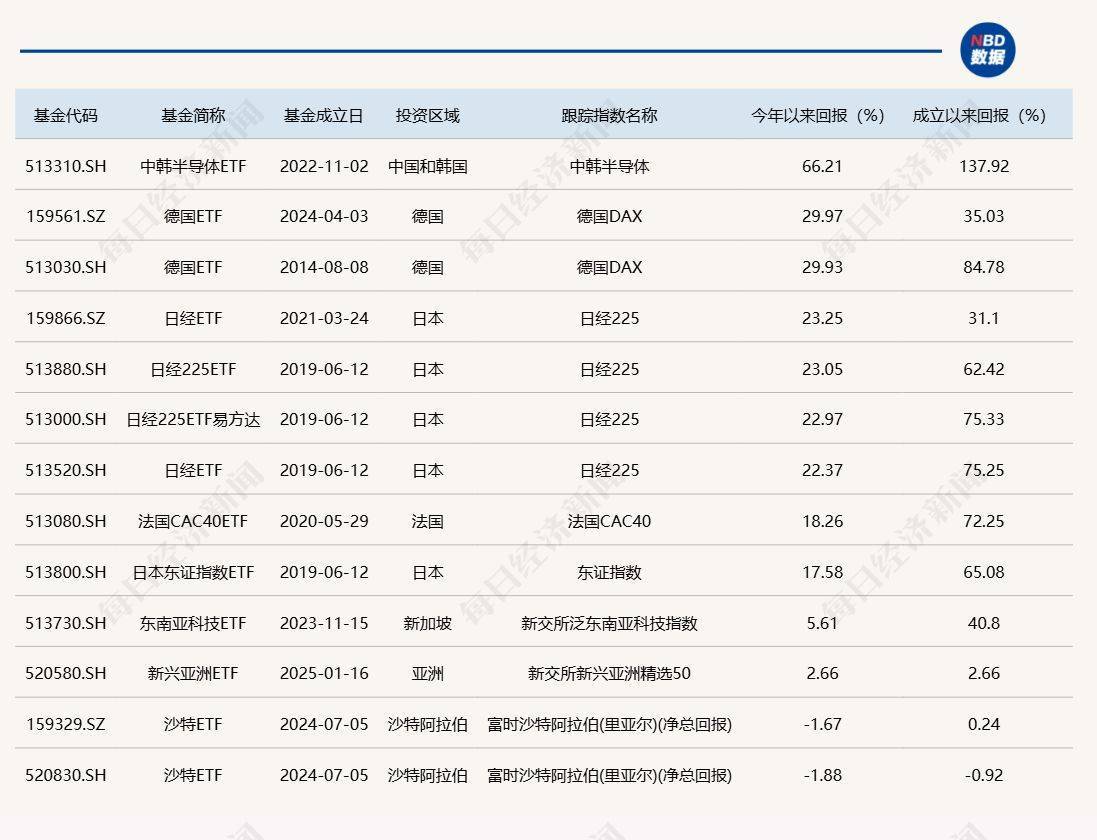
Group 1 - The core viewpoint of the articles is the introduction of new cross-border investment funds, specifically ETFs focused on the Brazilian market, which enhances connectivity between Chinese and Brazilian capital markets [1][3][5] - On October 13, the China Securities Regulatory Commission announced the approval of two new QDII ETFs: the Huaxia Bradesco Brazil Ibovespa ETF and the E Fund Itaú Brazil IBOVESPA ETF, allowing investors to easily access the Brazilian capital market [2][3] - The Brazilian capital market is highlighted as the largest and most influential financial system in Latin America, offering opportunities for global investors to benefit from its resource dividends and economic growth potential, while also being affected by domestic fiscal policies and political dynamics [2][3] Group 2 - The Ibovespa index, which is a key indicator of the Brazilian stock market, has shown an annualized return of over 12% over the past decade, with a year-to-date return of 21.6% as of September [2][3] - The emergence of these Brazilian ETFs is seen as a significant development in the ongoing collaboration between China and Brazil in capital market connectivity, following previous initiatives such as the Bradesco Huaxia ChiNext ETF launched in May [3][4] - The trend of public funds expanding into cross-border investments has led to the creation of various products targeting emerging markets, with many of these funds achieving double-digit returns this year, including the notable performance of the China-Korea Semiconductor ETF, which has risen by 66.21% [4][6] Group 3 - The market has seen a diversification of cross-border funds, with products now available for investment in countries such as South Korea, Germany, France, Japan, and others, indicating a growing interest in emerging markets [5][6] - The introduction of dedicated investment tools for the Brazilian market has garnered significant attention, reflecting the increasing sophistication of public funds in meeting investor demand and the deepening of capital market openness [6][7] - Future expectations include the emergence of more products targeting niche countries or markets, as well as cross-border ETFs focusing on global themes such as renewable energy and healthcare, creating a multi-dimensional product matrix for investors [7][8]
华夏、易方达出手,又有重要创新产品来了
Zhong Guo Ji Jin Bao· 2025-10-13 13:09
Core Insights - The China Securities Regulatory Commission has approved the applications for two Brazil-focused ETFs, marking a significant step in the interconnection between Chinese and Brazilian capital markets [1][4] - Brazilian capital markets are characterized as the largest and most influential financial system in Latin America, offering global investors opportunities to tap into its resource dividends and economic growth potential [2][3] Group 1: ETF Developments - China Asset Management has launched the "Hua Xia Bradesco Brazil Ibovespa ETF," while E Fund has introduced the "E Fund Itaú Brazil IBOVESPA ETF," facilitating easier access for investors to the Brazilian market [1] - The approval of these ETFs is seen as a continuation of previous collaborations, including the successful listing of the Bradesco Hua Xia ChiNext ETF in Brazil earlier this year [4] Group 2: Market Characteristics - Brazil's capital market is noted for its high growth potential and volatility, influenced by domestic fiscal policies, interest rate cycles, and political dynamics [2] - The Ibovespa index, a key indicator of the Brazilian economy, has shown a 12% annualized return over the past decade and a year-to-date return of 21.6% as of September [3] Group 3: Investment Opportunities - The Ibovespa index is heavily resource-oriented, comprising major global commodity players, which aligns its performance with international raw material prices and Chinese economic demand [3] - The Brazilian market is positioned as an important destination for global investors seeking diversified portfolios and high returns, with a low correlation to A-shares [2][3]

华夏、易方达出手!又有重要创新产品来了
中国基金报· 2025-10-13 12:44
Core Viewpoint - The approval of Brazil ETFs by China’s Huaxia Fund and E Fund marks a significant step in the interconnection of capital markets between China and Brazil, facilitating easier investment access for investors into the Brazilian market [2][3]. Group 1: Brazilian Capital Market Overview - The Brazilian capital market is the largest and most influential financial system in Latin America, offering global investors opportunities to share in its resource dividends and economic growth potential, while also being affected by domestic fiscal policies, interest rate cycles, and political ecology [3][4]. - Brazil is a key emerging market and a member of the BRICS nations, with a significant consumer market and ongoing recovery in domestic demand, alongside increasing digital penetration and growth in the service sector [3][4]. Group 2: Ibovespa Index Insights - The Ibovespa index is the oldest and most representative index in the Brazilian capital market, covering sectors with comparative advantages such as mining and agriculture, with high weights in finance and energy [4][5]. - The index is currently valued at a relatively low level compared to other emerging markets, and its performance shows low correlation with A-shares, making it an important destination for global asset allocation [4][5]. Group 3: Investment Performance and Opportunities - The Ibovespa index has delivered an annualized return of over 12% over the past decade, with a year-to-date return of 21.6% as of September, reflecting Brazil's political and economic reforms and capturing global capital flows into emerging markets [5]. - The interconnection of capital markets between China and Brazil has previously seen cooperation, such as the successful listing of the Bradesco Huaxia ChiNext ETF in Brazil, allowing Brazilian investors to easily access the vibrant Chinese market [5][6]. Group 4: ETF Connectivity Initiatives - The recent launch of mutual ETF listings between China and Brazil enhances the efficiency and convenience for overseas investors to allocate to Huaxia's ETFs, thereby increasing recognition of mutual ETFs and enhancing the influence of domestic capital markets [6]. - Huaxia Fund has been a pioneer in domestic ETFs and is actively promoting the two-way connectivity of ETF products, expanding its global market footprint [6].