
回购增持贷

Search documents
5月百余A股公司兑现回购承诺,多家“顶格”实施
Di Yi Cai Jing· 2025-06-04 10:48
Group 1 - The core viewpoint of the article highlights the ongoing trend of share buybacks among listed companies, driven by supportive policies and market conditions [1][2][3] - In May, over 60 A-share companies disclosed buyback plans, with nearly 150 companies completing buybacks, including major players like Yili and Heng Rui [1][2] - The buyback wave began in early April, influenced by market stabilization efforts, with significant funds entering the A-share market [1][2] Group 2 - Companies are rapidly fulfilling their buyback commitments, with some completing the process in less than a month [1][3] - Financial institutions are providing special loans to support these buybacks, with some companies sourcing over 80% of their buyback funds from these loans [1][8] - The "buyback and increase loan" policy tool has been instrumental, with over 210 related announcements and a total loan cap exceeding 436 billion yuan since April [8][9] Group 3 - The trend of buybacks is expected to continue, with over 70 A-share companies announcing new buyback plans since May [6][7] - Notable recent buyback announcements include Baofeng Energy planning to allocate 1 billion to 2 billion yuan for buybacks [6][7] - The low interest rates of special loans make them attractive for companies, allowing them to enhance earnings per share through cost-effective financing [9]
4月来已披露170余份计划,上市公司使用回购增持贷热情高涨
Di Yi Cai Jing· 2025-05-14 11:35
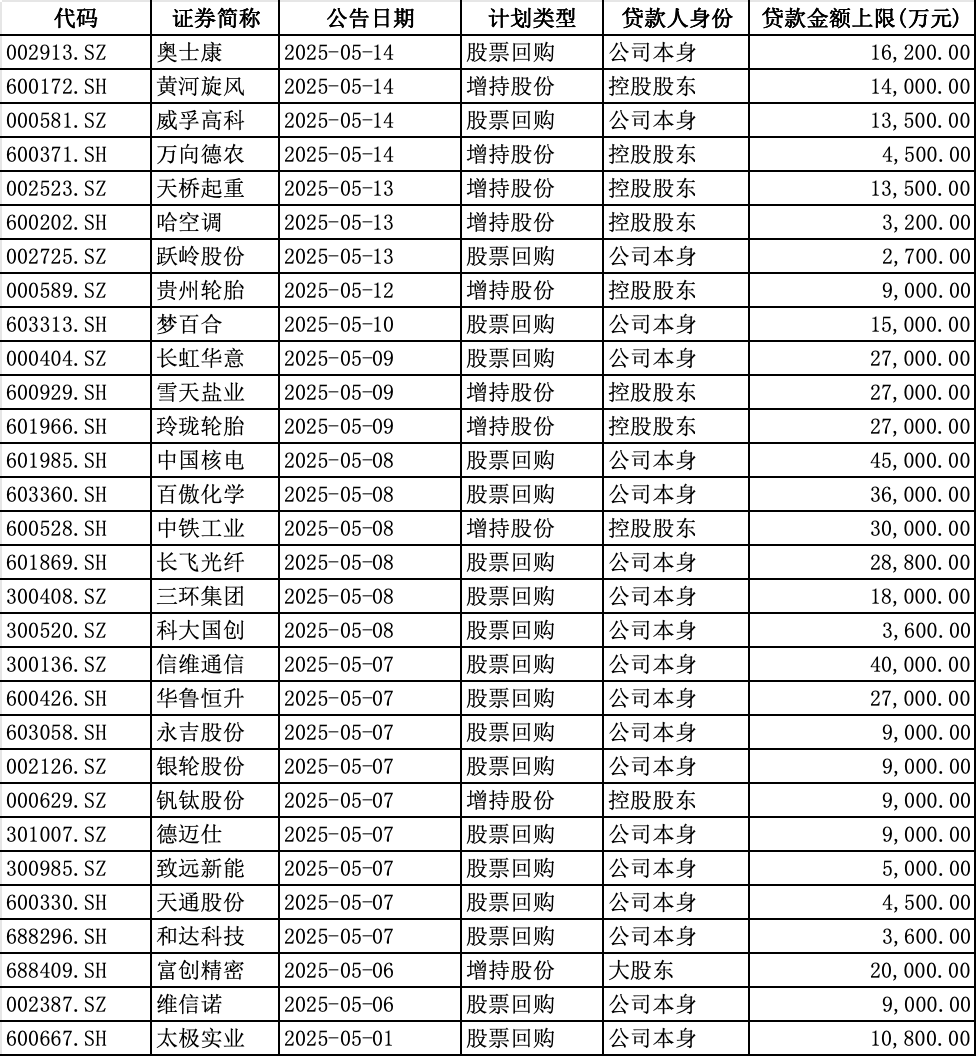
Core Viewpoint - The enthusiasm for "repurchase and increase" special loans among listed companies remains high, with over 80% of the funds for repurchase or increase coming from these loans, reflecting a strong market response to new financial policies [2][3][6]. Group 1: Loan Utilization and Market Response - Since the introduction of the "repurchase and increase" loan program, over 300 companies have disclosed 367 special loan announcements, with a total loan ceiling of approximately 70.5 billion yuan [3]. - In April alone, 146 A-share companies disclosed special loan situations, involving a total loan ceiling of 32.886 billion yuan, accounting for over 40% of the cumulative loan amount for the year [3]. - The number of companies utilizing "repurchase and increase" loans has surged, with significant participation from the chemical, hardware, and pharmaceutical industries [3][6]. Group 2: Financial Policy and Loan Details - The People's Bank of China announced a combined total of 800 billion yuan for securities, fund, and insurance company swap facilities and stock repurchase and increase loans, enhancing the flexibility and efficiency of these financial tools [10]. - The interest rate for stock repurchase and increase loans is around 2%, which is lower than the average dividend yield of listed companies, incentivizing companies to utilize these loans for stock buybacks [6][9]. - Major companies such as Rongsheng Petrochemical and Haier Smart Home have received special loans exceeding 1 billion yuan, indicating a trend towards larger financing amounts [4][5]. Group 3: Market Stability and Corporate Strategy - The use of "repurchase and increase" loans is driven by the need for market stabilization during periods of volatility, with companies leveraging low-cost financing to enhance earnings per share [6][9]. - Regulatory bodies have emphasized the importance of market value management, with state-owned enterprises taking the lead in stabilizing the market through repurchase actions [6][9]. - The recent financial policies aim to support companies in optimizing their capital structures and alleviating liquidity pressures, particularly for private enterprises [6][9].





回购增持贷上限总额突破千亿元
Zheng Quan Shi Bao· 2025-04-17 18:19
Core Viewpoint - Stock buybacks and increases have become important measures for listed companies in managing market value, especially during periods of market volatility, providing additional funds to effectively respond to short-term shocks and stabilize investor confidence [1] Group 1: Buyback and Increase Loan Overview - Since the announcement of the stock buyback and increase loan policy on October 18, 2022, listed companies and major shareholders have actively responded, with the total amount of buyback and increase loans reaching 102.14 billion yuan as of April 17, 2023 [2] - Among the companies utilizing buyback loans, Muyuan Foods has the highest amount at 2.5 billion yuan, followed by Haier Smart Home, Hikvision, China Railway, and Wens Foodstuffs with amounts of 1.8 billion yuan, 1.75 billion yuan, 1.6 billion yuan, and 1 billion yuan respectively [2] - The number of companies obtaining large increase loans is higher, with Dongfang Shenghong's increase loan amount reaching 2.8 billion yuan, and six other companies exceeding 1 billion yuan [2] Group 2: Bank Participation in Loans - Seven large state-owned banks and twelve commercial banks are involved in providing these loans, with the "Big Four" state-owned banks contributing over 10 billion yuan each, totaling 66.25 billion yuan, which accounts for 64.86% of the total loan amount [3] - CITIC Bank leads among commercial banks with a total of 8.8 billion yuan in loans [3] Group 3: Corporate Nature and Loan Distribution - Private enterprises have the highest total loan amount at 54.61 billion yuan, followed by local state-owned enterprises and central state-owned enterprises at 19.93 billion yuan and 18.05 billion yuan respectively [4] - Central state-owned enterprises show a stronger inclination towards buybacks, with 51.5% of their loans used for this purpose compared to 30.68% for private enterprises [4] - The enthusiasm of central state-owned enterprises for buybacks is closely linked to supportive policies from the State-owned Assets Supervision and Administration Commission [4] Group 4: Recent Trends in Buyback and Increase Loans - In April 2023, the number of announcements regarding buyback and increase loans surged, with 67 companies reporting a total loan amount of 19.33 billion yuan, a month-on-month increase of 67.71% [5] - The People's Bank of China has been actively promoting the stock buyback and increase loan business through various initiatives, encouraging state-owned listed companies to take the lead [6]