
国投瑞银产业趋势混合A

Search documents
国投瑞银基金旗下部分产品业绩不佳 权益产品平均管理费率高于行业均值
Zhong Guo Jing Ji Wang· 2026-02-10 07:28
Core Viewpoint - The recent volatility of Guotou Ruijin's silver futures LOF has raised concerns among investors, particularly regarding its high management fees and poor performance relative to industry averages [1][2][3][4] Group 1: Fund Performance and Management Fees - Guotou Ruijin's average management fee rate for its equity products is higher than the industry average, with some products underperforming this year [1][2] - The silver futures LOF experienced a dramatic drop of 31.5% in a single day, marking a historical record for public funds, followed by a temporary suspension and subsequent recovery [1] - The company reported that 20 of its funds incurred a total loss of approximately 1.6 billion yuan in the first half of last year while collecting over 76 million yuan in management fees [4] Group 2: Comparative Analysis of Management Fees - The average management fee rate across the public fund industry is 0.69%, with mixed funds averaging 1.08%, while Guotou Ruijin's overall average is 0.72% [2] - A total of 46 of Guotou Ruijin's products have management fees exceeding 1%, with 44 of those at 1.2% [2] - The management fees for Guotou Ruijin's mixed funds are close to 1.14%, while its stock funds average around 0.62% [2] Group 3: Long-term Performance Metrics - Guotou Ruijin's funds, including several mixed and stock funds, have underperformed their benchmarks by over 10 percentage points in the last three years, with some lagging by at least 30 percentage points [3] - Specific funds such as Guotou Ruijin's New Energy Mixed Fund and Industry Trend Mixed A have reported significant losses while still generating substantial management fees [4]
基金经理个人被诉 基金公司同为被告
Zhong Guo Jing Ji Wang· 2025-12-29 02:35
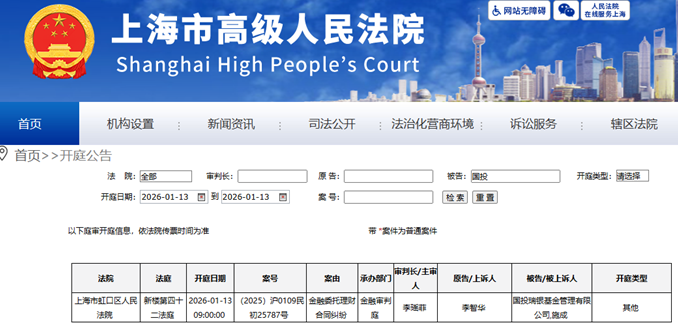
Core Viewpoint - The case of investors suing Guotai Junan Fund and star fund manager Shi Cheng for financial contract disputes is set to be heard on January 13, 2026, marking a rare instance in the public fund industry where a fund manager is named as a co-defendant alongside the fund company [1] Group 1: Legal Proceedings - The lawsuit involves investor Li, who claims a "financial contract dispute" against both Guotai Junan Fund and Shi Cheng, with the hearing scheduled at the Shanghai Hongkou District People's Court [1] - This case is notable as it is uncommon for a fund manager to be personally implicated in such disputes within the public fund sector [1] Group 2: Fund Performance - Shi Cheng's managed products have generally underperformed in recent years, with significant declines in net asset values observed [1] - Currently, Shi Cheng manages six fund products with a total scale of approximately 10.7 billion yuan, having previously seen management scale increase from under 4 billion yuan to over 20 billion yuan due to the rise of the new energy sector from 2020 to 2021 [1] - However, following adjustments in the new energy sector, the net values of his managed products have experienced substantial declines [1] Group 3: Comparative Performance - The performance of Guotai Junan's funds under Shi Cheng's management has been poor, with the Guotai Junan Industrial Transformation Mixed A fund showing negative returns over approximately three and a half years, while the average return for similar funds exceeded 8% during the same period [2] - Other funds managed by Shi Cheng have also underperformed compared to their peers, with a total estimated loss of around 10 billion yuan across the six funds from 2023 to 2024, and continued losses expected in the first half of 2025 [2] Group 4: Strategic Shifts - In response to performance pressures, Shi Cheng has made significant adjustments to his portfolio, including large-scale sell-offs of new energy stocks and a shift towards investments in AI and robotics, which has drawn market skepticism as a "passive response to performance pressure" [2] - Shi Cheng has defended this strategy in his quarterly report, expressing confidence in the ongoing investment potential in AI [2] Group 5: Industry Implications - The lawsuit has garnered significant attention in the market, with industry insiders anticipating that it may lead to a shift in the assessment mechanisms for public fund managers, moving from a focus solely on performance to a more balanced approach that includes compliance [2]
公募行业罕见纠纷 基金经理个人被诉 基金公司同为被告
Shen Zhen Shang Bao· 2025-12-28 16:37
Group 1 - The Shanghai High People's Court will hear a case on January 13, 2026, where investors are suing Guotou Ruijin Fund and star fund manager Shi Cheng for a financial trust contract dispute, marking a rare instance of a fund manager being named as a co-defendant alongside the fund company [1] - Shi Cheng's managed products have generally performed poorly in recent years, with some experiencing significant net value declines [1] - Shi Cheng currently manages six fund products with a total scale of approximately 10.7 billion yuan, having previously seen his management scale grow from less than 4 billion yuan to over 20 billion yuan due to the rise of the new energy sector from 2020 to 2021 [1] Group 2 - The performance of Shi Cheng's funds has been disappointing, with the Guotou Ruijin Industrial Transformation Mixed A fund showing a negative return over approximately three and a half years, while the average return of similar funds exceeded 8% during the same period [2] - The six funds managed by Shi Cheng are projected to incur a combined net loss of around 10 billion yuan from 2023 to 2024, with continued losses expected in the first half of 2025 [2] - In response to performance pressures, Shi Cheng has significantly adjusted his portfolio, clearing out positions in new energy stocks and shifting focus to AI and robotics, a move that has drawn market skepticism [2]
国投瑞银与基金经理施成被起诉 6基金任职回报输均值
Zhong Guo Jing Ji Wang· 2025-12-26 07:58
Core Viewpoint - The article discusses a lawsuit against Guotou Ruijin Fund and fund manager Shi Cheng, initiated by an investor over a financial trust management contract dispute, with details of the case yet to be disclosed [1]. Company Overview - Guotou Ruijin Fund was established in 2002, originally named Zhongrong Fund Management Co., Ltd. It was acquired by Guotou Trust Investment Co., Ltd. and UBS Group in 2005, holding 51% and 49% of the shares respectively [2]. - As of September 30, 2025, Guotou Ruijin Fund has a management scale of 240.53 billion yuan and employs 32 fund managers [2]. Fund Manager Profile - Shi Cheng has a background as a researcher at China Jianyin Investment Securities Co., Ltd., and has held positions at various investment management firms before joining Guotou Ruijin Fund in March 2017. He has been a fund manager since March 29, 2019 [3]. - Under Shi Cheng's management, he oversees 12 funds, with a total scale of approximately 10.736 billion yuan. Six of these funds have underperformed compared to their peers [3]. Fund Performance - The two funds managed by Shi Cheng, Guotou Ruijin Industrial Transformation One-Year Holding Mixed A and C, have reported significant losses of 24.62% and 26.16% respectively as of December 25, 2025 [3]. - The top ten holdings of the fund include major companies such as Tencent Holdings, Alibaba, and Geely Automobile, indicating a diversified investment strategy across various sectors [4].

天雷滚滚,基金经理“金饭碗”告急!哪些“顶流”基金经理可能要被降薪?
市值风云· 2025-12-15 10:08
Core Viewpoint - The introduction of the new performance assessment guidelines for fund managers aims to tightly link their compensation to both relative and absolute performance, with a significant focus on ensuring that investors earn returns [3][4]. Group 1: New Regulations and Impact - The new guidelines stipulate that fund managers who underperform their benchmarks by more than 10% over three years and incur losses will face a salary reduction of at least 30% [3][4]. - Approximately 30% of active equity fund managers may hit the "30% salary reduction" threshold due to poor performance [5][10]. - The ultimate goal of the regulations is to align the interests of fund managers with those of investors, ensuring that investors genuinely profit from their investments [4]. Group 2: Performance Statistics - Data shows that nearly 60% of funds have failed to outperform their benchmarks over the past three years, with only 44% of the 3,794 funds analyzed achieving this [6]. - Among these, 1,394 funds have underperformed their benchmarks by over 10%, representing nearly 37% of the total sample [7]. - The analysis indicates that around 34% of funds not only underperformed but also had negative profit margins, failing to generate positive returns for investors [10]. Group 3: Notable Fund Managers and Cases - Several prominent fund managers, such as Lu Bin and Shi Cheng, have multiple funds that have triggered the salary reduction criteria, with all their managed products underperforming significantly [15][16]. - Lu Bin's funds have consistently underperformed, with all seven products managed by him failing to meet benchmarks over the past three years [16]. - Shi Cheng's strategy of heavily investing in a single sector (new energy) led to significant gains during a bull market but resulted in substantial losses as market conditions changed, highlighting the risks of concentrated investment strategies [21][22].
国投瑞银施成在管产品3年业绩大幅跑输基准 知名基金经理或面临降薪
Shen Zhen Shang Bao· 2025-12-08 23:48
Core Viewpoint - The China Securities Investment Fund Industry Association has revised the "Performance Assessment Management Guidelines for Fund Management Companies (Draft for Comments)," which stipulates that fund managers of actively managed equity funds with poor performance for three consecutive years may face a salary reduction of 30% [1] Group 1: Fund Manager Performance - Notable fund manager Shi Cheng has recently attracted market attention due to his products underperforming benchmarks over the past three years, with more than half of the profit margins being negative, potentially leading to a salary cut [1] - According to Tonghuashun data, Shi Cheng's six actively managed equity funds have shown year-to-date returns outperforming the benchmark by 20% to 38%, but over the last three years, the returns have ranged from -5% to 28%, underperforming the benchmark by 18% to 48% [1] Group 2: Specific Fund Performance - The net values of Guotou Ruijin Advanced Manufacturing Mixed Fund, Guotou Ruijin Industry Trend Mixed A, and Guotou Ruijin Jinbao Mixed Fund have decreased by 27.97%, 27.86%, and 26.81% respectively over the last three years, underperforming their benchmarks by 47.71, 47.5, and 39.59 percentage points [1] - The Guotou Ruijin New Energy Mixed A fund has seen a net value decline of 26.78% over the past three years, underperforming its benchmark by nearly 18 percentage points [1] - The Guotou Ruijin Industry Transformation One-Year Holding Mixed A and Guotou Ruijin Industry Upgrade Two-Year Holding Mixed A, co-managed by Shi Cheng and others, have net value declines of 18.78% and 4.68% respectively, underperforming their benchmarks by 38.41 and 24.32 percentage points [1]
国投瑞银知名基金经理施成在管产品三年业绩大幅跑输基准 或面临降薪
Sou Hu Cai Jing· 2025-12-08 09:43
Core Viewpoint - The China Securities Investment Fund Industry Association has revised the "Performance Assessment Management Guidelines for Fund Management Companies (Draft for Comments)", which includes a performance salary adjustment mechanism for active equity fund managers based on their performance over the past three years [1][3]. Group 1: Performance Assessment Guidelines - Fund management companies must establish a tiered performance salary adjustment mechanism based on the past three years' performance compared to benchmarks and fund profitability [1]. - If a fund manager's product performance is more than 10 percentage points below the benchmark and the fund's profitability is negative, their performance salary should decrease by at least 30% [1]. - For performance below the benchmark but with positive profitability, the salary should still decrease, while those with performance above the benchmark and positive profitability may see reasonable salary increases [1]. Group 2: Fund Manager Performance - Notable fund manager Shi Cheng's products have underperformed benchmarks over the past three years, with returns ranging from -5% to 28%, lagging behind benchmarks by 18% to 48% [2]. - Specific funds managed by Shi Cheng, such as Guotou Ruijin Advanced Manufacturing Mixed and Guotou Ruijin Industry Trend Mixed A, have seen net values drop significantly, with declines of 27.97% and 27.86%, respectively, underperforming benchmarks by 47.71 and 47.5 percentage points [2]. - Shi Cheng has recently adjusted his portfolio, moving away from heavily concentrated positions in the struggling new energy sector to focus on AI and technology stocks, which has led to some recovery in fund performance [3]. Group 3: Industry Implications - The new guidelines aim to create a long-term performance assessment system that aligns the interests of fund managers with the long-term returns of investors, addressing issues of short-term incentives and soft accountability in the industry [4]. - The implementation of these guidelines is expected to shift the industry focus from mere scale expansion to value creation, trust accumulation, and high-quality development, ultimately contributing to the stability of the capital market [4]. - Attention will be needed on the detailed execution of these policies, particularly regarding the standardization of performance benchmarks and the regulation of co-investment operations to ensure that the benefits of reform reach investors [4].