在线支付

Search documents
过去十年希腊银行卡使用增长位居欧盟第二
Shang Wu Bu Wang Zhan· 2026-01-19 15:42
Core Insights - Greece ranks second in the EU for the growth rate of card usage from 2015 to 2024, according to a study by the Foundation for Economic and Industrial Research (IOBE) [1] Group 1: Card Usage Growth - The volume of card transactions in Greece has increased approximately 25 times from 2014 to 2024, while the transaction amount has grown about 10 times [1] - The usage of cash is continuously declining, with card payments contributing positively to tax compliance [1] Group 2: Online Payment Trends - Online payments saw significant growth during the COVID-19 pandemic and have continued to rise post-pandemic [1] - The ratio of online to offline transactions improved from less than 1:5 before the pandemic to 1:3 during the pandemic, and further to approximately 1:2 afterward [1] Group 3: Digital Payment in Services - Digital payments account for a higher proportion of goods transactions compared to service trade, although the gap is narrowing [1] - Over 40% of digital payments now occur in the service sector, up from less than 20% in 2015, while service expenditures represent about 45% of total household consumption [1]
数字消费贡献持续攀升 “Z世代”、银发族用户占比近四成
Di Yi Cai Jing· 2026-01-08 12:59
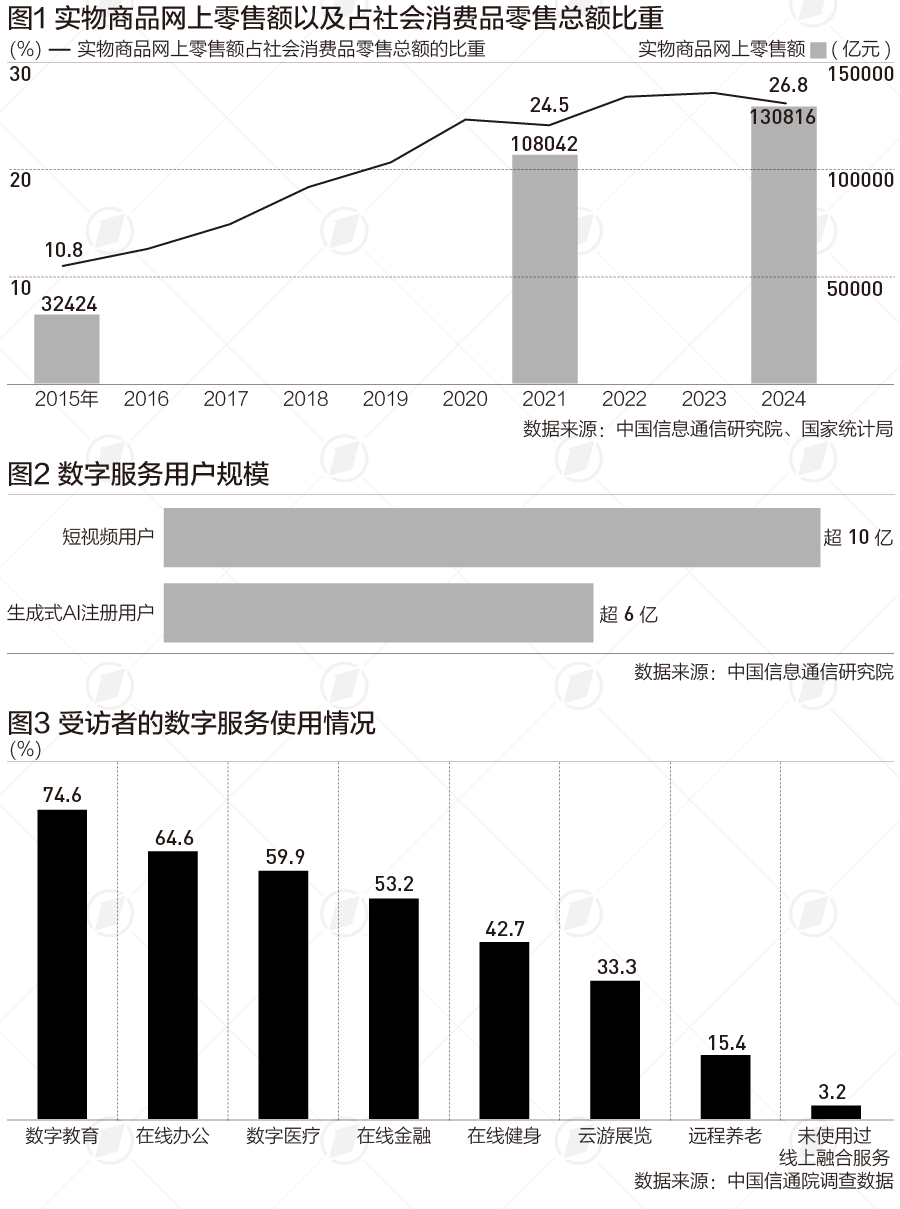
Core Insights - Digital consumption is increasingly contributing to overall consumption growth in China, driven by technological advancements, innovative product models, and changing consumer demands [1][2][4] Group 1: Digital Consumption Trends - The proportion of online retail sales of physical goods has risen from 10.8% a decade ago to an expected 26.8% in 2024 [1] - The digital consumer base is expanding across age, gender, and regional boundaries, with significant participation from the "Z generation" and the elderly [1][5] - By mid-2025, the digital consumption amount in China is projected to reach 9.37 trillion yuan, accounting for 46.5% of total household consumption expenditure [4] Group 2: User Demographics and Behavior - As of June 2025, the number of digital consumption users has surpassed 958 million, with the "Z generation" accounting for 27.2% of this group [5] - The "Z generation" shows a high engagement with digital services, with 71.4% using generative AI, significantly higher than the overall internet user rate [5] - The elderly demographic is also becoming a significant force in digital consumption, with 71.7% willing to pay for convenient online products and services [6] Group 3: Market Growth and Innovations - The digital economy's core industry value added reached 14.08 trillion yuan in 2024, growing by over 10% year-on-year [7] - The integration of AI in consumer products is expected to enhance market penetration, with AI smartphones and PCs projected to exceed 50% and 80% penetration rates, respectively, in the next three years [7] - The growth of digital services is evident in sectors like healthcare, with internet hospitals increasing from about 1,600 in 2021 to 3,340 by the end of 2024 [7] Group 4: Future Outlook - The digital consumption landscape is evolving with new consumption patterns, including online-offline integration and immersive experiences [1][2] - Emerging consumption trends such as digital and green consumption are expected to further stimulate overall consumption growth [8]

数字消费贡献持续攀升,“Z世代”、银发族用户占比近四成
Di Yi Cai Jing· 2026-01-08 12:32
Core Insights - Digital consumption is increasingly contributing to overall consumption growth in China, driven by technological advancements, innovative product models, and changing consumer demands [1][2][4] Group 1: Digital Consumption Trends - The proportion of online retail sales of physical goods has risen from 10.8% a decade ago to an expected 26.8% in 2024 [1] - The digital consumer base is expanding across age, gender, and geographic boundaries, with significant participation from the "Z generation" and the elderly [1][5] - By mid-2025, digital consumption is projected to reach 9.37 trillion yuan, accounting for 46.5% of total household consumption expenditure [4] Group 2: User Demographics and Behavior - As of June 2025, the number of digital consumers in China surpassed 958 million, with the "Z generation" accounting for 27.2% of this group [5] - The "Z generation" shows a high engagement with smart products, with 59.3% having purchased smart devices online, and a notable 71.4% using generative AI services [5] - The elderly demographic is also becoming a significant force in digital consumption, with 71.7% willing to pay for convenient online services [6] Group 3: Market Growth and Innovations - The digital economy's core industries are expected to see a value increase of 13.3 billion yuan in 2024, with a growth rate exceeding 10% [7] - The integration of AI in consumer products is leading to significant upgrades in smart devices, with projections indicating that AI smartphones and PCs will achieve over 50% and 80% market penetration, respectively, in the next three years [7] - The healthcare sector is rapidly expanding its digital services, with internet hospitals increasing from around 1,600 in 2021 to 3,340 by the end of 2024 [7]