增程式乘用车

Search documents
五维度看2025中国乘用车发展之“术”
Xin Lang Cai Jing· 2025-12-31 16:01
Core Insights - The Chinese passenger car market is experiencing unprecedented vitality and resilience due to various transformative forces, with a focus on the industry's ability to identify and solve problems [1][2]. Group 1: New Energy Vehicle Market - The penetration rate of new energy vehicles (NEVs) in China reached 53.6% in the first 11 months of 2025, indicating a shift from policy-driven to market-driven growth [4]. - The number of new car models launched in 2025 exceeded 200, showcasing the industry's strength and providing diverse options for consumers [5]. - Major NEV manufacturers have established comprehensive product platforms, enabling rapid iteration and performance enhancement across various models [6]. Group 2: Technological Advancements - Significant advancements in foundational technologies, such as intelligent chassis systems, are enhancing the overall level of the NEV industry [7]. - The performance of pure electric vehicles has improved, with extended driving ranges and enhanced safety features, addressing consumer concerns [8]. - Range-extended vehicles have also seen performance improvements, with some models achieving over 1000 kilometers of range [9]. Group 3: Autonomous Driving and AI Integration - The first batch of Level 3 conditional autonomous driving vehicle licenses was issued, marking a new phase in the commercialization of autonomous driving in China [10]. - AI technology is being integrated into smart cockpit systems, enhancing user interaction and experience [11]. - The automotive industry is witnessing a shift towards cognitive intelligence, allowing vehicles to understand and respond to complex commands [23]. Group 4: Domestic Brand Performance - Domestic brands captured a market share of 69.6% in the first 11 months of 2025, reflecting their growing competitiveness [13]. - High-end NEV sales have been dominated by domestic brands, indicating their increasing strength in the premium segment [14]. - Domestic brands are expanding internationally, with significant export growth and market penetration in Europe and Southeast Asia [15]. Group 5: Brand Image and Communication - Automotive leaders are increasingly engaging with consumers through relatable narratives, moving away from traditional high-end marketing [39]. - The industry is addressing issues of "involution" and promoting high-quality development to avoid harmful price competition [40][41]. - Companies are adopting transparent communication strategies to build trust and address safety concerns following incidents involving autonomous driving technologies [44][46].




车市“金九”成色足:销量创新高,新能源渗透率升至57.8%
Bei Ke Cai Jing· 2025-10-13 13:37
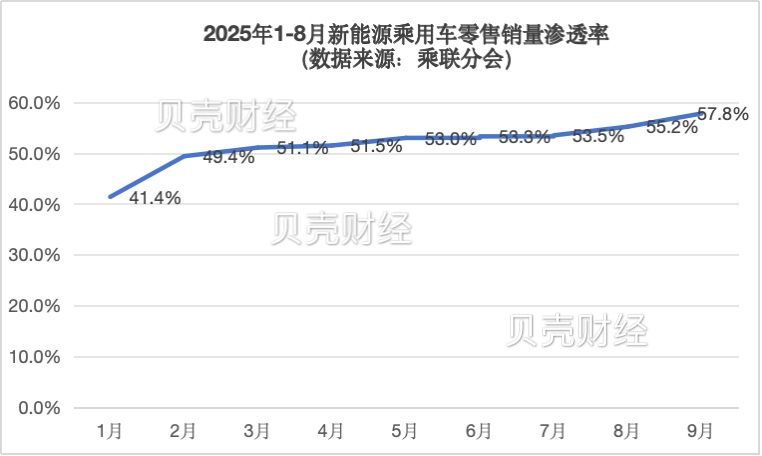
Core Insights - In September, China's passenger car production, retail, and export volumes reached historical highs for the month, with retail sales at 2.241 million units, a year-on-year increase of 6.3% [1] - The retail penetration rate of new energy passenger vehicles rose to 57.8%, up 5 percentage points from the same period last year, indicating stable growth supported by policies such as tax exemptions [2][4] Group 1: Market Performance - The retail sales of new energy passenger vehicles in September increased by 15.5% year-on-year to 1.296 million units, maintaining a penetration rate above 50% for the seventh consecutive month since March [2] - The sales of pure electric passenger vehicles reached 826,000 units in September, showing a year-on-year growth of 28.5% and a month-on-month increase of 19.8% [5] - The overall passenger car market in the first nine months of the year saw cumulative retail sales of 17.005 million units, a year-on-year increase of 9.2% [7] Group 2: Segment Analysis - The market share of pure electric vehicles has significantly increased, while the growth rates of plug-in hybrid and range-extended vehicles have slowed down, indicating a shift in consumer preference [4][5] - The sales distribution for September was approximately 64% for pure electric vehicles, 28% for plug-in hybrids, and 8% for range-extended vehicles [5] Group 3: Company Performance - Among the top domestic automakers, Geely, BYD, and SAIC have achieved over 70% of their sales targets for the year, with Geely's cumulative sales reaching 2.17 million units, achieving a target completion rate of 72% [8] - New energy vehicle startups have shown a clear differentiation in sales target completion rates, with companies like XPeng and Leap Motor exceeding 75% [8] - The market share of domestic brands in retail reached 64.8%, an increase of 5.9 percentage points compared to the previous year, highlighting the growth of domestic brands in both the new energy and export markets [8]


创历史新高!9月全国乘用车零售销量达224.1万辆 乘联分会:车市将现“银九金十”
Mei Ri Jing Ji Xin Wen· 2025-10-13 07:33
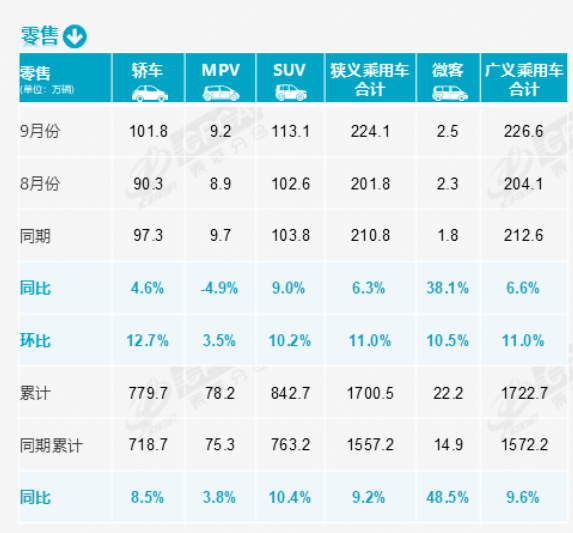
Core Insights - In September, China's passenger car retail sales reached a record high of 2.241 million units, marking a 6.3% year-on-year increase and surpassing the previous record of 2.19 million units set in September 2017 by 50,000 units, indicating strong growth before the end of year policy withdrawal [1][4] Retail Sales Performance - The retail sales of passenger cars in September included 1.018 million sedans, 1.131 million SUVs, and 224.1 million narrow passenger vehicles, with a total of 2.266 million broad passenger vehicles sold [2] - Cumulative retail sales from January to September reached 17.005 million units, reflecting a 9.2% year-on-year growth [4] Brand Performance - Domestic brands continued to show high growth, with retail sales of 1.5 million units in September, a 13% year-on-year increase and a 12.9% month-on-month increase, capturing a market share of 66.9% [5][6] - In the top five manufacturers by retail sales in September, four were domestic brands, with BYD leading at 347,000 units, followed by Geely, Changan, and Chery [5] Export and Wholesale Trends - In September, China's passenger car exports reached 528,000 units, a 20.7% year-on-year increase, with domestic brands accounting for 463,000 units of this total [6] - The wholesale volume of new energy vehicles (NEVs) in September was 1.5 million units, a 22.4% year-on-year increase, with pure electric vehicles (BEVs) making up 63% of the total [12] Market Dynamics - The market is shifting towards reduced price cuts and stable promotions, with 23 models seeing price reductions in September compared to 36 in the previous year [7][8] - The penetration rate of new energy vehicles reached 57.8% in September, up 5 percentage points year-on-year, indicating a stable growth driven by policies and market dynamics [8] Future Outlook - The market is expected to maintain a "Silver September, Golden October" trend, with October's performance anticipated to surpass that of September [4][13] - The upcoming adjustments to the new energy vehicle purchase tax policy in 2026 are expected to stimulate consumer purchases towards the end of the year, contributing to a slight positive growth in the fourth quarter [13]