处理器及控制器

Search documents
国金宏观:AI对出口的影响有多大?
Xin Lang Cai Jing· 2026-02-09 04:29
Group 1 - AI has become an essential part of global trade, with China as the largest exporter of AI products and the US as the leading investor in AI [3][24][33] - AI investment is projected to significantly boost the US GDP, contributing 0.8 percentage points to the growth by Q3 2025, with a total global AI spending expected to reach $1.8 trillion in 2025 and $2.5 trillion in 2026 [4][24][33] - The global trade of AI-related goods is expected to grow at a much faster rate than non-AI goods, with a projected 21.7% year-on-year increase by Q2 2025 [6][34] Group 2 - The AI trade is expected to account for 15% of global trade by 2025, contributing over 40% to the overall growth of global merchandise trade [6][34] - The AI industry value chain includes hardware, cloud computing, data, models, and applications, with a focus on hardware components such as raw materials and chip manufacturing equipment [9][38] - By 2024, the narrow AI goods trade is estimated to reach $3.3 trillion, representing 13.6% of global trade, with a year-on-year growth of 10.2% [10][38] Group 3 - In the first three quarters of 2025, the broad AI goods trade in major sample regions is projected to reach $2.7 trillion, marking a 16.9% increase year-on-year [10][39] - AI-related goods exports from mainland China are expected to total $840.7 billion in 2025, accounting for 22% of total exports, with a year-on-year growth of 10.9% [19][48] - The main export destinations for AI-related goods include Hong Kong, the US, and Vietnam, with significant impacts from US tariffs on Chinese imports [21][50]

AI影响了多少出口
SINOLINK SECURITIES· 2026-02-08 08:22
Group 1: Industry Investment Rating - No information provided Group 2: Core Viewpoints - AI trade has become a significant part of global trade. The sustainability of US AI investment determines the continuation of China's high - export prosperity this year. If the US AI bubble bursts, it may lead to a significant decline in the US economy and drag down the global economy and general trade [3][41] - AI investment has become an important part of the global economy. In the first three quarters of 2025, it pulled the US real GDP growth rate by 0.8 percentage points. The IMF estimates that the global economic growth rate will reach 3.3% in 2026 [5] - AI trade is growing rapidly. In Q2 2025, global AI - related commodity trade increased by 21.7% year - on - year, much higher than the 4.2% growth rate of non - AI - related commodity trade. The WTO estimates that by 2040, global trade volume will increase by 34% - 37% and global GDP will increase by 12% - 13% compared to 2025 [8] Group 3: AI Investment - In the first three quarters of 2025, broad AI investment pulled the US real GDP growth rate by 0.8 percentage points. As of mid - 2025, IT manufacturing and data center investment accounted for 1% of the US GDP, and the proportion reached 5% after including software and other equipment, exceeding the peak level during the "Internet bubble" in 2000 [5] - Gartner estimates that global AI spending will be $1.8 trillion in 2025 and expand to $2.5 trillion in 2026 [5] Group 4: AI Trade - In Q2 2025, global AI - related commodity trade increased by 21.7% year - on - year, much higher than the 4.2% growth rate of non - AI - related commodity trade. AI - related commodities accounted for 15% of the global trade scale and contributed more than 40% to the global commodity trade growth rate [8] - Asia is the region with the fastest - growing AI trade, and North America is the region with the largest AI trade scale [8] - The WTO estimates that by 2040, global trade volume will increase by 34% - 37% and global GDP will increase by 12% - 13% compared to 2025, driven by AI technology diffusion and related trade [8] Group 5: AI Industry Chain and Trade Scale - The AI industry chain includes five links, and AI trade is mainly concentrated in the hardware layer. The WTO's AI trade list has 104 categories, and the broad AI commodity trade has about 138 categories, divided into three major categories: raw materials, intermediates, and equipment [12] - In 2024, the narrow - sense AI commodity trade scale was $3.3 trillion, accounting for 13.6% of the global trade volume, with a year - on - year growth of 10.2%, pulling global trade growth by 1.4 percentage points. The broad - sense AI commodity trade scale was $3.6 trillion, accounting for 15.0%, with a year - on - year growth of 8.5% [12] - In the first three quarters of 2025, the broad - sense AI commodity trade scale in major regions was $2.7 trillion, with a year - on - year growth of 16.9%, pulling trade growth by 3.6 percentage points, and the contribution rate exceeded 50% [13] Group 6: AI Trade by Region - China Mainland, the EU, ASEAN, China Taiwan, China Hong Kong, and the US are the main exporters of AI - related commodities, accounting for 91% of global AI trade [20] - In the first three quarters of 2025, the export growth rates of AI commodities in China Taiwan, Thailand, and Malaysia exceeded those of other commodities by 44, 35, and 29 percentage points respectively [20] - AI - related commodities accounted for more than 50% of the exports of China Hong Kong and China Taiwan, and 47% and 32% of the exports of Singapore and South Korea respectively [20] Group 7: China's AI Trade - In 2025, China's broad - sense AI - related commodity export totaled $840.7 billion, accounting for 22% of the export volume, with a year - on - year growth of 10.9%, pulling export growth by 2.4 percentage points. Non - AI - related commodity exports increased by 4% year - on - year [30] - China Hong Kong, the US, and Vietnam are the main export destinations of China Mainland's AI - related commodities, accounting for 19.1% ($160.4 billion), 9.5% ($80 billion), and 7.2% ($60.2 billion) respectively [33] - In 2025, the US increased the tariff rate on Chinese mainland goods. Some AI - related commodities may be re - exported to the US via China Hong Kong and ASEAN, or production capacity may be relocated overseas. Some hard - to - replace raw materials maintain high exports to the US [33]

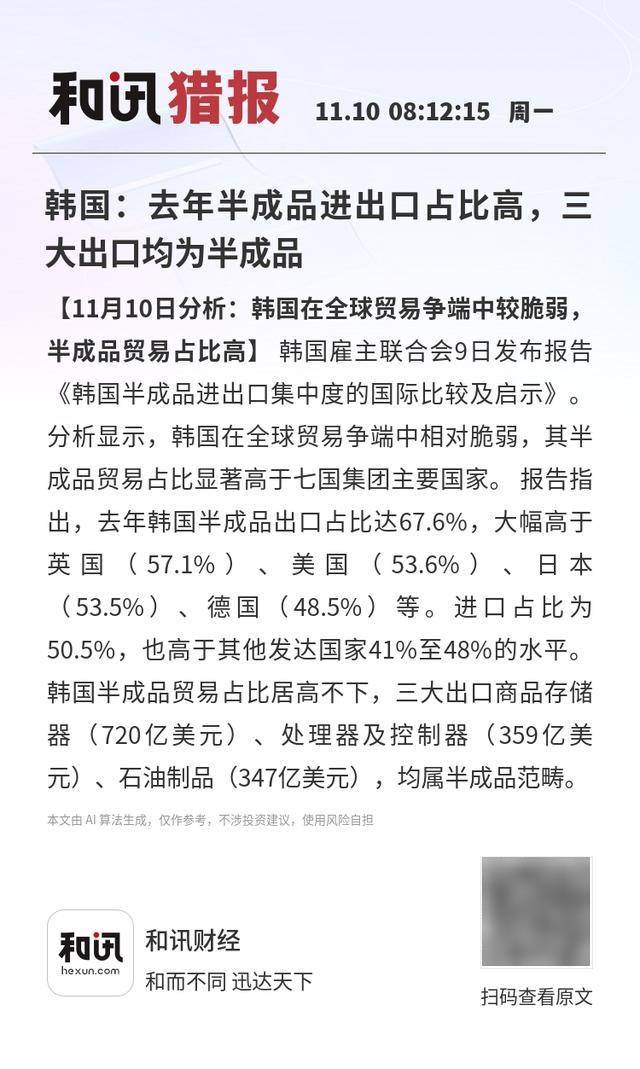
韩国:去年半成品进出口占比高,三大出口均为半成品
Sou Hu Cai Jing· 2025-11-10 01:23
Core Insights - South Korea is relatively vulnerable in global trade disputes due to its high reliance on semi-finished goods trade, which significantly exceeds that of major G7 countries [1] Group 1: Trade Dependency - In 2022, South Korea's semi-finished goods export ratio reached 67.6%, markedly higher than the UK (57.1%), the US (53.6%), Japan (53.5%), and Germany (48.5%) [1] - The import ratio of semi-finished goods in South Korea was 50.5%, also surpassing the levels of other developed countries, which range from 41% to 48% [1] Group 2: Key Export Products - The three main export products categorized as semi-finished goods include memory chips (valued at $72 billion), processors and controllers ($35.9 billion), and petroleum products ($34.7 billion) [1]