锂离子蓄电池

Search documents
东兴证券晨报-20260319
Dongxing Securities· 2026-03-19 04:14
Economic News - The Central Committee and State Council of China issued opinions on extending the second round of land contracts for another 30 years, emphasizing collective ownership and farmers' rights [2] - The U.S. Federal Reserve maintained the federal funds rate target range at 3.5% to 3.75%, with predictions for rate cuts in 2026 and 2027 [2] - China's customs data showed that from January to February, exports of "new three items" (electric passenger cars, lithium-ion batteries, and solar batteries) reached 233.72 billion yuan, a 50.7% increase year-on-year [5] - Major cloud service providers in China raised prices for AI computing and storage products by up to 34%, influenced by a new price cycle in global storage chips [5] Company Insights - Tencent Holdings reported Q4 revenue of 194.37 billion yuan, a 13% year-on-year increase [5] - Fenglong Co. announced a tender offer to acquire 13.02% of the company's shares at a price of 17.72 yuan per share [5] - Heshun Petroleum plans to acquire 51.11% voting rights of Kuixin Technology for 540 million yuan [5] - Aerospace Power's subsidiary plans to invest 81 million yuan in precision processing capacity construction [5] Transportation Industry Analysis - Domestic airlines increased capacity by approximately 11.4% year-on-year in February, with a notable increase due to the timing of the Spring Festival [8] - The overall passenger load factor for domestic airlines in February improved by about 0.7 percentage points year-on-year, with a significant month-on-month increase of 2.9 percentage points [8] - International airlines saw a 16.5% year-on-year increase in capacity for February, with a notable rise in passenger load factor by over 4 percentage points [9] - The instability in the Middle East has positively impacted demand for direct flights from China to Europe, leading to increased ticket prices [9] Investment Recommendations - The report suggests focusing on large airlines that are expected to benefit from improved earnings elasticity due to industry rebalancing [11][12]
中西部外贸进出口增速领跑全国 外贸结构持续优化
Jing Ji Ri Bao· 2026-02-23 23:48
Core Viewpoint - In 2025, China's foreign trade demonstrates strong resilience and vitality amidst challenges such as unilateral trade restrictions and geopolitical tensions, with the central and western provinces showing remarkable performance in trade growth [1] Group 1: Trade Growth and Structure Optimization - The export value of China's "new three items" (electric vehicles, photovoltaic products, lithium-ion batteries) increased by 27.1% year-on-year in 2025, with central and western regions becoming key drivers of this growth [2] - Provinces like Gansu, Henan, Yunnan, Anhui, Chongqing, Xinjiang, and Hubei led in the export growth of the "new three items" [2] - The diversification of trade partners is a crucial indicator of the optimization of the foreign trade structure in the central and western regions, with significant year-on-year growth in trade with Belt and Road countries [3] Group 2: Economic and Strategic Factors - The growth of foreign trade in the central and western regions is attributed to three main factors: resource endowment upgrades, trade pattern reshaping, and national strategic empowerment [4] - The central and western regions possess abundant resources, with over 60% of the national power generation capacity, supporting the development of green and high-end manufacturing industries [4] - In 2025, China's total import and export volume with Belt and Road countries reached 23.6 trillion yuan, an increase of 6.3%, with significant growth in trade with ASEAN, Latin America, and Africa [5] Group 3: Infrastructure and Support Mechanisms - The establishment of cross-border logistics networks, such as the China-Europe Railway Express and the Western Land-Sea New Corridor, has significantly improved trade conditions in the central and western regions [6] - The functions of free trade zones and comprehensive bonded zones are continuously strengthened, becoming hubs for institutional innovation and foreign trade industry aggregation [6] - The development of cross-border e-commerce platforms has provided essential support for many small and medium-sized enterprises to access global markets [6] Group 4: Future Opportunities and Challenges - The central and western regions have formed a green industry cluster represented by the "new three items," which has significant scale effects and advantages in the industrial chain [7] - Challenges include global economic recovery issues and the need to avoid homogenization in overseas markets, which could lead to "increased revenue without increased profit" [8] - Recommendations for seizing new opportunities include leveraging comparative advantages, optimizing the business environment, and enhancing logistics hub functions [8]
中西部外贸进出口增速何以领跑
Jing Ji Ri Bao· 2026-02-23 23:29
Core Viewpoint - In 2025, China's foreign trade demonstrates strong resilience and vitality amidst challenges such as unilateral trade restrictions and geopolitical tensions, with the central and western provinces showing remarkable performance in trade growth [1] Group 1: Trade Growth and Structure Optimization - The export value of China's "new three items" (electric vehicles, photovoltaic products, lithium-ion batteries) increased by 27.1% year-on-year in 2025, with the central and western regions becoming the main drivers of this growth [1] - Provinces like Xinjiang, Shaanxi, Hubei, Gansu, and Yunnan are leading the national growth rates in foreign trade, indicating that the central and western regions are emerging as new highlands for inland openness [1] - The diversification of trade partners is a key indicator of the optimization of the foreign trade structure in the central and western regions, with significant year-on-year growth in trade with Belt and Road countries [2] Group 2: Economic and Strategic Factors - The growth of foreign trade in the central and western regions is attributed to three main factors: resource endowment upgrades, trade pattern reshaping, and national strategic empowerment [3] - The central and western regions are leveraging their resource and geographical advantages to drive industrial structure transformation, with over 60% of the national power generation capacity located in these areas [3] - National strategies such as the Western Development and Central Rise initiatives are providing strong support for foreign trade growth, with policies encouraging foreign investment in these regions [4] Group 3: Logistics and Trade Platforms - The construction of cross-border logistics networks, including the China-Europe Railway Express and the Western Land-Sea New Corridor, has significantly improved the trade positioning of the central and western regions [5] - The functions of free trade zones and comprehensive bonded zones are being continuously strengthened, serving as highlands for institutional innovation and foreign trade industry aggregation [5] - The development of cross-border e-commerce platforms is enabling many small and medium-sized enterprises to reach global markets, providing crucial support for the expansion and quality improvement of foreign trade [5] Group 4: Future Opportunities and Challenges - In 2026, China's foreign trade will face both opportunities and risks, with geopolitical influences increasing external uncertainties while high-quality Belt and Road initiatives enhance global supply chain resilience [6] - The central and western regions have formed a green industry cluster represented by the "new three items," which is expected to maintain growth in foreign trade [6] - Challenges include the need to avoid homogenization in overseas markets and the existence of shortcomings in digital and service trade sectors, indicating further optimization is necessary [6][7] Group 5: Recommendations for Development - To seize new opportunities in foreign trade, the central and western regions should implement differentiated development strategies, leveraging their resource advantages and actively engaging with emerging markets [7] - Improving the business environment and enhancing "going out" services are essential, including building industry service platforms and optimizing logistics functions [7] - Strengthening international rule alignment and establishing risk warning mechanisms will help enterprises navigate the complexities of global trade [7]
国金宏观:AI对出口的影响有多大?
Xin Lang Cai Jing· 2026-02-09 04:29
Group 1 - AI has become an essential part of global trade, with China as the largest exporter of AI products and the US as the leading investor in AI [3][24][33] - AI investment is projected to significantly boost the US GDP, contributing 0.8 percentage points to the growth by Q3 2025, with a total global AI spending expected to reach $1.8 trillion in 2025 and $2.5 trillion in 2026 [4][24][33] - The global trade of AI-related goods is expected to grow at a much faster rate than non-AI goods, with a projected 21.7% year-on-year increase by Q2 2025 [6][34] Group 2 - The AI trade is expected to account for 15% of global trade by 2025, contributing over 40% to the overall growth of global merchandise trade [6][34] - The AI industry value chain includes hardware, cloud computing, data, models, and applications, with a focus on hardware components such as raw materials and chip manufacturing equipment [9][38] - By 2024, the narrow AI goods trade is estimated to reach $3.3 trillion, representing 13.6% of global trade, with a year-on-year growth of 10.2% [10][38] Group 3 - In the first three quarters of 2025, the broad AI goods trade in major sample regions is projected to reach $2.7 trillion, marking a 16.9% increase year-on-year [10][39] - AI-related goods exports from mainland China are expected to total $840.7 billion in 2025, accounting for 22% of total exports, with a year-on-year growth of 10.9% [19][48] - The main export destinations for AI-related goods include Hong Kong, the US, and Vietnam, with significant impacts from US tariffs on Chinese imports [21][50]


AI影响了多少出口
SINOLINK SECURITIES· 2026-02-08 08:22
Group 1: Industry Investment Rating - No information provided Group 2: Core Viewpoints - AI trade has become a significant part of global trade. The sustainability of US AI investment determines the continuation of China's high - export prosperity this year. If the US AI bubble bursts, it may lead to a significant decline in the US economy and drag down the global economy and general trade [3][41] - AI investment has become an important part of the global economy. In the first three quarters of 2025, it pulled the US real GDP growth rate by 0.8 percentage points. The IMF estimates that the global economic growth rate will reach 3.3% in 2026 [5] - AI trade is growing rapidly. In Q2 2025, global AI - related commodity trade increased by 21.7% year - on - year, much higher than the 4.2% growth rate of non - AI - related commodity trade. The WTO estimates that by 2040, global trade volume will increase by 34% - 37% and global GDP will increase by 12% - 13% compared to 2025 [8] Group 3: AI Investment - In the first three quarters of 2025, broad AI investment pulled the US real GDP growth rate by 0.8 percentage points. As of mid - 2025, IT manufacturing and data center investment accounted for 1% of the US GDP, and the proportion reached 5% after including software and other equipment, exceeding the peak level during the "Internet bubble" in 2000 [5] - Gartner estimates that global AI spending will be $1.8 trillion in 2025 and expand to $2.5 trillion in 2026 [5] Group 4: AI Trade - In Q2 2025, global AI - related commodity trade increased by 21.7% year - on - year, much higher than the 4.2% growth rate of non - AI - related commodity trade. AI - related commodities accounted for 15% of the global trade scale and contributed more than 40% to the global commodity trade growth rate [8] - Asia is the region with the fastest - growing AI trade, and North America is the region with the largest AI trade scale [8] - The WTO estimates that by 2040, global trade volume will increase by 34% - 37% and global GDP will increase by 12% - 13% compared to 2025, driven by AI technology diffusion and related trade [8] Group 5: AI Industry Chain and Trade Scale - The AI industry chain includes five links, and AI trade is mainly concentrated in the hardware layer. The WTO's AI trade list has 104 categories, and the broad AI commodity trade has about 138 categories, divided into three major categories: raw materials, intermediates, and equipment [12] - In 2024, the narrow - sense AI commodity trade scale was $3.3 trillion, accounting for 13.6% of the global trade volume, with a year - on - year growth of 10.2%, pulling global trade growth by 1.4 percentage points. The broad - sense AI commodity trade scale was $3.6 trillion, accounting for 15.0%, with a year - on - year growth of 8.5% [12] - In the first three quarters of 2025, the broad - sense AI commodity trade scale in major regions was $2.7 trillion, with a year - on - year growth of 16.9%, pulling trade growth by 3.6 percentage points, and the contribution rate exceeded 50% [13] Group 6: AI Trade by Region - China Mainland, the EU, ASEAN, China Taiwan, China Hong Kong, and the US are the main exporters of AI - related commodities, accounting for 91% of global AI trade [20] - In the first three quarters of 2025, the export growth rates of AI commodities in China Taiwan, Thailand, and Malaysia exceeded those of other commodities by 44, 35, and 29 percentage points respectively [20] - AI - related commodities accounted for more than 50% of the exports of China Hong Kong and China Taiwan, and 47% and 32% of the exports of Singapore and South Korea respectively [20] Group 7: China's AI Trade - In 2025, China's broad - sense AI - related commodity export totaled $840.7 billion, accounting for 22% of the export volume, with a year - on - year growth of 10.9%, pulling export growth by 2.4 percentage points. Non - AI - related commodity exports increased by 4% year - on - year [30] - China Hong Kong, the US, and Vietnam are the main export destinations of China Mainland's AI - related commodities, accounting for 19.1% ($160.4 billion), 9.5% ($80 billion), and 7.2% ($60.2 billion) respectively [33] - In 2025, the US increased the tariff rate on Chinese mainland goods. Some AI - related commodities may be re - exported to the US via China Hong Kong and ASEAN, or production capacity may be relocated overseas. Some hard - to - replace raw materials maintain high exports to the US [33]

深圳经济总量居首 梅州GDP增速第一
Nan Fang Du Shi Bao· 2026-02-06 06:00
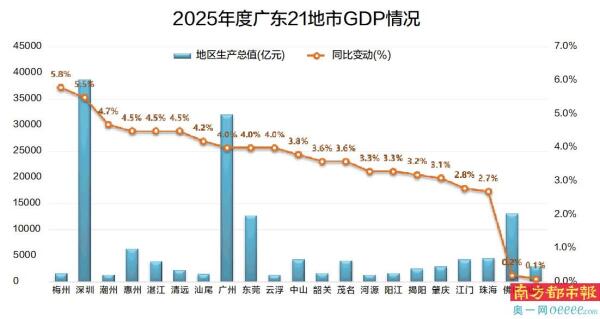
Economic Overview - As of February 5, 2025, all economic data for 21 cities in Guangdong has been released, with Shenzhen leading the province with a GDP of 3.87 trillion yuan [3] - The overall GDP growth rate for Guangdong is 3.9%, with Meizhou leading at 5.8%, followed by Shenzhen at 5.5% and Chaozhou at 4.7% [3] Industrial Growth - Zhanjiang leads the province in industrial added value growth at 10.7%, with Huizhou and Meizhou both at 8.6% [4] - Zhanjiang's industrial sector contributes over 40% to its economic growth, with significant increases in communication equipment and computer manufacturing [4] - Meizhou's industrial added value growth is 8.6%, with notable increases in non-ferrous metal smelting and electronic equipment manufacturing [5] Investment and Consumption - Industrial technological transformation investment in Yangjiang exceeds 60%, with several cities maintaining high investment levels in key and high-tech industries [7] - Guangzhou's retail sales of consumer goods show significant growth, particularly in furniture and communication equipment [8] - The consumption policies, such as trade-in programs, have positively impacted the consumer market across various cities [8] Foreign Trade - Shenzhen's total import and export volume reaches a record high of 4.55 trillion yuan, with exports at 2.74 trillion yuan [9] - Zhaoqing leads the province in export growth at 21.1%, with significant contributions from electromechanical products [10] - Guangzhou's foreign trade also shows strong performance, with a total volume of 1.2 trillion yuan and a 10.4% year-on-year growth [11] Agriculture - Agricultural production remains strong, with cities like Maoming and Zhanjiang exceeding 110 billion yuan in total agricultural output [13] - Zhuhai's agricultural output grows by 6.6%, leading the province, particularly in fisheries [13] - Yangjiang's agricultural output also shows positive growth, with a 6.4% increase [13]
外贸规则适配性持续提升
Jing Ji Ri Bao· 2026-02-05 22:13
Core Viewpoint - The APEC "China Year" has commenced with a focus on enhancing trade and cooperation among member economies, emphasizing the importance of technology and innovation for sustainable growth [1] Group 1: Trade Performance and Growth - In 2025, China's total import and export value with APEC economies reached 26.29 trillion yuan, accounting for 57.82% of the total foreign trade value during the same period [1] - During the "14th Five-Year Plan" period, this figure accumulated to 125.49 trillion yuan, representing a 39.4% increase compared to the "13th Five-Year Plan" [1] - High-tech product exports amounted to 4.63 trillion yuan, with a year-on-year growth of 8.1% [2] Group 2: Regional Cooperation and Supply Chain - China's trade with emerging economies such as ASEAN, Peru, and Mexico is expected to maintain rapid growth [2] - The integration of supply chains has deepened, with enhanced connectivity to ASEAN's railway network, improving regional logistics resilience [2] - The establishment of a high-end manufacturing support system with Japan and South Korea, and infrastructure cooperation with Southeast Asia, is fostering a mutually beneficial regional industrial ecosystem [2] Group 3: New Business Models and Digital Trade - New business models, including cross-border e-commerce and digital trade, are emerging as significant contributors to foreign trade growth [3] - The digitalization of trade documents and the promotion of green trade are driving factors for sustainable growth in foreign trade [3] - The implementation of the upgraded China-ASEAN Free Trade Area 3.0 is facilitating tariff reductions and regulatory coordination [3] Group 4: Customs and Trade Facilitation - The "Smart Customs" partnership program aims to enhance cooperation in areas such as paperless trade, cross-border e-commerce, and green trade [4] - The customs authority is focusing on stabilizing and smoothing supply chains, promoting soft connectivity of rules and standards [4] - The establishment of a "2026 APEC Smart Customs Case Database" is intended to share experiences and foster practical cooperation [4]
广东21地市2025年度经济数据出炉:梅州GDP增速第一
Nan Fang Du Shi Bao· 2026-02-05 11:44
Economic Overview - As of February 5, 2025, all economic data for 21 cities in Guangdong has been released, with Shenzhen leading the province with a GDP of 3.87 trillion yuan [2] - The overall GDP growth rate for the province is 3.9%, with ten cities exceeding this rate, including Meizhou at 5.8%, Shenzhen at 5.5%, and Chaozhou at 4.7% [4] Industrial Growth - Zhanjiang leads the province in industrial added value growth at 10.7%, with Huizhou and Meizhou both at 8.6% [5] - Zhanjiang's industrial sector contributes over 40% to its economic growth, with significant increases in various industries, including a 64.5% growth in communication equipment and a 46.9% growth in printing and media replication [7] - Meizhou's industrial added value growth is 8.6%, with notable increases in non-ferrous metal smelting and processing at 114.2% and electronics manufacturing at 20.9% [8] Investment Trends - Investment in industrial upgrades in cities like Yangjiang, Chaozhou, and Meizhou has exceeded 20%, driven by large-scale equipment renewal policies [10] - Shenzhen's investment in key industries such as information technology services and scientific research has seen significant growth, with increases of 88.3% and 67.7% respectively [12] Trade and Export Performance - Shenzhen's total import and export volume reached a record high of 4.55 trillion yuan, with exports at 2.74 trillion yuan, marking an 8% increase [15] - Zhaoqing leads the province in export growth at 21.1%, with a total trade volume of 46.28 billion yuan [17] - Guangzhou's import and export volume surpassed 1.2 trillion yuan, with exports growing by 17.8%, particularly in electric vehicles and photovoltaic products [18] Agricultural Production - Agricultural production remains strong, with cities like Maoming and Zhanjiang exceeding 110 billion yuan in total agricultural output [19] - Zhuhai's agricultural output grew by 6.6%, leading the province, particularly in fisheries [21]

APEC“中国年”首次高官会在广州启幕,亚太伙伴谈了什么大事?
Xin Lang Cai Jing· 2026-02-04 13:21
Group 1 - The APEC first senior officials' meeting is taking place in Guangzhou, marking the beginning of the "China Year" for APEC, which will last until October 10 [1] - By 2025, China's trade with APEC members is projected to reach 26.29 trillion yuan, accounting for 57.82% of China's total foreign trade, with a 39.4% increase during the 14th Five-Year Plan period [1] - China's trade with emerging APEC members, including ASEAN, Latin America (Peru, Mexico), and Central and Eastern Europe, is growing rapidly, supported by the Belt and Road Initiative [1] Group 2 - In 2025, China's exports of high-tech products to APEC members are expected to reach 4.63 trillion yuan, with a year-on-year growth of 8.1%, including significant increases in lithium-ion batteries, photovoltaic products, and electric vehicles [3] - Imports from APEC members are primarily in energy, agricultural products, semiconductor equipment, and precision instruments, with notable growth in machinery and high-tech products [3] Group 3 - Nearly half of China's exports to APEC members consist of intermediate goods, indicating a stable "China production - APEC assembly - global sales" supply chain, with a shift towards "R&D + manufacturing + services" [5] - The rapid growth of cross-border e-commerce exports and the dual drive of digital and green trade are emerging as new growth points [5] Group 4 - The construction of the Asia-Pacific Free Trade Area is providing long-term institutional guarantees for trade and investment liberalization, with China leveraging APEC to align with international high-standard trade rules [7] - Trade facilitation measures are being upgraded, including the 3.0 version of the China-ASEAN Free Trade Area, which reduces costs through tariff concessions and rule coordination [7] Group 5 - APEC "China Year" is expected to not only boost short-term trade growth but also facilitate the transformation of China's foreign trade from "scale expansion" to "quality improvement," enhancing its core position in the Asia-Pacific industrial chain [8]
视频丨APEC“中国年”正式开启 我国与APEC其他成员市场空间得到不断拓展
Sou Hu Cai Jing· 2026-02-04 10:51
Group 1 - The APEC first senior officials' meeting is taking place in Guangzhou, marking the beginning of the "China Year" for APEC, which will last until October 10 [1] - In the "14th Five-Year Plan" period, China's trade with other APEC members has seen a nearly 40% increase, with total imports and exports reaching 26.29 trillion yuan, accounting for 57.82% of China's total foreign trade [2] - By 2025, China is expanding its market space with APEC members, focusing on new trade opportunities with emerging members such as ASEAN, Latin America, and Central and Eastern Europe [4] Group 2 - China's exports of high-tech products to APEC members reached 4.63 trillion yuan in 2025, reflecting an 8.1% year-on-year growth, with significant increases in lithium-ion batteries, photovoltaic products, and electric vehicles [5] - Imports from APEC members are primarily in energy, agricultural products, semiconductor equipment, and precision instruments, with notable growth in imports of electromechanical products and high-tech products [7] - Nearly half of China's exports to APEC members consist of intermediate goods, indicating a stable "China production - APEC assembly - global sales" supply chain [9] Group 3 - Cross-border e-commerce exports and digital trade are rapidly growing, driven by data flow and green trade initiatives, becoming new growth points for China's trade with APEC members [11] - The construction of the Asia-Pacific Free Trade Area is providing long-term institutional guarantees for trade and investment liberalization, enhancing the adaptability of foreign trade rules [12] - The "China Year" of APEC is expected to facilitate a transition in China's foreign trade from "scale expansion" to "quality improvement," strengthening its core position in the Asia-Pacific industrial chain [14]