
外卖餐食

Search documents
都市评:外卖厨房莫成安全盲区 政府与平台要有针对性监管
Nan Fang Du Shi Bao· 2025-09-17 19:23
Core Insights - The rise of "shared kitchens" or "delivery kitchens" in the food industry has led to significant concerns regarding food safety and fire hazards due to poor operational practices [1][2] - Traditional regulatory methods struggle to keep pace with the dynamic nature of shared kitchens, which host multiple vendors in a single space, necessitating more precise and adaptive oversight mechanisms [1][2] Group 1: Industry Overview - The shared kitchen model allows food vendors to rent small spaces (approximately 10m²) to prepare and deliver meals, significantly lowering the barriers to entry for food entrepreneurship [1] - The lack of transparency in food production processes within these kitchens raises serious concerns about consumer safety, as evidenced by delivery riders' reluctance to order from these establishments [1] Group 2: Regulatory Challenges - Current food safety laws place responsibility on operators, but the shared kitchen model complicates enforcement due to the high turnover and shared facilities among vendors [1][2] - There is a pressing need for immediate reforms and long-term regulatory strategies to ensure that food delivery meets hygiene standards, allowing consumers to feel secure in their choices [2] Group 3: Recommendations for Improvement - Suggestions include the implementation of targeted management regulations, such as a "visible kitchen" initiative and a star rating system for food safety, which could be prerequisites for food business licenses [2] - Delivery platforms must enhance their oversight of vendors, moving beyond profit-driven models to ensure compliance with safety standards, thereby fostering a collaborative governance model among government, platforms, vendors, and consumers [2]
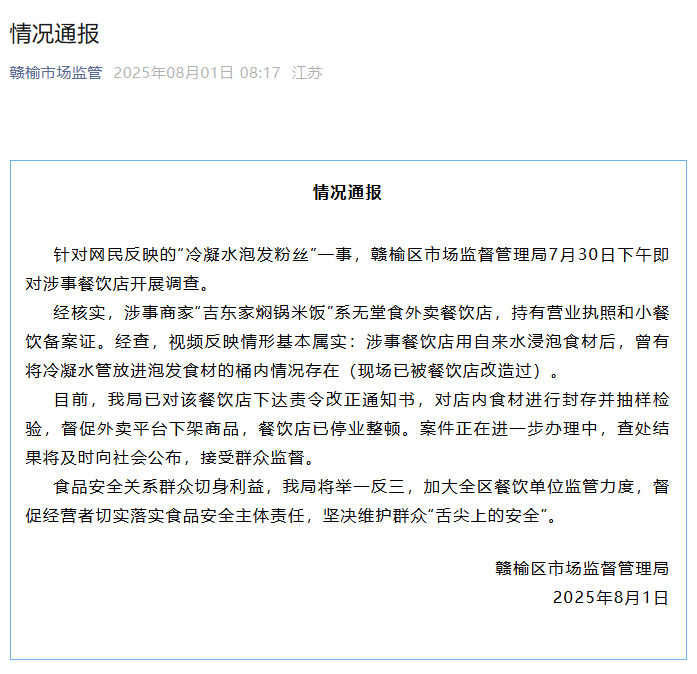
江苏一餐饮店用冷凝水泡发粉丝?官方通报:基本属实,已停业整顿
Xin Jing Bao· 2025-08-01 03:30
Core Viewpoint - The Jiangsu Province Lianyungang City Ganyu District Market Supervision Administration has initiated an investigation into a restaurant following reports of food safety violations involving the use of condensate water to soak ingredients [1] Group 1: Investigation Details - The restaurant "Jidongjia Braised Rice" is identified as a takeout-only establishment with a valid business license and small catering record [1] - The investigation confirmed that the restaurant had previously placed a condensate water pipe into a bucket used for soaking ingredients, although the site has since been modified [1] Group 2: Regulatory Actions - The Market Supervision Administration has issued a corrective notice to the restaurant, sealed the food ingredients, and conducted sampling inspections [1] - The administration has urged the food delivery platform to remove the restaurant's products and has ordered the restaurant to cease operations for rectification [1] Group 3: Future Measures - The Ganyu District Market Supervision Administration plans to enhance regulatory efforts across all local dining establishments to ensure compliance with food safety responsibilities [1] - The administration emphasizes the importance of safeguarding public health and will continue to monitor the situation closely, with results of the investigation to be disclosed to the public [1]

“揭榜挂帅”欲破食品安全困局
Xiao Fei Ri Bao Wang· 2025-07-04 02:43
Core Viewpoint - The article highlights the increasing challenges in food safety due to sophisticated fraud techniques, prompting the introduction of the "Hero List" initiative by the State Administration for Market Regulation to enhance food safety measures and restore consumer trust [1][2]. Group 1: Food Safety Challenges - Recent incidents of food fraud include the detection of poppy shell powder in takeout food and banned substances in popular beverages, indicating a growing trend of deceptive practices in the food industry [1]. - Traditional food safety regulation often falls into a passive cycle where illegal vendors use new chemical substances to evade detection, while regulatory bodies struggle with outdated testing methods [1]. Group 2: "Hero List" Initiative - The "Hero List" initiative aims to address critical issues in food safety by focusing on the detection of adulterated substances and illegal additives, encouraging interdisciplinary collaboration to develop innovative testing methods [1][2]. - This initiative seeks to break down barriers in research and development by inviting diverse teams, including academic labs and private testing organizations, to contribute to food safety solutions [1]. Group 3: Consumer Trust and Market Impact - Food safety anxiety has become a significant factor affecting consumer confidence, with over 60% of consumers checking testing reports before purchasing food and nearly 40% reducing takeout orders due to safety concerns [2]. - The successful application of new testing methods in regulatory practices is expected to rebuild the trust between consumers and the market, ensuring that technological advancements translate into tangible safety assurances for consumers [2]. Group 4: Comprehensive Governance System - To effectively combat food safety issues, a comprehensive governance system encompassing detection, enforcement, punishment, and education is necessary [2]. - Implementing strict penalties for confirmed violations and establishing food safety credit records for companies are essential steps in deterring fraudulent practices [2]. Group 5: Future Expectations - The collaboration between scientific innovation and consumer health needs is anticipated to yield more effective food safety measures, ensuring that every meal reflects both technological integrity and regulatory commitment [3].