
大型储能系统

Search documents
欧洲户储市场跟踪调研
2026-03-26 13:20
Summary of Key Points from Conference Call Records Industry Overview - The European household storage market is shifting from economic arbitrage to energy security strategies, with an expected market growth rate exceeding 30% by 2026 [1] - Distributed energy storage is becoming a necessity due to grid vulnerabilities, negative electricity prices, and virtual power plant (VPP) scheduling [1] - The supply chain is predominantly led by Chinese companies, with a high market share in battery cells, where price and industry reputation are critical competitive factors [1] - Mature markets like the Netherlands are seeing increased demand for energy storage due to the cancellation of net metering subsidies, leading to significant growth in existing solar photovoltaic (PV) installations [1] - Emerging markets in Asia, Africa, and Latin America show substantial potential, driven by zero tariffs in Brazil and urgent needs in Pakistan and Africa [1] Core Insights and Arguments - The recent Middle East conflict has stimulated demand for household storage, similar to the effects of the Russia-Ukraine conflict, as geopolitical events raise energy prices and influence electricity costs [2] - Europe's energy transition from centralized to distributed generation is a long-term trend, with increasing renewable energy proportions leading to greater grid instability [2][3] - The core drivers for household storage have evolved from purely economic considerations to strategic energy security, emphasizing the need for resilience in the face of potential crises [3] - Government policies are crucial in promoting storage installations through subsidies, tax reductions, and low-interest loans, as seen in Australia [2][3] Market Dynamics and Predictions - The growth of the household storage market in Europe is expected to continue, driven by the need for energy independence and the transition to renewable energy sources [3][8] - The competitive landscape in the European household storage market is dominated by Chinese companies, with significant players including Huawei, BYD, and others, while local brands struggle to compete on price [9] - The market is currently cautious regarding inventory strategies due to past experiences with stockpiling during geopolitical tensions, leading to a more measured approach in response to the current Middle East conflict [7] Investment and Financial Considerations - The investment payback period for household storage systems typically ranges from 6 to 8 years, influenced by local electricity prices and household consumption levels [16] - Financial solutions, such as low-interest loans and subsidies, are key catalysts for increasing market penetration [1][5] Emerging Markets and Global Trends - Emerging markets in Asia, Africa, and Latin America are showing significant growth potential for household storage, with governments recognizing the importance of distributed energy storage [10][18] - Countries like Brazil are implementing favorable policies to encourage market development, while regions with unstable electricity supplies, such as parts of Africa, are expected to see explosive growth in storage needs [11][18] Additional Insights - The current European household storage systems typically have capacities between 5 to 10 kWh, with costs influenced by various factors including installation and equipment [14] - The demand for household storage is increasingly driven by existing solar PV users adding storage capabilities, particularly in markets like the Netherlands where net metering policies have changed [17] - The competitive edge in the market is shifting towards price and industry reputation, as product differentiation diminishes [12][13]
2026年储能新品全球首发!150+日程正式公布!
中关村储能产业技术联盟· 2026-03-20 07:17
Core Insights - The 14th Energy Storage International Summit and Exhibition (ESIE 2026) will be held from March 31 to April 3, 2026, at the Capital International Exhibition Center in Beijing, focusing on "Scenario Innovation, Value Reconstruction, and Global Win-Win" [3][20][32] - The event will feature over 800 leading energy storage brands, covering an exhibition area of more than 160,000 square meters, and is expected to attract over 200,000 professional visitors [3][5] - ESIE 2026 will serve as a significant platform for energy storage companies to launch new products, with over 150 new energy storage products set to debut, including solid-state battery systems and AI technology applications [5][6][37] Event Overview - The summit will include a grand opening ceremony, a closed-door leaders' meeting, an academic forum, high-end dialogues, international conferences, and numerous thematic forums and activities [3][5][36] - The event will also feature a global product launch area, where major companies like CATL, Envision, and others will unveil their latest innovations [5][6] Product Launch Highlights - Notable new products include high-capacity energy storage systems, solid-state energy storage systems, and AI-driven solutions [6][7][8] - The focus on solid-state battery systems and AI technology indicates a trend towards advanced energy storage solutions [5][6] Thematic Forums and Discussions - The summit will host various thematic forums, including discussions on advanced energy storage materials, safety standards, and the integration of energy storage with power markets [33][36][38] - The event aims to foster international cooperation and knowledge exchange in the energy storage sector [36][38] Participation and Networking Opportunities - ESIE 2026 will provide numerous networking opportunities for industry professionals, including international business matchmaking sessions and open industry salons [38][36] - The event is designed to facilitate dialogue between energy storage companies and potential investors, enhancing collaboration within the industry [38]





去年外贸创新高 今年还有新王牌 顶压前行 上海实现进出口四点五一万亿元 同比增百分之五点六
Jie Fang Ri Bao· 2026-01-17 03:09
Core Insights - In 2025, Shanghai's foreign trade is projected to reach 4.51 trillion yuan, a year-on-year increase of 5.6%, with imports at 2.49 trillion yuan and exports at 2.02 trillion yuan [1] - Shanghai's foreign trade is expected to achieve historical highs in all three metrics, with a growth of 1 trillion yuan compared to the end of the 13th Five-Year Plan in 2020 [1] - The trade structure shows significant growth in exports to emerging markets, with double-digit growth rates in trade with Africa, India, and ASEAN [1] Trade Performance - Shanghai's foreign trade has shown resilience, with 10 out of 16 districts achieving foreign trade volumes exceeding 100 billion yuan [2] - Notable districts include Pudong, which is advancing the integrated circuit industry, and Songjiang, which capitalized on artificial intelligence opportunities [2] - The export of high-value products such as lithium batteries, LNG vessels, and surgical robots has significantly contributed to Shanghai's export growth [1][2] Product and Market Dynamics - The export of lithium batteries increased by over 30%, while the export of LNG vessels reached 37.87 billion yuan, doubling in growth [1] - Surgical robots saw an impressive export growth rate of 370% [1] - Shanghai's exports include both large-scale equipment with over 70% global market share and popular domestic products [1] Policy and Future Outlook - The customs authority has proposed tax policy recommendations to support the export of intelligent bionic robots and clean robots, which have been adopted in the 2026 tariff adjustment plan [2] - The strong capabilities of China's manufacturing sector and global consumer demand are expected to support stable growth in Shanghai's exports [2] - The emergence of high-value products like large-scale energy storage systems and humanoid robots indicates a promising future for Shanghai's foreign trade [2]
甩掉星星后,万帮能否成功上市
Sou Hu Cai Jing· 2026-01-16 04:08
Core Viewpoint - Wanbang Digital Energy has submitted its prospectus to the Hong Kong Stock Exchange, marking its fourth attempt to go public, this time without its subsidiary Star Charging, which has been sold off to streamline operations [2][8]. Group 1: Company Background and IPO Attempts - Wanbang Digital Energy has previously attempted to go public three times, with the latest effort focusing on the Hong Kong market rather than A-shares [4][6]. - The company initially planned to list in A-shares in 2020 but faced delays and ultimately terminated that plan in mid-2023 [5][6]. - In early 2024, Wanbang aimed to raise approximately $500 million with a valuation of around $5 billion for its IPO in Hong Kong [6][7]. Group 2: Financial Performance - For the fiscal years 2023 and 2024, Wanbang reported revenues of approximately RMB 3.47 billion and RMB 4.18 billion, respectively, with net profits of RMB 492 million and RMB 336 million [12][28]. - The company's gross margin has been declining, from 33.4% in 2023 to 29.2% in 2024, and further down to 24.6% in the first three quarters of 2025 [23][24][28]. - Wanbang's financial reports indicate a concerning trend of increasing revenue without corresponding profit growth, leading to a situation of "increasing revenue but decreasing profit" [25][28]. Group 3: Market Position and Strategy - Wanbang has established a dominant position in the private charging pile market, holding over 90% market share as of September 2024 [15]. - The company has shifted its focus from charging operations to equipment manufacturing, citing the need to streamline operations and improve management efficiency [27]. - Wanbang's revenue from microgrid systems is expected to grow significantly, from 7.6% in 2023 to 19.8% by 2025, indicating a strategic pivot towards new business areas [21][22]. Group 4: Challenges and Future Outlook - Despite the divestment of Star Charging, Wanbang still faces significant challenges, including declining gross margins and reliance on other income sources to maintain profitability [23][30]. - The company has reported a substantial increase in "other income," which has raised concerns about the sustainability of its profit margins [30][32]. - The overall market for microgrid systems is projected to grow rapidly, with estimates suggesting a market size of RMB 10.38 billion by 2030, indicating potential future revenue streams for Wanbang [22].

万帮数字能源:两次折戟A股,上市之路因何辗转六年?
Zhi Tong Cai Jing· 2026-01-15 08:43
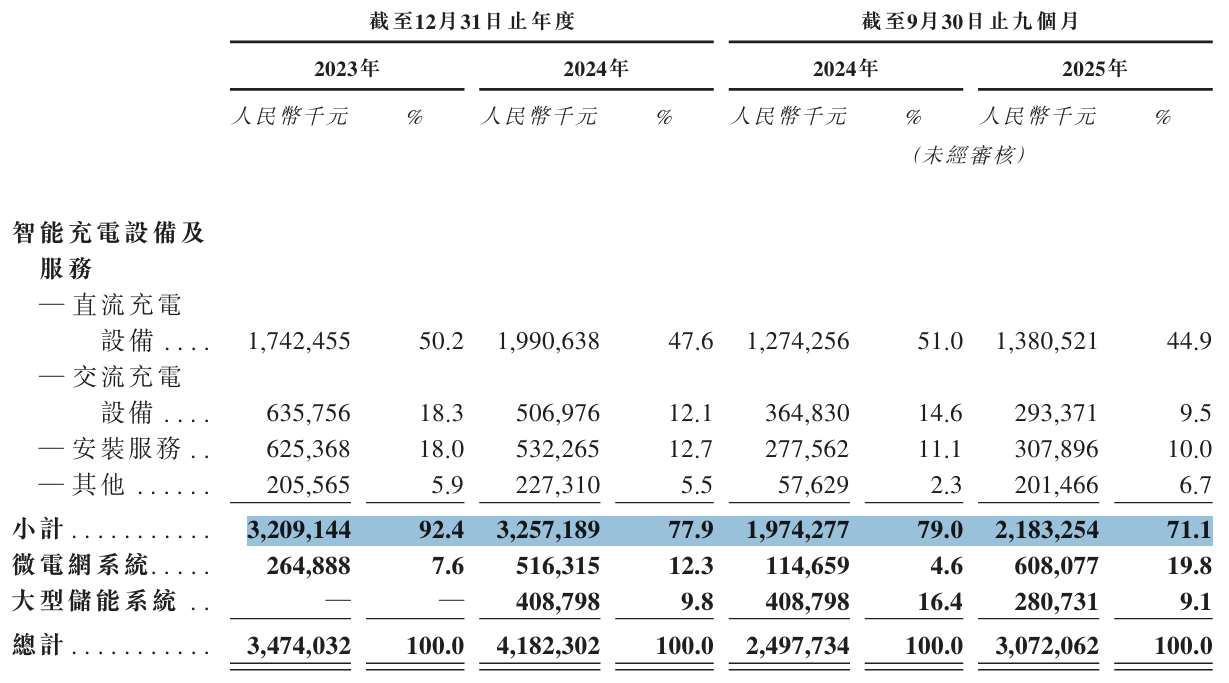
Core Viewpoint - The Chinese automotive market is undergoing a historic shift with the penetration rate of new energy vehicles surpassing 50% for the first time, leading to a transition from a "price war" to a focus on "value" in the industry. This shift is driving significant growth in charging infrastructure, with Wanbang Digital Energy Co., Ltd. preparing for an IPO on the Hong Kong Stock Exchange [1][8]. Company Overview - Wanbang Digital Energy is a leading global supplier of smart charging equipment and an early practitioner of microgrid systems, aiming to create a comprehensive smart energy solution [1][2]. - The company has delivered over 300 microgrid systems across various applications, showcasing its project experience and adaptability [2][3]. Financial Performance - Revenue figures for Wanbang Digital Energy show a steady increase, with approximately 3.474 billion RMB in 2023, 4.182 billion RMB in 2024, and 3.072 billion RMB in the first nine months of 2025, indicating an ongoing optimization of revenue structure [2][3]. - The revenue contribution from smart charging equipment is declining, from 92.4% in 2023 to 71.1% in the first nine months of 2025, while microgrid and energy storage systems are gaining traction [3][6]. Global Expansion - The company has expanded its reach to approximately 70 countries and regions, with overseas revenue reaching 572.9 million RMB in the first nine months of 2025, accounting for 18.6% of total revenue [4][5]. - Europe is a key focus for global strategy, with a joint venture established to promote charging equipment and services, enhancing brand recognition and setting a benchmark for quality [5][8]. Industry Trends - The charging infrastructure industry in China is experiencing rapid expansion, with a target of 28 million charging facilities by the end of 2027, reflecting a 52% year-on-year growth [7][8]. - The global market for charging equipment is projected to grow from 21.41 billion RMB in 2020 to 59.7 billion RMB in 2024, with a compound annual growth rate of 29.2% [8]. Challenges - Despite revenue growth, the company's overall gross margin has declined from 33.4% in 2023 to 24.6% in the first nine months of 2025, primarily due to increased competition, rising raw material costs, and a higher proportion of lower-margin microgrid and energy storage businesses [5][6]. - Net profit has also decreased from 493 million RMB in 2023 to 301 million RMB in the first nine months of 2025, indicating challenges in maintaining profitability amid industry changes [6][9]. Future Outlook - The charging infrastructure industry is expected to continue growing, supported by domestic policies and increasing global demand for charging solutions. Wanbang Digital Energy's IPO is seen as a test of its strategic execution and operational efficiency [9].
新股前瞻|万帮数字能源:两次折戟A股,上市之路因何辗转六年?
智通财经网· 2026-01-15 08:37
Core Viewpoint - The Chinese automotive market is undergoing a historic shift with the penetration rate of new energy vehicles surpassing 50% for the first time, leading to a transition from a "price war" to a focus on "value" in the industry. This shift is driving significant growth in charging infrastructure, with Wanbang Digital Energy Co., Ltd. preparing for an IPO in Hong Kong after previous attempts in the A-share market failed [1][2]. Company Overview - Wanbang Digital Energy is a leading global supplier of smart charging equipment and an early practitioner of microgrid systems, aiming to create a comprehensive smart energy solution [1][2]. - The company has delivered over 300 microgrid systems across various applications, showcasing its project experience and adaptability in promoting renewable energy applications [2][3]. Financial Performance - Revenue from smart charging equipment remains the mainstay but is declining in proportion, from 92.4% in 2023 to 71.1% in the first nine months of 2025. The direct current charging equipment contributed the most, generating 1.381 billion yuan, accounting for 44.9% of total revenue in the first nine months of 2025 [3]. - Microgrid system revenue has significantly increased, reaching 608 million yuan in the first nine months of 2025, representing 19.8% of total revenue, while large-scale energy storage systems contributed 281 million yuan, accounting for 9.1% [3]. - The company's overall revenue for 2023, 2024, and the first nine months of 2025 was approximately 3.474 billion yuan, 4.182 billion yuan, and 3.072 billion yuan, respectively, indicating a continuous optimization of revenue structure [2][3]. Global Expansion - Wanbang Digital Energy has expanded its market presence to approximately 70 countries and regions, with overseas revenue reaching 572.9 million yuan in the first nine months of 2025, accounting for 18.6% of total revenue [4][5]. - The company views Europe as a key market for its global strategy, establishing a joint venture with Schneider Electric to promote charging equipment and services in the region [5]. Industry Trends - The Chinese charging infrastructure industry is experiencing rapid expansion, with a target of 28 million charging facilities by the end of 2027, reflecting a 52% year-on-year growth as of November 2025 [7]. - The global charging equipment market is projected to grow from 21.41 billion yuan in 2020 to 59.7 billion yuan in 2024, with a compound annual growth rate of 29.2% [8]. Challenges - Despite revenue growth, the company's overall gross margin has declined from 33.4% in 2023 to 24.6% in the first nine months of 2025, primarily due to intensified competition, rising raw material costs, and a higher proportion of lower-margin microgrid and energy storage businesses [5][6]. - Net profit has also decreased from 493 million yuan in 2023 to 301 million yuan in the first nine months of 2025, indicating challenges in maintaining profitability amid business expansion and industry pressures [6]. Future Outlook - The charging infrastructure industry is expected to continue growing, supported by domestic policies and increasing global demand. Wanbang Digital Energy's IPO is seen as a test of its strategic execution and operational efficiency [9].
万邦数字港股上市路:应收账款与业务剥离的双重考验
Sou Hu Cai Jing· 2026-01-12 11:34
Group 1 - The core focus of Wanbang Digital Energy Co., Ltd. is its significant accounts receivable of 3.796 billion RMB and the prolonged collection cycle, which have raised concerns among the market and regulators [1][6][10] - The company submitted its listing application to the Hong Kong Stock Exchange on January 4, 2026, with joint sponsors including JPMorgan, Guotai Junan International, and China Merchants International [1] - Wanbang Digital is the largest global supplier of smart charging equipment, with projected sales exceeding 470,000 units in 2024, although the revenue contribution from this segment is gradually declining [2][13] Group 2 - Revenue for the company is expected to grow from 3.474 billion RMB in 2023 to 4.182 billion RMB in 2024, with a net profit of 474 million RMB in 2023, but the net profit margin has decreased from 14.2% to around 8% [4][5] - The gross profit margin for smart charging equipment has dropped from 34% to 26.6%, attributed to increased competition and price wars in the domestic charging pile sector [3][4] - The company has seen a significant increase in trade receivables, which accounted for nearly 60% of current assets, with average turnover days extending to 228.9 days [6][10] Group 3 - Wanbang Digital's business restructuring involved the spin-off of its energy operation business, including the Star Charging brand, to an affiliated company, which has since become one of its top five customers [11] - The company has established a framework for ongoing related transactions with Wanbang Investment Group, with transaction limits set to increase annually from 1.7 billion RMB in 2026 to 2.8 billion RMB in 2028 [11][12] - The microgrid system business is emerging as a growth area, with revenue rising from 264 million RMB to 608 million RMB, representing an increase in its share of total revenue from 7.6% to 19.8% [13] Group 4 - The charging pile industry is heavily reliant on policy support, and the overall growth rate of new energy vehicles is slowing, leading to intensified competition and uncertainty regarding subsidy policies [14] - Wanbang Digital must provide clearer explanations regarding cash flow sustainability, business independence, and profitability pathways to address regulatory scrutiny and market concerns [14] - The company has established a leading position in global smart charging equipment sales and has accumulated advantages in the microgrid segment, but faces substantial challenges in the listing process [14]
两度冲击A股IPO折戟 180亿“独角兽”星星充电母公司“转战”港交所
Zhong Guo Jing Ying Bao· 2026-01-09 02:12
Core Viewpoint - Wanbang Digital Energy is seeking to list on the Hong Kong Stock Exchange after unsuccessful attempts to enter the A-share market, with plans to use the raised funds for operational and R&D center development and global market expansion [1][3]. Group 1: Company Overview - Wanbang Digital Energy, founded in October 2014, is based in Changzhou, Jiangsu, and has evolved into a leading player in the new energy sector, particularly in smart charging equipment [2]. - The company is recognized as the largest global supplier of smart charging devices, with over 470,000 units sold in 2024, and has been valued at 18 billion RMB, ranking 422nd on the Hurun Global Unicorn List [2]. Group 2: Financial Performance - Revenue figures for Wanbang Digital Energy show 3.474 billion RMB in 2023, 4.182 billion RMB in 2024, and 3.072 billion RMB in the first three quarters of 2025, with net profits of 493 million RMB, 336 million RMB, and 301 million RMB respectively [5][6]. - The company reported a significant one-time gain of 195.7 million RMB from asset transfers, which constituted 58.4% of its pre-tax profit for the first three quarters of 2025 [5]. Group 3: Profitability and Margins - Wanbang Digital Energy has experienced a decline in gross margins, with figures of 33.4% in 2023, 29.2% in 2024, and 24.6% in the first three quarters of 2025 [6]. - The gross margin for the smart charging equipment and services segment has also decreased, from 34.0% in 2023 to 26.6% in 2025 [6]. Group 4: Market Strategy and Expansion - The company is focusing on international expansion, with overseas revenue reaching 572.9 million RMB, accounting for 18.6% of total revenue in the first three quarters of 2025 [7][8]. - Wanbang Digital Energy plans to establish regional marketing and service centers in key areas including Africa, the Middle East, Southeast Asia, South America, and North America to enhance its global presence [8]. Group 5: Challenges and Risks - The company acknowledges potential risks associated with its international operations, including government sanctions, export controls, and trade protection measures that could impact its competitiveness and financial performance [9].
万帮数字IPO:上市前夕剥离星星充电甩掉“包袱”?利润下滑32%、负债资产比率近75%、应收款直逼38亿元
Xin Lang Zheng Quan· 2026-01-08 10:21
Core Viewpoint - Wanbang Digital Energy has submitted its listing application to the Hong Kong Stock Exchange, aiming to raise funds for R&D, global market expansion, production capacity enhancement, and working capital supplementation. The company has divested its charging operation business, "Xingxing Charging," to focus on its core manufacturing business amid increasing competition in the electric vehicle charging market [1][2][12]. Financial Performance - Wanbang Digital's revenue for 2023, 2024, and the first three quarters of 2025 were CNY 3.474 billion, CNY 4.182 billion, and CNY 3.072 billion, respectively. However, profits showed a decline, with 2024 profits expected to drop by 32% despite a 20.4% revenue increase, indicating a "growth without profit" scenario [3][6]. - The company's gross profit margin decreased from 33.4% in 2023 to 29.2% in 2024, while the net profit margin fell from 14.2% to 8% during the same period [6][7]. Debt and Cash Flow - The debt-to-asset ratio has been rising, reaching nearly 75%, with accounts receivable nearing CNY 3.8 billion. The company's cash and cash equivalents were reported to be less than CNY 800 million, raising concerns about its ability to meet long-term funding needs for R&D and capacity expansion [8][9][10]. - The net cash flow from operating activities is projected to drop significantly from CNY 1.15 billion in 2023 to CNY 272 million in 2024, a decline of approximately 76% [8]. Market Position and Strategy - The domestic charging pile industry is characterized by intense competition and a lack of high concentration. Wanbang Digital's decision to divest its charging operation is seen as a strategy to streamline operations and focus on the more profitable equipment manufacturing segment [2][12]. - The company aims to present a more focused "technology story" to the capital market, which could potentially lead to a higher valuation and open new financing channels to address its current financial challenges [12].

两次尝试A股上市未果 万帮数字递表港交所
Mei Ri Jing Ji Xin Wen· 2026-01-07 13:12
Core Viewpoint - Wanbang Digital Energy Co., Ltd. has submitted its IPO application to the Hong Kong Stock Exchange, aiming to raise funds for R&D, global market expansion, production capacity enhancement, strategic investments, and working capital [1] Group 1: Company Overview - Wanbang Digital is recognized as the largest supplier of smart charging equipment globally, with projected sales exceeding 470,000 units in 2024 [2] - The company has delivered over 300 microgrid systems across various applications, including charging stations and industrial parks, during the reporting period [2] - The primary revenue source for Wanbang Digital is smart charging equipment and services, which accounted for 92.4%, 77.9%, and 71.1% of total revenue from 2023 to 2025 [2] Group 2: Financial Performance - Wanbang Digital's revenue for the reporting period was 34.74 billion, 41.82 billion, and 30.72 billion, while profits were 4.93 billion, 3.36 billion, and 3.01 billion, indicating a revenue increase of approximately 20.4% in 2024 but a profit decline of 31.74% [3] - The company's gross margin decreased from 33.4% in 2023 to 29.2% in 2024, with a further drop to 24.6% in the first nine months of 2025 [5] - The net cash flow from operating activities significantly declined from 11.5 billion in 2023 to 2.72 billion in 2024, a drop of about 76.38% [3] Group 3: Sales and Distribution - The majority of Wanbang Digital's revenue comes from direct sales, with distributor revenue accounting for only 5.9%, 3.9%, and 5.4% during the reporting period [3] - The average selling price of direct current charging equipment fell to 38,800 yuan per unit in 2024, down 8.92% from 42,600 yuan in 2023, while the average price of microgrid systems dropped by 27.72% [3] Group 4: Related Party Transactions - Wanbang Digital has significant related party transactions, with Jiangsu Wanbang Taiyi Technology Co., Ltd. being one of its top five customers, contributing 2.78 billion, 2.03 billion, and 1.7 billion to total revenue during the reporting period [8] - The company has a large network of 138 distributors, although distributor revenue remains a small portion of total income [3] Group 5: Future Outlook - Wanbang Digital aims to leverage the Hong Kong Stock Exchange for capital acquisition and to enhance its market visibility, having previously terminated plans for an A-share listing [8]