天枢智能系统

Search documents
长安汽车天枢智能:冰面淬炼,锻造“天生安全”的终极好车
Nan Fang Du Shi Bao· 2026-02-10 02:42
Core Insights - Changan Automobile's Tian Shu intelligent system has demonstrated impressive performance in extreme cold conditions, achieving significant milestones in safety and technology [1][8] - The company emphasizes that true safety must withstand the harshest natural tests, showcasing its confidence in the Tian Shu system's capabilities [2] Technical Advancements - The Tian Shu system was rigorously tested in extreme environments, proving its reliability under conditions where traditional technologies might fail [2] - The system's all-domain perception capabilities were optimized for low temperatures, ensuring accurate obstacle detection even in challenging weather [3] Performance Metrics - The Tian Shu system achieved a record speed of 92.3 km/h for lane changes on icy surfaces without deviation, and maintained stability at 95 km/h during a tire blowout [4][8] - The low-temperature endurance rate for the Avita 07 model reached 61.2%, the highest in the industry, addressing a critical issue for electric vehicles [6][8] Safety Innovations - The distributed electric drive system showcased revolutionary control capabilities, allowing for independent torque control at each wheel, enhancing stability during adverse conditions [4] - The intelligent chassis demonstrated full-chain crisis response capabilities, effectively managing low-traction scenarios and optimizing torque distribution for safe navigation [5] Broader Implications - The technology developed for extreme conditions is being adapted for everyday driving scenarios, ensuring that safety features are applicable across various environments [7] - Changan's commitment to safety is reflected in its comprehensive approach to integrating safety technologies from the design phase, rather than as an afterthought [8]

L3级自动驾驶上路,我们离「放手」开车还有多远?
3 6 Ke· 2025-12-30 10:26
Core Insights - The transition from L2 to L3 autonomous driving is not merely a technical upgrade but involves comprehensive challenges related to legal responsibilities, costs, and user trust [1][6][11] Group 1: Policy and Regulation - The Ministry of Industry and Information Technology (MIIT) has approved the first two L3 autonomous driving models in China: Changan Deep Blue SL03 and BAIC Blue Valley Arcfox Alpha S Pioneer Edition, set to be tested under specific conditions by the end of 2025 [2][3] - The L3 level allows for conditional automation where the driver can fully disengage from driving tasks, but responsibility for accidents may be shared between the system and the driver [2][3] - New regulations, such as the Beijing Autonomous Driving Vehicle Regulations, have established accident liability rules, requiring manufacturers to bear product liability and maintain insurance of at least 5 million yuan [3] Group 2: Technical Challenges - Transitioning from L2 to L3 involves a significant shift in responsibility, technology architecture, and business logic, necessitating redundant systems to ensure safety [6][7] - The cost of implementing redundancy in systems, such as steering, can increase significantly, with estimates suggesting costs could rise from 1,500-2,000 yuan to 4,000-6,000 yuan per unit [6][7] - The choice between in-house development and third-party suppliers complicates the responsibility chain in the event of an accident, requiring clearer regulations [7] Group 3: User Experience and Trust - Users have reported issues such as "phantom braking" and hesitation during lane changes, highlighting a gap between marketing promises and actual user experiences [5][8] - Many users express a lack of trust in autonomous systems, often feeling uncertain about when to intervene, which can lead to negative experiences and a reluctance to use the technology [8][11] - Education on the capabilities and limitations of autonomous driving systems is lacking, with few manufacturers incorporating training into the sales process [9][10] Group 4: Recommendations for Improvement - Companies must take responsibility for educating users about autonomous driving, while regulatory bodies should promote clear and understandable guidelines [11] - Enhancing human-vehicle interaction through transparent communication of system intentions can help build trust and improve user experiences [11] - The successful integration of L3 autonomous driving into everyday life requires a collective effort from the industry, regulators, and consumers to foster understanding and trust [11]


出行观|L3级自动驾驶将进入生活,但行业仍需“谨慎乐观”
Guan Cha Zhe Wang· 2025-12-18 23:49
Core Viewpoint - The approval of L3-level conditional autonomous driving vehicles marks a significant milestone in China's autonomous driving technology, transitioning from testing to mass production [2][3] Group 1: Product Approval - The Ministry of Industry and Information Technology approved two models with L3-level conditional autonomous driving capabilities: Changan Automobile's Deep Blue SL03 and BAIC Group's Arcfox Alpha S6 [2] - The Deep Blue SL03 features Changan's self-developed "Tianshu Intelligent" system, while the Arcfox Alpha S6 is equipped with Huawei's QianKun Intelligent Driving ADS system [2] - This approval indicates that L3-level autonomous driving technology is moving from "test tracks" to "mass production" [2] Group 2: Conditional Nature of L3 - L3 is classified as "conditional autonomous driving," meaning the vehicle can perform all driving tasks under specific conditions, but the driver must be ready to take control when requested [4] - The operational limits for these L3 vehicles include specific urban areas, road types, speed limits, and scenarios, as outlined in the Ministry's announcement [4][5] - For instance, the Deep Blue SL03 can operate in congested traffic on highways and urban expressways at a maximum speed of 50 km/h, while the Arcfox Alpha S6 can do so at up to 80 km/h [4] Group 3: Regulatory and Management Framework - The approval of L3 products necessitates the establishment of a management and regulatory framework to address issues such as traffic responsibility, insurance, and policy integration [6] - The process of validating and refining standards, regulations, and policies will be crucial as L3 vehicles are introduced on the roads [6] - This approval is seen as a "constrained advancement," acknowledging technological progress while setting clear operational boundaries for future advancements in autonomous driving [6] Group 4: Future Outlook - A cautious optimism is suggested regarding the impact of L3 product approval on transportation and industry dynamics, emphasizing the importance of not overestimating its current capabilities [7] - The future of autonomous driving in China will depend on both technological capabilities and the patience to progress step by step [7]
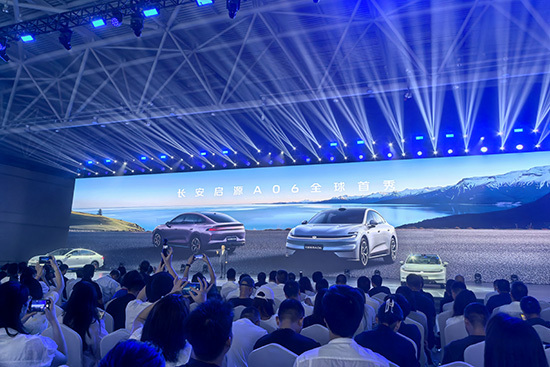
引领新能源家轿价值新风尚,长安启源A06开启全球首秀
Zhong Guo Jing Ji Wang· 2025-09-08 02:35
Core Viewpoint - The automotive industry is undergoing a digital transformation, with users seeking vehicles that offer elegance, spaciousness, technological convenience, and safety. The launch of Changan Automobile's new intelligent brand "Tianshu Intelligent" and the debut of the Changan Qiyuan A06 aims to address these evolving consumer demands [1][3]. Product Launch and Market Positioning - Changan Qiyuan A06, equipped with the Tianshu Intelligent system, is positioned to accelerate the launch of Changan Qiyuan products, showcasing strong competitiveness in its market segment [3]. - Since its establishment in 2023, Changan Qiyuan has introduced high-value products like A07, A05, and Q07, attracting over 300,000 users. In August 2023, Qiyuan's sales reached 37,300 units, nearly doubling year-on-year, significantly contributing to Changan's growth in the new energy sector [3][5]. Technological Innovations - The Qiyuan A06 features three major reconstructions in space design, energy power, and digital experience, achieving over a 10% increase in space utilization through innovative materials and structures [5]. - Charging time has been reduced by 65% compared to 1.6C and by 40% compared to 3C, thanks to the application of new materials like silicon carbide and layered electrode technology [5]. - The vehicle's computing power has increased by 140% through software-driven hardware integration, enhancing the user experience [5][8]. User Experience Enhancements - The Qiyuan A06 boasts a space utilization rate of 90%, with an interior volume of 2,168 liters, accommodating up to 42 pieces of 20-inch luggage. The total trunk capacity is 764 liters, including a front trunk of 108 liters [7]. - It features advanced comfort options such as four-season zero-pressure electric massage seats and a unique 145° electric reclining rear seat, designed to minimize physical strain [7][8]. Safety Features - The vehicle incorporates a "ten horizontal and nine vertical" mixed steel-aluminum safety structure, with high-strength steel and aluminum alloy making up 82.9% of the body [10]. - Enhanced collision safety is achieved through a design that improves energy absorption efficiency by 70%, ensuring the safety of passengers and the battery during impacts [10]. Market Impact - The introduction of the Qiyuan A06 is expected to invigorate the new energy sedan market, demonstrating that family vehicles can effectively combine space, comfort, intelligence, and safety [10].