天然气轮机

Search documents
大摩:AI热潮背后的隐忧,到2028年,美国电力缺口或相当于44座核电站
美股IPO· 2025-11-12 23:34
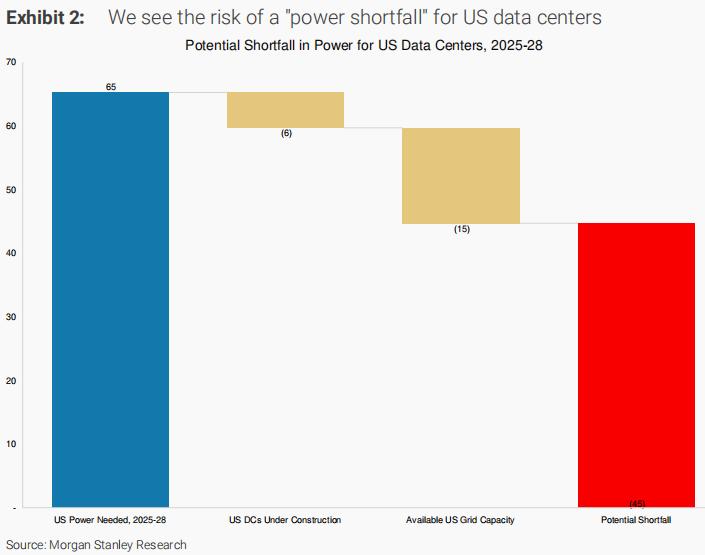
Core Insights - The report from Morgan Stanley highlights a significant increase in electricity demand for data centers in the U.S. driven by the rapid expansion of artificial intelligence (AI) infrastructure, predicting a power shortfall of up to 44 gigawatts (GW) by 2028, equivalent to the output of 44 nuclear power plants [1][3][5] Electricity Demand and Supply - By 2028, total electricity demand from U.S. data centers is expected to reach approximately 69 GW, with 10 GW from data centers under construction and 15 GW accessible through the existing grid, leaving a shortfall of about 44 GW [3][6] - This forecast has been revised upward from a previous estimate of a 36 GW shortfall made in December of the previous year [5] Solutions to Power Shortage - The U.S. Department of Energy is preparing to provide hundreds of billions in financing for nuclear projects to alleviate potential power supply pressures [7] - Morgan Stanley emphasizes that without immediate enhancements to power supply through natural gas turbines, fuel cells, or retrofitting existing facilities, the U.S. may struggle to support the rapid growth of AI infrastructure [7] "Time to Power" Solutions - Morgan Stanley proposes several "Time to Power" solutions to address the electricity shortfall, which could reduce the gap to approximately 20% (13 GW) if fully implemented [8] - The report lists potential solutions, including: - Natural gas turbines (15-20 GW potential) - Bloom Energy fuel cells (5-8 GW potential) - Direct power transactions from existing nuclear plants (5-15 GW potential) - Conversion of existing Bitcoin mining sites (10-15 GW potential) [10][13] Bitcoin Mining Site Transformation - The report highlights the trend of transforming Bitcoin mining sites into high-performance computing (HPC) data centers, with two primary business models emerging: - "New Neocloud" model, where mining companies build data centers and lease computing power to large cloud service providers [14] - "REIT Endgame" model, where mining companies construct infrastructure and sign long-term leases with cloud computing firms [14][15] Valuation Insights - The report provides valuation references for Bitcoin mining sites transitioning to data centers, indicating that larger sites with stable grid access and over 100 MW capacity have varying enterprise value per watt (EV/W) multiples, with lower multiples indicating more attractive conversion opportunities [18]

摩根士丹利:AI让美国的电力资产全被重估了一遍
3 6 Ke· 2025-08-21 08:26
Group 1 - The core viewpoint of the report is that AI-driven infrastructure investment has entered a practical implementation phase, with a revaluation window for related assets now open [1] - The report highlights that GPU deployment has exceeded expectations, and power supply has become the biggest bottleneck for AI infrastructure [1][5] - It predicts that natural gas will serve as the primary transitional energy source, eventually transitioning to nuclear energy [1] Group 2 - The demand for AI infrastructure is surging, with GPU demand consistently surpassing expectations, indicating a structural shortage of AI inference chips [2] - Significant data center construction transactions are expected in states like Texas, Louisiana, Arkansas, and Pennsylvania, primarily utilizing natural gas turbines and fuel cells [3] - Energy Transfer has received connection requests from approximately 200 data centers, signaling a catalyst for scaling AI facilities [4] Group 3 - The report identifies a severe shortfall in available power for AI data centers, estimating a potential shortfall of 45GW to 68GW from 2025 to 2029 [5][7] - To address this power gap, four feasible methods are proposed: repurposing Bitcoin mining sites, deploying data centers near large nuclear plants, constructing new natural gas power plants, and utilizing distributed fuel cells [7] Group 4 - The value of time saved in power solutions is projected to create approximately $500 billion in value over three years, potentially reaching $1.1 trillion by 2030 [8][9] - Companies that can provide power solutions in the next 3-5 years will be positioned at the core of the value reassessment in the AI chain [8] Group 5 - Natural gas suppliers are expected to benefit from long-term premium contracts due to increased demand from AI data centers [13] - New nuclear power, particularly small modular reactors (SMRs), is becoming a strategic focus for major cloud companies to achieve power additionality and decarbonization goals [15] Group 6 - Microgrids are emerging as a critical solution for stable energy supply, allowing essential loads and facilities to operate when the surrounding grid is unavailable [16][18] - Bloom Energy is identified as a key beneficiary in providing microgrid solutions, which are increasingly important in the current energy development landscape [16] Group 7 - A "bridge development" strategy is proposed to address regulatory requirements for additionality, involving the deployment of mobile power solutions before securing grid access [23] - This trend is expected to favor companies that provide mobile power or rapidly deployable generation equipment, such as GE Vernova and Siemens Energy [23] Group 8 - The report concludes that AI investment is entering a realization phase, with the next few years being critical for reshaping the valuation structure of the AI industry due to power supply bottlenecks [24] - Companies with capabilities in early power supply, rapid deployment, and high additionality will directly benefit from valuation increases [24][25]
工业板块“火力全开”!政策红利+AI基建热潮助推下领涨美股
Zhi Tong Cai Jing· 2025-07-30 03:58
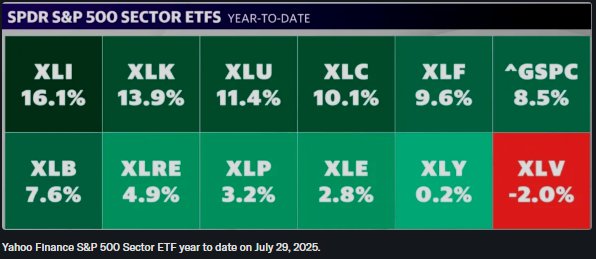
Core Insights - The industrial sector (XLI) has outperformed other sectors in the S&P 500, rising 16% year-to-date, surpassing technology (13%) and utilities (11%) [1][2] - Key drivers of this performance include increased aerospace capacity, AI-driven data center construction, and investments in electrical infrastructure [2][3] Group 1: Industrial Sector Performance - The industrial sector has led the S&P 500 to new highs, with a year-to-date increase of 16.1% [2] - Boeing (BA.US) reported better-than-expected quarterly earnings, with its stock up 28% year-to-date, benefiting from trade policies and significant orders [3] - General Electric Aviation (GE.US) has seen a 60% increase in stock price this year, driven by a surge in overseas engine orders [3] Group 2: Government Policies and Future Outlook - The strong performance of the industrial sector reflects the Trump administration's focus on manufacturing revival through trade and internal incentives, including the recently signed "Big and Beautiful Act" [3] - PNC Asset Management's chief investment strategist believes the fiscal legislation will support the industrial sector's strong performance in the coming quarters [3] - The demand for power in AI data centers and grid upgrades has also boosted stocks of electrical equipment manufacturers, with General Electric Energy (GEV.US) seeing a 90% increase in stock price year-to-date [3] Group 3: Technology Sector Investments - Major tech companies like Meta (META.US), Microsoft (MSFT.US), Amazon (AMZN.US), and Alphabet (GOOGL.US) are expected to spend a total of $325 billion by 2025 on AI infrastructure [4] - The rapid construction of data centers is significantly influenced by the prosperity of the industrial sector [4]