天翼AI手机

Search documents
携手三星电子 中国电信深耕定制机市场
Zhong Guo Jing Ying Bao· 2025-10-13 14:24
Core Insights - China Telecom and Samsung Electronics have launched the W26 smartphone, marking the 18th generation of their "Heart of the World" series since 2008, targeting high-end business users [2][4] - The customized smartphone market is limited, with operator channel shipments expected to reach 9.9 million units in the first half of 2025, accounting for 7.2% of the overall smartphone market in mainland China [2] - The trend of decreasing customized phones is driven by the popularity of all-network and dual-SIM technologies, leading to higher demands for flexibility and choice among consumers [2][5] Product Features - The W26 supports satellite communication, features a 200-megapixel wide-angle main camera, and weighs only 215 grams, along with AI experiences like "Instant Briefing" and "Meeting Assistant" [2] - The device is equipped with Samsung's One UI 8 and a multi-modal AI assistant, Bixby, which can execute complex voice commands and summarize documents [3] - The pricing for the W26 is set at 16,999 yuan for the 16GB+512GB version and 18,999 yuan for the 16GB+1TB version [4] Market Dynamics - The customized smartphone market has seen a shift from operator-exclusive models to all-network models combined with operator subsidy packages, indicating a need for deeper collaboration between manufacturers and operators [7][8] - The introduction of AI capabilities in customized phones is seen as a way to accelerate the development of new business opportunities, although the overall market remains small [6][7] - The W series, particularly with its unique design and exclusive user interface, aims to attract high-end business users while showcasing the need for innovative cooperation between telecom operators and smartphone manufacturers [8]


165.81亿元!这一央企巨头拟大手笔分红
Zheng Quan Ri Bao Zhi Sheng· 2025-08-14 13:19
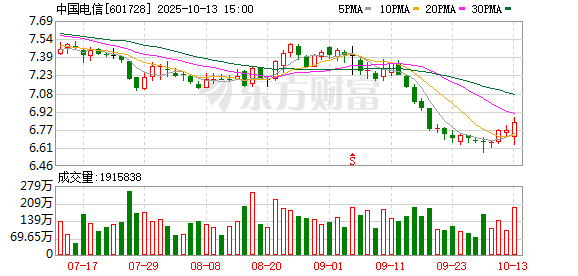
Group 1 - The core viewpoint of the news is that China Telecom reported a revenue increase of 1.3% year-on-year for the first half of 2025, reaching 269.42 billion yuan, and a net profit increase of 5.5%, amounting to 23.017 billion yuan [1] - The company plans to distribute a cash dividend of 0.1812 yuan per share, totaling 16.581 billion yuan, which represents 72% of the net profit attributable to shareholders during the reporting period [1] - Mobile communication service revenue was 106.6 billion yuan, showing a year-on-year growth of 1.3%, while broadband and smart home service revenue reached 64.1 billion yuan, growing by 0.2% [1] Group 2 - The number of mobile users reached 433 million, and broadband users totaled 199 million, with an ARPU of 46.0 yuan for mobile users and 48.3 yuan for broadband [1] - The company achieved industrial digitalization revenue of 74.9 billion yuan, with AIDC revenue growing by 7.4% [1] - Key product revenues showed significant growth, with Tianyi Cloud revenue at 57.3 billion yuan, smart revenue at 6.3 billion yuan (up 89.4%), security revenue at 9.1 billion yuan (up 18.2%), and satellite revenue increasing by 20.5% [1] Group 3 - China Telecom is focusing on the implementation of a cloud transformation strategy, enhancing innovation-driven development, and promoting the integration of basic and digital business [3] - The company is advancing its "AI+" initiative, which includes the development of over 160 AI applications across various sectors to improve efficiency and reduce costs [2] - Capital expenditures for the first half of the year totaled 34.2 billion yuan, with investments in mobile networks and industrial digitalization at 12.1 billion yuan and 11.6 billion yuan, respectively [2]
运营商增长“熄火”? 华为MWC现场献计:盯紧骑手和主播!
Xin Lang Ke Ji· 2025-06-19 00:18
Core Insights - The annual MWC Shanghai highlighted the telecom industry's shift towards AI and large models, with 5G taking a backseat as operators face growth challenges [2] - The three major telecom operators reported low growth in Q1, indicating a saturation in demand and a need for new growth narratives [2][3][4] Group 1: Financial Performance - China Mobile reported Q1 revenue of 263.8 billion yuan, a slight increase of 0.02% year-on-year, with a net profit of 30.6 billion yuan, up 3.5% [2] - China Telecom's Q1 revenue was 134.5 billion yuan, showing a year-on-year increase of 0.01%, with a net profit of 8.9 billion yuan, up 3.1% [3] - China Unicom achieved Q1 revenue of 103.35 billion yuan, a year-on-year growth of 3.88%, with a net profit of 2.61 billion yuan, up 6.5% [4] Group 2: Growth Strategies - Huawei's rotating chairman Xu Zhijun emphasized the importance of identifying new growth demands, particularly from high-value user groups like delivery riders and live streamers, whose ARPU is significantly higher than average users [2][6] - The global number of delivery riders is expected to reach 160 million by 2030, with their ARPU being 1.6 times that of ordinary users; professional live streamers are projected to reach 130 million, with an ARPU four times higher [6] - Other strategies include enhancing high-definition video traffic, capitalizing on smart connected vehicles, and connecting individual businesses through FTTR technology [6] Group 3: AI and Robotics - The telecom operators are focusing on AI as a new narrative, with China Mobile's chairman stating that the industry is entering the AI+ era, where AI capabilities are reaching or exceeding human levels [2][10] - China Unicom launched the U PLUS SMART product system, integrating AI into various applications, while China Telecom showcased AI applications like the Tianyi AI phone and AI cloud computer [10][11] - Several robotics companies, including Yushu Technology and Leju Robotics, showcased their innovations at the event, highlighting the potential of AI in robotics for various applications [13][15]