太阳能制造设备

Search documents
9月出口增长超预期!美国的关税,已经快成笑话了
Sou Hu Cai Jing· 2025-10-26 11:32
Core Viewpoint - Despite facing U.S. tariffs, China's export growth accelerated in September, with a year-on-year increase of 8.3%, surpassing the 4.4% growth in August and exceeding expert predictions of 6% [1][3]. Group 1: Export Performance - China's exports to the U.S. have been declining since the imposition of tariffs by the Trump administration, which began several years ago [3][4]. - Exports to Asia, Africa, and Latin America are increasing, offsetting the impact of U.S. tariffs [3][4]. - In 2024, China's trade with RCEP member countries is projected to reach 13.16 trillion yuan, a year-on-year increase of 4.5%, maintaining over 30% of China's total trade [3][4]. Group 2: Strategic Response - China's export performance is attributed to a diversified export strategy, with ASEAN becoming the largest trading partner, surpassing the U.S. market [3][4]. - The implementation of the RCEP has provided new momentum for China's exports [3][4]. - Companies are adapting to tariffs through supply chain adjustments and diversification, as exemplified by BYD's overseas sales reaching 470,000 units in the first half of 2025, particularly in Europe [4][6]. Group 3: U.S. Tariff Impact - The effectiveness of U.S. tariffs has been lower than expected, with tariff revenue for the U.S. in fiscal year 2025 projected at $122 billion, only 6.5% of the predicted deficit [6]. - The U.S. has had to grant tariff exemptions on certain products, highlighting the contradictions in its tariff strategy [6]. - As China's export resilience continues to grow, the marginal benefits of U.S. tariffs are diminishing, making them increasingly ineffective [6][8].


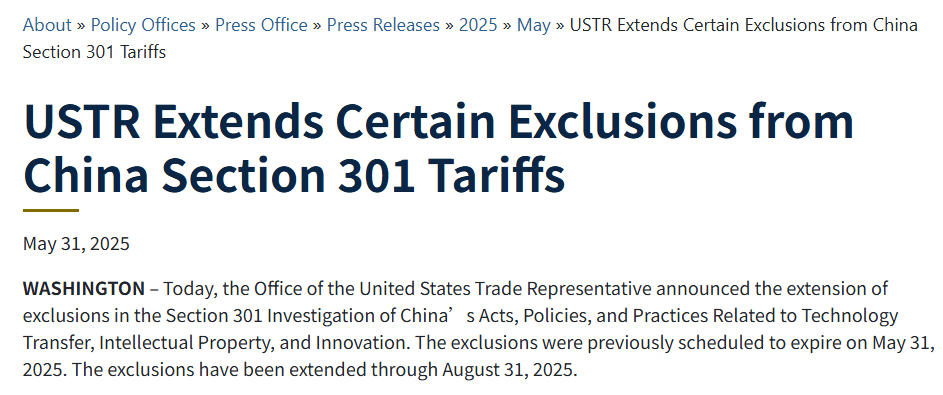
11月29日到期!美国对华301调查关税豁免评估启动!
Xin Lang Cai Jing· 2025-09-17 13:30
Core Viewpoint - The U.S. Trade Representative (USTR) is seeking public comments on whether to extend tariff exemptions for 178 items, including 14 specific solar manufacturing equipment exemptions, beyond November 29, 2025 [1][2]. Group 1: Exemption Details - The 14 solar-related exemptions are part of the USTR's four-year review of the Section 301 investigation against China, initially set to be effective from January 1, 2024, to May 31, 2025 [2]. - These exemptions include equipment such as silicon growth furnaces, multicrystalline silicon casting furnaces, silicon wafer cutting machines, and diamond wire saws [2]. - The exemptions were previously extended to August 31, 2025, and then further to November 29, 2025, forming a total of 178 exemptions (164 regular exemptions + 14 solar equipment exemptions) [2]. Group 2: Public Comment Process - The public comment period is open from September 16, 2025, to October 16, 2025, where companies and industry associations can submit written opinions [3]. - USTR will evaluate the exemptions based on four core dimensions, including the availability of solar manufacturing equipment from non-Chinese sources and the efforts made by companies to source equipment from the U.S. or third countries [3]. - The evaluation will also consider the potential impact of extending the exemptions on U.S. interests and the broader goal of addressing the issues identified in the Section 301 investigation against China [3]. Group 3: Industry Implications - The extension of the 14 solar manufacturing equipment exemptions is crucial for the U.S. solar industry, as the expiration without extension would impose additional tariffs on imports from China, increasing production costs [4]. - Industry representatives express concerns about the stability and pricing of equipment sourced from non-Chinese regions, indicating that an extension would provide more time to adjust supply chains [4]. - The outcome of the public comment process will serve as an important indicator of the U.S. trade policy direction regarding solar equipment from China, with potential implications for the pace of domestic solar capacity expansion [4].
突发!美国宣布关税豁免延长
Sou Hu Cai Jing· 2025-06-03 01:39
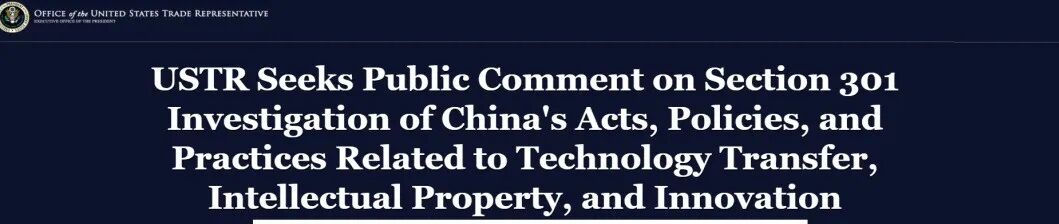
Core Points - The U.S. Trade Representative's Office announced an extension of the tariff exemption period for certain products related to China's technology transfer, intellectual property, and innovation practices from May 31, 2025, to August 31, 2025 [1][3] Group 1: Tariff Exemption Extension - The extension of the tariff exemption is based on public feedback received by December 29, 2023, and ongoing evaluations during the four-year review process [3] - A total of 164 items from Attachment A and 14 items from Attachment B will have their exemptions extended for an additional three months [3] - The exemption applies to products listed in Attachments A and B, including chemical materials, electronic components, medical supplies, solar manufacturing equipment, and wafer handling equipment [4] Group 2: Historical Context and Economic Impact - Historical data indicates that during the Trump administration, four rounds of "301 tariffs" were imposed on China, with the first three rounds having a 25% increase and the fourth round at 7.5% [3] - The average weighted tariff rate on Chinese imports was 19.3% at the beginning of 2020, but is projected to decrease to 10.7% by the end of 2024 due to changes in export proportions and product categories [3] - The U.S. has faced criticism for its unilateral and protectionist measures, which have been deemed to disrupt international trade order and supply chain stability [4] Group 3: New Investigations and Responses - On April 17, the U.S. Trade Representative's Office initiated a 301 investigation into China's maritime, logistics, and shipbuilding industries, which has been met with strong opposition from China [5] - China's Ministry of Commerce criticized the U.S. for misrepresenting normal trade activities as threats to national security and for blaming its own industrial issues on China [5] - The Chinese government has urged the U.S. to respect facts and multilateral rules, calling for a return to a rules-based multilateral trading system [5]