套利策略

Search documents
为什么你的配置,抗不住一场危机?
雪球· 2026-03-24 09:06
Core Viewpoint - The article emphasizes the importance of asset allocation in investment, highlighting that a diversified portfolio is essential for managing risk and achieving stable returns [4][14]. Group 1: Asset Allocation Concept - Asset allocation is likened to assembling a high-performance "off-road vehicle" composed of various components such as domestic stocks, foreign stocks, bonds, and gold [6][7]. - The relationship between different asset classes allows for a balanced approach, where declines in one area can be offset by gains in another, leading to a more stable wealth accumulation [9][10]. Group 2: Common Misconceptions - A common misconception is that simply holding a mix of assets constitutes proper asset allocation; however, true allocation requires a scientific approach that leverages the low correlation between assets [12][14]. Group 3: Key Components of Asset Allocation - The three core components of a well-structured portfolio are: 1. **Engine**: Represents aggressive assets like long positions in stocks and certain commodities, which are crucial for capturing industry profits and driving overall account performance [18][20]. 2. **Chassis**: Comprises stable assets such as bonds and arbitrage strategies, providing low volatility and steady returns, acting as a ballast for the portfolio [22][24]. 3. **Safety Airbag**: Includes assets like gold and CTA strategies that offer protection during market crises, often rising in value when traditional markets decline [26][28]. Group 4: Personalization of Investment Strategy - Despite achieving diversification and low correlation, many investors still experience poor outcomes because their portfolio may not align with their individual risk tolerance and investment goals [32][34]. - Understanding one's risk preference is crucial for tailoring a personalized investment strategy, as there is no perfect asset that offers low risk and high returns [34][39].


小盘风格继续演绎,资产配置如何调整
私募排排网· 2026-03-13 07:00
Core Viewpoint - The current market exhibits significant structural characteristics, with a strong small-cap style persisting for some time, while discussions about the sustainability of this style have intensified as index valuations rise. A more pragmatic question is how to construct a strategy that performs well across different style phases [2]. Group 1: Market Analysis - The market has shown that small-cap stocks often outperform large-cap stocks due to risk premiums associated with scale effects over the past decade [6]. - The cumulative return trend of small-cap versus large-cap styles has been analyzed using the CSI 300 Index and the Guozheng 2000 Index, with the latter capturing a broader and more growth-oriented small-cap style [2][5]. - Since 2013, small-cap stocks have entered a strong performance phase, while large-cap stocks gained strength due to macro factors like the "beautiful 50" narrative, trade wars, and the pandemic [8]. Group 2: Strategy Performance - From 2017 to 2020, the CSI 500 Index enhancement strategy slightly outperformed the CSI 300 Index enhancement strategy, achieving a return of 80.78% compared to 75.07% [10]. - In 2018, during a broad market downturn, strategies like CTA, arbitrage, and bond strategies generated positive returns, effectively hedging some risks associated with equity exposure [11]. - The analysis suggests that after a bull market in 2025, investors may consider rebalancing their portfolios, incorporating strategies like CSI 500 enhancement, CTA, arbitrage, and bond strategies to reduce future volatility [11].

多元配置 打造财富稳健增长工具
Zhong Guo Zheng Quan Bao· 2025-10-19 20:13
Core Insights - The value of FOF (Fund of Funds) allocation strategies is being reinforced in the current market environment, with a rapid increase in its share among high-net-worth clients' asset allocations [1][2] - The FOF strategy is expected to become a mainstream asset allocation tool in the domestic market, driven by a large fund product market, long-term capital inflows, and improved investor awareness [2][3] FOF Development Potential - The demand for wealth management is shifting from "single appreciation" to "stable diversification," making FOF strategies increasingly attractive due to their multi-asset and multi-strategy advantages [1][2] - The domestic market has a rich base asset pool, with non-monetary public fund scale exceeding 22 trillion yuan and private fund scale exceeding 12 trillion yuan [2] Multi-Dimensional Allocation Framework - FOF strategies require investors to set target volatility based on their risk tolerance, forming a three-layer framework of "macro direction, mid-level strategy selection, and micro fund selection" [3] - The FOF strategy allows for diversified asset allocation and strategy dispersion, mitigating extreme risks from single assets while capturing multi-dimensional returns [2][3] Risk Control Mechanism - The core of FOF risk control lies in "double dispersion," which provides a more robust safeguard compared to traditional funds that only diversify single asset risks [4][5] - The first layer of dispersion involves diversifying underlying fund assets, while the second layer focuses on diversifying strategies and managers to avoid "same-source risk" [5] Future Outlook - The potential for FOF products in the domestic market is significant, with expectations for the introduction of quantitative and hedging strategies to enhance risk-return profiles and product attractiveness [5]
报!私募山庄惊现七把绝世神兵
雪球· 2025-09-19 08:37
Core Viewpoint - The article presents a metaphorical exploration of various investment strategies in the private equity space, likening them to legendary weapons, each with unique strengths and weaknesses, suitable for different market conditions and investor preferences [2][6]. Group 1: Investment Strategies - The first strategy, "Qinglong Yanyue Dao" (Subjective Long), relies heavily on the fund manager's ability to select stocks and time the market, performing well in bullish markets with clear themes [9][10][15]. - The second strategy, "Xuedizi" (Quantitative Long), utilizes complex algorithms to identify stocks based on specific metrics, excelling in active markets with high trading volumes [18][20][23]. - The third strategy, "Zhuge Lian" (Macro Hedging), involves top-down asset allocation across stocks, bonds, and commodities, generally effective in diverse market conditions but can fail during extreme events [26][30][31]. - The fourth strategy, "Fang Tian Hua Ji" (CTA Strategy), focuses on futures markets, capturing trends regardless of price direction, suitable for markets with significant price movements [33][35][39]. - The fifth strategy, "Taiji Shuang Jian" (Market Neutral), aims to generate absolute returns by hedging market risks, effective in bear and volatile markets but may underperform in bull markets [41][45][48]. - The sixth strategy, "Ruan Wei Jia" (Fixed Income +), combines high-quality bonds with a small allocation to riskier assets, providing stability but vulnerable to rising interest rates [50][53][56]. - The seventh strategy, "Xiu Hua Zhen" (Arbitrage), exploits price discrepancies across markets, generating small but cumulative profits, effective in volatile conditions but reliant on market efficiency [58][61][63]. Group 2: Strategy Suitability - Each strategy is designed for specific market conditions, with subjective long strategies thriving in bullish environments, while quantitative strategies excel in active trading scenarios [15][23]. - Macro hedging strategies are versatile but can falter during extreme market events, while CTA strategies benefit from significant price trends [31][39]. - Market neutral strategies provide a buffer against market downturns, whereas fixed income plus strategies are contingent on interest rate movements [48][56]. - Arbitrage strategies are most effective in volatile markets but depend on the quick correction of price discrepancies [63]. Group 3: Conclusion - The article concludes by encouraging investors to choose strategies that align with their risk preferences, highlighting the importance of understanding each strategy's unique attributes and market applicability [67][69].

小众“宝藏”策略揭秘!博润银泰入围套利榜!钧富投资亮相期权榜
Sou Hu Cai Jing· 2025-06-30 06:46
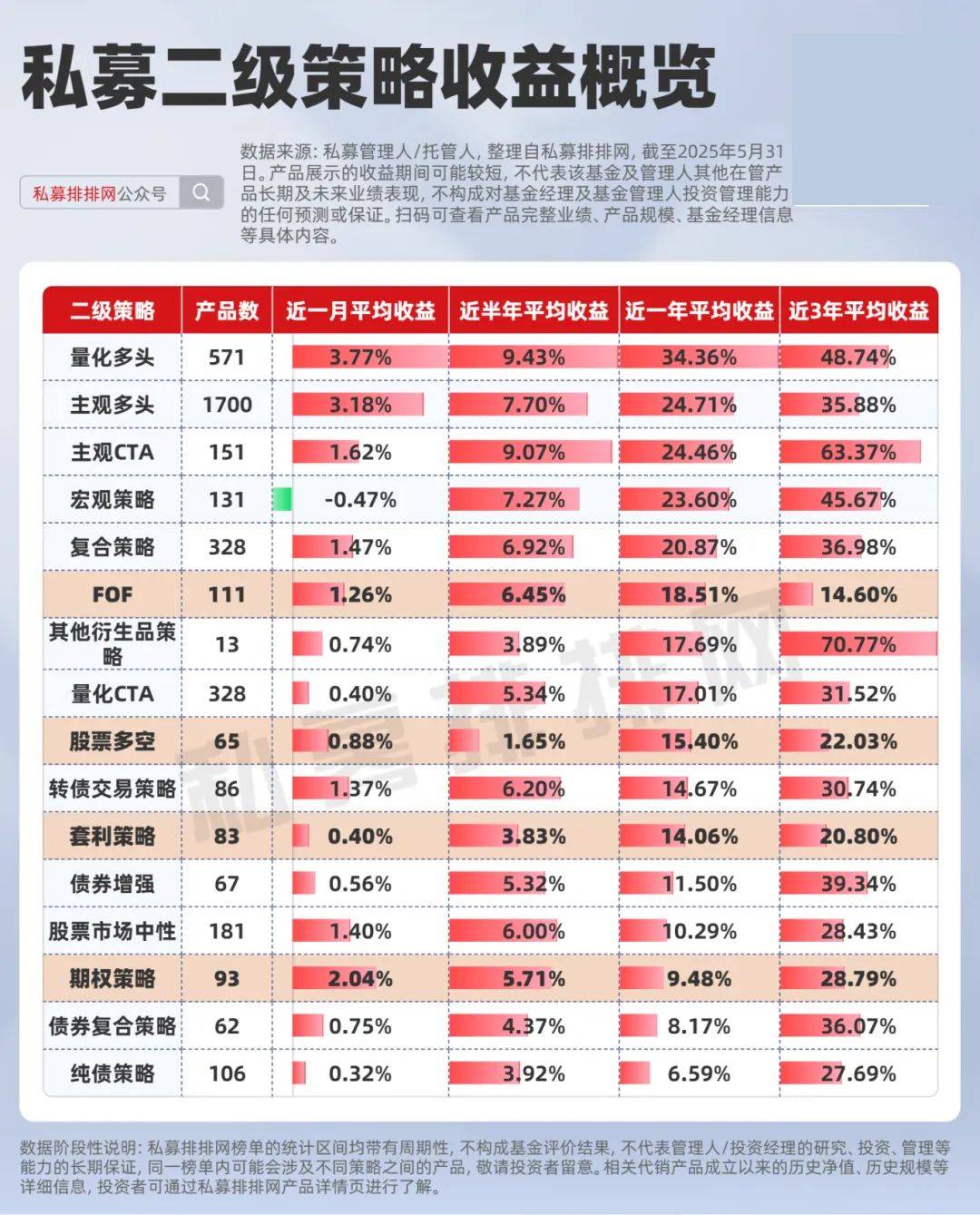
Group 1: Core Insights - The article highlights lesser-known investment strategies such as FOF, long-short equity, arbitrage, and options strategies, which have shown promising performance over the past year [1] - It aims to provide investors with a comprehensive overview of these strategies and their recent performance metrics [1] Group 2: FOF Strategy - FOF (Fund of Funds) is designed to invest in other investment funds, helping investors navigate the challenge of selecting from thousands of funds [3] - As of the end of May, there were 111 FOF products with an average one-year return of 18.51%, ranking them in the upper-middle tier among secondary strategies [3] - The recent performance metrics for FOF include average returns of 1.26% over the last month, 6.45% over the last six months, and 14.60% over the last three years [3] Group 3: Long-Short Equity Strategy - The long-short equity strategy has shown a one-year average return of 15.40%, with 65 products reported as of the end of May [6] - This strategy aims to hedge risks and achieve returns in various market conditions, outperforming major indices like the CSI 300 [6] - Notable products in this category include "奇点多元策略1号" from 共青城奇点, which achieved significant returns [6][7] Group 4: Arbitrage Strategy - The arbitrage strategy, which exploits price differences across markets, has 83 products with an average one-year return of 14.06% [9] - Recent performance metrics include average returns of 0.40% over the last month, 3.83% over the last six months, and 20.80% over the last three years [9] - Leading products in this category include "安合融信匠人匠心10号" from 安合融信, which ranks first in returns [10] Group 5: Options Strategy - The options strategy has gained traction in the domestic market, with 93 products reporting an average one-year return of 9.48% [12] - This strategy utilizes options and their combinations to navigate complex market environments [12] - The top-performing product in this category is "汇誉欣欣向荣一号A类份额" from 云南汇誉, which has significantly outperformed others [12][13]
小众“宝藏”策略揭秘!套利、期权、股票多空谁更强?博润银泰、钧富投资等亮相!
私募排排网· 2025-06-25 01:45
Core Viewpoint - The article introduces lesser-known investment strategies such as FOF, long-short equity, arbitrage, and options strategies, highlighting their performance over the past year and providing insights for investors [2]. FOF Strategy - FOF (Fund of Funds) is designed to invest in other investment funds, helping investors navigate the challenge of selecting from thousands of funds [5]. - As of May 31, there are 111 FOF products with an average return of 18.51% over the past year, ranking in the upper-middle tier among secondary strategies [5]. - The top-performing FOF products include "老友天玑一号" from Shanghai Taiying, which achieved significant returns [4][11]. Long-Short Equity Strategy - The long-short equity strategy holds both long and short positions to hedge risks and achieve returns in various market conditions [12]. - There are 65 long-short equity products with an average return of 15.40% over the past year, outperforming major indices like the CSI 300 [12]. - Notable products include "奇点多元策略1号" from 共青城奇点, which has shown rapid growth since the market rally [12][18]. Arbitrage Strategy - Arbitrage strategies exploit price differences across markets for low-risk profits and include various forms such as ETF arbitrage and statistical arbitrage [19]. - There are 83 arbitrage products with an average return of 14.06% over the past year, slightly lower than FOF and long-short strategies [19]. - Top products include "安合融信匠人匠心10号" from 安合融信, which ranks first in returns [21]. Options Strategy - Options strategies utilize options and their combinations to navigate complex market environments [24]. - There are 93 options products with an average return of 9.48% over the past year, ranking lower among secondary strategies [24]. - The leading product is "汇誉欣欣向荣一号A类份额" from 云南汇誉基金, which significantly outperformed others [28].