
宝贝成长卡

Search documents
存压岁钱给高息,银行打响儿童账户争夺战
阿尔法工场研究院· 2026-03-02 11:32
Core Viewpoint - The article discusses the rising trend of children's financial products in banks, driven by the management of "lucky money" received during the Chinese New Year, with banks competing to attract families through high-interest savings accounts for children [5][6]. Group 1: Market Dynamics - A competition among banks for "children's accounts" is intensifying, with various financial institutions launching specialized products aimed at this niche market [6][8]. - Banks are offering competitive interest rates on children's savings accounts, often higher than traditional savings products, to attract families [8][12]. Group 2: Product Offerings - The products include children's savings accounts, parent-child joint accounts, and customized savings certificates for lucky money, characterized by low minimum deposit requirements and no associated fees [8][9]. - For example, Beijing Rural Commercial Bank's "Sunshine Baby Card" offers a 1.6% interest rate for a two-year term with a minimum deposit of 1,000 yuan, surpassing the 1.5% rate of a 200,000 yuan large deposit certificate [8][10]. Group 3: Strategic Importance for Banks - The management of small amounts of lucky money is significant for banks as it represents a strategic move to enhance retail business and expand customer segments amid pressure on net interest margins [12][14]. - Retail asset management (AUM) is a crucial growth indicator for banks, with major banks reporting substantial retail AUM figures, indicating a shift towards retail banking as a key profit source [13]. Group 4: Long-term Customer Engagement - Children's financial products are seen as a way to lock in future customers, with banks aiming to build long-term relationships with families through these accounts [14][17]. - The focus is on creating a comprehensive ecosystem that includes financial education and ongoing engagement, rather than just one-time customer acquisition [16][17].

货币探秘启财商 宝贝成长卡引“存钱热”
Jiang Nan Shi Bao· 2026-02-27 04:18
Group 1 - The core idea of the news is the collaboration between Industrial and Commercial Bank of China (ICBC) and local R media to enhance financial literacy among youth through engaging activities [1][2] - ICBC successfully held the first "Exploring the Secrets of Currency" financial theme practice activity for young reporters, combining fun experiences with professional explanations to initiate financial education [1] - The activity covered the evolution of currency from ancient forms to modern anti-counterfeiting techniques, helping children build a foundational understanding of money [1] Group 2 - A highlight of the event was the introduction of the "Baby Growth Card," a specialized bank card designed for children that includes savings and financial management features [2] - The card offers unique products like "Baby Piggy Bank" and "ICBC New Year Money," catering to children's specific financial needs and promoting savings habits [2] - ICBC aims to deepen collaboration with R media to leverage the influence of young reporters, embedding the Baby Growth Card into various educational and financial service scenarios to enhance customer acquisition [2]

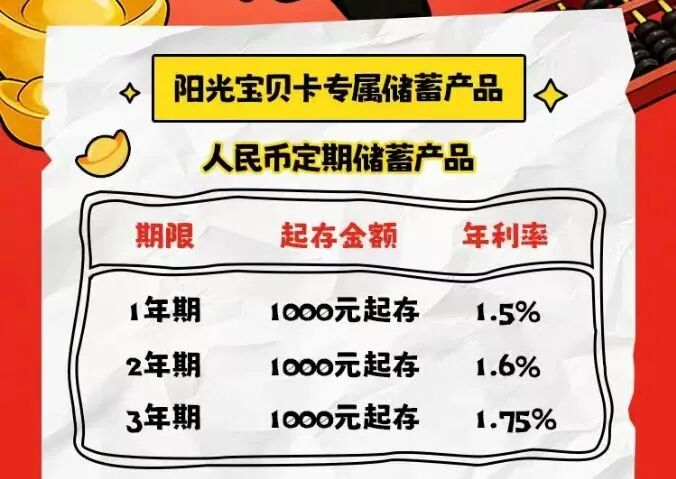
各大银行盯上了压岁钱:孩子存1000元,比你存20万利息高
Mei Ri Jing Ji Xin Wen· 2026-02-27 00:26
Core Insights - The article discusses the emerging trend of banks offering higher interest rates on children's savings accounts compared to traditional adult deposit products, indicating a strategic shift in the banking sector towards targeting the youth market [1][2][3]. Group 1: Interest Rate Dynamics - Beijing Rural Commercial Bank's "Sunshine Baby Card" offers a three-year interest rate of 1.75%, surpassing both the bank's standard fixed deposit rates and high-value time deposit rates [1][2]. - This "interest rate inversion" phenomenon, where children's small deposits yield higher rates than adult large deposits, is becoming a common strategy among banks to attract young customers [2][3]. Group 2: Strategic Implications - Industry experts suggest that this trend represents a long-term investment in customer lifetime value, as banks aim to establish emotional connections with young clients who will have a financial lifecycle of 50 to 60 years [3][7]. - The strategy allows banks to optimize their liability structure and manage liquidity more effectively, as children's savings typically have long retention periods and lower transaction frequencies [3][7]. Group 3: Product Offerings and Market Segmentation - Different types of banks are creating tailored product matrices to capture the significant market of "lucky money" from the Chinese New Year, focusing on specialized accounts, unique deposits, and parent-child co-management [4][5][6]. - State-owned banks leverage their comprehensive financial services to create one-stop solutions for financial management and education, while joint-stock banks emphasize differentiated account features and service experiences [4][5]. Group 4: Long-term Relationship Building - The shift towards children's financial products is seen as a transition from merely attracting deposits to building long-term relationships with families, allowing banks to access a broader range of financial needs within households [7][8]. - Successful examples include banks like China Merchants Bank and Beijing Bank, which have reported significant growth in their child account customer bases, indicating the effectiveness of this strategy in establishing family financial connections [8]. Group 5: Future Directions - Analysts recommend that banks expand their children's financial services within compliance frameworks, enhancing product offerings and integrating financial literacy education to create a comprehensive service ecosystem [9]. - The focus should be on transforming "lucky money" into a child's first financial asset, emphasizing the importance of financial education and responsible management of funds [9].



理财从娃娃抓起:一笔9000元的“人生第一桶金”
Di Yi Cai Jing Zi Xun· 2026-02-25 15:40
Core Viewpoint - The discussion around "lucky money" during the Spring Festival highlights its evolving role from a traditional gift to a financial education tool for children, prompting banks to innovate retail financial products targeting this demographic [2][11]. Group 1: Children's Financial Products - Various banks, including state-owned and joint-stock banks, have launched children's savings accounts, family financial management plans, and customized savings certificates for "lucky money," with some products offering interest rates higher than adult deposits for the same term [2][6]. - The introduction of children's financial products is seen as a strategic move by banks to capture a new customer segment, with offerings like the "Parent-Child Exclusive Account" from ICBC and "Sunshine Growth Plan" from Huaxia Bank [6][7]. Group 2: Changing Attitudes Towards Financial Education - Families are increasingly viewing "lucky money" as a tool for financial literacy, with parents encouraging children to manage their own funds and understand financial planning from a young age [4][11]. - The trend reflects a shift in financial education from merely earning money to understanding risk and planning, as families become more aware of asset allocation and risk management [11]. Group 3: Retail Banking Transformation - Banks are focusing on retail business expansion as a response to narrowing net interest margins, with children's financial products serving as a means to secure future customer relationships [8][9]. - The retail asset management scale (AUM) is a critical growth indicator for banks, with major banks reporting significant AUM figures, indicating the importance of retail banking in overall profitability [8]. Group 4: Market Dynamics and Competitive Strategies - The competitive landscape for children's financial products is intensifying, with banks offering attractive interest rates and low entry thresholds to differentiate themselves in a crowded market [9]. - The long-term strategic value of children's accounts is recognized, as they can lead to increased customer loyalty and cross-selling opportunities in other financial services [9].

理财从娃娃抓起 银行抢滩低龄客群
Di Yi Cai Jing· 2026-02-25 12:47
Core Insights - The discussion around "lucky money" (压岁钱) has intensified post-Spring Festival, highlighting its significance as a substantial income for children and a practical lesson in financial education for parents [1] - Banks are increasingly viewing this seemingly small amount of money as a new piece in their retail transformation puzzle, launching various child-specific savings accounts and financial products [1] Group 1: Children's Financial Products - Many banks, from state-owned to commercial banks, have launched child-specific savings accounts and financial management plans, with some products offering interest rates higher than those for adult deposits [1][4] - The introduction of products like "parent-child exclusive accounts" and customized savings certificates reflects banks' strategies to capture the growing market of children's financial management [4][5] Group 2: Changing Family Financial Education - The trend of children managing their "lucky money" is shifting from a mere cultural practice to a tool for financial literacy, with parents increasingly encouraging their children to plan and manage their finances [2][8] - Families are becoming more aware of asset allocation, leading to an earlier emphasis on financial education and risk awareness among children [2][8] Group 3: Retail Banking Transformation - In the context of narrowing net interest margins, banks are focusing on retail business as a key revenue source, with children's financial products seen as a way to secure future customer relationships [6][7] - The retail asset management scale (AUM) is a crucial growth indicator for banks, with major banks reporting significant retail AUM figures, indicating a shift towards retail banking as a profit contributor [6] Group 4: Market Dynamics and Consumer Behavior - The cautious risk appetite among residents has led to a renewed interest in deposits and low-risk financial products, with children's products being offered at competitive rates to attract customers [7] - The long-term strategic value of children's accounts is recognized, despite their smaller individual amounts, due to the potential for scale effects and family asset binding [7] Group 5: Educational Focus in Financial Products - The rise of children's financial products is not solely a banking strategy but also reflects a broader parental focus on cultivating children's risk awareness and planning abilities [8] - Financial literacy for children should prioritize savings and planning over high-risk investments, emphasizing the relationship between saving, spending, and financial planning [8]
理财从娃娃抓起,银行抢滩低龄客群
Di Yi Cai Jing· 2026-02-25 12:37
Core Viewpoint - The article discusses the emerging trend of banks targeting children's financial products, particularly in the context of managing "lucky money" received during the Chinese New Year, as a strategy to enhance retail banking and customer engagement [2][5][7]. Group 1: Market Trends - Many banks, from state-owned to commercial banks, are launching children's savings accounts and financial management plans to capture the growing market of "lucky money" [2][5]. - The amount of "lucky money" received by children has increased significantly, with reports of children in major cities receiving thousands to tens of thousands of yuan, indicating a shift in how families view this money as a financial education tool [4][6]. Group 2: Product Offerings - Banks are introducing various products aimed at children, including dedicated savings accounts, customized fixed deposits, and family asset management plans [6][7]. - Notable offerings include the Industrial and Commercial Bank's "Parent-Child Exclusive Account" and Guangxi Beibu Gulf Bank's "Dream Savings No. 1," which features competitive interest rates [5][6]. Group 3: Strategic Importance - The push into children's financial products is seen as a way for banks to secure future customer relationships, as these accounts, while small in individual size, can lead to long-term customer loyalty and additional financial services [7][8]. - Retail banking is becoming increasingly important for banks as traditional interest income faces pressure, making the expansion into children's financial products a strategic necessity [7][8]. Group 4: Educational Focus - The core value of children's financial products is seen as fostering financial literacy and risk awareness among children, rather than merely focusing on returns [9]. - Parents are increasingly emphasizing the importance of teaching children about money management, shifting from a focus on earning to understanding risk and planning [9].
银行花式“抢客” 理财“春节档”营销热闹登场
Shang Hai Zheng Quan Bao· 2026-02-11 17:50
Core Viewpoint - The banking industry is intensifying its marketing efforts for the upcoming Spring Festival, focusing on attracting customers through various promotional activities and tailored financial products aimed at year-end bonuses and traditional "lucky money" [1][2][4]. Group 1: Marketing Strategies - Banks are leveraging both online and offline channels for marketing, with mobile apps featuring festive themes and special investment links, while physical branches are decorated and hosting engaging activities [2][4]. - The marketing campaigns are primarily targeting year-end bonuses and "lucky money," with banks creating specialized financial products and services to cater to these seasonal funds [2][3]. Group 2: Product Offerings - Financial products designed for year-end bonuses include short-term, high liquidity, and stable return options, with some products offering annualized returns 0.3 to 0.8 percentage points higher than regular offerings [2][4]. - For "lucky money," banks are promoting children's exclusive bank cards and educational savings accounts, along with low-threshold fund investment plans [3]. Group 3: Industry Challenges - The current banking environment is characterized by declining interest rates and a scarcity of quality assets, leading to increased competition for "quality liabilities" [4]. - Banks are facing dual challenges of rising liability costs and profitability pressures, as the macroeconomic transition has made stable, high-return assets scarce [4]. Group 4: Investment Recommendations - Suitable short-term investment options for the Spring Festival include money market funds, government bond reverse repos, and bank cash management products, each with varying risk and liquidity profiles [5]. - Investors are advised to focus on product risk levels, asset allocation clarity, and redemption rules to ensure effective fund utilization during the holiday period [6][7].
一则协助客户解决亲情账户换绑难题的案例分析
Jiang Nan Shi Bao· 2026-01-27 12:38
Case Overview - A young mother faced difficulties in changing the binding of her child's "Baby Growth Card" account from the father's mobile banking to her own due to family reasons, leading her to visit the bank for assistance [1] - The customer service manager promptly addressed the customer's concerns, actively listened to her needs, and investigated the issue, ultimately identifying that the relationship type needed to be changed to "guardian and ward" [1] Case Analysis - The resolution of this case highlights the professional competence and adaptability of the customer service staff in handling complex and rare business scenarios, enhancing customer satisfaction and accumulating valuable experience for future similar situations [2] - The process reflects the improved comprehensive service capabilities of the customer service manager, supported by the bank's investment in financial technology [2] Case Insights - Strengthening the review and learning mechanism for special and rare business cases is essential, including regular employee training and sharing sessions on complex and uncommon business processes [3] - Enhancing customer service quality is crucial, with a focus on attentive listening to customer needs and providing detailed solutions, as well as creating a positive atmosphere to alleviate customer anxiety during longer processes [3] - Improving the business acumen and problem-solving skills of customer service managers is necessary, encouraging them to seek guidance from experienced colleagues and participate in internal skill competitions for practical training [3]
工商银行大理分行斩获“全国文明单位”殊荣
Zhong Guo Jin Rong Xin Xi Wang· 2025-07-01 11:15
Core Viewpoint - The Dali branch of the Industrial and Commercial Bank of China (ICBC) has been recognized as a "National Civilized Unit," reflecting its commitment to serving the local community and promoting cultural heritage through financial services [1][2]. Group 1: Civilized Creation and Social Responsibility - The Dali branch integrates the cultivation and practice of socialist core values into its daily operations, fostering a positive atmosphere of virtue and excellence [2]. - The branch has received multiple accolades, including the National Financial Labor Award and recognition as a Model Workers' Home, showcasing its commitment to employee welfare and excellence [2]. - A number of exemplary figures have emerged from the branch, enhancing team cohesion and driving high-quality development [2]. Group 2: Financial Contributions and Innovations - The Dali branch has established a "Five Major Articles" work mechanism to support local economic initiatives, focusing on key sectors such as energy, transportation, and manufacturing [3]. - The branch ranks second in loan growth among peers, with a significant increase in loans for strategic emerging industries and green finance initiatives [3]. - Since 2009, the branch has invested a total of 1.474 billion yuan in environmental protection efforts, particularly for the Erhai Lake [3]. Group 3: Community and Elderly Services - The Dali branch prioritizes community service, enhancing financial services for the elderly and providing over 1,000 personalized services [4]. - The branch has developed platforms to assist migrant workers, ensuring they have access to essential banking services [4]. - Innovative financial products for youth, such as the "Mengwa Card" and "Baby Growth Card," have been introduced to support financial literacy among children [4]. Group 4: Philanthropy and Environmental Initiatives - The Dali branch has engaged in significant philanthropic efforts, donating a total of 1.22 million yuan to support poverty alleviation and rural revitalization [5]. - Employees have participated in over 100 volunteer activities, contributing approximately 300 hours to community service [5]. - The branch actively promotes environmental protection through various initiatives, including the "Three Cleanups" campaign in the Erhai Lake basin [5].