国债逆回购

Search documents
瞄准年终奖、压岁钱!银行理财迎“黄金窗口期”
Guo Ji Jin Rong Bao· 2026-02-26 14:46
Core Viewpoint - The banking wealth management sector is actively launching "work resumption wealth management" products to cater to the post-holiday investment needs of clients, with a focus on low-volatility and stable products to enhance customer loyalty and meet diverse risk preferences [1][2][4]. Group 1: Market Trends - Over 10 banks have introduced "work resumption wealth management" strategies as of February 26, with a significant emphasis on low-volatility and stable investment products [1]. - The post-Spring Festival period has become a crucial window for banks to recommend new products, aiming to capture the influx of idle funds from year-end bonuses and other sources [2][4]. - The current market is viewed as a "golden window period" for fund allocation, with expectations of continued recovery in the wealth management market [8]. Group 2: Product Offerings - Banks are offering a variety of products tailored to different investor needs, including short-term, medium-term, and long-term investment options, with annualized returns exceeding 2% for many products [3]. - The recommended products predominantly fall into low-risk (R1) and medium-low risk (R2) categories, with annualized returns typically ranging from 1.5% to 3.5% [5]. - A notable trend is the introduction of products with significantly lower investment thresholds, such as those starting at 1 yuan, contrasting with previous higher minimums [6]. Group 3: Competitive Landscape - Banks are competing for high-quality liabilities, such as year-end bonuses and long-term retained funds, to stabilize their funding structures amid declining deposit rates [4][6]. - The marketing strategies around wealth management products are designed not only to attract customers but also to address the banks' operational pressures related to performance assessments [4]. Group 4: Economic Context - The People's Bank of China has increased medium-term liquidity injections, indicating a stable funding environment that supports the wealth management sector [7]. - The current economic backdrop, characterized by low interest rates and a focus on liquidity, is driving investor demand for flexible and stable wealth management products [6][8].
真兰仪表:拟使用不超10.00亿元部分闲置募集资金(含超募资金)进行现金管理
2 1 Shi Ji Jing Ji Bao Dao· 2026-02-26 10:45
Core Viewpoint - The company plans to utilize part of its idle raised funds, including over-raised funds, for cash management, with a maximum amount of 1 billion yuan allocated for low-risk, high-safety financial products [1] Group 1: Board Meetings - The company held the 18th temporary meeting of the sixth board of directors and the 11th meeting of the audit committee on February 26, 2026 [1] Group 2: Fund Utilization - The company intends to invest up to 1 billion yuan of idle raised funds in low-risk financial products such as large transferable certificates of deposit, structured deposits, time deposits, and reverse repos [1] - The investment period is valid for 12 months from the date of approval by the shareholders' meeting [1] - The funds can be used in a rolling manner within the approved limit and will not affect the progress of the investment projects funded by the raised funds or the company's normal production and operations [1]

【收藏】投资实战&总结感悟篇:螺丝钉精华文章汇总2025
银行螺丝钉· 2026-02-18 13:53
Market Analysis and Review - The recent decline in the dividend index raises questions about future investment strategies [4] - The Hong Kong tech sector has seen significant gains; the potential for further investment is under consideration [4] - The market size has surpassed 5.3 trillion, indicating explosive growth in A-share index funds [4] - Global stock markets have experienced a downturn, prompting discussions on appropriate responses [4] - The underlying logic for the recent rise in the dividend index is explored, along with its sustainability [4] - A decrease in deposit rates may benefit certain investment categories [4] - Index rebalancing could have implications for investment strategies [4] - The banking index has risen, leading to considerations about profit-taking [4] - Current bull market trends are compared to historical patterns [4] - Characteristics of the A-share and Hong Kong bull markets are analyzed, along with future growth prospects [4] - The consumer sector is facing challenges; reasons for this downturn and potential recovery are discussed [4] - Certain investment categories have reached overvaluation this year [4] - The resurgence of tariff crises may impact investment strategies [4] - After short-term volatility, the outlook for A-share and Hong Kong markets remains optimistic [4] - The implications of potential U.S. interest rate cuts on investment strategies are examined [4] - Third-quarter earnings reports indicate trends in corporate profit growth [4] - Strategies for navigating global market fluctuations are outlined [4] - The characteristics of the A-share bull market are reiterated, questioning its current status [4] - Future expectations for five-star ratings in investments are discussed [4] - The potential for the market to reach 4000 points is analyzed [4] Investment Strategies - Investment value assessments for broad-based indices such as the STAR Market and ChiNext are provided [5] - The investment value of the CSI A50 index is evaluated [5] - The investment potential of the CSI 300 index is discussed [5] - Various strategy indices, including leader, dividend, value, low volatility, growth, and quality, are analyzed for investment value [5] - The quality strategy index's investment value is assessed [5] - The investment value of free cash flow indices is explored [5] - Guidelines for investing in value series indices are provided [5] - The investment value of the CSI Value Index is examined [5] - The investment potential of the CSI All-Share Free Cash Flow Index is discussed [5] - Investment guidelines for Hong Kong index funds are presented [5] - The investment value of the Hong Kong tech index is analyzed, revealing characteristics of its four cycles of rise and fall [5] - Recommendations for personal pension accounts and retirement index funds are provided [5] - Investment guidelines for pharmaceutical and consumer index funds are discussed [5] - The performance and appeal of "Fixed Income +" products are evaluated [5] - The reasons behind the popularity of "Fixed Income +" as a stable investment choice are explored [5] - Practical methods for investing in bond funds are outlined [5] - The yield-risk characteristics of "Fixed Income +" products are analyzed, identifying suitable investor profiles [5] - The strategic advantages of "Fixed Income +" are highlighted, emphasizing the importance of stock-bond allocation and rebalancing [5] - Introduction of "Fixed Income +" indices is discussed, focusing on the "constant proportion" strategy [5] - The investment value of gold is assessed, considering current market conditions [5] - Guidelines for operating government bond reverse repos are provided, ensuring yield management during holidays [5] - Recent fluctuations in gold prices and their valuation are analyzed [5]


看京沈两地券商将金融服务融入民生烟火
Zheng Quan Ri Bao Zhi Sheng· 2026-02-13 15:40
Core Viewpoint - The brokerage industry is undergoing a significant transformation from traditional brokerage services to wealth management, particularly evident during the pre-Spring Festival period, highlighting a shift in focus towards comprehensive asset allocation and investor education [2][9]. Group 1: Wealth Management Transition - Brokerages are increasingly positioning themselves as "financial stations" rather than mere trading platforms, emphasizing the importance of asset allocation and risk management to retain clients [8]. - The focus on wealth management is reflected in the types of products being promoted, with a preference for low-risk, short-term, and high-liquidity investments, such as cash management and fixed-income products [5][4]. - The shift in client behavior is notable, with investors now prioritizing liquidity over safety and returns, indicating a more rational and pragmatic approach to financial management [5][4]. Group 2: Investor Education and Protection - Investor education has become a key component of brokerage services, with firms implementing comprehensive strategies to protect clients from fraud, particularly during high-risk periods like the Spring Festival [3][4]. - Innovative educational methods, including live broadcasts and short videos, are being utilized to make investor education more relatable and effective [4]. - The emphasis on personalized service, especially for vulnerable groups like the elderly, showcases the industry's commitment to safeguarding clients' financial interests [4][3]. Group 3: Market Demand and Client Engagement - There has been a notable increase in client engagement, with a 30% rise in customer visits to brokerage offices during the week leading up to the Spring Festival, indicating heightened interest in financial products and services [7]. - Brokerages are actively hosting market seminars and personalized consultations to address client needs and enhance service efficiency, resulting in reduced waiting times for clients [7][8]. - The evolving landscape of client expectations is evident, as investors express a desire for more comprehensive financial services rather than just stock trading [9].
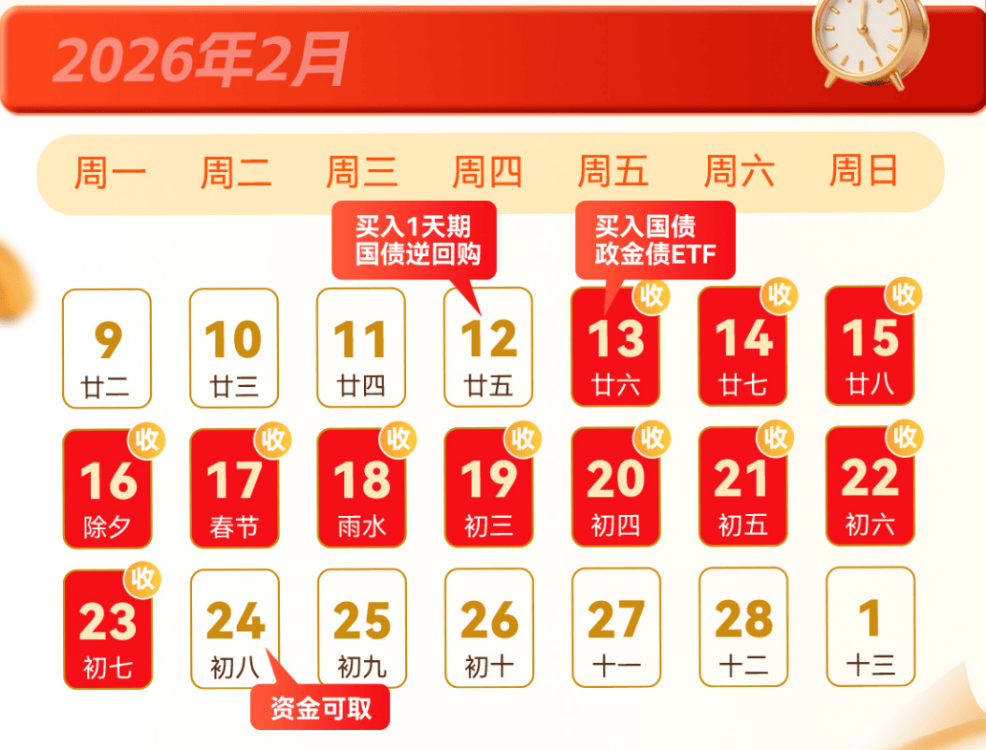
国债逆回购节前“买1躺11”,收益吸引力却大幅下降
第一财经· 2026-02-12 13:10
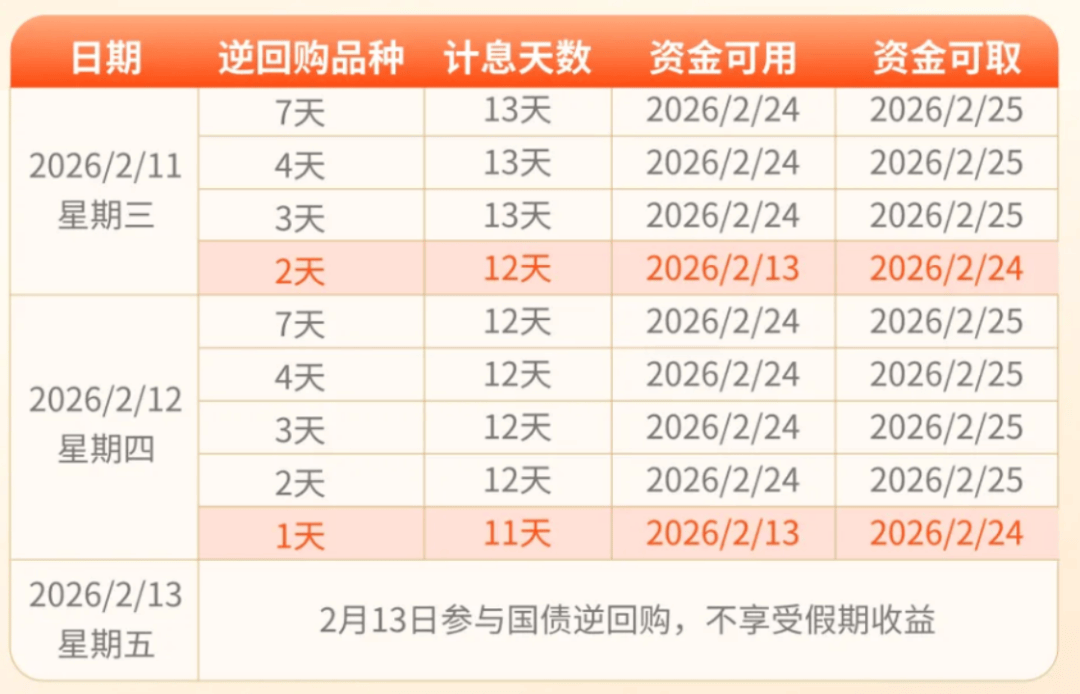
Core Viewpoint - The article discusses the increasing popularity of government bond reverse repos as a method for investors to manage idle funds during the upcoming Spring Festival holiday, highlighting the operational details and market conditions affecting returns [3][6]. Group 1: Government Bond Reverse Repo Operations - Investors can engage in 1-day government bond reverse repos on February 12, allowing them to earn interest for 11 days, with funds available for trading on February 13 [5][6]. - The operation is characterized as a short-term loan where investors lend money against bond collateral, offering flexibility, safety, low fees, and simplicity [6][7]. - The trading window for optimal returns is emphasized, with February 12 identified as the best day for transactions before the holiday [7]. Group 2: Market Conditions and Interest Rates - This year's pre-holiday funding rates are notably lower compared to previous years, indicating a more relaxed liquidity environment, which diminishes the potential returns from reverse repos [8][10]. - Historical trends show that funding rates typically rise before holidays due to increased cash demand, but this year, the central bank's liquidity support has kept rates low [9][10]. - As of February 12, the 1-day government bond reverse repo rates were reported at 1.27% and 1.21% for Shanghai and Shenzhen exchanges, respectively, reflecting a downward trend [10]. Group 3: Central Bank Actions - The central bank announced a significant reverse repo operation of 1 trillion yuan to maintain liquidity, indicating a continued supportive stance towards monetary policy [11]. - The expectation of further liquidity support through various tools, including medium-term lending facilities and government bond transactions, is anticipated in the coming months [11].

国债逆回购节前“买1躺11”,收益吸引力却大幅下降
Di Yi Cai Jing· 2026-02-12 11:48
Core Viewpoint - The article discusses the opportunity for investors to utilize the 1-day treasury reverse repurchase agreement (repo) to earn interest during the upcoming extended Spring Festival holiday, highlighting the unique benefits and current market conditions affecting interest rates [1][4]. Group 1: Investment Strategy - Investors can trade 1-day treasury reverse repos on February 12 to earn interest for 11 days, with funds becoming available for trading on February 13 [2][3]. - The operation of treasury reverse repos is explained as a short-term loan where investors lend money and receive fixed interest, backed by bonds as collateral, making it a flexible and low-cost investment option [2][3]. Group 2: Market Conditions - The current market shows a significant decrease in interest rates for treasury reverse repos compared to previous years, with the 1-day repo rate reported at 1.27% and 1.21% for different exchanges as of February 12 [5]. - The People's Bank of China (PBOC) has adopted a liquidity-supportive stance, conducting a 10,000 billion yuan reverse repo operation to maintain ample liquidity in the banking system, indicating a broader trend of low interest rates [5][6]. Group 3: Historical Context - Historically, interest rates for treasury reverse repos tend to spike before holidays due to increased cash demand, but this year, the rates have remained stable and lower than in previous years, reducing the potential for profit from these transactions [4][5]. - In previous years, such as 2025, the 1-day repo rate surged above 5%, but this year's rates have shown less volatility, reflecting the PBOC's efforts to manage liquidity effectively [5].
春节“红包”!1天赚11天利息,逆回购最佳时点来了!
证券时报· 2026-02-12 08:10
Core Viewpoint - The article emphasizes the opportunity for investors to utilize idle funds during the upcoming Spring Festival by engaging in government bond reverse repos, which can yield interest over the holiday period [1][3]. Group 1: Investment Strategy - Investors can earn interest for 11 days by participating in a 1-day reverse repo on February 12, with funds available for withdrawal before the market opens on February 24 [3][5]. - The optimal time for executing the reverse repo is before the market closes, as interest rates may drop significantly after 3 PM [5][12]. - The process of engaging in reverse repos is straightforward, requiring only a stock account and a few simple steps to execute the trade [7]. Group 2: Corporate Participation - Not only individual investors, but also listed companies are increasingly participating in government bond reverse repos to manage idle funds effectively [9]. - For instance, a company named Nabichuan plans to use up to 315 million RMB of idle funds for cash management, including investments in reverse repos [9]. Group 3: Common Misconceptions - A common mistake among investors is to execute reverse repos the day before non-working days, which may not yield optimal interest due to changes in the calculation of interest days [11]. - Investors are advised to place orders in smaller batches rather than a lump sum to capture higher interest rates throughout the day [12]. - The misconception that transaction fees for reverse repos are high is addressed, clarifying that fees are minimal, with a maximum charge of 30 RMB for a 10 million RMB investment over 30 days [13].

最后半小时!春节“国债逆回购”发福利,1天赚11天利息
2 1 Shi Ji Jing Ji Bao Dao· 2026-02-12 07:27
Core Viewpoint - The article highlights the optimal timing for engaging in reverse repurchase agreements (reverse repos) on government bonds, particularly focusing on a one-day reverse repo that can yield interest over an extended period due to the upcoming Chinese New Year holiday [1] Group 1: Reverse Repo Mechanics - The one-day reverse repo purchased on February 12 will accrue interest for 11 days, from February 13 to February 23, despite the nominal term being only one day [1] - The actual interest calculation is based on the actual number of days the funds are utilized, rather than the nominal period [1] Group 2: Market Implications - On February 13, the funds will be in a "available but not withdrawable" state, allowing for investment in stocks, funds, and other market instruments, effectively enabling the capital to serve dual purposes [1] - The funds will be credited back on the first trading day after the holiday, February 24, allowing for strategic financial planning around the holiday period [1]
1天赚11天利息!逆回购最佳时点来了
Sou Hu Cai Jing· 2026-02-12 07:16
Group 1 - The upcoming Spring Festival holiday presents an opportunity for investors to utilize idle funds through government bond reverse repos, which can yield risk-free returns [1][2] - Investors can earn interest for 11 days by executing a 1-day reverse repo on February 12, with funds available for withdrawal before the market opens on February 24 [2][4] - The best time to operate a 1-day reverse repo is on February 12, allowing investors to maximize interest earnings during the holiday period [3][4] Group 2 - Companies are also engaging in government bond reverse repos to manage idle funds, with Nanbaichuan planning to use up to RMB 315 million for cash management through various financial products, including reverse repos [6] - The current low-interest environment makes government bond reverse repos an attractive option for institutions seeking low-risk asset allocation [7] Group 3 - Common misconceptions about reverse repos include the timing of operations, with many investors mistakenly executing trades before non-working days, which can lead to suboptimal interest earnings [8] - It is advisable for investors to place orders in batches rather than in large amounts to capture higher daily interest rates effectively [9] - The fees associated with reverse repos are minimal, with a cost of approximately RMB 1 for every RMB 100,000 per day, making it a cost-effective investment strategy [10]
一鱼两吃,这份春节薅羊毛攻略请收好
Sou Hu Cai Jing· 2026-02-12 06:52
Core Viewpoint - The article emphasizes the opportunity for investors to utilize idle funds in their stock accounts during the Chinese New Year holiday by engaging in specific financial operations that can yield returns. Group 1: Investment Strategy - Investors are encouraged to perform a one-day reverse repurchase agreement (repo) before the holiday, which allows them to earn interest for the entire 11-day holiday period [1]. - The first step involves executing a one-day reverse repo on February 12, which will generate interest for the duration of the holiday [1]. - The second step is to invest the returned funds into the government bond ETF (511580) on February 13, which will also start accruing interest from the next day [2][3]. Group 2: Benefits of the Investment - By utilizing both the reverse repo and the government bond ETF, investors can earn dual returns: interest from the reverse repo and coupon payments from the ETF during the holiday [3]. - The government bond ETF is highlighted for its high safety due to its underlying assets being government bonds and policy financial bonds, which carry minimal default risk [5]. - The ETF has a historical annualized return of 2.49%, significantly higher than typical money market funds, making it an attractive cash management tool [5]. - The ETF features low fees, with a management fee of 0.15% per year and a custody fee of 0.05% per year, maximizing investor returns [5]. - The ETF offers strong liquidity with T+0 trading, allowing investors to sell at any time after the holiday without delay [5].