小滴

Search documents
为什么是滴滴先把AI打车做出来?
Feng Huang Wang· 2026-03-21 10:09
Core Insights - The article discusses the evolution of AI in the transportation sector, particularly focusing on Didi's AI travel assistant "Xiao Di" and its capabilities to meet personalized user demands [2][6][16] - It highlights the importance of a robust supply system to effectively execute user requests, emphasizing that understanding user needs is not enough without the necessary data and operational infrastructure [8][12][15] Group 1: AI Implementation in Transportation - Didi's AI assistant "Xiao Di" allows users to make complex requests for rides, such as specifying vehicle comfort for pregnant passengers, showcasing a shift from traditional app functionalities [7][12] - The article contrasts the capabilities of different AI agents, noting that many struggle to execute user requests effectively due to a lack of underlying data and supply systems [8][15] Group 2: Supply Chain and User Experience - The effectiveness of an AI agent is heavily dependent on the depth of its supply pool, as more specific user requests can lead to fewer available options if the platform lacks scale [9][12] - Didi's extensive operational history and driver network provide a solid foundation for its AI capabilities, allowing for a more granular approach to fulfilling user needs [12][13] Group 3: Trust and Service Reliability - The article emphasizes that user trust in AI agents is built on the reliability of service delivery, rather than just the ability to understand complex requests [13][15] - Didi's operational model allows for better control over service quality, which is crucial for meeting user expectations in real-world scenarios [13][15] Group 4: Market Differentiation - Didi's approach with "Xiao Di" is presented as a practical example of how AI can enhance existing services without overhauling established processes, focusing on reliability and user satisfaction [16][18] - The article suggests that many current AI agents lack the basic delivery capabilities, which can lead to user frustration when they fail to meet expectations [18][19] Group 5: Future Directions - Didi's AI assistant is evolving to include additional features such as location queries and automated ride requests, indicating a move towards a more comprehensive travel assistant [18][19] - The article concludes that the true value of technology lies in its ability to seamlessly integrate into daily life and enhance user experiences consistently [19]


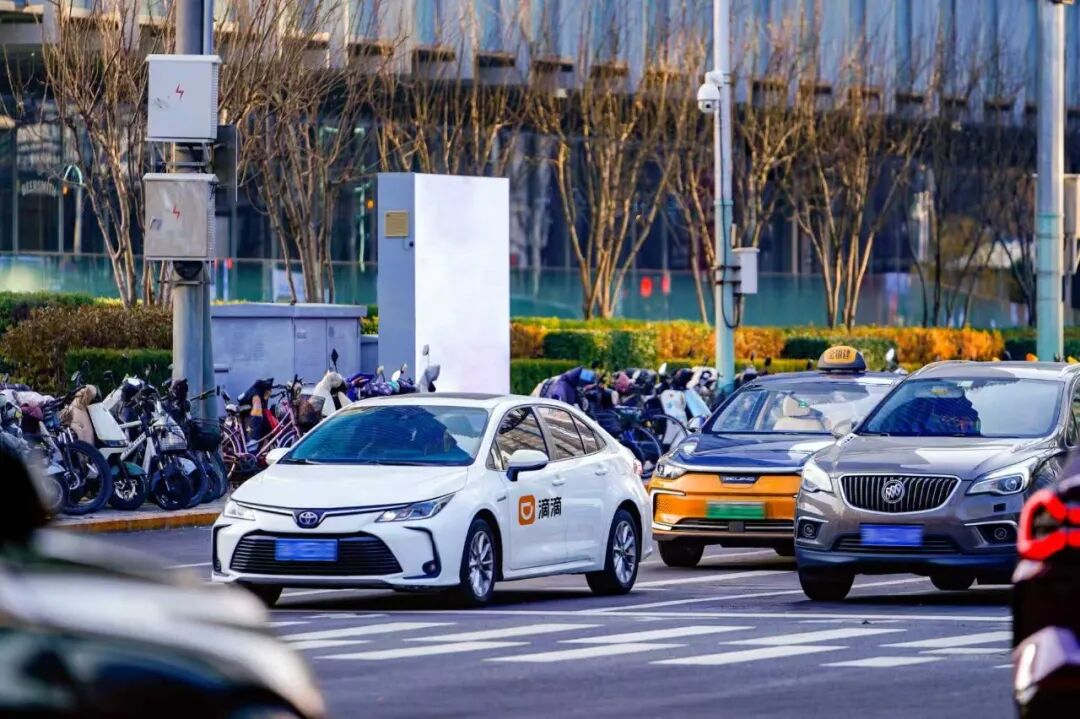
腾讯研究院AI速递 20260116
腾讯研究院· 2026-01-15 16:06
Group 1: AI Chip Regulations - The U.S. has imposed a 25% tariff on advanced AI chips like Nvidia's H200 and AMD's MI325X, with export licenses now subject to case-by-case review instead of presumed denial [1] - New regulations stipulate that the number of chips exported to China cannot exceed half of the total quantity for U.S. customers and must meet specific safety standards [1] - The U.S. House of Representatives has passed the Remote Access Security Act to restrict China's access to AI chips via cloud computing services [1] Group 2: Google AI Developments - Google has launched the Personal Intelligence feature powered by the Gemini3 model, integrating data across Gmail, Photos, YouTube, and Search for contextual understanding [2] - This feature includes a natural language correction mechanism, allowing users to correct AI errors in real-time, thus lowering the management threshold for data models [2] - Currently in beta testing, it is available to paid users and will eventually be accessible to free users across multiple platforms [2] Group 3: Nvidia's Autonomous Driving - Nvidia's new L2++ level driving system in the Mercedes CLA has successfully completed a 40-minute test in San Francisco, demonstrating capabilities comparable to Tesla's FSD [3] - Nvidia plans to launch L2 highway and city driving features by mid-2026, with a goal to expand Robotaxi deployment by 2027 and achieve L3 highway driving by 2028 [3] - The company has achieved city autonomous driving functionality in just one year, utilizing the Drive AGX Thor chip, which costs approximately $3,500 [3] Group 4: AI Shopping Innovations - The Qianwen App has introduced over 400 service functions, enabling AI-driven shopping experiences across various Alibaba ecosystem services [4] - New features include AI food ordering, shopping, restaurant reservations, and direct access to 50 government services, enhancing user convenience [4] - The app's "Task Assistant" function leverages breakthroughs in AI coding and multimodal understanding for various applications [4] Group 5: Didi's AI Assistant - Didi has launched an AI assistant named "Xiao Di," allowing users to specify vehicle preferences through simple phrases, including vague requests like "for large luggage" [6] - The assistant prioritizes user needs into categories such as "necessary," "priority," and "preferable," enhancing the personalization of service [6] - After three months of iterations, the AI has improved user experience by remembering habits and preferences [6] Group 6: Step-Audio-R1 Model - The Step-Audio-R1.1 model has topped the Artificial Analysis Speech Reasoning leaderboard with a 96.4% accuracy rate, surpassing other leading models [7] - It is the first open-source native speech reasoning model capable of end-to-end understanding and real-time responses without added latency [7] - The model will have a complete real-time speech API available by February, with current chat modes supporting fluid reasoning [7] Group 7: GPT-5.2 Browser Development - The CEO of Cursor has utilized GPT-5.2 to autonomously write 3 million lines of code over a week, creating a complete browser from scratch [8] - The project employed a multi-agent system with planners and executors to ensure efficient task completion with minimal conflicts [8] - Results indicate that GPT-5.2 can maintain focus and follow instructions effectively over extended periods, outperforming other models in planning capabilities [8] Group 8: Robot Rental Platform - The world's first robot rental platform, "Qingtian Rent," has completed seed funding, led by Hillhouse Capital and supported by several other investors [9] - Within three weeks of launch, the platform has registered over 200,000 users and maintains an average of over 200 rental orders daily [9] - The platform employs a shared rental and scheduling model, with rental prices ranging from 200 yuan per day for long-term rentals to over 1,000 yuan for daily rentals [9] Group 9: AI in Robotics - A research project from Columbia University has been featured on the cover of Science Robotics, showcasing a humanoid robot capable of synchronized lip movements using deep learning [10] - The robot's facial structure contains over 20 micro-motors hidden beneath flexible silicone skin, utilizing self-supervised learning to control expressions [11] - It can convert sound signals into natural lip movements across various languages and environments, demonstrating robust cross-linguistic capabilities [11]



滴滴给我发了个赛博助理,专管出行的那种
量子位· 2026-01-15 08:53
Core Viewpoint - The article discusses the evolution of AI-driven agents, particularly focusing on the Didi's agent "Xiao Di," which enhances the ride-hailing experience by personalizing services and understanding user needs more intuitively [1][50]. Group 1: Agent Functionality - The agent allows users to make ride requests with simple voice commands, eliminating the need for multiple clicks and selections [4][5]. - Users can specify various preferences, such as vehicle type, color, and features, making the ride-hailing process more personalized [12][21]. - The agent can understand and prioritize user needs, even when they are expressed vaguely, creating a more seamless interaction [29][42]. Group 2: User Experience - The agent adapts to user habits over time, remembering preferences like vehicle type based on past interactions [53]. - Users report feeling like they have a "chauffeur" service, as the agent can match their requests with suitable vehicles effectively [50][51]. - The agent's ability to suggest nearby restaurants or activities based on user prompts indicates a shift towards a more integrated travel assistant role [46]. Group 3: Industry Trends - The rise of agents like Xiao Di represents a broader industry trend towards personalized AI services, moving beyond traditional app functionalities [52][54]. - Didi's early adoption of this technology positions it as a leader in the evolving landscape of ride-hailing services, leveraging AI to enhance user experience [51][55]. - The article suggests that 2025 was a pivotal year for agents, with 2026 expected to bring even more advancements and possibilities in this space [54].
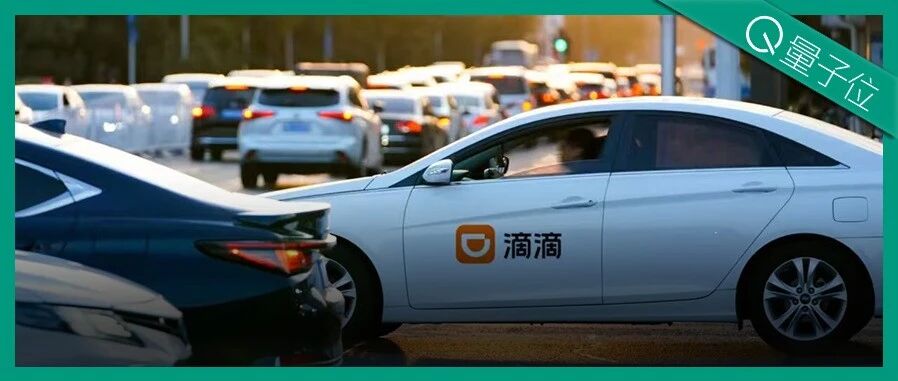
争夺“超级AI助理”:本地生活入口战火升级,谁主沉浮?
Cai Jing Wang· 2025-11-25 11:32
Core Insights - The launch of JD's independent delivery app and AI-driven tools marks a new phase in local life services, initiating a competition for "super AI assistants" [1][2] - JD's commitment to non-commercialization of its review and ranking tools addresses industry issues of trust and authenticity in user reviews [2] - The AI Agent landscape is evolving, with major players like Meituan and Didi also introducing their own AI-driven solutions for local services [3][4] Group 1: Company Strategies - JD has launched an independent delivery app alongside AI tools "JD Review" and "JD True List," utilizing AI to analyze consumer data and create the first AI-generated rankings globally [2] - Meituan's "Xiao Mei" app, powered by its self-developed LongCat-Flash-Chat model, aims to enhance user experience in local services through natural language interactions [3] - Didi's AI travel assistant "Xiao Di" transforms the ride-hailing experience by allowing users to actively choose vehicles based on their needs [3] Group 2: Market Trends - The competition in the local life services sector is intensifying, with AI Agents seen as a key area for commercial potential due to their ability to meet frequent user demands [4][5] - The AI Agent market in China is projected to grow significantly, with estimates suggesting it will reach 6.9 billion yuan by 2025, reflecting a growth rate exceeding 140% [7] - The introduction of AI technology in local services aims to address issues like information asymmetry and high decision costs, which have plagued traditional models [7][8] Group 3: Challenges and Requirements - AI Agents in local life services face higher demands for real-time responsiveness, multi-turn dialogue capabilities, and data privacy compliance [5][6] - The complexity of integrating AI Agents with various platforms and ensuring accurate execution of tasks presents significant challenges [6] - Industry experts highlight the need for AI Agents to evolve from basic functionality to seamless service execution across multiple scenarios [9]


从查路线到算时间,还能约到“空气清新的老司机车” AI成了我的“长假出行搭子”
Mei Ri Jing Ji Xin Wen· 2025-10-02 09:55
Core Insights - The article discusses the launch and functionality of Didi's AI travel assistant "Xiao Di," which aims to enhance user experience during peak travel times by providing personalized travel solutions [1][9]. Group 1: AI Travel Assistant Features - "Xiao Di" analyzes user requests and generates a complete travel plan after approximately 30 seconds of data processing, suggesting optimal departure times and monitoring conditions [1]. - The assistant can respond to vague requests, such as recommending nearby tourist attractions and matching users with suitable vehicles based on specific preferences [3][8]. - Users can describe their travel needs in detail, allowing the AI to present up to three vehicle options for manual confirmation, moving beyond traditional ride-hailing methods [8]. Group 2: Integration and Future Prospects - Didi has launched the MCP (Model Context Protocol) service, enabling other applications to integrate its AI travel capabilities, potentially allowing users to plan and book rides without opening the Didi app [9]. - The article highlights the broader trend of AI integration in travel and transportation, with other companies like T3 and Gaode also developing AI-driven solutions [9]. - Despite the promising advancements, Didi acknowledges that "Xiao Di" is still in its early stages and requires continuous learning from real-world scenarios to improve its service [9]. Group 3: User Experience and Perception - The AI assistant's ability to understand nuanced user needs, such as preferring a vehicle with a fresh atmosphere, signifies a shift from mere execution of commands to a more empathetic interaction [10]. - The article emphasizes the potential for AI to create a more human-like relationship in the travel experience, enhancing efficiency and user satisfaction [10]. - The ongoing development of AI in travel is seen as a significant step towards a more personalized and responsive service model, with users contributing to its evolution through feedback [10].
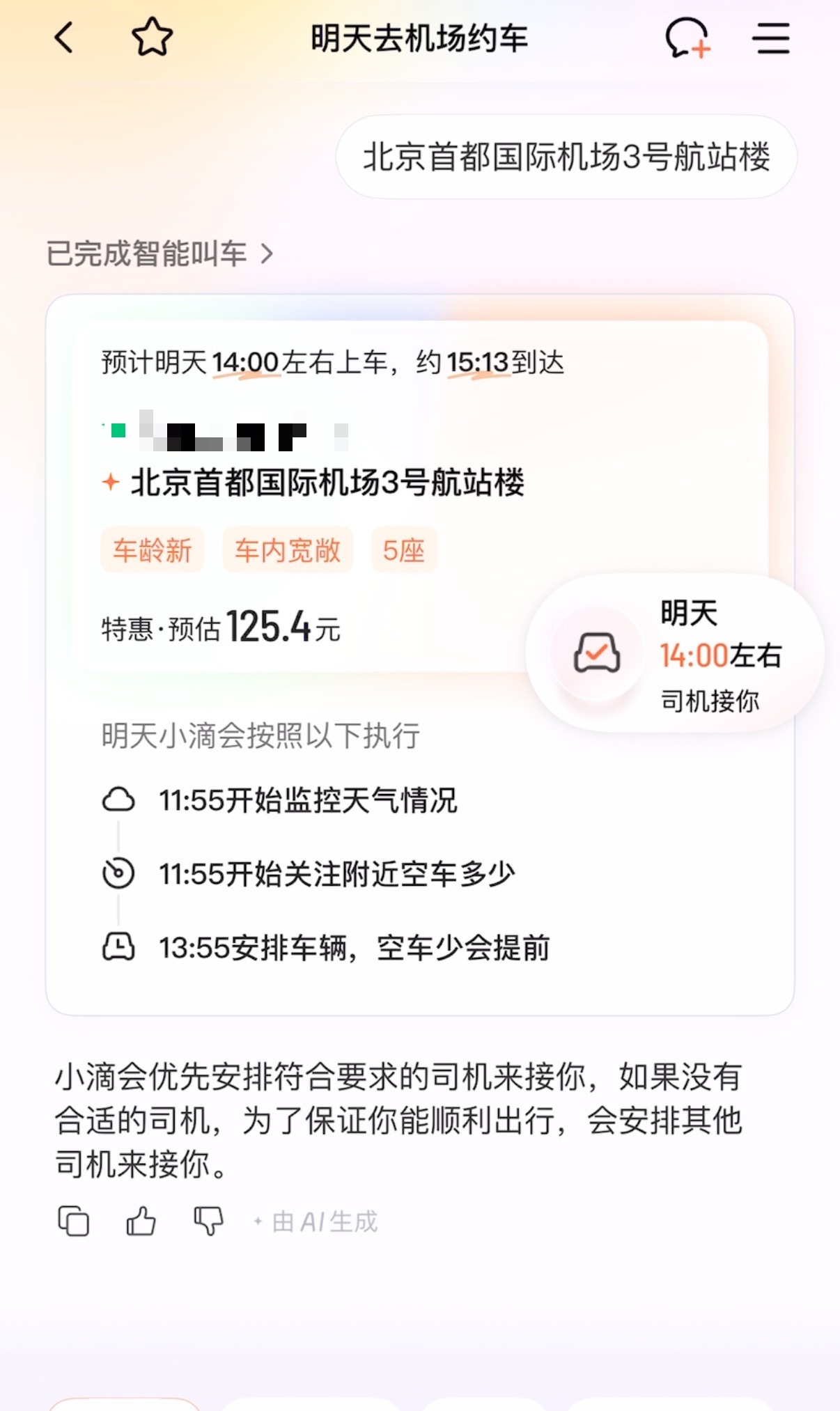
打车像点单?实测滴滴AI助手,打车也能“私人订制”了
量子位· 2025-09-30 12:22
Core Viewpoint - The article discusses the transformative impact of AI on the ride-hailing experience through the introduction of "Xiaodi," a new intelligent assistant by Didi, which allows users to actively choose their ride preferences rather than passively waiting for a match [1][49]. Group 1: Xiaodi's Features - Xiaodi changes the traditional ride-hailing logic by enabling users to specify their preferences, such as vehicle type, air quality, and other personalized requirements [1][20]. - Users can interact with Xiaodi through voice or text to communicate multiple needs, enhancing the customization of their ride experience [20][23]. - The interface of Xiaodi resembles a chatbot, providing a more engaging and interactive experience compared to traditional ride-hailing apps [10][12]. Group 2: User Experience - The article highlights a seamless user experience where Xiaodi not only finds suitable vehicles but also provides detailed information about each option, including model, distance, estimated arrival time, and price [16][18]. - Users can track their ride history and expenses easily, making it particularly beneficial for business travelers [31][32]. - Xiaodi can assist in planning cost-effective travel routes even when not using a ride-hailing service, showcasing its versatility [29][31]. Group 3: MCP Service - Didi has launched the MCP service, allowing developers to integrate Xiaodi's capabilities into their applications, thus broadening the potential for personalized ride-hailing experiences [34][48]. - The MCP service offers different versions (Beta, Pro, Pro+) catering to various user needs, from simple experiences to comprehensive enterprise solutions [46][48]. - The rapid iteration and updates of the MCP service indicate a commitment to enhancing the AI-driven ride-hailing ecosystem [48]. Group 4: Industry Implications - The introduction of AI in ride-hailing not only benefits passengers but also enhances the visibility and earnings of drivers who provide better services [50]. - Didi's extensive experience and technological foundation in the ride-hailing sector enable it to implement AI solutions effectively, setting a precedent for future developments in the industry [51][52]. - The article suggests that as data accumulates, the AI models will become more sophisticated, continuously improving user experiences in ride-hailing [52].