
小米小爱同学

Search documents
万字详解智能体2.0:手机里的“互联互通”新战场
2 1 Shi Ji Jing Ji Bao Dao· 2026-02-24 00:10
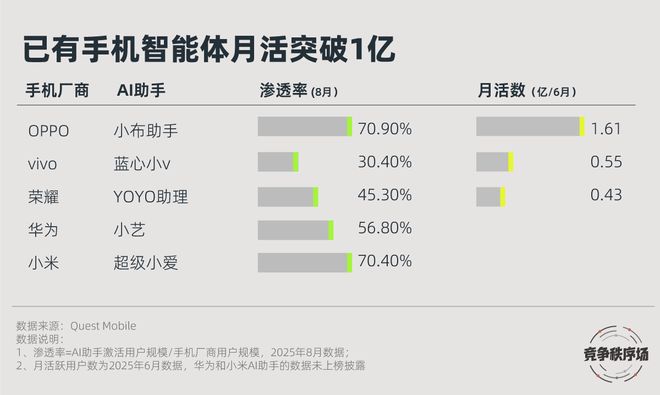
Core Insights - The AI industry is shifting focus towards edge-based intelligent agents, with significant developments in both domestic and international markets [1][2][3] - ByteDance's Doubao and other intelligent agents are gaining traction, operating across various personal devices and applications, but face challenges related to privacy and operational capabilities [2][3][5] - The industry consensus is that the future of intelligent agents will depend on their ability to connect multiple personal devices and services, reshaping the ecosystem [2][3] Group 1: Market Developments - OpenClaw has gained popularity in Silicon Valley, while Doubao is embedded in smartphones in China, with high demand reflected in the second-hand market [1] - The user base for intelligent agents among six major Chinese smartphone manufacturers grew by 65 million in one year, reaching a total of 535 million users [3] - OPPO, Vivo, and Honor are leading the charge in the domestic market, with OPPO's Xiaobu Assistant achieving 160 million monthly active users by June 2025 [3] Group 2: Technical Challenges - Current intelligent agents are struggling with task execution, often only able to perform basic functions like opening apps rather than completing complex tasks [7][8] - A recent evaluation of seven intelligent agents revealed a success rate of only 20% for completing tasks, with many tasks failing or being interrupted [5][7] - The technology behind these agents is still in its infancy, with most operating at a basic level and lacking the ability to handle complex, multi-step tasks effectively [8][10] Group 3: Privacy and Security Concerns - Intelligent agents require extensive permissions, often exceeding 100, raising concerns about privacy and potential misuse of sensitive data [17][18] - The use of high-sensitivity permissions, such as accessing location and reading messages, poses significant risks to user privacy [19][20] - The reliance on cloud processing for data handling introduces vulnerabilities, as sensitive information may be exposed during transmission [27][28] Group 4: Industry Dynamics - A ceasefire agreement has been reached between ByteDance and several app developers, allowing for normal login procedures while limiting AI operations [35] - The competitive landscape is marked by tensions between smartphone manufacturers and app developers, with concerns over the implications of intelligent agents on existing business models [30][31] - The future of intelligent agents hinges on establishing a viable revenue-sharing model and addressing the concerns of both hardware manufacturers and app developers [31][32]





苹果低下了高傲的头颅
创业邦· 2026-01-19 01:13
Core Viewpoint - The collaboration between Apple and Google represents a strategic alliance to leverage Google's AI capabilities through the Gemini model, allowing Apple to enhance its Siri functionality while mitigating its own technological lag in AI development [6][14][21]. Group 1: Apple's AI Concerns - Apple's delay in AI development is evident, with only 5% global AI smartphone penetration in 2023, projected to rise to 28% by 2025 and 54% by 2027, indicating a significant market opportunity that Apple is missing [8]. - Apple's self-developed AI model has only 150 billion parameters, with a benchmark score of 78.6%, falling short of industry leaders [8]. - The loss of key AI team members to competitors like Meta and OpenAI has delayed Apple's AI progress by 18 months, raising concerns about its competitive position [8]. Group 2: Siri's Performance and Market Impact - Siri's user satisfaction has dropped to 62% in 2025, a 15% decline from 2023, and it ranks lower than competitors like Google Assistant and Huawei's Xiao Yi [10]. - The decline in Siri's performance is affecting iPhone sales, with a 2.1% drop in global smartphone market share attributed to unmet AI functionality demands [10]. - Apple estimates that building the infrastructure for a trillion-parameter AI model would cost $48 billion and take at least three years, raising questions about its willingness to invest in potentially outdated technology [10]. Group 3: Strategic Partnership Dynamics - Apple will pay Google $1 billion annually to utilize the Gemini model, which will enhance Siri's capabilities and provide Apple with a buffer period for its own AI development [14][24]. - The partnership allows Apple to maintain user experience while avoiding significant capital expenditure risks, effectively transferring some of the risks associated with AI development [14]. - Google's ambition with Gemini is to create a platform that serves as the foundational AI layer for all smart devices, requiring extensive real-world data for optimization [15]. Group 4: User Engagement and Data Acquisition - iPhone users engage with voice assistants 4.2 times daily, significantly more than Android users, indicating a higher quality of interaction that Google can leverage through this partnership [16]. - By integrating Gemini into Siri, Google can access a high-quality user base for data collection, enhancing Gemini's capabilities in real-time [18]. - The collaboration is expected to increase Gemini's monthly active users to over 500 million by the end of 2026, boosting its market share to over 25% [18]. Group 5: Future Implications and Market Position - The partnership signifies a shift in the AI industry from performance competition to ecosystem binding capabilities, with the ability to integrate into mainstream hardware being crucial for dominance [21]. - OpenAI's market share may decline as Gemini becomes the primary AI engine for Apple devices, potentially reducing OpenAI's influence in the Apple ecosystem [21]. - Apple's non-exclusive agreement with Google allows for the possibility of integrating other AI models in the future, indicating a strategic approach to maintain flexibility in AI partnerships [23].
AI手机给谁开了窗
Bei Jing Shang Bao· 2025-12-04 16:13
Core Insights - The collaboration between ByteDance's Doubao model and ZTE has officially launched, with the Nubia M153 smartphone selling out quickly at a price of 3499 yuan, leading to a surge in ZTE's stock price and market capitalization [1][3][6] - ZTE's partnership with ByteDance is seen as a significant opportunity to enhance its market position, especially as it has been in the second tier of the industry for a long time [5][6] - The market response has been overwhelmingly positive, with the Doubao smartphone experiencing significant price premiums in the second-hand market, indicating strong demand [4][6] Company Performance - ZTE's 2024 financial report shows a revenue of 121.3 billion yuan, a year-on-year decline of 2.38%, and a net profit of 8.43 billion yuan, down 9.66%, with a significant drop in Q4 net profit by 65.08% [6][8] - The collaboration with ByteDance is viewed as a critical opportunity for ZTE to alleviate financial pressures and improve its market visibility [6][8] Market Dynamics - The smartphone market is experiencing a shift, with leading brands like Huawei, Xiaomi, and others maintaining a significant market share, while the "other" segment is gradually increasing from 15.3% in 2022 to an expected 20.8% in 2024 [3][10] - The partnership allows ZTE to leverage ByteDance's AI capabilities while providing a hardware platform for the Doubao model, creating a complementary relationship between software and hardware [5][10] Competitive Landscape - The collaboration highlights a broader trend in the industry where smaller manufacturers are seeking partnerships to integrate AI capabilities, contrasting with larger brands that are developing their own systems [10][11] - The future competition in the smartphone market will focus on the depth of AI integration, adaptability to various scenarios, and overall user experience satisfaction [12]


商汤科技20250727
2025-07-28 01:42
Summary of Key Points from the Conference Call Company and Industry Involved - **Company**: SenseTime Technology (商汤科技) - **Industry**: Artificial Intelligence (AI) and its applications across various sectors Core Insights and Arguments 1. **Advancements in AI Technology**: Chinese large model technology has shown outstanding performance in reasoning capabilities, open-source ecosystems, cost efficiency, and vertical applications, necessitating continuous technological breakthroughs and algorithm originality [2][3][41] 2. **Shanghai's AI Ecosystem**: Shanghai has established a parallel system of open-source and commercial large models, with 82 models registered nationally, positioning AI as a new growth engine for the city's economy [2][5] 3. **Sustainability Challenges**: The AI industry faces sustainability challenges, particularly regarding the energy consumption of data centers, which is projected to account for 8% of global electricity usage by 2030 [2][8] 4. **Economic Impact of AI Investment**: Investment in computing power and AI yields significant economic benefits, with a 1% increase in computing power index correlating to a 1.8‰ GDP growth [3][13] 5. **Policy Support for AI Development**: There is a call for enhanced policy support to create a favorable environment for AI development, including the use of intellectual property and fiscal policies [3][4] Other Important but Possibly Overlooked Content 1. **AI's Role in Reducing Carbon Emissions**: AI can significantly reduce carbon emissions in heavy industries and enhance energy efficiency in factories, with successful implementations already seen in Singapore and ASEAN [3][11] 2. **Challenges in AI Training**: The training of large models is energy-intensive, with the energy consumption during the reasoning phase increasing significantly with usage, potentially becoming a major source of energy consumption [8][9] 3. **Future Directions for AI Models**: The future of large model technology may involve expanding current paradigms to accept natural language feedback and developing autonomous online agents capable of self-learning [25][26] 4. **Open Source vs. Closed Source Dynamics**: The ongoing competition between open-source and closed-source models will shape the AI ecosystem, with open-source models driving efficiency and collaboration [37][39] 5. **SenseTime's Innovations**: SenseTime has made significant strides in AI, particularly with its SenseNova large model, which aims to unlock general AI task capabilities at low costs, facilitating widespread AI adoption across industries [41][59] This summary encapsulates the key points discussed during the conference call, highlighting the advancements, challenges, and future directions of AI technology, particularly in the context of SenseTime and the broader industry landscape.