小米汽车SU7系列

Search documents
雷军:2025,迎接风暴
3 6 Ke· 2025-12-22 00:40
Core Insights - The article discusses the transformation of Lei Jun, the founder and CEO of Xiaomi, as the company navigates both achievements and challenges in 2025, marking the 15th anniversary of Xiaomi and the 4th year of its automotive venture [1][4]. Financial Performance - Xiaomi has seen significant growth in revenue and profit for three consecutive quarters, with a notable performance in the automotive sector, where the SU7 series became the best-selling sedan over 200,000 yuan in the past year [1]. - In Q3 2025, Xiaomi's automotive business delivered 109,000 vehicles, generating revenue of 29 billion yuan with a gross margin of 25.5%, achieving operational profitability for the first time with an operating profit of 700 million yuan [4]. Product Development - Xiaomi launched the self-developed 3nm flagship SoC chip, Xuanjie O1, becoming one of the first companies in mainland China to release such a chip, which is also integrated into the Xiaomi 15S Pro smartphone [6]. - The automotive business reached a milestone with the production of its 500,000th vehicle in just over 1 year and 7 months, setting a record for the fastest in the domestic new energy vehicle industry [4]. Brand Challenges - Despite the successes, Xiaomi and Lei Jun faced significant public scrutiny due to safety concerns following accidents involving the SU7 and questions regarding the authenticity of marketing claims [3][4]. - Lei Jun expressed frustration over the negative publicity, stating that Xiaomi has been one of the most criticized brands post-launch of its automotive line [3]. Strategic Direction - Xiaomi is transitioning from an internet company to a hard-tech company, emphasizing the importance of self-developed chips as a critical path for success [9]. - The company plans to invest over 32 billion yuan in R&D in 2025, with a projected total investment of 200 billion yuan over the next five years [9]. Manufacturing Expansion - In October 2025, Xiaomi's smart home appliance factory in Wuhan commenced operations, marking the third major smart manufacturing base for the company, which aligns with its "human-vehicle-home ecosystem" strategy [9].


雷军罕见出手,小米的转折点?
财富FORTUNE· 2025-12-05 13:05
Core Viewpoint - Xiaomi's stock price has experienced significant volatility, with a nearly 100% increase in the first half of the year followed by a decline of over 35% from its June peak, reflecting the challenges faced by the company and its founder Lei Jun's influence on market sentiment [1] Group 1: Stock Buyback and Market Response - Lei Jun's recent investment of over 100 million HKD in Xiaomi shares and the company's aggressive stock buyback strategy, with a single buyback amount reaching up to 400 million HKD, are seen as efforts to instill confidence in the market [1] - Following these actions, Xiaomi's stock price rose over 5% on November 25, returning above 40 HKD, indicating a potential recovery trend [1] Group 2: Business Challenges - Xiaomi's smartphone business, a cornerstone of the company, reported a revenue of 46 billion CNY in Q3 2025, a year-on-year decline of 3.2%, with a gross margin dropping to 11.1% due to rising manufacturing costs and aggressive pricing strategies from competitors like Huawei [2] - The IoT and lifestyle products segment, while showing a revenue growth of 5.6% to 27.6 billion CNY in Q3, faced a 15.7% decline in smart home appliance revenue, attributed to reduced government subsidies and intensified competition [2] Group 3: Automotive Business and Trust Issues - Xiaomi's automotive division has seen rapid growth, with the 500,000th vehicle rolling off the production line in just over a year, but it faces scrutiny over product quality and marketing practices, leading to a potential trust crisis [4] - Controversies surrounding the SU7 Ultra model, including legal disputes over marketing claims, have raised questions about the integrity of the company's messaging and the founder's accountability [5][6] Group 4: Industry Implications - The challenges faced by Xiaomi reflect broader issues within the Chinese electric vehicle industry, which is transitioning from a focus on hardware to software reliability and ethical data use, highlighting the need for improved transparency and communication [6] - The company's reliance on founder Lei Jun's personal brand and the need for a shift from a "celebrity-driven" model to one based on product reliability and service quality are critical for regaining consumer trust [7]

小米17发布!雷军年度演讲,谈小米如何“逆天改命”
证券时报· 2025-09-25 13:42
Core Viewpoint - The article highlights Xiaomi's transformation over the past five years, emphasizing its shift from an internet company to a smart manufacturing powerhouse, focusing on core technologies and innovation in the automotive and semiconductor sectors [2][6]. Group 1: Company Transformation - Xiaomi's journey involved a significant re-evaluation of its business model, leading to a commitment to invest 100 billion yuan in core technologies over five years [6][7]. - The company faced criticism and skepticism regarding its technological capabilities, prompting a strategic pivot towards becoming a technology-driven firm [6][9]. Group 2: Product Launch - The Xiaomi 17 series was officially launched, featuring advancements in screen technology, imaging, and battery life, with prices starting at 4,499 yuan for the standard version [4][14]. - The series aims to compete directly with Apple's iPhone, showcasing superior battery capacity and innovative display technology [10][13]. Group 3: Financial Performance - In the first half of 2025, Xiaomi reported total revenue of 227.2 billion yuan, a year-on-year increase of 38.2%, and a net profit of 22.83 billion yuan, reflecting a substantial growth of 146% [9].
小米汽车SU7系列新增支持4K云台摄像头等生态件
Huan Qiu Wang Zi Xun· 2025-09-21 04:56
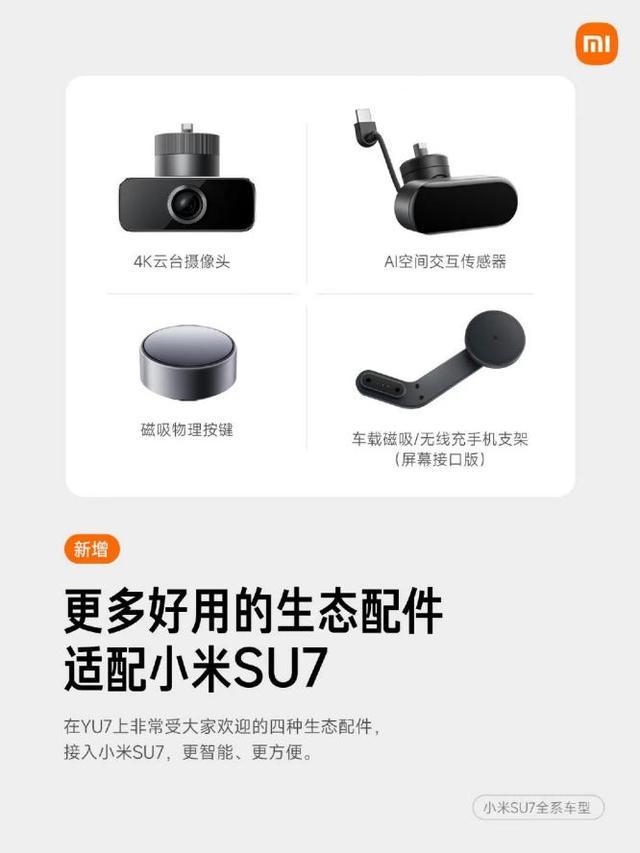
Core Viewpoint - Xiaomi Automotive has announced the addition of new features and ecosystem components for its SU7 series and SU7 Ultra vehicles following the upgrade to Xiaomi HyperOS 1.10.0 [1][4]. Group 1: New Features - The upgrade includes support for a 4K gimbal camera, magnetic physical buttons, AI spatial interaction sensors, and a car-mounted magnetic/wireless charging phone holder [1][4]. - The 4K gimbal camera can be used for in-car child monitoring, remote pet surveillance, and can record travel videos with a storage card, featuring Xiao Ai voice control for rotation and operation [4]. - The magnetic physical buttons can be customized through Xiaomi Super Task to perform functions like one-click air conditioning activation and map overview [4]. Group 2: AI and Charging Innovations - The AI spatial interaction sensor allows control through six specific gestures, enabling functions such as music control and scene entry [4]. - The car-mounted magnetic/wireless charging phone holder provides convenient charging and includes a reminder feature to prevent leaving the phone in the vehicle [4]. - Xiaomi Automotive has indicated plans to introduce more ecosystem products for the SU7 series and SU7 Ultra in the future [4].