
市场化租赁住房

Search documents
中指研究院:1-11月50城住宅租金累计跌幅扩大至3.04%
智通财经网· 2025-12-11 08:22
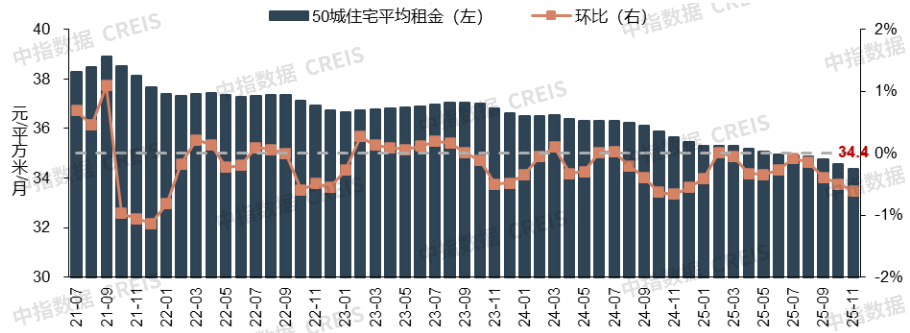
Core Insights - The 2025 outlook for China's housing rental market indicates a continued decline in rental prices, with a cumulative drop of 3.04% in the average rent across 50 key cities from January to November, exacerbated by weak employment income expectations and increased supply of guaranteed rental housing [1][2] - The central government is shifting its focus from large-scale construction of guaranteed rental housing to optimizing supply based on demand, which is expected to stabilize the market and promote the development of professional rental companies [1][11] - The implementation of the Housing Rental Regulations aims to standardize the rental market, enhancing the operational quality of rental housing enterprises and fostering tenant trust in brands [1][20] Rental Price Trends - The average rental price in 50 key cities has seen a cumulative decline of 3.04% from January to November 2025, with November's average rent at 34.4 yuan per square meter per month, reflecting a month-on-month decrease of 0.60% and a year-on-year decrease of 3.57% [2][5] - Among the 50 cities, 49 experienced a decline in rental prices, with cities like Wenzhou, Sanya, Nanjing, and Haikou seeing drops exceeding 5% [5][12] - First-tier cities recorded a smaller cumulative rental decline of 2.06%, while second-tier cities saw a drop of 3.66% [5][12] Investment Returns - The rental-to-price ratio in 50 key cities improved slightly to 2.23% as of November 2025, up from 2.12% at the end of 2024, indicating better investment returns in the rental market [7][8] - The rental-to-price ratio has been steadily increasing due to the ongoing adjustments in housing prices and the professionalization of the rental market [8][11] Policy Analysis - The "14th Five-Year Plan" emphasizes the transition of China's housing rental market towards high-quality development, with a focus on optimizing the supply of guaranteed rental housing [11][12] - Policies have been introduced to enhance the financing channels for rental housing enterprises, including the expansion of public REITs for rental housing [13][16] - The Housing Rental Regulations, effective from September 2025, establish a legal framework for the rental market, promoting a more regulated and professional environment [20][21] Local Policies - Over 150 housing rental-related policies were introduced by local governments from January to November 2025, with a focus on optimizing the supply and management of rental housing [22][23] - Local governments are increasingly emphasizing a "market + guarantee" housing supply system, with policies shifting from large-scale construction to standardized management [23][24] Market Demand Trends - The demand for rental housing remains strong, with a notable increase in the proportion of tenants planning to renew their leases, although renting is still viewed as a transitional choice for many [45]

如何理解房地产发展新模式?
Sou Hu Cai Jing· 2025-12-05 02:42
Core Insights - The article discusses the need for a shift in China's real estate investment strategy, emphasizing the importance of aligning investments with actual market demand and improving quality and structure in the sector [2][3]. Group 1: Real Estate Investment Trends - Real estate investment in China has significantly increased, with its share of GDP rising from 4% in 2000 to 13.7% in 2020, peaking at 14.5% in 2014, which is notably higher than the international average of 4%-7% [2]. - The high proportion of housing assets in urban residents' wealth, at 59.1%, indicates a significant imbalance in wealth distribution, with an average housing asset value of 1.878 million yuan per household [2]. - The leverage ratio of households is projected to reach 60% by 2025, a substantial increase from 17.6% in 2008, highlighting the growing financial risk in the sector [2]. Group 2: Policy Shifts and New Development Models - The 20th National Congress emphasized the need for a new real estate development model that focuses on high-quality development and integrates real estate into the social welfare framework [4][5]. - The new model aims to establish a housing supply system that meets both rigid and improvement housing demands, promoting a multi-entity supply and a dual rental-purchase housing system [5][12]. Group 3: Supply and Demand Dynamics - The supply of new real estate has sharply declined since 2020, with new construction area dropping by approximately 78% from its peak, while the inventory of unsold properties remains high at over 750 million square meters [4][15]. - The government is focusing on enhancing the quality of housing, with initiatives to build "good houses" that are safe, comfortable, green, and smart, as part of the broader goal of improving living standards [10][17]. - The shift towards现房销售 (selling completed homes) is gaining traction, with the proportion of现房销售 increasing to 35% by 2025, reflecting a move to mitigate risks associated with pre-sales [18][20]. Group 4: Market Adjustments and Future Outlook - The market is witnessing a transition from a focus on demand control to optimizing supply structures and matching housing needs more precisely [9][19]. - The involvement of state-owned enterprises in market-driven land acquisition is expected to accelerate land storage and improve market stability [16]. - The current real estate landscape suggests that larger firms may gain a competitive edge due to their ability to manage financing and compliance more effectively, potentially leading to increased market concentration [21].
供需两端发力 楼市政策效果逐步显现
Zheng Quan Ri Bao· 2025-11-13 17:06
Core Viewpoint - Recent policies across various regions in China aim to stabilize the real estate market by addressing both supply and demand sides [1] Demand Side Summary - Optimization of housing provident fund policies is a key focus for many local real estate policies, with initiatives such as allowing fund withdrawals for property management fees and easing conditions for purchasing existing homes [2] - For instance, the Housing Provident Fund Management Committee in Taizhou announced that from 2025, contributors can withdraw funds to pay property management fees for their own homes [2] - Experts suggest that these measures lower the barriers to home buying and enhance buyers' payment capabilities, thereby stimulating market activity and improving supply-demand dynamics [2] Supply Side Summary - Local governments are actively promoting the acquisition of existing residential properties for use as affordable housing [3] - Hangzhou's Anju Group has initiated a public solicitation for suitable properties to increase acquisition efforts, with a focus on market-oriented and legal principles [3] - The acquisition of existing homes for affordable housing is expected to help reduce excess inventory in the market and stabilize new home prices [4] Market Dynamics and Future Outlook - The ongoing acquisition of existing homes is characterized by market-driven pricing, diverse uses, and refined standards, with purchase prices typically 30% to 50% lower than market rates [4] - As of now, Jingmen City has acquired 651 units for affordable housing, with additional properties being repurposed for market rental housing [4] - Experts predict that with the relaxation of housing provident fund policies and the implementation of affordable housing initiatives, the real estate market may establish a "market bottom" by the end of 2025, with a stable transaction environment in core cities and moderate inventory reduction in lower-tier cities [4][5] Policy Recommendations - Experts recommend further optimization of existing policies, such as allowing provident fund withdrawals for second-hand home purchases and expanding the variety of housing options available under housing vouchers [5] - There is a call for local governments to enhance the coverage of favorable policies to continuously tap into market demand [5]