广发价值优选混合A

Search documents
2025年谁流落亏损榜?“亏损王”爱调仓折腾,多位知名老将在列
Feng Huang Wang· 2026-01-03 23:21
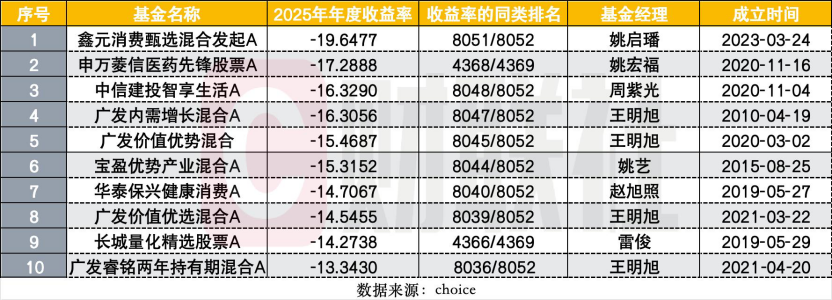
Core Viewpoint - The A-share market in 2025 exhibited a clear structural bull market, with significant performance disparities among active equity funds, highlighted by the top-performing fund achieving a record annual return of 233.29% while others faced substantial losses, including the worst performer with a -19.65% return [1][4]. Group 1: Market Performance - The Shanghai Composite Index, Shenzhen Component Index, ChiNext Index, and Sci-Tech Innovation 50 Index rose by 18.41%, 29.87%, 49.57%, and 35.92% respectively in 2025 [1]. - A total of 4888 active equity products from 160 public fund institutions reported positive returns, while 144 products from 68 institutions experienced losses [1][9]. Group 2: Fund Performance Disparities - The top-performing fund, Yongying Technology Smart Selection, achieved a record annual return of 233.29%, surpassing the previous record set by Wang Yawei in 2007 [1]. - The worst-performing fund, Xinyuan Consumption Selection, recorded a -19.65% return, marking a significant gap of 252.94% from the top performer [2][4]. Group 3: Xinyuan Consumption Selection Analysis - Xinyuan Consumption Selection's poor performance is attributed to aggressive trading strategies, frequent personnel changes, and scale challenges, leading to a lack of coherent investment logic [3][5]. - The fund's industry allocation showed erratic shifts, moving from heavy investments in pharmaceuticals to technology and later to media, missing key market trends [5][6]. Group 4: Fund Manager Insights - Notable fund managers, including Wang Mingxu and Han Weijun, saw their products listed among the worst performers, with their total managed assets shrinking by over 70% compared to previous peaks [3][9][12]. - Xinyuan Consumption Selection faced a critical challenge to meet its scale assessment, needing to grow from 0.29 billion to 2 billion within three months [7][8]. Group 5: Institutional Investment Trends - Institutional ownership in Xinyuan Consumption Selection dropped from over 95% to 42.94% by mid-2025, indicating a significant withdrawal of institutional funds [7]. - The trend of multiple products from the same fund manager appearing on the loss list highlights a broader issue within the industry, affecting even previously successful managers [9][10].

押注失误,巨亏爆表,广发百亿基金6只倒数产品
Sou Hu Cai Jing· 2025-10-28 04:16
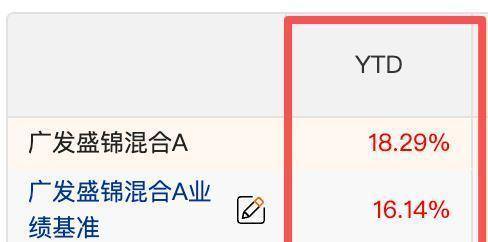
Core Insights - The performance of Wang Mingxu's funds has significantly declined, with a year-to-date return of -12.69%, ranking last among 1522 fund managers [1][10] - A systemic issue is evident as six out of seven equity products managed by Wang have consistently underperformed, with declines mostly in double digits [2][4] - The concentrated investment strategy, heavily weighted in traditional value stocks, has led to increased risk and poor performance, especially as market styles shift [3][6] Performance Analysis - Wang's funds were primarily established during market peaks in 2020-2021, leading to a disadvantage as market preferences shifted towards growth and technology sectors [3] - The contrasting performance of the Guangfa Shengjin Mixed Fund, which achieved an 18.29% positive return, highlights the importance of a diversified investment approach [3] - The management scale of Wang has decreased from over 300 billion to around 100 billion, indicating a loss of market confidence [6] Market Sentiment - Investor dissatisfaction is growing due to the significant gap between expectations and actual performance, exacerbated by long-term underperformance [4][8] - The second quarter saw Wang reduce holdings in real estate and brokerage sectors while increasing positions in banks and consumer electronics, which did not align with market trends [4] - The upcoming quarterly report will be crucial in determining whether there will be substantial adjustments in fund positions and risk management strategies [8] Fund Performance Metrics - Specific funds managed by Wang have shown substantial losses, with the Guangfa Value Advantage Mixed Fund down 17.40% and the Guangfa Value Preferred Mixed Fund down 15.36% year-to-date [9] - The performance of these funds is significantly lagging behind the benchmark index, the CSI 300, which has gained 17.06% [9][10] Strategic Recommendations - The need for timely adjustments and clear communication from the fund management is critical to restore investor trust and improve performance [8][10] - Enhancing portfolio diversity and risk management execution will be essential for future recovery, as the market may not remain forgiving [10]
百亿基金经理的滑铁卢:广发基金经理王明旭旗下产品集体垫底引发的投资策略反思
Sou Hu Cai Jing· 2025-10-27 02:51
Core Viewpoint - The public fund market in 2025 presents a stark contrast, with the A-share market recovering while prominent fund manager Wang Mingxu faces significant setbacks, leading to a decline in the performance of his managed funds [3][11]. Performance Overview - Wang Mingxu's seven independently managed equity funds have all reported negative returns year-to-date as of October 23, 2025, with four of them ranking among the bottom ten in performance within their category [4][5]. - The funds managed by Wang Mingxu have underperformed significantly compared to the benchmark index, with the flagship fund, Guangfa Value Advantage Mixed, showing a decline of 17.40%, contrasting sharply with the 17.06% increase in the CSI 300 index [5][6]. Investment Strategy - An analysis of Wang Mingxu's investment strategy reveals a high degree of similarity across his funds, with concentrated holdings in specific stocks such as Jiangsu Bank and Sifang Jingchuang, which have not performed well in the current market [8][10]. - The strategy of heavily investing in traditional value stocks has not aligned with the market's preference for growth stocks, particularly in sectors like pharmaceuticals and technology, leading to poor performance [10]. Comparative Performance - In contrast to Wang Mingxu's struggling funds, the Guangfa Shengjin Mixed Fund, co-managed with Duan Tao, achieved a positive return of 18.29%, highlighting the importance of diversified investment strategies [10]. - The successful performance of Guangfa Shengjin Mixed underscores the necessity for flexibility and balance in investment portfolios, especially in a rapidly changing market environment [10]. Investor Sentiment - Wang Mingxu's management scale has decreased from a peak of 306.52 billion yuan in mid-2021 to 108.91 billion yuan, reflecting a growing trust crisis among investors [11]. - The dissatisfaction among investors is evident, with many expressing frustration over losses, indicating a potential shift in investor confidence and expectations for future performance [11][12].
9月份混基跌幅榜前十广发基金占一半 王明旭5基金跌1成
Zhong Guo Jing Ji Wang· 2025-10-10 08:08
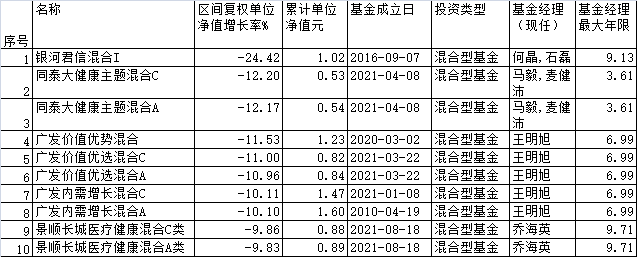
Core Insights - In September, five mixed funds managed by GF Fund ranked among the top ten funds with the largest declines, each experiencing a drop of over 10% [1][2] Group 1: Fund Performance - The five funds with significant declines include GF Value Advantage Mixed (-11.53%), GF Value Preferred Mixed C (-11.00%), GF Value Preferred Mixed A (-10.96%), GF Domestic Demand Growth Mixed C (-10.11%), and GF Domestic Demand Growth Mixed A (-10.10%) [1][4] - All five funds are managed by Wang Mingxu, who has nearly seven years of experience managing funds and has held various positions in the finance sector [1][2] Group 2: Fund Holdings - The top ten holdings for GF Value Advantage Mixed include Midea Group, Jiangsu Bank, Yangtze Power, Longxin Group, TCL Electronics, Chengdu Bank, Sifang Jingchuang, Hangzhou Bank, Lakala, and Kweichow Moutai [1][2] - Similar holdings are observed in other funds, with a consistent focus on large-cap blue-chip stocks and undervalued sectors, reflecting Wang Mingxu's investment style [2]
9月份超81%混基正收益 嘉实新优选混合涨30.17%
Zhong Guo Jing Ji Wang· 2025-10-09 23:10
Core Insights - In September, 81.81% of the 8627 mixed funds with comparable performance saw an increase in net value, while 1549 funds experienced a decline [1] - Fourteen mixed funds achieved a monthly increase of over 25%, with the top performers being 嘉实新优选混合, 东方新能源汽车主题混合, and others, showing returns between 27.03% and 30.17% [1][2] - 嘉实新优选混合 fund, established in April 2016, reported a year-to-date return of 54.33% and a cumulative net value of 1.4440 yuan as of September 30, 2025 [1][2] Fund Performance - 嘉实新优选混合 increased its allocation to leading lithium battery equipment companies, with top holdings including 宁德时代 and 星宇股份 as of June 30 [2] - 泉果旭源三年持有期混合A, the largest fund by size, had a monthly increase of 26.02% and a year-to-date return of 48.80%, with a cumulative net value of 1.1172 yuan [3] - The top holdings of 泉果旭源三年持有期混合A include 科达利 and 腾讯控股, focusing on sectors like high-end manufacturing and internet companies [3] Declining Funds - Eight mixed funds experienced a decline of over 10% in September, with five belonging to 广发基金, showing declines ranging from 10.10% to 11.53% [4]
“924”一周年:7年老将旗下广发价值优选逆势亏5%
Zhong Guo Jing Ji Wang· 2025-09-26 08:15
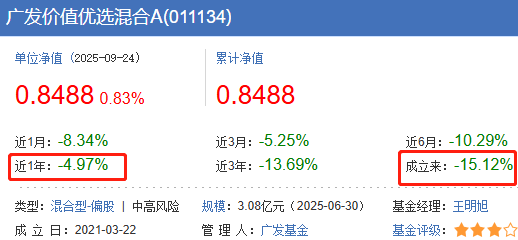
Core Insights - The article discusses the performance of the fund "Guangfa Value Selected Mixed A" over the past year, highlighting that despite a significant market recovery since "September 24" last year, the fund has experienced losses due to poor sector allocation by fund managers [1] Fund Performance Summary - Guangfa Value Selected Mixed A has reported a one-year loss of 4.97% and a cumulative loss of 15.12% since its inception on March 22, 2021 [1][2] - The fund maintained over 90% equity exposure in the past year but struggled due to inaccurate sector allocation, particularly in the liquor and real estate sectors during Q4 of last year and Q1 of this year [1] - The fund's performance metrics as of September 24, 2025, show a unit net value of 0.8488 and a total fund size of 308 million yuan [2] Manager Background - The fund is managed by Wang Mingxu, who has extensive experience in investment management and has been managing funds at Guangfa since October 2018 [3] - Wang's investment style focuses on undervalued blue-chip stocks, but the recent downturn in blue-chip stocks has negatively impacted the fund's performance, with year-to-date losses of 12.31% for A shares and 12.57% for C shares [3] Comparative Performance - The fund's performance is significantly below its peers, with the average return for similar funds being 54.48% over the past year, while the Shanghai and Shenzhen 300 index has returned 35.04% [4][6] - The fund's ranking among peers has declined, with A shares ranking 4795 and C shares ranking 4796 out of nearly 4800 funds in various time frames [4][6]