
引力二号

Search documents
朱雀三号即将再次回收试验,我国火箭重复使用技术有望突破
Changjiang Securities· 2026-03-03 00:49
Investment Rating - The industry investment rating is "Positive" and maintained [6] Core Viewpoints - On February 25, Blue Arrow Aerospace announced that its Zhuque-3 reusable launch vehicle plans to conduct another recovery test in the second quarter of this year, aiming for its first recovery flight in the fourth quarter [3][4] - The successful recovery of reusable rockets is expected to significantly reduce launch costs, accelerating the development of China's commercial aerospace industry [4][9] - The Zhuque-3's first recovery test, although unsuccessful, provided valuable real-world data that can be used to improve technology through a cycle of testing and refinement [4][9] - Multiple Chinese commercial aerospace companies are expected to conduct their first flights or recovery tests within the year, indicating a shift from technological breakthroughs to large-scale development in the industry [4][9] Summary by Sections Event Description - Blue Arrow Aerospace plans to conduct a recovery test for the Zhuque-3 in the second quarter and aims for its first recovery flight in the fourth quarter [3] Event Commentary - The Zhuque-3's first recovery test provided critical data despite its failure, which will aid in refining technology for future tests [4] - The timeline for Zhuque-3's recovery flight could be significantly shorter than that of SpaceX, showcasing China's rapid advancements in commercial aerospace [4] - Other companies like CAS Space and Tianbing Technology are also set to conduct significant tests this year, reflecting a broader trend in the industry towards frequent and cost-effective operations [4]
未知机构:商业航天动态当地时间2月28日美国已将太空部队空军海军海军陆战队-20260302
未知机构· 2026-03-02 02:45
Summary of Key Points from Conference Call Records Industry Overview - The records focus on the **commercial aerospace industry** and highlight various companies involved in space technology and rocket launches, including **SpaceX**, **信维通信 (XW Communication)**, **RKLB**, **蓝箭航天 (Blue Arrow Aerospace)**, and others. Core Insights and Arguments - **SpaceX IPO**: According to Bloomberg, SpaceX is expected to file for an IPO as early as March, with the IPO anticipated in June, and a valuation exceeding **$1.75 trillion** [1] - **Starship V3 Launch**: The Starship V3 is scheduled for its maiden flight in mid-March [2] - **RKLB Neutron Rocket**: The reusable Neutron rocket from RKLB is planned for its first flight in Q2 [2] - **Domestic Launches**: - The **Li Jian No. 2** reusable rocket is set for its first flight in late March [2] - The **Zhuque No. 3** is expected to attempt recovery in Q2, with a reuse flight targeted for Q4 [2] - Other rockets, including **Tianlong No. 3**, **Zhishenxing No. 1**, and **Xingyun No. 1**, are also scheduled for upcoming launches [2] - **Intensified Launch Schedule**: Starting from April, China will see a concentrated schedule of new rocket launches and recoveries, with 2026 potentially marking a significant year for rocket recovery in the country [2] Investment Recommendations - The commercial aerospace sector is entering a **catalytic period**, with strong certainty in market trends [2] - Key investment targets include: - **GW Core Targets**: 电科蓝天 (Electric Science Blue Sky), 信科移动 (XW Mobile), 航天电子 (Aerospace Electronics), and others [2] - **G60 Core Targets**: 电科蓝天, 上海瀚讯 (Shanghai Hanxun), 长江通信 (Yangtze Communication) [2] - Specific segments such as laser communication and power systems have highlighted companies like 航天电子 and 明阳智能 (Mingyang Smart Energy) [2] Additional Important Content - The records mention the **upcoming two sessions** in early March, which may influence policy and investment in the aerospace sector [2] - The **Blue Arrow Aerospace** and **Zhongke Aerospace** IPOs are progressing steadily, indicating a robust market for new entrants [2] - The focus on **core targets** across various segments suggests a strategic approach to investment based on potential growth and market dynamics [2][3]
四大利好驱动,商业航天概念活跃丨盘中线索
2 1 Shi Ji Jing Ji Bao Dao· 2026-02-27 02:40
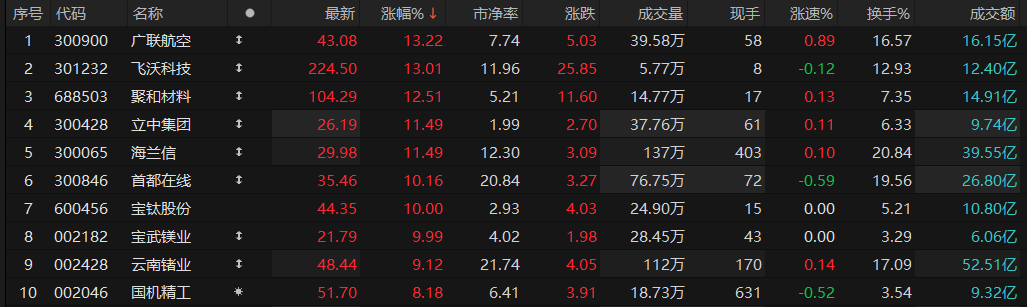
Group 1 - The commercial aerospace sector is experiencing a resurgence driven by four main advantages: policy support, capital influx, industry activity, and technological breakthroughs [1][2] - Policy support is evident as over 20 provinces in China have mentioned plans for commercial aerospace industries during local meetings, with expectations for further emphasis during the upcoming national meetings [1] - Capital influx is highlighted by significant financing events, including a record 5.037 billion yuan raised by Space Honor in its D++ round, indicating a growing recognition of the commercial aerospace sector [1] - The industry is witnessing increased activity with the completion of the main structure of the Hainan commercial aerospace launch site, which is expected to have a launch capacity of 60 per year by the end of the year [1][2] Group 2 - Technological advancements are leading to a peak in domestic commercial aerospace launches, with multiple reusable rockets scheduled for launch in March [2] - The market for commercial aerospace is expanding, prompting a "recommended" rating from Huolong Securities, which suggests focusing on specific companies in rocket launching, satellite manufacturing, and satellite applications [2] - On February 27, stocks related to commercial aerospace, such as Guanglian Aviation and Feiwo Technology, saw significant gains, indicating strong market interest [3]





中美俄,重磅!深夜,跳水;谈判一波三折,油价大涨;美联储,重大变数!
Sou Hu Cai Jing· 2026-02-05 00:47
Market Dynamics - The U.S. stock market showed mixed results, with the Dow Jones up by 0.53%, while the S&P 500 and Nasdaq fell by 0.51% and 1.51% respectively, with the Nasdaq breaking below its 100-day moving average [1] - Southbound capital in Hong Kong saw a net inflow of approximately 13.373 billion HKD, marking the highest single-day inflow since January 22, with Tencent and Alibaba receiving net purchases of about 2.231 billion HKD and 1.171 billion HKD respectively [4] - The latest data indicates that the number of newly opened margin trading accounts in January 2026 reached 190,500, a 29.5% increase from December 2025, and a 157.09% increase year-on-year [4] Commodity Prices - WTI crude oil futures rose by 3.05% to $65.14 per barrel, while Brent crude increased by 3.16% to $69.46 per barrel [2] - COMEX gold futures increased by 1.04% to $4,986.4 per ounce, and silver futures rose by 5.36% to $87.765 per ounce [2] Industry Developments - Domestic private commercial rocket company Dongfang Space is expected to complete the first flight of its "Gravity II" medium-sized liquid reusable launch vehicle by mid-2026 [5] - The National Space Computing Center, part of the "Star Computing" plan by Guoxing Aerospace, aims to establish a super space computing network consisting of 2,800 satellites, with the first group already launched [5] - Tesla's Shanghai factory delivered 69,129 vehicles in January, marking a 9% year-on-year increase, continuing a trend of growth in wholesale sales for three consecutive months [16] Technological Innovations - The brain-machine interaction and human-machine integration laboratory has developed the first brain-controlled acupuncture and neuro-rehabilitation equipment platform in China, which is currently undergoing clinical trials [9] - Tencent's AI Infra team launched an open-source high-performance LLM inference core operator library, achieving a 30% improvement in model inference performance [7] Regulatory and Policy Updates - The People's Bank of China emphasized the need for structural monetary policy tools to support key areas such as expanding domestic demand and technological innovation [10] - The Ministry of Industry and Information Technology highlighted the importance of AI in manufacturing, aiming to strengthen application foundations and key technologies [11]
商业火箭,“芯级回收”走到哪一步了?
Feng Huang Wang· 2026-02-04 05:56
Core Viewpoint - The domestic private commercial rocket company, Dongfang Space, is set to complete the first flight of its medium-sized liquid reusable launch vehicle, "Gravity II," by mid-2026, marking a significant advancement in China's commercial space sector [1] Group 1: Technology and Innovation - "Gravity II" features an innovative core-level recovery design aimed at meeting the demands of large-scale satellite networking and commercial high-orbit launches [1] - The core-level recovery technology is customized for commercial space needs, allowing for at least 30 reuses of the rocket body through the use of lightweight, high-strength alloy materials and modular design [2] - The rapid turnaround capability enables the recovered core to be ready for launch again within 48 hours after maintenance, supporting a high-density launch schedule of "one rocket per week" [2] Group 2: Market Context and Competition - The demand for reusable rockets is driven by the urgent need for bulk satellite launches due to the recent surge in low Earth orbit communication satellite constellations [2] - Internationally, SpaceX leads the field with its Falcon 9 rocket, achieving over 200 recoveries and more than 180 reuse flights, demonstrating the operational viability of recovery technology [2] - In China, both state-owned and private companies, including China Aerospace Science and Technology Corporation and Blue Arrow Aerospace, are advancing reusable rocket development, creating a collaborative environment between state and private sectors [3] Group 3: Challenges and Differentiation - The understanding of core-level recovery among domestic commercial space companies is diversifying, with some viewing it as essential for high-frequency near-Earth orbit launches, while others question its economic viability in larger payload scenarios [4][5] - Dongfang Space's approach with "Gravity II" represents a critical capability enhancement, transitioning from solid rocket systems to liquid reusable rockets, which will determine its competitiveness in the medium to large commercial launch market [5]
商业火箭,“芯级回收”走到哪一步了?
财联社· 2026-02-04 05:35
Core Viewpoint - The article discusses the advancements in China's commercial space industry, particularly focusing on the development of reusable rocket technology, exemplified by the "Gravity-2" rocket from Dongfang Space, which is set to complete its maiden flight by mid-2026 [1][4]. Group 1: Development of "Gravity-2" - Dongfang Space's "Gravity-2" is a medium-to-large liquid reusable launch vehicle designed for large-scale satellite networking and commercial high-orbit launch needs, featuring innovative core stage recovery technology [1][2]. - The core stage recovery technology is customized for commercial space needs, allowing for at least 30 reuses of the rocket body and enabling rapid turnaround with maintenance completed within 48 hours [2]. Group 2: Importance of Core Stage Recovery - The demand for satellite launches has surged due to the large-scale deployment of low Earth orbit communication satellite constellations, making reusable rockets more suitable for high-frequency launch scenarios [3]. - Reusable rockets significantly reduce the cost of each launch, with SpaceX's Falcon 9 demonstrating a cost reduction of approximately 20-30% per launch through recovery and reuse [3]. Group 3: Competitive Landscape - China is accelerating its efforts in the reusable rocket sector, with both state-owned enterprises like China Aerospace Science and Technology Corporation and private companies like Dongfang Space and Blue Arrow Aerospace focusing on this technology [5]. - The industry is witnessing a division in understanding of core stage recovery, with some companies prioritizing high-frequency near-Earth orbit launches, while others assess the economic viability of recovery mechanisms in more complex mission scenarios [6].

卫星ETF鹏华(563790)涨超3.6%,“引力二号”预计2026年年中完成首飞
Xin Lang Cai Jing· 2026-02-03 07:07
Core Viewpoint - The commercial aerospace sector is experiencing significant activity, with the launch of the self-developed Gravitational No. 2 rocket by Dongfang Space, aimed at meeting the demand for medium to large satellite networks and commercial high-orbit launches, expected to complete its maiden flight by mid-2026 [1] Group 1: Industry Developments - The demand for rockets is surging, prompting attention to upstream materials, while the midstream equipment sector is expected to see significant changes in engine technology and 3D printing, which are characterized by scarcity and long-term inflationary logic [1] - The domestic market is anticipated to enter a new era of reusable rockets in 2026, driven by the synergy between commercial companies and state-owned enterprises [1] Group 2: Market Performance - As of February 3, 2026, the Zhongzheng Satellite Industry Index (931594) rose by 4.28%, with notable increases in constituent stocks such as Hailanxin (up 15.91%), XW Communication (up 11.58%), and Chip Origin (up 10.07%) [1] - The Penghua Satellite ETF (563790), which closely tracks the Zhongzheng Satellite Industry Index, increased by 3.61%, with a latest price of 1.23 yuan [1] Group 3: Index Composition - As of January 30, 2026, the top ten weighted stocks in the Zhongzheng Satellite Industry Index include Aerospace Electronics, China Satellite, Zhenlei Technology, and others, collectively accounting for 64.36% of the index [2]




马斯克押注太空AI算力,Space X完成收购xAI,商业航天再度全线起飞,广联航空涨超11%,航发控制涨停,航空ETF汇添富(159257)大涨3.46%
Sou Hu Cai Jing· 2026-02-03 05:40
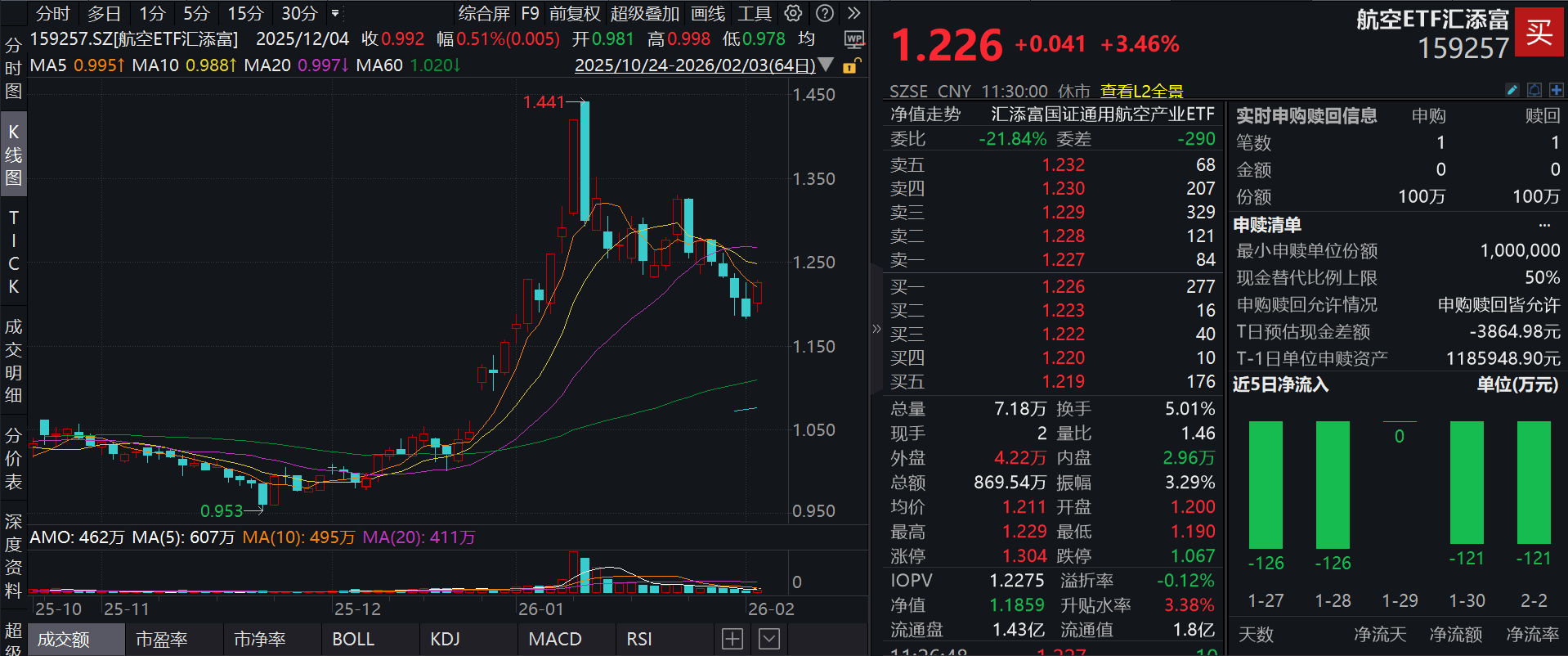
Core Viewpoint - The A-share market has rebounded, with over 4,300 stocks rising, particularly in the commercial aerospace sector, which saw significant gains in related indices and stocks [1] Group 1: Market Performance - The National General Aviation Industry Index (980076) surged by 3.49%, with key stocks like Guanglian Aviation rising over 11% and Hangfa Control hitting the daily limit [1] - The Aviation ETF Huatai (159257) increased by 3.46%, with a latest price of 1.23 yuan, and has shown a cumulative increase of 2.60% over the past month [1] - The Aviation ETF Huatai had a turnover rate of 5.8% during the trading session, with a transaction volume exceeding 10 million yuan [1][3] Group 2: Fund Flows and Growth - The Aviation ETF Huatai experienced a scale growth of 101 million yuan over the past three months, ranking third among comparable funds [3] - The latest net outflow for the Aviation ETF Huatai was 1.206 million yuan, but it attracted a total of 113 million yuan over the past 21 trading days [4] Group 3: Strategic Developments - SpaceX announced the acquisition of AI startup xAI, integrating its rocket and satellite technology with AI capabilities, marking a strategic move towards building a "Space AI Empire" [4][5] - The concept of deploying orbital data centers in space to utilize solar energy for AI processing is seen as a breakthrough in overcoming current data center limitations [4] - The Chinese commercial aerospace sector is focusing on reusable rockets to reduce launch costs and increase frequency, with significant advancements expected in the coming years [5][6] Group 4: Industry Outlook - The Chinese aerospace sector is planning to develop new fields such as space tourism and smart infrastructure, with initiatives like the establishment of the "China Jiuquan Commercial Aerospace Port" [6] - The Aviation ETF Huatai focuses on low-altitude economy, military industry, and commercial aerospace, with defense and military sectors making up 61.6% of its index [7][10] - The low-altitude economy concept stocks account for 53% of the index, indicating strong potential for growth in this area [9][10]

商业火箭迎关键验证窗口:发动机决定太空探索深度,3D打印则是降本核心
Hua Er Jie Jian Wen· 2026-01-23 14:43
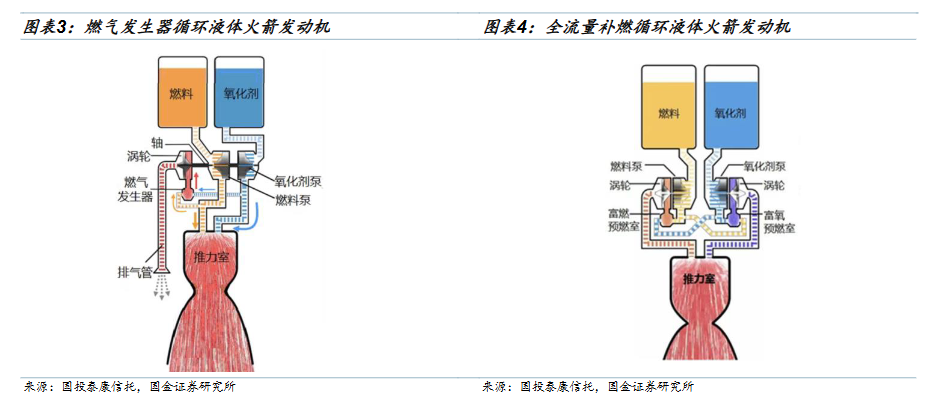
Core Viewpoint - The key to competition in the commercial aerospace industry lies in surpassing the profitability threshold of "2.8 tons payload at 800 km orbit," which is fundamentally linked to advancements in upstream hard technology, particularly in engine performance and 3D printing capabilities [1][2]. Industry Analysis - The commercial aerospace sector is entering a critical development phase, with 2026-2027 identified as a pivotal window for Chinese commercial rocket companies, marking the first flights of several medium to large liquid rockets and the practical testing of reusable technology [1][2]. - The demand for satellite internet, such as GW constellations, is driving the need for enhanced payload capacity and cost control, making companies that can meet the "2.8 tons at 800 km" threshold key players in the market [1][2]. Technological Advancements - Engine technology is evolving towards full-flow staged combustion and large thrust capabilities, which are essential for increasing rocket performance limits. Currently, most Chinese commercial rocket engines utilize gas generator cycles, but the industry is shifting towards more efficient full-flow staged combustion designs [3][4]. - 3D printing has become a core production capability in the aerospace sector, significantly reducing production cycles and weight. For instance, production times have decreased from 50 hours to 10 hours, with weight reductions exceeding 50% for certain components [10][11]. Market Dynamics - The transition from small solid rockets to medium and large liquid reusable rockets is reshaping the supply chain, with a focus on core components like 3D printing, large storage tanks, and servo systems, which are gaining increased market attention [2][3]. - The Chinese 3D printing market is projected to reach approximately 41.5 billion yuan in 2024, with the aerospace sector accounting for about 16.7% of this market, highlighting the growing importance of this technology in commercial rocket manufacturing [10][11]. Structural and Material Innovations - As payload capacities increase, rocket structures are evolving towards larger dimensions, with tank costs comprising over 60% of the overall structure costs. New materials, such as stainless steel, are being adopted for storage tanks due to their strength and cost-effectiveness [13]. - The control systems in rockets are also being upgraded to meet the demands of high-frequency launches, transitioning from traditional electric servos to electromechanical hydraulic servos, creating new market opportunities for related supply chain companies [13].
商业航天行业研究:商业火箭产业链梳理——基于一二级产业的视角
SINOLINK SECURITIES· 2026-01-23 00:24
Investment Rating - The report suggests a positive investment outlook for the commercial rocket industry, particularly focusing on the upcoming key validation window in 2026-2027 for Chinese commercial rocket companies [1][12]. Core Insights - The commercial aerospace industry is experiencing a global resonance, with multiple medium and large rocket launches expected in China by 2026, leading to a dense launch schedule and large-scale satellite networking by 2027 [1][11]. - The success rate of rocket launches and corresponding payload capacity are critical indicators of a company's competitive edge in future commercial operations [1][12]. - The report emphasizes the importance of engine design capabilities, thrust, and parallel capabilities as core focus areas for rocket engines, with a shift towards full-flow staged combustion liquid oxygen-methane engines anticipated [2][17]. Summary by Sections 1. Commercial Rocket Launch Status and Outlook - 2026-2027 is identified as a critical validation window for Chinese commercial rocket companies, with many planning to launch liquid rockets and conduct recovery tests [12][13]. - Successful completion of high payload or reusable flights will provide companies with reliability and cost advantages, potentially securing contracts with leading satellite companies [12][13]. 2. Engine Development - The majority of Chinese commercial rocket companies utilize gas generator cycle engines, with future developments expected to focus on full-flow staged combustion engines and nuclear-powered engines [2][17]. - The report highlights that successful launches of liquid rocket engines have primarily been sourced from state-owned enterprises, with only a few private companies achieving launch success [2][28]. 3. 3D Printing Technology - 3D printing is recognized as a key technology for reducing costs and shortening production times in commercial aerospace, with significant applications in manufacturing lightweight and complex components [3][30]. - The Chinese 3D printing market is projected to reach approximately 41.5 billion yuan in 2024, with the aerospace sector accounting for about 16.7% of this market [31][34]. 4. Structural Components - Structural components account for approximately 25%-30% of commercial rocket costs, with tank costs exceeding 60% of this value [36][37]. - The report anticipates a trend towards larger structural components as engine thrust increases, with a shift from aluminum alloys to higher strength, lower cost stainless steel materials [36][37]. 5. Control Systems - The flight control software is described as the "brain" of the rocket, primarily developed in-house by rocket companies, with servo systems representing 6%-10% of the rocket's value [4][39]. - The report notes a transition from electric servos to electromechanical hydraulic servos in commercial aerospace [4]. 6. Investment Recommendations - The report recommends focusing on listed companies within the system and those closely collaborating with leading private rocket companies, particularly in high-value segments such as 3D printing, tanks, servos, and materials [5].