
微信Agent

Search documents
招商证券国际:维持腾讯控股“增持”评级 调低目标价8.6%至700港元
Xin Lang Cai Jing· 2026-03-20 03:36
Core Viewpoint - The report from China Merchants Securities International lowers the target price for Tencent Holdings (00700) from HKD 766 to HKD 700, a decrease of 8.6%, while maintaining an "Overweight" investment rating [1][4]. Financial Performance - Tencent's Q4 performance for the previous year met expectations, leading to a 6% downward revision in the earnings forecast for the fiscal years 2026-27, primarily due to increased investments in artificial intelligence (AI) [1][4]. - The projected revenue and adjusted net profit growth for Tencent in fiscal year 2026 is estimated at 10% and 8%, respectively, with the new target price corresponding to a 21 times forecasted price-to-earnings (P/E) ratio for that year [1][4]. Valuation Comparison - Tencent's current valuation for fiscal years 2026/27 stands at 16 times and 14 times forecasted P/E ratios, which is in line with the company's historical average [1][4]. - In comparison, Chinese peers are valued at 14 times and 11 times, while U.S. peers are at 24 times and 20 times [1][4]. Growth Drivers - The report highlights several growth drivers for Tencent, including a strong social network moat, advancements in AI technology, accelerated advertising business, new game launches (e.g., "Honor of Kings: World" expected in April), commercialization of AI products, overseas opportunities, and profit margin improvements driven by AI [1][4].



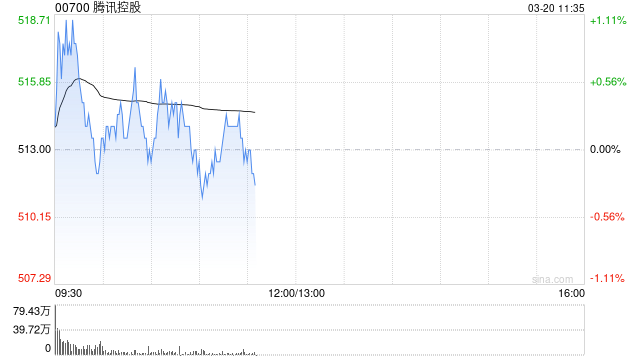
招商证券国际:维持腾讯控股(00700)“增持”评级 调低目标价8.6%至700港元
智通财经网· 2026-03-20 02:26
Core Viewpoint - The report from China Merchants Securities International indicates a reduction in the target price for Tencent Holdings (00700) from HKD 766 to HKD 700, representing an 8.6% decrease, while maintaining an "Overweight" investment rating [1] Financial Performance - Tencent's Q4 performance for the previous year met expectations, leading to a downward revision of the earnings forecast for the fiscal years 2026-27 by 6% due to increased investments in the AI sector [1] - The projected revenue and adjusted net profit growth for Tencent in the fiscal year 2026 is estimated at 10% and 8%, respectively, with the new target price corresponding to a 21 times forecasted price-to-earnings ratio for 2026 [1] Valuation Comparison - Tencent's current valuation for the fiscal years 2026/27 stands at 16 times and 14 times forecasted price-to-earnings ratios, which aligns with the company's historical average [1] - In comparison, Chinese peers are valued at 14 times and 11 times, while U.S. peers are at 24 times and 20 times [1] Growth Drivers - The report highlights several growth drivers for Tencent, including a strong social network moat, advancements in AI technology, accelerated advertising business, new game launches (e.g., "Honor of Kings: World" expected in April), commercialization of AI products, overseas opportunities, and profit margin improvements driven by AI [1]
暴涨逾6%!大数据ETF华宝(516700)冲击12连阳
Mei Ri Jing Ji Xin Wen· 2026-01-12 02:39
Group 1 - The AI application sector continues to surge, with the big data ETF Huabao (516700) experiencing a price increase of over 6%, marking a 12-day consecutive rise in daily trading volume [1] - Positive news includes the anticipated release of DeepSeek V4, which may surpass OpenAI GPT in AI programming capabilities, and Alibaba's Qwen 3.5, expected to enhance multimodal understanding and coding abilities [1] - The listing of Zhihui, the first global large model stock, on January 8 in Hong Kong, signifies a growing interest in AI models [1] Group 2 - Data centers are identified as the core infrastructure for AI, with a high demand for computing power driving growth in the IDC industry [2] - The North American and Chinese markets are highlighted as key growth areas, with significant projects still pending in overseas markets, while domestic demand is expected to rebound after a temporary slowdown due to import restrictions on computing cards [2] - The big data ETF Huabao (516700) passively tracks the CSI Big Data Industry Index, focusing on sectors like data centers and cloud computing, with major holdings in leading companies such as Inspur, iFlytek, and China Software [2]
冲击12连阳!DeepSeek V4有望春节发布,大数据ETF华宝(516700)暴拉4%,易点天下二连板,股价再创新高!
Xin Lang Cai Jing· 2026-01-12 01:57
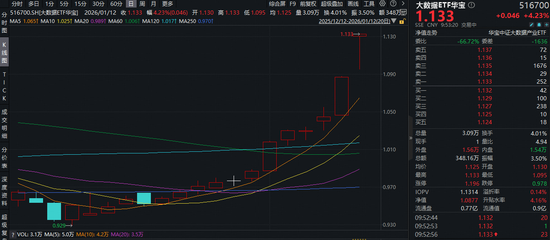
Core Viewpoint - The AI application sector continues to surge, with the big data ETF Huabao (516700) experiencing a significant price increase of 4.23%, marking a 12-day consecutive rise in its daily line [1]. Group 1: Market Performance - The big data ETF Huabao focuses on data technology and data security, heavily investing in sectors such as data centers, cloud computing, and big data processing [6]. - Key stocks within the ETF include Zhongke Shuguang, Keda Xunfei, Unisplendour, Inspur Information, China Greatwall, and China Software, indicating a strong focus on technology self-reliance [6]. - Notable stock performances include Yidian Tianxia reaching a new high with a 19.47% drop, while Tax Friend and China Greatwall hit the daily limit up [9][10]. Group 2: AI Model Developments - The AI model landscape is evolving, with DeepSeek V4 expected to be released around the Spring Festival, potentially surpassing OpenAI's GPT in programming capabilities [11]. - Alibaba's Qwen 3.5 is anticipated to enhance multimodal understanding and coding abilities, while the first global AI model stock, Zhipu, began trading on January 8 [11]. - The competition among major internet companies is intensifying, leading to a "arms race" in model training and inference, with a strong demand for computing power as a foundational support for growth [11]. Group 3: Policy and Infrastructure - The Ministry of Industry and Information Technology is encouraging the transformation of AI in manufacturing, which is expected to drive upgrades in AI computing infrastructure [12]. - The demand for data centers is increasing due to the high growth in the computing power market, with North America and China identified as key growth regions [12]. - The domestic AIDC bidding is showing signs of recovery, which may serve as an early indicator of improved sentiment in the domestic AI sector [12]. Group 4: Investment Catalysts - Investors focusing on technology self-reliance may find opportunities in three key areas: the call for "technology to take the lead," the activation of digital productivity through top-level design, and the acceleration of the Xinchuang 2.0 wave [13].
大模型不能-吞噬一切-重视AI应用投资机会
2026-01-04 15:35
Summary of Key Points from Conference Call Industry Overview - The AI application market in 2025 performed generally poorly, with disappointing results from Q2 to Q4, despite some growth driven by Deepseek post-Spring Festival [2][4] - The acquisition of Manus by Facebook has sparked renewed interest in AI applications, indicating that vertical AI applications have independent value and that Chinese companies have strong overseas commercialization capabilities [2][4] Core Insights and Arguments - The perception that large models dominate the market has hindered the growth of non-top-tier AI application products [2][4] - The optimism for the AI application market in 2026 is driven by major companies accelerating their consumer-facing (C-end) strategies, such as Alibaba's integration of its Qianwen app with Gaode Map and ByteDance's collaboration with CCTV for the Spring Festival Gala [2][5] - ByteDance's focus on its Doubao AI assistant and Tencent's upgrade of its AI architecture, particularly for WeChat Agent, highlight the competitive landscape in C-end AI applications [7][9] - The competition between ChatGPT and Google's Gemini is intensifying, with Gemini surpassing ChatGPT in usage time as of October 2025, despite ChatGPT maintaining a larger user base [11] Important Trends and Developments - The AI application market is expected to see significant growth in 2026, with OpenAI projecting revenues of $20 billion for 2025, primarily from ChatGPT subscriptions [13] - Major tech companies are focusing on building their traffic entry points to capture market share in the AI era, with companies like Alibaba and ByteDance leading the charge [12][14] - MiniMax is positioned competitively in the multi-modal AI model space, with strong performance in audio, video, and text models contributing to its revenue [22][23] Potential Investment Opportunities - Investors are advised to focus on major tech companies and their ecosystem partners, as well as advertising marketing opportunities that may arise from the commercialization of AI applications [27] - Bilibili (B站) is expected to see significant growth in 2026, driven by its successful New Year's Eve gala and upcoming game releases, with a projected adjusted profit of approximately 30.7 billion yuan [28][29] Other Noteworthy Points - The acquisition of Manus by Facebook signifies the importance of vertical AI applications and the potential for Chinese companies to thrive in international markets [4][6] - The competitive landscape for traffic entry points is crucial for companies to seize new opportunities in the evolving AI market [12][14] - The rise of Generative Engine Optimization (GO) as a new advertising marketing technique presents a high market potential for companies that can effectively leverage AI search capabilities [17][21]

字节“造”手机:走华为造车的路,打阿里腾讯的脸?
Xin Lang Cai Jing· 2025-12-02 05:56
Core Viewpoint - ByteDance is set to release an AI-integrated smartphone in collaboration with ZTE, marking a significant move into hardware without directly manufacturing devices, leveraging its AI capabilities instead [1][2][3]. Group 1: ByteDance's Smartphone Strategy - ByteDance is collaborating with ZTE to launch an AI smartphone, where ByteDance leads the integration of its AI model, Doubao, while ZTE focuses on hardware design and manufacturing [1]. - The smartphone will feature a high-permission AI Agent that can execute complex tasks across applications, significantly enhancing user experience compared to traditional AI applications [1][2]. - This strategy allows ByteDance to embed its AI capabilities deeply into hardware without the need to produce its own devices, similar to Huawei's approach in the automotive sector [3][4]. Group 2: Comparison with Competitors - Other tech giants like Tencent and Alibaba are also developing AI Agents, with Tencent's WeChat aiming to create a comprehensive ecosystem that integrates various services within its platform [13][14]. - Alibaba's "Qianwen" project aims to create a personal AI assistant that can seamlessly integrate with its existing services, enhancing user experience through a closed-loop system [15]. - However, both Tencent and Alibaba face limitations in their ecosystems, as their AI Agents are constrained by the need for data sharing and permissions from third-party applications, which may hinder their effectiveness [16]. Group 3: Lessons from Past Experiences - ByteDance previously acquired Smartisan Technology but faced challenges in the smartphone market, leading to a strategic shift towards partnerships rather than direct hardware production [9][10]. - The decision to collaborate with Nubia reflects a learning curve from past experiences, allowing ByteDance to focus on its strengths in AI technology while avoiding the pitfalls of hardware manufacturing [11]. - This approach not only mitigates risks associated with hardware sales but also positions ByteDance as a technology provider, potentially redefining standards in the AI smartphone market [12].
游戏ETF(516010)近20日净流入超3亿元,AI产业逐步从算力端向应用端发散
Mei Ri Jing Ji Xin Wen· 2025-11-26 06:16
Group 1: Overseas AI Developments - Google has launched the Nano Banana Pro, showcasing its strong capabilities in the multimodal large model field, integrating Gemini 3 Pro's understanding abilities and Google's search knowledge base [1] - The Nano Banana Pro has improved text rendering capabilities compared to its predecessor and supports 2K and 4K high-definition resolutions, catering to professional production needs [1] - The understanding of the physical world has also been enhanced, with a trend of increasing multimodal capabilities and decreasing usage thresholds and costs, benefiting both ordinary users and professional creators in various fields such as marketing, film, gaming, and e-commerce [1] Group 2: Domestic AI Developments - Alibaba has released the Qianwen App, an all-in-one AI assistant that has been upgraded from the Tongyi App and Quark AI, now integrated with the Qwen3-Max large model to enhance intelligent interaction capabilities [2] - Ant Group has introduced the Lingguang App, a multimodal AI assistant supporting 3D digital models, audio, icons, animations, and maps for comprehensive information output [2] - ByteDance's Doubao has deeply integrated with Douyin's e-commerce and local life services, achieving seamless connection between AI tools and consumer scenarios [2] - Tencent aims to develop WeChat Agent as a core focus, leveraging its ecosystem in social, content, and transaction areas to create an integrated intelligent service system [2] Group 3: Industry Insights - The Game ETF (516010) tracks the Animation and Gaming Index (930901), which selects listed companies involved in game development, animation production, and related services to reflect the overall performance of the animation and gaming industry [2] - This index focuses on the core industrial chain of the animation and gaming sector, effectively representing market dynamics and development potential within the industry [2]
互联网传媒周报:阿里千问APP品牌升级,游戏关注巨人网络等-20251123
Shenwan Hongyuan Securities· 2025-11-23 14:55
Investment Rating - The industry investment rating is "Overweight," indicating a positive outlook for the sector compared to the overall market performance [2]. Core Insights - Recent adjustments in consumer spending on gaming, trendy toys, and music, along with significant fluctuations in Hong Kong's cloud computing and AI applications, are attributed to crowded trading, domestic demand concerns, and product cycle volatility. However, the report suggests that overly high expectations have been digested, and the upward trend in fundamentals remains intact [2]. - The report highlights advancements in AI, particularly with the release of Google's Gemini 3, which showcases significant performance improvements. In China, applications like Alibaba's Qianwen and Ant Group's Lingguang are evolving from chatbots to consumer-facing application ecosystems [2]. - The gaming sector has seen a substantial drop in valuations, now around a PE of 15x for 2026. Despite this, there are positive developments, including a stronger willingness to pay among younger users and potential growth from overseas markets. The report emphasizes the importance of differentiated competition based on user demographics and game categories [2]. - The music industry is experiencing a shift, with a notable adjustment in the past two months. The report discusses the stratification of music consumption and the challenges faced by platforms like Tencent Music and NetEase Cloud Music in monetizing their offerings effectively [2]. Summary by Sections AI Applications - The report notes the impressive capabilities of overseas AI models like Google's Gemini 3 and highlights the competitive landscape in China, where companies are vying for market share in AI applications [2]. - Key recommendations include Tencent Holdings, Alibaba, and Baidu, with a focus on their respective AI advancements and market strategies [2]. Gaming Sector - The gaming industry is projected to recover, with new product launches expected to drive revenue growth. The report identifies several companies with strong potential, including Giant Network and Tencent Holdings, emphasizing their innovative game offerings and market positioning [2][4]. - The report also mentions the increasing number of game licenses being issued, which could benefit companies that adapt to differentiated competition strategies [2]. Music Industry - The report discusses the recent adjustments in the music sector, particularly the impact of platforms like Soda Music, and the need for increased investment in copyright to enhance advertising ROI [2]. - Companies like Tencent Music and NetEase Cloud Music are highlighted for their core user communities and membership models, which are essential for their revenue generation [2]. Other Notable Companies - The report also mentions other companies of interest, including Pop Mart, Damai Entertainment, and Alibaba Health, indicating a broader focus on the entertainment and health sectors [2].