
豆包AI助手

Search documents
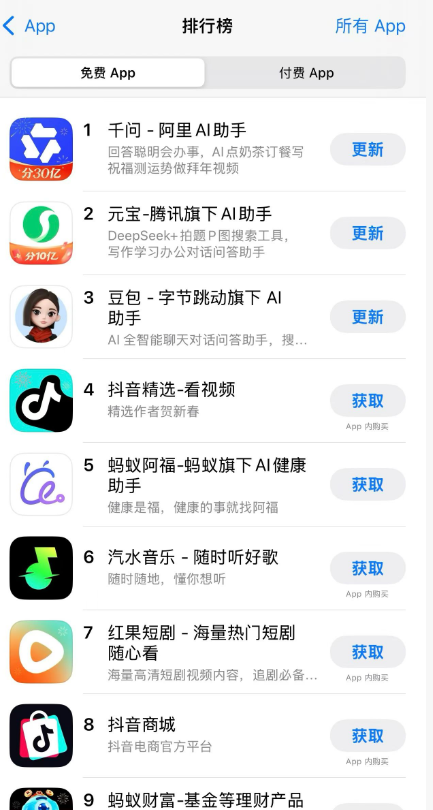
千问APP冲上苹果应用商店免费榜第一
Xin Lang Cai Jing· 2026-02-06 06:00
Group 1 - Alibaba's Qianwen officially launched the "Spring Festival 3 Billion Free Order" campaign, achieving over 5 million orders within 5 hours of launch [1][4] - The Qianwen app reached the top of the free app chart on the Apple App Store [1][4] - Users reported that the latest sharing code for the Qianwen red envelope could not be copied within WeChat, limiting participation in the campaign [1][4] Group 2 - Qianwen is ranked as the number one free app, outperforming competitors such as Tencent's Yuanbao and ByteDance's Doubao [2][5] - The app features capabilities such as smart responses, ordering drinks, and creating New Year greeting videos [2][5]

AI入口大战打响!尾盘又现巨额压单
Mei Ri Jing Ji Xin Wen· 2026-01-26 12:04
Group 1 - Tencent announced a cash distribution of 1 billion yuan for the Spring Festival, with individual red envelopes reaching up to 10,000 yuan [1] - Baidu's Wenxin Assistant will also distribute 500 million yuan in cash red envelopes from January 26 to March 12, with a maximum reward of 10,000 yuan [1] - ByteDance's Doubao AI Assistant will be the exclusive AI cloud partner for the 2026 CCTV Spring Festival Gala, indicating a competitive landscape among major internet companies in the AI sector [2] Group 2 - The A-share market saw all three major indices decline, with the Shanghai Composite Index down 0.09% and the Shenzhen Component and ChiNext indices down 0.85% and 0.91%, respectively [4] - The trading volume in the Shanghai and Shenzhen markets reached 32,810 billion yuan, an increase of 1,627 billion yuan compared to the previous Friday [4] - Over 3,700 stocks declined, with a median drop of 1.33% in stock price changes [4] Group 3 - The market is characterized by a stable index performance, but individual stocks are experiencing significant pressure, particularly for those who bought at high prices [5] - Large sell orders were observed in major stocks, including Zijin Mining with a sell order of 4.07 billion yuan and China Ping An with 2.05 billion yuan [5][6] - The recent surge in the non-ferrous metals sector, particularly gold and silver, is notable, with gold prices surpassing 5,100 USD per ounce and silver prices increasing by over 7% in a single day [6] Group 4 - Fund allocation in the non-ferrous sector reached 11% in Q4 2025, up from 9.2% in Q3, indicating growing interest in this sector [6] - Other sectors with increased fund allocation include telecommunications, basic chemicals, non-bank financials, and machinery, with respective increases in allocation percentages [7] - The oil sector saw significant gains, with the sector index rising by 4.6%, and major companies like China National Petroleum and China National Offshore Oil Corporation experiencing over 5% increases [8] Group 5 - The commercial aerospace sector experienced a decline, with the index falling below the previous week's gains [10] - AI applications saw an overall adjustment, but some leading stocks experienced a return of funds, indicating potential resilience in this sector [11] - The liquor sector faced challenges, with Yanghe Brewery's performance falling short of expectations, while Kweichow Moutai finally saw a positive turn after a series of declines [11]
大模型不能-吞噬一切-重视AI应用投资机会
2026-01-04 15:35
Summary of Key Points from Conference Call Industry Overview - The AI application market in 2025 performed generally poorly, with disappointing results from Q2 to Q4, despite some growth driven by Deepseek post-Spring Festival [2][4] - The acquisition of Manus by Facebook has sparked renewed interest in AI applications, indicating that vertical AI applications have independent value and that Chinese companies have strong overseas commercialization capabilities [2][4] Core Insights and Arguments - The perception that large models dominate the market has hindered the growth of non-top-tier AI application products [2][4] - The optimism for the AI application market in 2026 is driven by major companies accelerating their consumer-facing (C-end) strategies, such as Alibaba's integration of its Qianwen app with Gaode Map and ByteDance's collaboration with CCTV for the Spring Festival Gala [2][5] - ByteDance's focus on its Doubao AI assistant and Tencent's upgrade of its AI architecture, particularly for WeChat Agent, highlight the competitive landscape in C-end AI applications [7][9] - The competition between ChatGPT and Google's Gemini is intensifying, with Gemini surpassing ChatGPT in usage time as of October 2025, despite ChatGPT maintaining a larger user base [11] Important Trends and Developments - The AI application market is expected to see significant growth in 2026, with OpenAI projecting revenues of $20 billion for 2025, primarily from ChatGPT subscriptions [13] - Major tech companies are focusing on building their traffic entry points to capture market share in the AI era, with companies like Alibaba and ByteDance leading the charge [12][14] - MiniMax is positioned competitively in the multi-modal AI model space, with strong performance in audio, video, and text models contributing to its revenue [22][23] Potential Investment Opportunities - Investors are advised to focus on major tech companies and their ecosystem partners, as well as advertising marketing opportunities that may arise from the commercialization of AI applications [27] - Bilibili (B站) is expected to see significant growth in 2026, driven by its successful New Year's Eve gala and upcoming game releases, with a projected adjusted profit of approximately 30.7 billion yuan [28][29] Other Noteworthy Points - The acquisition of Manus by Facebook signifies the importance of vertical AI applications and the potential for Chinese companies to thrive in international markets [4][6] - The competitive landscape for traffic entry points is crucial for companies to seize new opportunities in the evolving AI market [12][14] - The rise of Generative Engine Optimization (GO) as a new advertising marketing technique presents a high market potential for companies that can effectively leverage AI search capabilities [17][21]


AI时代的云计算“牌局”要换新庄家了?|南方产业观
Sou Hu Cai Jing· 2025-12-23 18:09
Group 1 - The Force Original Power Conference is a B2B event that emphasizes practical value, attracting significant attendance and indicating the value of Volcano Engine to B-end users [3] - The new Doubao model 1.8 was introduced, designed to enhance multi-modal agent capabilities, optimizing for tool usage and complex command adherence, marking a step forward for AI assistants [4] - Volcano Engine has become a significant player in the AI era, with a reported 49.2% market share in public cloud model service calls in China, indicating its growing influence in the cloud computing landscape [12] Group 2 - The daily call volume for the Doubao model has exceeded 50 trillion, reflecting over tenfold growth compared to last December, with over 1 million enterprises and individuals utilizing its services across more than 100 industries [12] - Doubao consistently ranks at the top of application download charts, showcasing its popularity and the support provided by Volcano Engine [13] - Traditional industries are increasingly adopting AI as a development accelerator, positioning Volcano Engine favorably in the competitive landscape of large models [14]

火山引擎总裁谭待:谈论Agent与APP冲突还太早
Di Yi Cai Jing· 2025-12-18 15:26
Core Insights - ByteDance's cloud platform Volcano Engine has released the Doubao model 1.8 and the Seedance 1.5 pro audio-video creation model, with Doubao's daily token usage exceeding 50 trillion, up from 30 trillion in September [2] - The industry views the targeted restrictions on internet apps as a conflict between the "Agent era and the APP era," but the president of Volcano Engine, Tan Dai, believes that the core value for users lies in achieving goals more conveniently and at lower costs, regardless of the medium used [2] - Tan Dai emphasizes that AI's primary role should be to optimize the efficiency of unmet needs, suggesting a coexistence of Web, APP, and Agent rather than a replacement [2] Industry Readiness - The exploration of AI and Agents is still in a trial phase, with market demand present but models not yet fully developed, a situation expected to last for about three more years [3] - The core issue regarding the industry's readiness for Agent integration lies in the improvement of Agent tools, with Volcano Engine investing significant resources to make existing functions recognizable and callable by Agents [3] - Tan Dai notes that both Doubao AI assistants and APPs consist of complex Agent collections, facing challenges in foundational capabilities and real-world application requirements [3] Multi-Modal Models - By the end of 2025, leading domestic and international model manufacturers are intensifying efforts, with multi-modal models like Seedance 1.5 pro marking a shift towards deeper AI applications [4] - Multi-modal capabilities allow models to "see, hear, speak, and act," moving beyond text-based interactions to practical applications such as traffic recognition and quality inspection [4] - Tan Dai believes that while multi-modal models face data challenges, significant progress has been made compared to last year, and the pace of model advancement is rapid [4] Cloud Services in AI Era - Volcano Engine continues to highlight the value of cloud services in the AI era, with AWS aiming for its generative AI platform Bedrock to become the "largest reasoning engine globally," comparable to its core computing service EC2, which is currently valued at around $40 billion [4] - Tan Dai acknowledges this trend and compares the development of MaaS (Model as a Service) to the chip business, indicating a shift from GPU training to inference processes [4] Future of AI Hardware - Tan Dai cites the early 2025 AI wave as evidence of the importance of cloud business, noting that many users faced issues with fixed-capacity AI hardware due to rapid technological iterations [5] - The inability to privatize deploy technologies like Agents and the fixed capabilities of one-machine solutions hinder the successful implementation of diverse AI applications [5] - Consequently, the private one-machine model from the software era is expected to be phased out in the AI era [5]
假如,字节的豆包AI手机是腾讯的 | 马上评
Tai Mei Ti A P P· 2025-12-09 02:20
Core Insights - The emergence of AI smartphones is facing significant challenges, particularly highlighted by the collaboration between ByteDance and ZTE, which encountered operational issues due to system-level permission conflicts with major applications like WeChat [1][4][5] - The competition for AI integration in mobile devices is intensifying, with questions about how new entrants can gain trust within established ecosystems dominated by giants like Tencent [2][6] Technical Challenges - The AI assistant, Doubao, attempted to utilize system-level permissions, allowing it to simulate user actions across applications, which triggered security alerts from popular apps [4][5] - This capability effectively positioned Doubao as an invasive entity within the mobile ecosystem, raising concerns about user data privacy and security [5][6] Ecosystem Dynamics - The conflict is not merely technical but rooted in the competitive dynamics between ByteDance and Tencent, where trust and data security are paramount [6][9] - Doubao's intent to streamline user interactions across multiple applications poses a direct threat to the existing flow of traffic and user engagement for established platforms like WeChat and Alibaba [7][8] Strategic Implications for Tencent - Tencent is likely to adopt a more integrated approach by leveraging its existing ecosystem, potentially creating an AI assistant that seamlessly integrates with WeChat, thus enhancing user experience without compromising security [13][14] - The strategy may involve deep partnerships with manufacturers that lack strong ecosystems, allowing Tencent to maintain control over the software and user interactions [11][12] Market Reactions and Future Outlook - The response from existing applications to Tencent's potential AI assistant will be critical, as many rely heavily on WeChat for user engagement and transactions [21][22] - Tencent's approach may involve a combination of incentives and pressures to ensure cooperation from third-party applications, thereby reinforcing its ecosystem dominance [23][24] - The future of AI smartphones may hinge on whether they can navigate existing ecosystem barriers or if they will need to align with established players to succeed [26]

豆包手机“助手”还是“住手”?一边是帮你操作的“神队友”,一边是被厂商围剿的“公敌”
Yang Zi Wan Bao Wang· 2025-12-08 07:00
Core Insights - The Doubao smartphone, featuring the Doubao AI assistant, has gained significant attention for its advanced capabilities, including cross-application automation and real-time visual understanding, leading to immediate sell-out on its launch day [1][3] - The device has created a unique user experience, with reports of its ability to assist in complex tasks such as answering quiz questions and video editing, showcasing a glimpse of a future where voice commands can replace manual actions [3][5] - However, the smartphone has faced backlash due to login issues with several major applications, raising concerns about security and fairness in the digital ecosystem, as its AI capabilities mimic human interactions [5][6] Market Response - The initial market response has been overwhelmingly positive, with the smartphone selling out quickly and commanding high resale prices on second-hand platforms, indicating strong demand [1][3] - Users have shared their experiences on social media, highlighting the device's ability to perform tasks that were previously thought to require human intervention, thus enhancing its appeal [3][5] Regulatory and Industry Challenges - The smartphone's advanced AI features have led to restrictions from various applications, including WeChat and several financial apps, due to concerns over account security and the potential for misuse [5][6] - The Doubao team has announced adjustments to the AI's operational capabilities, including limiting its use in gaming and financial applications, reflecting the industry's struggle to adapt to the implications of AI as an active operator rather than a mere tool [6][7] - The situation underscores the broader challenges faced by the AI industry, including the need for clear regulations and guidelines to address liability and ethical considerations as AI technology evolves [7]

豆包抢入口,捅了马蜂窝
硬AI· 2025-12-05 06:45
Core Insights - The article highlights the competition for the "super entry point" in the AI era, emphasizing that the ability to control data and traffic is shifting from traditional apps to system-level AI agents [2][17] - The recent developments surrounding the Doubao AI assistant reveal the challenges faced by AI companies in navigating existing app ecosystems and data security regulations [5][19] Group 1: Doubao AI Assistant Launch and Challenges - Doubao AI assistant was launched on December 1, enabling cross-application operations, which generated significant market excitement [7][4] - Shortly after its launch, Doubao announced a temporary suspension of its ability to operate financial apps due to security concerns, highlighting the need for clear AI operation guidelines [3][4] - Major apps like WeChat, Taobao, and banks implemented measures to prevent Doubao AI from functioning properly, indicating a defensive response to the new technology [8][10] Group 2: Industry Dynamics and Competitive Landscape - The conflict between AI companies, hardware manufacturers, and app developers illustrates a complex interplay of interests and poses challenges to existing data security frameworks [5][12] - Goldman Sachs identified three core obstacles for third-party AI agents: system-level operation permissions, memory capabilities, and cross-application interface connections [12][14] - The dominance of major smartphone manufacturers in the Chinese market, which hold over 90% market share, makes it difficult for new players to disrupt the ecosystem [14][15] Group 3: Future of AI and App Ecosystem - The article suggests that as voice interaction becomes the primary entry point, traditional app operations may collapse, making it crucial to establish a default system entry point [17][20] - The ongoing battle for AI agents signifies a broader struggle involving major tech companies and highlights the potential for significant shifts in the internet landscape over the next decade [19][20]



手机之后,字节AI眼镜或跟上
财联社· 2025-12-05 04:52
Core Viewpoint - The competition in the AI industry is shifting from large model parameters to the hardware applications of AI, with major companies vying for the next generation of hardware entry points, particularly AI glasses and smartphones [5][6]. Group 1: AI Hardware Competition - Major companies like Alibaba, ByteDance, and Baidu are rapidly developing AI glasses to establish a foothold in the AI hardware ecosystem [4][6]. - The AI glasses are seen as the next critical terminal after smartphones, with both startups and major internet companies entering the market [6][7]. - The integration of AI capabilities into smartphones and AI glasses aims to create a closed-loop hardware ecosystem, with ByteDance's ambitions being particularly notable [7][13]. Group 2: User Interaction and Functionality - The "Doubao AI Assistant" on the Nubia M153 smartphone can perform tasks such as gaming and controlling smart devices, showcasing the potential of AI in enhancing user experience [8][11]. - AI assistants from various companies, including Alibaba's Qianwen Assistant, are being integrated into AI glasses to enable voice-controlled operations [12]. - The future of smartphones may involve AI generating interfaces and operations based on user intent, reducing reliance on traditional input methods [13]. Group 3: Regulatory Challenges - The integration of AI assistants with third-party applications like WeChat faces significant regulatory hurdles, leading to the suspension of certain functionalities due to compliance issues [15][17]. - Major apps, particularly WeChat, have strict regulations against automated operations, which complicates the deployment of AI assistants [17][22]. - Previous attempts by other smartphone manufacturers to integrate AI functionalities with WeChat have also been halted, indicating a broader trend of resistance from app developers [18][20]. Group 4: Hardware Development Challenges - Internet companies lacking hardware expertise face significant challenges in developing smart terminals, as evidenced by past struggles of companies like Google and ByteDance in the smartphone market [23][24]. - Despite skepticism about the sustainability of hardware ventures, some experts believe that companies like ByteDance can leverage their existing user base to support hardware initiatives [25]. - Alibaba's strength lies in its stable B2B customer base, while Baidu's advantage is its search capabilities, which can enhance the functionality of AI glasses [25].

豆包抢入口,捅了马蜂窝
Hua Er Jie Jian Wen· 2025-12-05 04:02
Core Insights - The "Doubao Phone" has decided to temporarily withdraw its capability to operate financial apps, citing the need for "prudent adjustments" to align technology development with industry ecology [1][2] - The launch of the Doubao AI Assistant, which allows cross-application operations, has faced significant backlash from major apps like WeChat and Taobao, indicating a conflict between AI developers and existing app ecosystems [3][4] Group 1: Doubao Phone and AI Assistant - Doubao's announcement on December 5 highlights a shift in strategy to ensure safe AI operations, particularly in financial applications [1][2] - The Doubao AI Assistant, launched on December 1, was initially well-received, leading to a surge in demand and price inflation for the associated smartphone [2][3] - Users reported issues with the AI Assistant causing abnormal logouts from WeChat and other apps, raising concerns about security and operational integrity [3][4] Group 2: Industry Response and Implications - Major apps like WeChat and Taobao have implemented measures to block the Doubao AI Assistant, reflecting a defensive stance against third-party AI operations [4][5] - The situation underscores the challenges faced by third-party AI agents in gaining system-level permissions and accessing user data, which are tightly controlled by smartphone manufacturers [5][6] - High-profile firms like Xiaomi are highlighted as having a competitive advantage due to their integrated AI systems and established ecosystems, which are difficult for new entrants to disrupt [6][7] Group 3: Future of AI and App Ecosystems - The conflict initiated by Doubao reveals a broader struggle for control over AI as a new entry point in the digital landscape, potentially reshaping user interactions with applications [7][8] - The need for third-party app authorization poses significant barriers for AI agents, as existing apps are likely to maintain strict security measures to protect user data [9][10] - The ongoing evolution of AI agents is seen as a pivotal moment in the tech industry, with major players vying for dominance in a rapidly changing environment [10]