泛娱乐

Search documents
传媒行业周观察(20260323-20260327):OpenAI 关停 Sora,AI 漫剧及 AI 真人剧持续发酵
Huachuang Securities· 2026-03-30 14:05
Investment Rating - The report maintains a "Recommendation" rating for the media industry [5] Core Insights - The media sector experienced a decline of 1.41% last week, aligning with the performance of the CSI 300 index, which also fell by 1.41% [11] - The A-share media market shows increased stock differentiation without a clear leading trend, with notable gainers including ST Mingcheng (21.39%), Qunshang Co. (17.24%), and Zhongnan Culture (13.27%) [12] - The report highlights the ongoing development of AI applications, with significant increases in model usage and application engagement, particularly during the Spring Festival promotions [25][26] Market Performance Review - The media sector index fell by 1.41%, ranking 21st among all sectors [11] - The Hang Seng Technology Index dropped by 1.91% [11] - The A-share media sector shows a total of 138 stocks with a total market capitalization of 1,773.82 billion [5] AI Models and Applications - The report notes a significant increase in AI model usage, with a projected 22.7 trillion tokens called from March 23 to March 29, marking an 11% week-on-week increase [18] - The top AI models by usage include MiMo-V2-Pro and MiniMax M2.7, with some models experiencing substantial growth in usage [22] - The report indicates that AI applications saw a notable increase in monthly active users (MAU), particularly during the Spring Festival, with leading applications like Doubao and Qianwen showing significant growth [26][33] Gaming Market - The report mentions the issuance of 130 domestic game licenses in March, reflecting a year-on-year increase of 0.8% [35] - Tencent's games continue to dominate the iOS sales charts in China, with new releases like "Lock Kingdom: World" achieving rapid success [36] - The gaming market remains robust, with several new titles expected to launch in early April, indicating a strong pipeline for growth [44]
公募出海策略曝光!瞄准技术赋能泛娱乐
证券时报· 2026-03-22 07:19
Core Viewpoint - The article highlights the growing interest of public funds in the "global comparative advantage" concept, particularly focusing on the pan-entertainment industry as a key area for investment due to its potential for accelerated revenue growth in overseas markets [1][3]. Group 1: Global Comparative Advantage - "Global comparative advantage" has become a highly recognized investment keyword among public funds, guiding stock selection and strategic direction [3]. - Prominent fund managers emphasize the importance of focusing on industries that leverage China's competitive strengths in technology, cost, and business models for overseas expansion [3]. - Several public funds have launched industry-specific funds named after "comparative advantage," targeting Chinese industries with global core competitiveness [3]. Group 2: Performance of Pan-Entertainment Companies - Companies like Pop Mart, Blokus, Xindong Company, Meitu, and Zhizi City Technology have shown strong growth in overseas markets, benefiting from mature cost control systems and AI technology [4]. - Blokus, heavily invested by Zhongyin Fund, saw its overseas revenue increase by 397% year-on-year by 2025, effectively offsetting a 19% revenue growth domestically [4]. - Xindong Company's overseas revenue share rose from 20% to nearly 50% as its stock price increased, highlighting the significance of overseas demand in driving performance [4]. Group 3: Investment Strategies and Future Outlook - Funds are increasingly investing in companies like Miniso, Zhizi City Technology, and Yuedu Group, which embody the "global comparative advantage" strategy [5]. - Miniso's overseas pan-entertainment business is expected to grow rapidly by 2025, while Zhizi City Technology anticipates a net profit exceeding 900 million yuan in 2025, with a year-on-year growth of no less than 87% [5]. - The high gross margins in the pan-entertainment sector are attracting more fund interest, as companies leverage China's engineering advantages and mature business models for international expansion [6][7]. Group 4: Market Trends and Valuation - The pan-entertainment sector is viewed as being at a valuation re-evaluation point, with recent market adjustments providing opportunities for investment [9]. - Non-tech sectors in the Hong Kong market have shown solid performance, with advertising, e-commerce, and gaming sectors experiencing steady revenue and profit growth [10]. - Companies in the pan-IP and pan-entertainment sectors are seeing increased overseas revenue shares, enhancing cash flow and growth certainty, which could lead to significant valuation increases [10].


公募出海策略曝光!瞄准技术赋能泛娱乐
券商中国· 2026-03-22 03:47
Core Viewpoint - The article emphasizes that public funds are increasingly focusing on the "global comparative advantage" in the context of restructuring global technology and consumer patterns, with the pan-entertainment sector becoming a key area for investment reallocation [1][2]. Group 1: Global Comparative Advantage - "Global comparative advantage" has become a highly recognized investment keyword among public funds, guiding stock selection and direction [2]. - Prominent fund managers highlight the importance of focusing on companies with competitive advantages in technology, cost, and business models that can expand overseas and achieve significant market impact [2]. - Several public funds have launched industry-specific funds named after "comparative advantage," targeting Chinese industries with global core competitiveness [2]. Group 2: Performance of Pan-Entertainment Companies - Companies like Pop Mart, Blokus, Xindong Company, Meitu, and Zhizi City Technology have shown strong growth in overseas markets, benefiting from mature cost control systems and AI technology [3]. - Blokus, heavily invested by Zhongyin Fund, is projected to see overseas revenue grow by 397% by 2025, effectively offsetting a 19% domestic revenue growth [3]. - Xindong Company's overseas revenue share increased from 20% to nearly 50% as its stock price rose, highlighting the importance of overseas demand for its performance [3]. Group 3: Fund Strategies and Investments - Funds are diversifying into companies like Miniso, which is transitioning to a trendy toy IP model, and Red Child City Technology, which is replicating successful domestic entertainment models in international markets [4]. - Red Child City Technology is expected to achieve a net profit of over 900 million yuan in 2025, with a year-on-year growth of no less than 87% [4]. Group 4: High Gross Margin and Competitive Edge - Public funds are attracted to the pan-entertainment sector due to the competitive gross margins driven by China's engineer dividend, mature business models, and effective cost control [5]. - The ongoing release of the engineer dividend and the rapid expansion of overseas businesses are expected to enhance profitability, potentially leading to significant valuation increases [6]. Group 5: Market Trends and Future Outlook - Fund managers believe the pan-entertainment sector is at a valuation reassessment point, with recent market adjustments providing opportunities for investment [8]. - The increasing share of overseas revenue among pan-IP and pan-entertainment companies is expected to enhance cash flow and growth certainty, opening up significant valuation uplift potential [8].

互联网传媒周报:苹果税下降利好游戏,Openclaw利好互联网叙事反转-20260315
Shenwan Hongyuan Securities· 2026-03-15 13:44
Investment Rating - The industry investment rating is "Overweight," indicating that the industry is expected to outperform the overall market [12]. Core Insights - The reduction of Apple's and Google's channel fees is expected to enhance the bargaining power of game content creators, leading to lower channel costs and increased profits for game manufacturers. This change may also boost game advertising and diversify distribution channels [4]. - The launch of new products in 2026 is anticipated to catalyze growth, with several key titles set to release, including Tencent's "Honor of Kings World" and Perfect World's "Yihuan" [4]. - Openclaw's Agent is gaining traction, benefiting large models and cloud computing, which may positively impact companies like Tencent, enhancing their narrative in the market [4]. Summary by Sections Industry Overview - The report highlights the impact of reduced fees from Apple and Google on the gaming industry, suggesting a potential increase in profitability for game developers and a shift towards third-party payment systems [4]. Key Companies - Recommended companies include Tencent, NetEase, Bilibili, and others, with a focus on their expected performance in the gaming and internet sectors [4]. - The report provides a valuation table for key companies, showing projected revenue and profit growth for 2025 and 2026, with Tencent expected to generate revenues of 75.56 billion and a net profit of 30.07 billion in 2026 [6]. Investment Recommendations - The report recommends investments in various sectors, including internet and AI (Tencent, Bilibili), trendy toys (Pop Mart), and gaming (Century Huatong, Giant Network) [4].
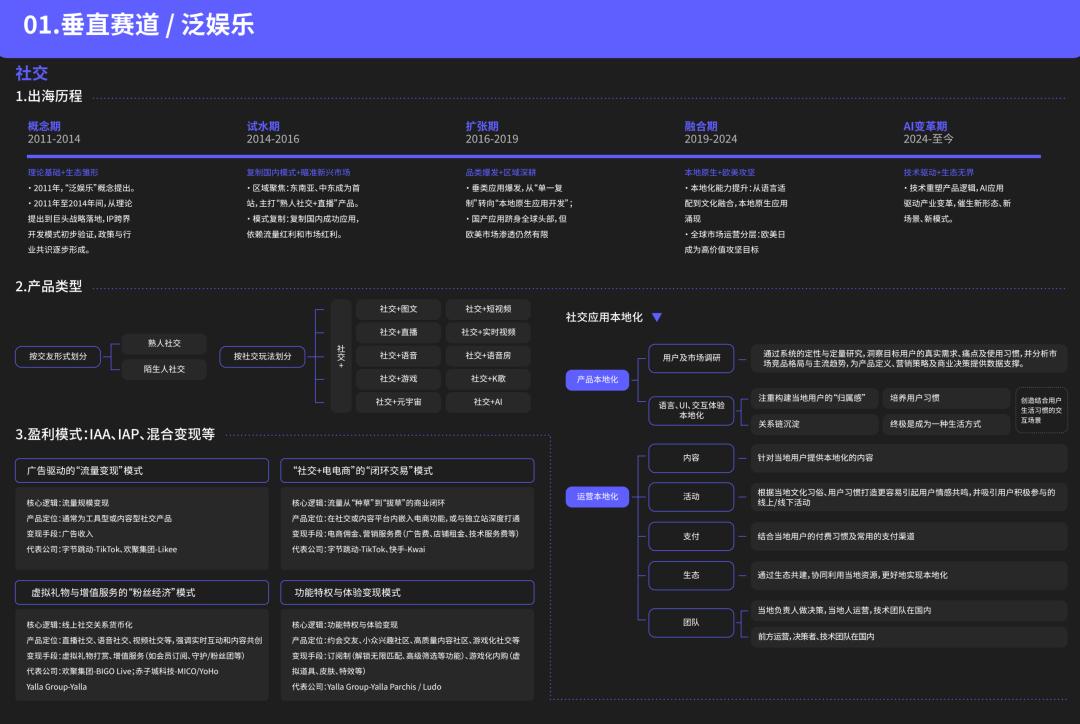
2026出海人必备的一站式地图
3 6 Ke· 2026-02-27 10:56
Core Insights - The global industrial system is undergoing reconstruction, and the map for Chinese companies going abroad is being redrawn, marking a significant shift in the global migration of "Chinese capabilities" [1] Industry Insights - The core driving force for the outbound entertainment industry has shifted from simple business model export to deep empowerment through "AI + culture," with the domestic market expected to reach 67.79 billion yuan by 2025, growing 34.4%, while the overseas market is projected to reach 21.07 billion USD, growing 145.7% [12] - In the cross-border e-commerce sector, the era of "barbaric growth" is ending, with a focus on localization and brand strength. By 2025, global e-commerce growth is expected to slow to 8.8%, prompting a shift towards "regional focus" and "brand cultivation" [15] - The artificial intelligence sector is characterized by a dual drive of "hardware-driven" and "application landing," with significant advancements in AI hardware and software leading to a rapid commercialization of AI applications [21] - The new energy sector is transitioning from "product output" to "ecological co-construction," with China's new energy vehicle exports expected to surge to 3.43 million units by 2025, a 70% year-on-year increase [28] Market Insights - North America remains a strategic high ground for outbound enterprises, characterized by high barriers and high returns, with a focus on compliance and localization due to ongoing tariff adjustments [29] - Europe presents a "quality competition arena" under green barriers, where compliance with stringent environmental regulations is essential for market entry [35] - Southeast Asia has evolved from simple trade to comprehensive investment and localized operations, becoming the largest destination for Chinese outbound investment [38] - The Middle East offers opportunities driven by economic diversification initiatives, with significant growth in exports of vehicles and electrical equipment from China [41] - Latin America is characterized by a demand for high-cost performance products, with a focus on affordable smart hardware and the rapid growth of e-commerce platforms [43] Strategy Insights - The approach to selecting target markets and entry paths is shifting from blind expansion to precise coupling, focusing on infrastructure capacity and user ecosystem maturity [45] - The product channel layout and marketing strategies are evolving towards "AI reconstruction and regional differentiation," emphasizing multi-channel integration and technology empowerment [48] - Compliance with regulations and risk avoidance is becoming critical, with a need for systematic compliance frameworks to navigate complex regulatory environments [53] - Organizational and talent development is essential for building agile global teams, with a focus on creating a unified global skills framework to address capability gaps [55] - The transformation of Chinese enterprises going abroad is moving from "product output" to "systemic rooting," emphasizing supply chain resilience and local integration [56]

互联网传媒周报:AI应用催化不断,泡泡玛特“电子木鱼”和星星人火爆-20260125
Shenwan Hongyuan Securities· 2026-01-25 12:44
Investment Rating - The industry investment rating is "Overweight," indicating that the industry is expected to outperform the overall market [12]. Core Insights - The report highlights the ongoing competition in the AI application space, with major companies like Tencent, Alibaba, and ByteDance vying for dominance in the domestic AI super entrance battle. This competition is expected to drive up transaction sentiment in AI applications [4][6]. - Pop Mart's recent buybacks and the success of its PUCKY "electronic wooden fish" and Valentine's Day series have alleviated market concerns about its reliance on the Labubu IP. The company's multi-IP strategy and global channel expansion are seen as key to its success [4][6]. - The upcoming Spring Festival is anticipated to boost the film and gaming sectors, with several films scheduled for release and optimistic expectations for AI-integrated content production [4][6]. Summary by Sections AI Applications - The report notes a resurgence in AI application interest, with significant developments from companies like Baidu and Alibaba. The competition among major players is expected to catalyze growth in AI applications [4][6]. Pop Mart - Pop Mart has executed two buybacks totaling approximately 350 million HKD, and the strong sales of its new products have reduced market fears regarding its IP dependency. The company's strategy of expanding its IP portfolio and global reach is validated [4][6]. Film and Gaming - The report outlines several films set for release during the Spring Festival, including "Flying Life 3" and "Biao Ren: Wind Rises in the Desert." The integration of AI in content production is expected to enhance the industry's growth, with projections indicating that the AI comic market could reach 22 billion RMB by 2026 [4][6]. Key Company Valuations - The report provides a valuation table for key companies, indicating their market capitalization, revenue forecasts, and profit margins. For instance, Tencent's market cap is 48,677 million RMB, with projected revenues of 8,453 million RMB for 2026, reflecting a 12% year-over-year growth [6].
那些从中兴、华为离开的人,在中东做出了下一个“小腾讯”
第一财经· 2025-12-24 10:28
Core Viewpoint - The article discusses the unique social dynamics and market opportunities in the Middle East, particularly focusing on how Chinese companies have successfully adapted their products to meet local cultural preferences and social habits, leading to significant growth in the region's entertainment and social media sectors [3][8][12]. Group 1: Market Characteristics - The Middle East is characterized by a strong social culture, with locals frequently gathering in cafes and public spaces to socialize, especially during the cooler evening hours [3][4]. - The region has a high demand for social interaction and entertainment, which has been successfully translated into online platforms by Chinese companies [6][8]. - Users in the Middle East are highly engaged with social media, averaging 8.4 accounts per person, with UAE users reaching 10.5 accounts, indicating a strong market for social applications [8][12]. Group 2: Company Performance - Yalla and Chaozi City (赤子城) have emerged as significant players in the Middle Eastern social media market, with Chaozi City reporting a revenue growth of over 50% in 2024, reaching 5.1 billion yuan [9]. - In the first half of 2025, Chaozi City's revenue grew by 40% to 3.2 billion yuan, with a net profit increase of 118% to approximately 500 million yuan [9]. - Yalla's revenue for 2024 was reported at 340 million USD (approximately 2.39 billion yuan), with a stock price increase of over 70% since the beginning of the year [9]. Group 3: Cultural Adaptation and Localization - Successful products like TopTop and Yalla have been developed through extensive local research, ensuring they align with the cultural and social habits of Middle Eastern users [6][7]. - Features such as family badges in TopTop were inspired by local customs, enhancing user engagement by reflecting cultural identity [7]. - Yalla's design is rooted in the traditional "Majlis" culture, facilitating a familiar social experience for users [7][8]. Group 4: Challenges and Market Entry - Entering the Middle Eastern market requires significant investment and time to build local networks, which can be a challenge for companies used to faster-paced environments [4][16]. - The market has high entry barriers, with initial costs for registration and compliance being substantial, often requiring millions to establish a presence [16][17]. - As competition increases, companies that have already established a foothold in the region are likely to perform better, making it harder for new entrants to succeed [17].


互联网传媒周报:字节AI云和入口变现加速,游戏受益春节旺季+应用商店议价力下降-20251222
Shenwan Hongyuan Securities· 2025-12-22 04:12
Investment Rating - The industry investment rating is "Overweight" indicating a positive outlook for the sector compared to the overall market performance [3][11]. Core Insights - ByteDance's AI application commercialization and MaaS (Model as a Service) are expected to accelerate, potentially forcing major internet companies like Alibaba, Tencent, and Baidu to expedite their AI strategies and monetization efforts [3]. - The demand for self-indulgent consumption among the post-90s and post-00s demographics is outpacing the overall domestic demand, with a focus on gaming, music, and trendy products [3]. - The gaming sector is anticipated to rebound quickly due to the upcoming Spring Festival, driven by younger audiences and a decline in global app store bargaining power [3]. Summary by Sections Industry Overview - ByteDance's advancements in AI and cloud services are likely to challenge competitors to enhance their AI capabilities and monetization strategies [3]. - The market remains optimistic about the growth of self-indulgent consumption, particularly in gaming and entertainment sectors, despite concerns over product cycle fluctuations [3]. Gaming Sector - The gaming industry is expected to see significant growth during the Spring Festival, with key products like Giant Network's "Supernatural" projected to achieve new highs in revenue and daily active users [3]. - Recommended stocks include Giant Network, 37 Interactive Entertainment, and Bilibili, with a focus on companies with new product reserves and low PE ratios [3]. Other Consumption Areas - In the music sector, subscription models are showing strong user retention and cash flow, with NetEase Cloud Music still in its growth phase [3]. - For trendy products, Pop Mart's revenue from single IPs has shown significant growth, supported by product innovation and market expansion [3]. Advertising Sector - Focus on the sustainability of advertising investments in the internet sector, with potential growth from acquisitions and high dividend yields providing a safety margin [3].


中国互联网大厂,在海外找到「利润黑马」
3 6 Ke· 2025-12-10 04:32
Group 1: Core Insights - The overseas business segments of major Chinese internet companies have become "profit dark horses," with Alibaba's international digital commerce turning profitable, Meituan's Keeta achieving monthly profitability in Hong Kong, and Tencent's overseas gaming revenue surging by 43% year-on-year [1] - As domestic internet traffic growth reaches diminishing returns, going overseas has become a necessary strategy for companies, evolving from "go overseas or go home" to "no core capabilities, no overseas expansion" [1] Group 2: Cross-Border E-commerce - Alibaba's international retail business reported revenue of 28.068 billion yuan, a 10% year-on-year increase, driven by growth from AliExpress and other international operations [2] - The international wholesale business generated 6.731 billion yuan, an 11% increase year-on-year, attributed to growth in value-added services related to cross-border business [2] - Temu's gross merchandise volume (GMV) growth is primarily due to rapid penetration in the European (30-40% share, 60-70% year-on-year growth) and Latin American markets (over 15% share), while growth in North America is slowing [2][3] Group 3: Local Lifestyle Services - Meituan's Keeta achieved its first monthly profitability in Hong Kong, marking a significant milestone in its overseas expansion [4] - Keeta is expanding in the Middle East and Brazil, utilizing AI algorithms and big data to optimize delivery routes and improve efficiency [4][5] - The competitive landscape in Brazil is intense, with Didi and Uber also expanding their food delivery services, indicating a battle for market share [6] Group 4: Entertainment Sector - Tencent's international gaming revenue reached 20.8 billion yuan, a 43% year-on-year increase, driven by successful titles like "Clash Royale" and "PUBG MOBILE" [7] - NetEase's overseas strategy is undergoing significant adjustments, with the closure of several overseas studios despite some successful game launches [8] Group 5: Mobile Phones - Xiaomi's smartphone revenue declined by 3.1% year-on-year to 46 billion yuan, attributed to a decrease in average selling price (ASP) [9] - Xiaomi's overseas internet service revenue reached a record high of 3.3 billion yuan, growing by 19.1% year-on-year, with a notable increase in the share of high-margin overseas market revenue [10] - The competition in the African market between Xiaomi and Transsion is intensifying, leading to price wars [10] Group 6: Conclusion - The third-quarter financial reports indicate a shift in Chinese internet companies' overseas strategies, moving from reliance on policy advantages and low prices to focusing on supply chain capabilities, AI technology, localization, and compliance management [12] - The transformation represents an upgrade from being participants in the global value chain to integrators, with challenges such as geopolitical compliance risks and cultural differences remaining significant [13]





凯撒文化12月11日“摘帽” 行业东风下的泛娱乐价值重估
Quan Jing Wang· 2025-12-10 00:48
Core Viewpoint - The company, Caesar Culture, has successfully applied to revoke its risk warning status, which will enhance its stock liquidity and broaden financing channels, aligning with the growth trends in the pan-entertainment industry [1][2][3] Group 1: Company Developments - Caesar Culture's application to revoke the risk warning has been approved, allowing its stock to resume trading under the name "Caesar Culture" with a price fluctuation limit increased from 5% to 10% [1] - The company has made significant improvements in governance, evidenced by a 41.57% reduction in short-term loans and a 52.40% decrease in financial expenses due to lower bank loan interest [1] - The net cash flow from operating activities has increased by 40.69% year-on-year, indicating a substantial alleviation of liquidity pressure [1] Group 2: Industry Positioning - Caesar Culture is focused on building an internet entertainment ecosystem centered around premium IP, leveraging various entertainment content to amplify IP value [2] - The company has seen a 76.66% year-on-year increase in R&D expenses, with a focus on applying AI and cloud computing technologies in game development [2] - The company's collaboration with leading platforms like Tencent Animation has strengthened its IP resource reserves, supporting future product iterations [2] Group 3: Strategic Outlook - The revocation of the risk warning aligns with the favorable trends in the pan-entertainment industry, as the Chinese government increases support for high-quality domestic content [2] - The dual-driven model of "classic IP moat + new technology growth" positions the company well for future growth, with stable cash flow from existing products funding new developments [3] - The application of AI technology in various development stages is expected to enhance efficiency and optimize product experiences, shortening the time to market for new products [3]