
指数型ETF

Search documents
感受散户们带来的震撼! 散户资金开年延续“扫货”狂潮 美股牛市之音仍在轰鸣
智通财经网· 2026-01-09 12:58
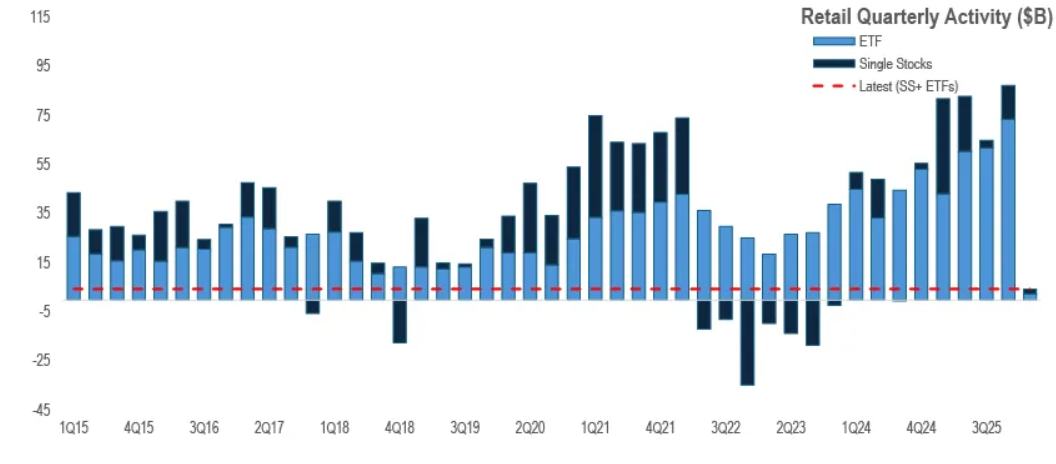
Core Viewpoint - The U.S. stock market is experiencing a strong bullish sentiment driven primarily by retail investors, despite cautious views from institutional investors regarding the sustainability of the recent market rally [1][3][4]. Group 1: Retail Investor Behavior - Retail investors have shown unprecedented confidence, with stock purchases reaching near-record levels in January, indicating a strong bullish sentiment [1][4]. - The trend of retail investors buying on dips has been effective, yielding over 20% returns in 2025, surpassing the performance of the S&P 500 index [5][8]. - Retail investors are increasingly influencing the market, with over 20% of total trading volume attributed to them, and they are actively participating in options trading, particularly bullish strategies [7][9]. Group 2: Market Dynamics and Predictions - The ongoing bullish sentiment among retail investors is expected to support the continuation of the bull market, with predictions that the S&P 500 index could reach 10,000 points in the future [3][11][12]. - Analysts from major financial institutions, including UBS and Citadel Securities, anticipate that strong earnings growth, particularly in AI and technology sectors, will drive the market upward in 2026 [10][11]. - The retail investor's shift towards gold ETFs indicates a diversification in investment strategies, reflecting a response to geopolitical risks and market volatility [8].


“财富效应”提振消费的关键在于普惠性
Cai Jing Wang· 2025-11-19 08:15
Core Insights - The concept of "deposit migration" has gained significant attention in the financial market this year, with expectations that residents will shift funds from low-yield assets like deposits to higher-yield investments such as stocks as interest rates decline and the stock market recovers [1] - The government is hopeful that the "wealth effect" from financial markets can enhance consumer spending and confidence, as reflected in the recent "14th Five-Year Plan" recommendations emphasizing the construction of a strong financial nation [1] Group 1: Market Trends - Data indicates that "deposit migration into the market" is indeed occurring, with a decline in residents' demand deposits and an increase in non-bank deposits, suggesting liquidity is moving towards capital markets [2] - From July to August, residents' demand deposits decreased by 1.3 trillion yuan, while non-bank deposits increased by 3.3 trillion yuan, indicating a potential flow of deposits into capital markets [2] - The M1 money supply is rising, showing that previously time-bound deposits are being "activated" and could enter the market as a backup force [2] Group 2: Investor Behavior - The new A-share accounts opened from June to September primarily come from high-net-worth individuals, with ordinary residents showing lower participation levels [2] - The number of new A-share accounts on the Shanghai Stock Exchange rose from 1.65 million to 2.94 million between June and September, but remains significantly lower than the peak of 6.85 million in October 2024 and 7.2 million in April 2015, indicating that the current market drive is more from high-net-worth individuals rather than retail investors [2] Group 3: Financial Inclusion - To truly harness the "wealth effect" for high-quality development, it is essential to enhance the inclusiveness of the financial system, allowing more ordinary residents to participate and benefit from capital market growth [4] - Financial markets need to focus on "breadth" and "inclusivity," encouraging financial institutions to develop investment tools aimed at the general public, such as low-fee, low-threshold mutual funds, index ETFs, and target-date funds [4] - Promoting automated investment options and simplifying investment education can help lower barriers for ordinary investors, thereby enhancing their confidence in consumption and investment [4]
纳斯达克首席经济学家Phil Mackintosh:美联储或降息至3.5%左右 企业盈利增长支撑美股市场
2 1 Shi Ji Jing Ji Bao Dao· 2025-09-24 23:11
Group 1: Federal Reserve Actions and Economic Outlook - The Federal Reserve faces challenges of weak employment and rising inflation, leading to a cautious monetary policy stance regarding interest rate cuts [1][3] - The recent rate cut of 25 basis points marks the first reduction since December, indicating a shift in U.S. monetary policy after months of observation [1][3] - Future expectations suggest the Fed may continue to lower rates, potentially reaching around 3.5%, which could signal recession risks if rates decline further [3][4] Group 2: Stock Market Dynamics - Recent stock market gains are attributed to improved corporate earnings, particularly driven by investments in artificial intelligence [2][6] - The decline in interest rates has reduced corporate financing costs, boosting valuations alongside earnings growth, providing strong market support [2][9] - Despite consumer confidence weakening, institutional investors remain focused on fundamental factors, leading to optimistic projections for the S&P 500 index to reach 7000 points by year-end [8][9] Group 3: Consumer Behavior and Market Sentiment - Consumer confidence has shown signs of weakening, with many retail investors becoming more cautious, although they continue to invest in index ETFs [8] - The job market's deterioration and rising credit defaults indicate increasing financial pressure on lower-income groups, affecting their investment behavior [8][9] - The ongoing focus on AI-related investments suggests a broader market trend, with valuations supported by actual earnings growth, although potential risks remain if earnings do not keep pace [7][9]