
摘要酒

Search documents
直击华润啤酒业绩会:啤酒要创新、白酒要稳固
Guo Ji Jin Rong Bao· 2026-03-24 14:57
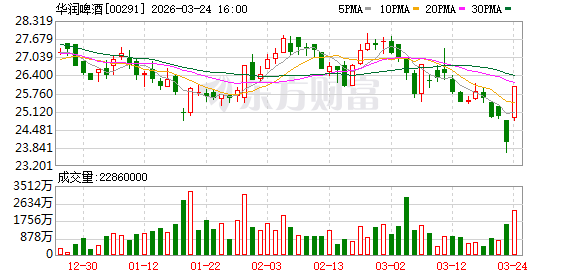
Core Viewpoint - China Resources Beer reported a decline in revenue and net profit for 2025, primarily due to goodwill impairment in its liquor business, but showed growth in its beer segment driven by high-end product sales [4][5]. Beer Business Performance - The beer segment achieved sales of 11.03 million kiloliters, a slight increase of 1.4% year-on-year, with a gross margin improvement of 1.4 percentage points to 42.5% [5]. - High-end beer products saw significant growth, with premium and above beer sales increasing by mid to high single digits, accounting for nearly 25% of total sales [5]. - Notable brands like "Heineken" and "Snow" recorded substantial growth, with "Snow" achieving nearly 60% growth and "Red Duke" doubling its sales compared to the previous year [5][6]. - The company plans to continue its high-end strategy while extending focus to mid-tier products, adapting to a more balanced market structure [5][6]. Liquor Business Challenges - The liquor segment faced a revenue decline of approximately 30.77%, with a significant goodwill impairment of about 2.88 billion yuan [9][10]. - Management acknowledged unexpected difficulties in the liquor sector, attributing the impairment to macroeconomic factors and industry cycles [8][10]. - The company is implementing measures to stabilize prices and improve cost-effectiveness, including controlling expenses and adjusting profit-sharing models with distributors [11]. Strategic Initiatives - The company is actively working to fill gaps in emerging business areas, particularly in online sales and instant retail, which have seen over 50% annual growth [6]. - Plans to "revive" local brands through innovative strategies are underway, targeting specific markets with tailored products [6]. - International expansion is a priority, focusing on markets that are culturally and politically favorable, leveraging partnerships to minimize risks [7]. Future Outlook - The company anticipates that by the end of the 14th Five-Year Plan (2030), the market share of mid-tier and above products could exceed one-third of total beer sales [6]. - The liquor business aims to enhance efficiency and optimize product structure, focusing on high-margin products while phasing out lower-margin SKUs [10][11].


直击华润啤酒业绩会:新帅力挺白酒业务,将重启部分地方啤酒品牌
2 1 Shi Ji Jing Ji Bao Dao· 2026-03-24 07:33
Core Viewpoint - China Resources Beer is exploring a second growth curve despite facing challenges in its white liquor business, which has impacted its profitability significantly in 2025 [1][8]. Financial Performance - In 2025, China Resources Beer reported a revenue of 37.985 billion RMB, a decrease of 0.76% year-on-year, and a net profit attributable to shareholders of 3.371 billion RMB, down 28.87% [1]. - The company declared a dividend of 1.021 RMB per share for 2025, an increase of 34.3% year-on-year [1]. Beer Sales and Market Strategy - The company achieved beer sales of approximately 11.03 million kiloliters in 2025, reflecting a year-on-year growth of 1.4% [4]. - High-end beer products continued to grow, with sales of premium and above beers increasing by nearly 10%, while sales of sub-premium beers grew in the mid-single digits, accounting for nearly 25% of total sales [4]. - The management team, newly appointed, is focused on addressing the challenges posed by a contracting market and increasing competition [3]. White Liquor Business - The white liquor segment, which has been part of the company's strategy for nearly three years, reported a revenue of 1.496 billion RMB in 2025, a decline of nearly 30% from 2.149 billion RMB in 2024 [8]. - A goodwill impairment of 2.877 billion RMB was recorded due to the acquisition of the white liquor business, marking a significant impact on overall profitability [8]. - The chairman expressed confidence in the long-term potential of the white liquor market despite current challenges, emphasizing the need for a second growth curve for the company [9][10]. International Expansion - The company is preparing for international expansion during the 14th Five-Year Plan period (2026-2030), leveraging its partnership with Heineken to explore overseas markets [7]. - The strategy includes focusing on countries that are culturally friendly to China and utilizing cooperative approaches to mitigate risks [7].
从“伊琍”到“金莎”,金沙新春双品牌营销“文化筑底”
Xin Lang Cai Jing· 2026-02-11 08:52
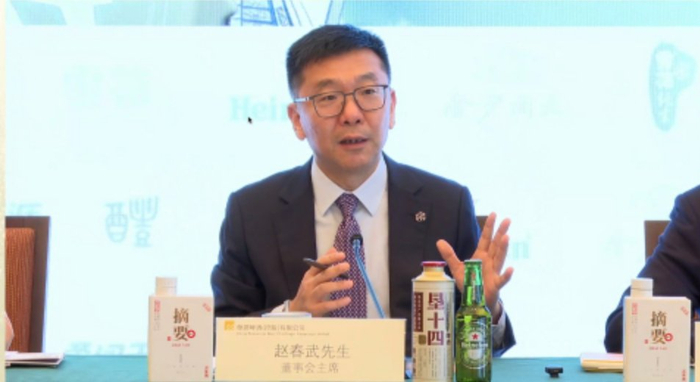
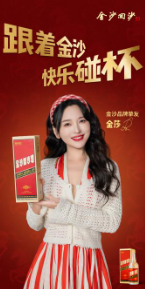
Core Viewpoint - The Chinese liquor industry, particularly the sauce-flavored liquor segment, is facing significant challenges in 2025, including production halts for small distilleries, a restructuring of pricing systems, and high channel inventories. However, Jinsha Liquor is leveraging its dual-brand strategy with "Summary" and "Jinsha Huai Sha" to enhance brand value amidst these pressures [1][10]. Group 1: Marketing Strategies - Jinsha Liquor has adopted a "listening persuasion" marketing approach by signing singer Jinsha as a brand friend, launching interactive topics such as "Shake with Jinsha" and "Cheers with Jinsha" to engage consumers [1][10]. - The collaboration with Jinsha, a well-known singer among the 80s and 90s generations, effectively connects with the core consumer demographic, enhancing brand recognition through phonetic association [4][13]. - The marketing strategy includes user-generated content (UGC) on platforms like Douyin, where consumers share personal experiences with Jinsha liquor, transforming them from passive viewers to active brand promoters [4][10]. Group 2: Cultural Integration - Jinsha Liquor's partnership with historian Yu Gengzhe aims to deepen cultural engagement, avoiding superficial marketing by embedding cultural narratives into brand storytelling [5][14]. - Previous initiatives, such as the "Beautiful Life·Book Fragrance China" event, have successfully linked the brand with cultural themes, reinforcing the "book and liquor coexist" philosophy [7][17]. Group 3: Product Focus - The marketing campaign is anchored on the launch of three new products related to the Year of the Horse, including the "Summary Year of the Horse" collectible liquor (1.5L) and gift boxes, designed to meet diverse consumer needs [9][19]. - A promotional campaign from January 1 to March 31 offers consumers a chance to win a 1.5L Jinsha Huai Sha Year of the Horse liquor or cash prizes through a QR code scanning initiative, ensuring a 100% winning rate [19][20]. - The dual-end strategy of incentivizing both consumers and store owners through the QR code campaign fosters a positive feedback loop, enhancing engagement and sales [20].
金沙酒业发布告知书:拼某某、某鱼等电商平台低价销售“摘要”酒, 部分产为假冒产品
Xin Lang Cai Jing· 2026-01-14 05:13
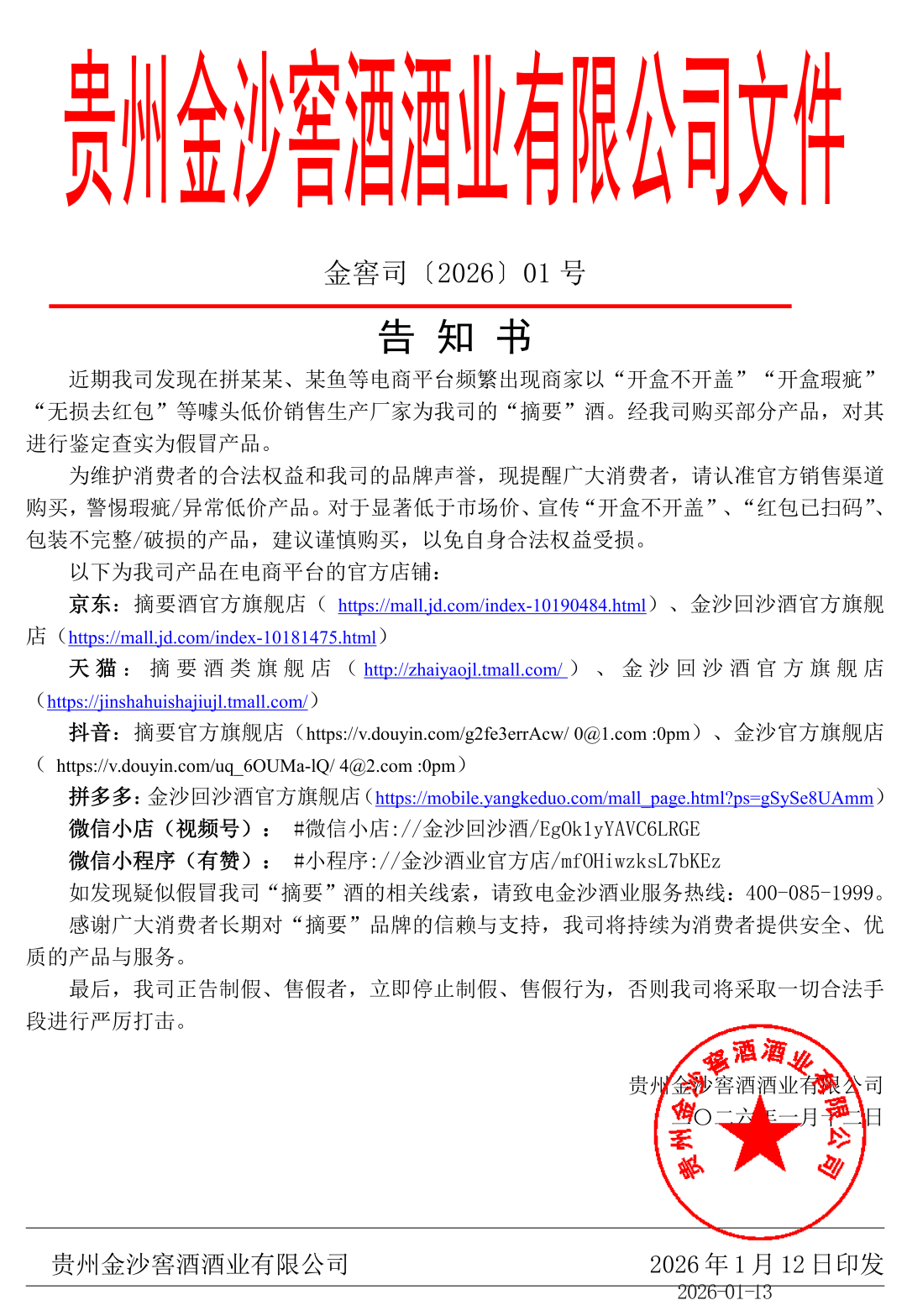
Core Viewpoint - The company has identified counterfeit products being sold on various e-commerce platforms under the guise of promotional tactics, urging consumers to purchase only from official channels to protect their rights and the brand's reputation [1][3][7]. Group 1: Counterfeit Products - The company discovered that counterfeit versions of its "Summary" liquor are being sold on platforms like Pinduoduo and Xiaohongshu, using phrases like "open box without lid" and "flawed open box" to attract buyers [1][3][7]. - After purchasing some of these products for verification, the company confirmed they were indeed counterfeit [3][9]. Group 2: Consumer Advisory - Consumers are advised to be cautious of products that are significantly below market price or advertised with incomplete or damaged packaging, as these may be counterfeit [1][3][9]. - The company emphasizes the importance of recognizing official sales channels to avoid potential loss of rights [1][3][9]. Group 3: Official Sales Channels - The company provided links to its official stores on various platforms, including JD.com, Tmall, Douyin, and Pinduoduo, to guide consumers towards legitimate purchases [3][9]. - A hotline is available for consumers to report suspected counterfeit products [3][9]. Group 4: Legal Action Against Counterfeiters - The company warns counterfeiters to cease their illegal activities immediately, stating that it will take all necessary legal actions against them [4][10].
金沙酒业:电商平台现“摘要”酒低价销售噱头
Sou Hu Cai Jing· 2026-01-13 14:10
Core Viewpoint - The company has identified that its product "摘要" wine is being sold at low prices on various e-commerce platforms using misleading marketing tactics [1] Group 1 - The company issued a notice on January 13 regarding the low-price sales of its "摘要" wine [1] - E-commerce platforms such as 拼某某 and 某鱼 are being used by merchants to sell the wine under the pretense of promotions like "open box without lid," "box defects," and "no damage to redeem coupons" [1]
金沙酒业发布告知书
Xin Lang Cai Jing· 2026-01-13 11:31
Core Viewpoint - The company has identified counterfeit products being sold at significantly lower prices on various e-commerce platforms, urging consumers to be cautious and purchase only from official channels to protect their rights and the brand's reputation [1] Group 1 - Guizhou Jinsha Jiao Wine Industry Co., Ltd. issued a notice regarding the frequent appearance of counterfeit products on platforms like Pinduoduo and Xianyu, marketed with phrases such as "open box without opening lid" and "flawed opening" [1] - The company conducted tests on some purchased products and confirmed they were counterfeit [1] - The company advises consumers to be wary of products priced significantly below market value and those with incomplete or damaged packaging [1]
金沙酒业:"开盒不开盖""无损去红包"等噱头低价销售的的"摘要"酒,经鉴定查实为假冒
Cai Jing Wang· 2026-01-13 05:26
Core Viewpoint - The company has issued a notice to combat counterfeit products being sold on various e-commerce platforms, emphasizing the importance of purchasing from official sales channels to protect consumer rights and brand reputation [1] Group 1: Counterfeit Products - The company has identified counterfeit products being sold under misleading terms such as "open box, unopened lid," "box defects," and "no damage for red envelope" on platforms like Pinduoduo and Xianyu [1] - After purchasing and verifying some of these products, the company confirmed they are indeed counterfeit [1] Group 2: Consumer Advisory - The company advises consumers to be cautious of products that are significantly below market price, especially those advertised with phrases like "open box, unopened lid," "red envelope already scanned," or those with incomplete/damaged packaging [1] - The notice aims to protect consumers from potential losses related to counterfeit products [1]
内升老将换下空降兵,金沙酒业能否盘活困局?
Xin Lang Cai Jing· 2025-12-25 08:25
Core Viewpoint - The recent personnel changes at Jinsha Liquor reflect a strategic adjustment in response to performance challenges, with the appointment of Han Yuguo as the new Vice General Manager and Marketing Center General Manager being a notable shift from external hires to internal promotions [1][4][5]. Group 1: Personnel Changes - Han Yuguo, a long-time employee of Jinsha Liquor, has been promoted from the position of General Manager of the Hunan, Hubei, and Jiangxi sales region to Vice General Manager and Marketing Center General Manager [3]. - The company has experienced frequent management changes since the acquisition by China Resources, with the chairman position changing three times and multiple high-level executives from the China Resources system joining the board [4][5]. - The frequent personnel changes are seen as part of a strategy to optimize management for long-term development and to enhance organizational efficiency [4][5]. Group 2: Performance Challenges - Jinsha Liquor's revenue has significantly declined from a peak of 3.64 billion yuan in 2021 to 2.149 billion yuan in 2024, with projected revenue for the first half of 2025 at 781 million yuan, indicating a nearly 60% reduction from its peak [9][11]. - The core product, the Zhai Yao liquor, has faced pricing issues, with its market wholesale price dropping from 485 yuan at the beginning of the year to 355 yuan, a decrease of 130 yuan [9][10]. - The company has attempted various marketing initiatives to boost sales, including partnerships with large corporations and nationwide tasting events, but these efforts have not yielded significant financial improvements [7][9]. Group 3: Strategic Adjustments - Jinsha Liquor's management has acknowledged the need for strategic adjustments in response to market conditions, including a shift in brand positioning and product offerings [12][14]. - The company has introduced new products aimed at the lower price segment, but faces intense competition from established brands in this market [14]. - The recent personnel changes, particularly the appointment of experienced internal candidates, are seen as a potential means to stabilize the company and address ongoing market challenges [15].

一场关于阅读的思考:如何自我“更新”与找到“答案”?
2 1 Shi Ji Jing Ji Bao Dao· 2025-12-22 06:45
Group 1 - The event titled "Updating and Answers: My 2025 Reading List" aimed to explore the concept of personal and cognitive renewal through reading and dialogue among business leaders and scholars [2][4] - Notable entrepreneur Ning Gaoning emphasized that true "updating" involves actively breaking cognitive boundaries and reconstructing thought patterns, rather than passively receiving information [2][3] - The event featured discussions on various topics, including management, economics, philosophy, and natural sciences, highlighting the importance of reading the right books and integrating knowledge into personal frameworks [3][4] Group 2 - Participants, including business leaders and scholars, discussed how wisdom and strength necessary for progress are embedded in human civilization's vast literature and practices [4] - The dialogue also focused on how effective reading and practice can trigger genuine "updating" and help individuals dynamically approach their own "answers" [4]
摘要酒独家总冠名 总裁读书会年终演讲系列活动举办
Zheng Quan Ri Bao Wang· 2025-12-15 04:28
Group 1 - The event "Updating and Answering: My 2025 Reading List" was held from December 13 to December 14, sponsored by the brand "Summary Wine" [1] - The main theme of the event was "Reading, Understanding People, and Reading the World," featuring two formats: a year-end lecture and a year-end speech [1] - Ning Gaoning, a prominent entrepreneur, emphasized that true "updating" involves actively breaking cognitive boundaries and reconstructing thinking patterns [1] Group 2 - Fan Shikai, Vice President of China Resources Beer and Chairman of Jinsha Wine Industry, highlighted that the collaboration between Summary Wine and the CEO Reading Club has evolved into a journey of updating thinking and seeking answers [2] - The event was supported by various institutions, including Shenzhen Satellite TV, Zhigang Think Tank, and several universities and publishers [2]