数字孪生水网

Search documents
系统谋划推进数字孪生水利体系建设
Ren Min Ri Bao· 2025-12-25 22:27
Core Viewpoint - The construction of a digital twin water conservancy system is essential for enhancing water safety and quality development in China, driven by the need to address increasing risks in water security and leverage advancements in technology [1][2]. Group 1: Digital Twin Water Conservancy System - The digital twin water conservancy system integrates physical water objects, spatial-temporal data, mathematical models, and water management knowledge to create a comprehensive system that allows for real-time interaction and optimization [2]. - This system consists of three components: digital twin basins, digital twin water networks, and digital twin projects, each focusing on different aspects of water management while ensuring connectivity and information sharing [2]. Group 2: Implementation Principles - The construction of the digital twin water conservancy system should follow principles of demand-driven application, intelligence empowerment, and capability enhancement, focusing on practical needs in flood prevention, water resource management, and rural water supply [3]. Group 3: Monitoring and Data Collection - A comprehensive "sky-ground-water-engine" integrated monitoring system is necessary to ensure precise, synchronous, and timely data collection from all water management objects [4]. - The system aims for full coverage of all water management entities, ensuring continuous and accurate data acquisition regardless of environmental conditions [4]. Group 4: Data Sharing and Standards - There is a need to revise monitoring standards to meet the requirements of the digital twin water conservancy system, ensuring high-frequency and online operation of data collection [5]. - Strengthening data sharing across regions and departments is crucial for effective management and utilization of water-related data [5]. Group 5: Technological Advancements - Accelerating the development and application of monitoring technologies, including satellite remote sensing and new equipment like drones and underwater robots, is vital for real-time monitoring of water-related parameters [6]. Group 6: Mathematical Modeling - High-fidelity mathematical models are critical for accurately mapping physical processes and enabling predictive capabilities within the digital twin water conservancy system [7]. - The focus should be on developing hybrid models that integrate mechanistic and statistical approaches to enhance predictive accuracy [8]. Group 7: Continuous Improvement - The digital twin water conservancy system must evolve through practical application and real-time upgrades to meet the changing demands of water governance and management [8].
人民网:为何要将水利工程“搬进”数字世界?
Shui Li Bu Wang Zhan· 2025-12-22 01:08
Core Insights - The digital twin water conservancy system integrates big data, cloud computing, and artificial intelligence with water conservancy operations to create intelligent simulations and management for water resource allocation and disaster prevention [1][2] Group 1: Digital Twin Water System Components - The digital twin water conservancy system consists of three components: digital twin river basins, digital twin water networks, and digital twin water conservancy projects, each with distinct focuses but interconnected for information sharing [1][2] Group 2: Digital Twin River Basin - The digital twin river basin aims for unified planning, governance, scheduling, and management to enhance flood and drought disaster prevention, optimize water resource allocation, and protect water ecology, achieving a "Pareto optimal" management of multiple factors and objectives [1] - For instance, the Pearl River Commission utilized the digital twin of the Pearl River to strengthen unified governance, successfully managing 25 heavy rain events and 7 typhoon defenses during the flood season [1] Group 3: Digital Twin Water Network - The digital twin water network supports the construction of a comprehensive, safe, efficient, and green water network, enabling real-time information exchange between physical and digital water networks [2] - An example includes the South-to-North Water Diversion Project, which improved traditional scheduling methods, allowing for the generation of over a hundred gate scheduling command sequences with a single click [2] Group 4: Digital Twin Water Conservancy Projects - The digital twin water conservancy projects focus on ensuring the safety and efficiency of water conservancy infrastructure throughout its lifecycle, providing real-time analysis and risk identification [2] - For example, the Xiaolangdi project uses digital twin technology to monitor dam conditions and predict water level changes, significantly enhancing scheduling efficiency and decision-making accuracy [2]

我国数字孪生水利体系框架基本形成
Xin Lang Cai Jing· 2025-12-20 20:03
Core Insights - The article discusses the implementation and progress of the Digital Twin Water Conservancy System in China, which integrates big data, cloud computing, and artificial intelligence to enhance water resource management and disaster prevention [1][2]. Group 1: Digital Twin Water Conservancy System Development - The framework for the Digital Twin Water Conservancy System has been largely established during the 14th Five-Year Plan period, with 94 pilot projects completed and 14 provincial digital water network areas initiated [1]. - Key projects such as the Three Gorges, South-to-North Water Diversion, and others have been put into practical application, with 49 digital twin irrigation areas and 230 rural water supply projects achieving significant results [1]. Group 2: Flood Management and Prevention - The "smart brain" has effectively supported flood management, successfully aiding in the defense against significant floods in the Haihe and Pearl River basins, with a record high water storage of 1,081 billion cubic meters in 58 reservoirs during the low water period [2]. - The Ministry of Water Resources has enhanced flood forecasting capabilities, extending the forecast period from 3 days to 10 days, achieving a 90% accuracy rate for key river flood forecasts [2]. Group 3: Water Resource Management - The Digital Twin Water Conservancy System has improved water resource management, achieving full coverage of water measurement in major irrigation areas and a 93% monitoring coverage for ecological flow in key rivers and lakes [3]. - The system has facilitated the identification of 185,000 issues related to water usage, significantly enhancing regulatory efficiency, with a 98.6% compliance rate for ecological flow standards in 2024 [3]. Group 4: Future Directions - The Ministry of Water Resources aims to continue enhancing the Digital Twin Water Conservancy System during the 15th Five-Year Plan, focusing on demand-driven applications and improving intelligent governance capabilities [4].
水利部答一财:推进数字孪生水利体系建设
Di Yi Cai Jing· 2025-09-29 02:54
Core Insights - The flood forecasting period for major rivers in China has been extended from 3 days to 10 days, enhancing the country's flood management capabilities [1][3] - The Ministry of Water Resources is focusing on the construction of a digital twin water conservancy system, which includes digital twin basins, water networks, and engineering projects, to improve flood prevention and water resource management [1][3] Group 1: Digital Twin Water Conservancy System - The digital twin system aims to enhance monitoring, mathematical modeling, and business applications within the water conservancy sector [3] - A comprehensive "sky-ground-water-engine" integrated monitoring system has been established to improve the perception of physical water objects, providing real-time information for risk monitoring and control [3] - The development of high-fidelity digital flow field simulation models supports decision-making for flood and drought disaster prevention and unified scheduling of water projects [3] Group 2: Practical Applications and Achievements - The digital twin platform has successfully supported the management of significant floods, including the largest flood in the Beijiang River since 1915 and the major flood in the Haihe River basin [3] - Monitoring and early warning systems have been implemented for 268 key river and lake ecological flow control sections across the country [3] - The digital twin system for the South-to-North Water Diversion Project provides real-time reflections of project conditions, optimizing scheduling and ensuring safety in water supply and quality [3]


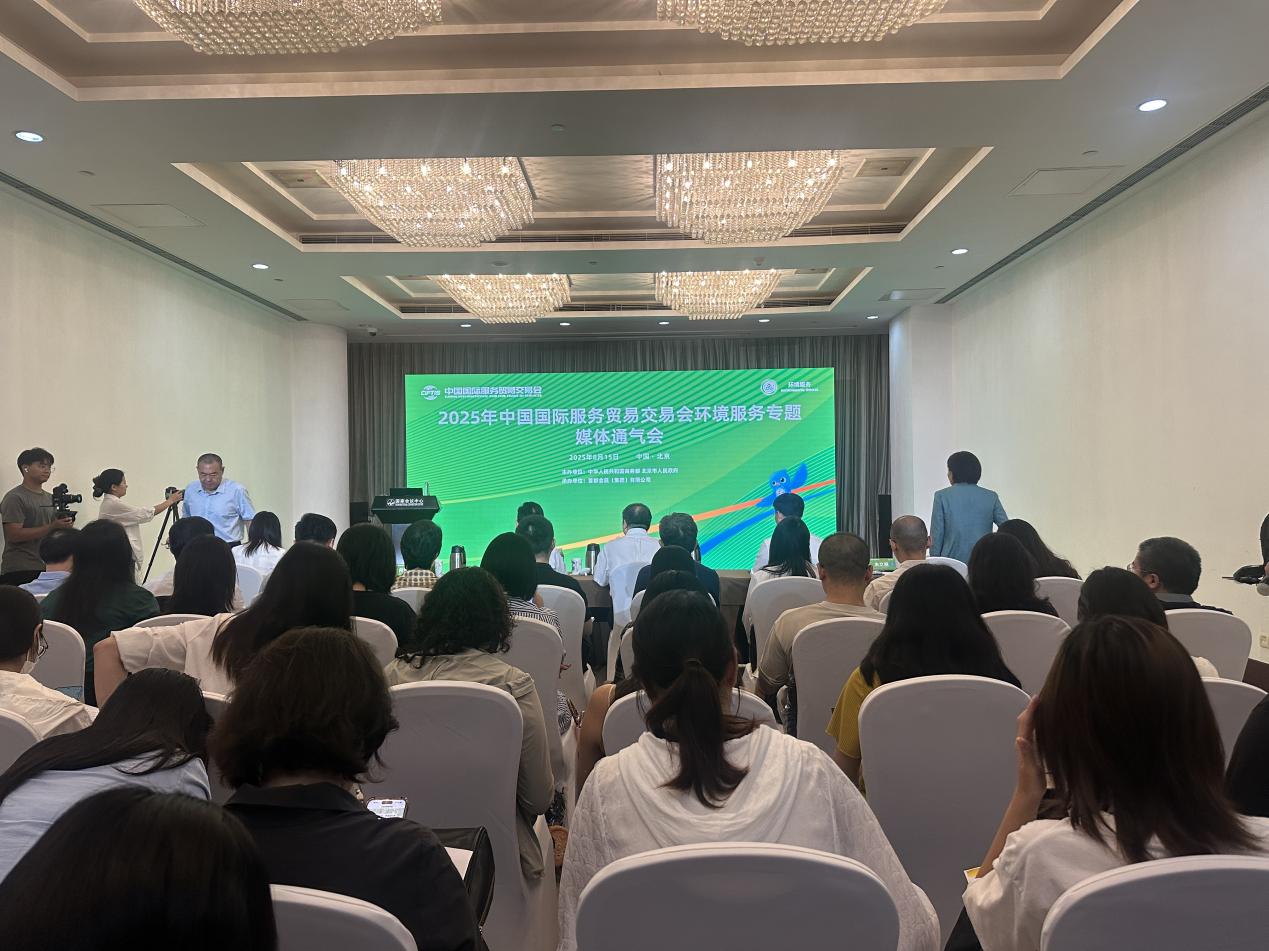
绿色未来 触手可及——提前走进2025年服贸会环境专题展
Zhong Guo Jing Ji Wang· 2025-08-16 08:16
Core Viewpoint - The 2025 China International Fair for Trade in Services (CIFTIS) will focus on environmental services, emphasizing green development and aligning with national strategies such as the "dual carbon" goals and the construction of a beautiful China [1] Group 1: Event Overview - The environmental services section will take place from September 10 to 14, 2025, at Shougang Park in Beijing, covering an exhibition area of 6,600 square meters with the theme "Green Productivity Empowering the Earth Home" [1] - The exhibition aims to showcase China's achievements in ecological civilization and connect global green resources [1] Group 2: Key Features of the Environmental Services Exhibition - The exhibition will feature over 50 participating companies, including 16 Fortune 500 and industry-leading firms, creating a display framework that emphasizes collaboration across the vertical supply chain in three core areas: new energy and low-carbon services, environmental ecological services and circular economy, and green low-carbon digital technologies and services [2] - Nine forums will be organized, including major themes such as the "Dual Carbon" strategy forum and the Global Green Economy Development Forum, enhancing the quality of discussions and knowledge sharing [2][3] Group 3: Innovation and Technology Focus - The exhibition will highlight nearly 30 representative innovations and practical applications, including smart water management systems and AI-driven waste incineration systems, showcasing Beijing's advanced development models that can be replicated and promoted [3][5] - The Beijing Water Technology Innovation Conference will take place on September 11, featuring innovations in smart water management, including integrated sensing systems and AI applications in water supply and drainage [5][6] Group 4: Green Economy Initiatives - The "Zero Carbon Park" exhibition area will present comprehensive solutions for achieving zero carbon emissions, organized by the International Green Economy Association [7][8] - The Global Green Economy Development Forum will address topics such as sustainable development goals (SDGs), green trade, and carbon footprint, with plans to release significant outcomes, including standards for ecological community construction [8][10]