
数字展览服务

Search documents
跨境电商营销行业报告
Sou Hu Cai Jing· 2026-01-10 07:46
Core Insights - The Chinese cross-border e-commerce market is experiencing rapid growth, with market size projected to increase from $22.8 billion in 2020 to $46.17 billion by 2024, representing a compound annual growth rate (CAGR) of 19.3% [1][13] - By 2029, the market size is expected to reach $93.36 billion, indicating a doubling from 2024 [1][13] - The primary transaction models in China's cross-border e-commerce include B2B, B2C, and C2C, each with distinct advantages and challenges [1][6] - The marketing services market for cross-border e-commerce is fragmented, with leading companies like Province Guang Group and Miduo Duo providing integrated marketing and digital exhibition services [1][6] - Future trends in cross-border e-commerce marketing are expected to focus on intelligence, socialization, and localization, with a rising demand for one-stop marketing services [1][29] Market Growth - The market size of China's cross-border e-commerce is projected to grow significantly, with a CAGR of 14.6% from 2025 to 2029 [12] - The growth is driven by factors such as the acceleration of online consumption habits due to the COVID-19 pandemic, the expansion of cross-border e-commerce pilot zones, and improvements in infrastructure like overseas warehouses [13][29] - The market is expected to quadruple in size over the next decade, approaching the $1 trillion mark [13] Transaction Models - B2B (Business-to-Business): Strong scale effects, high transaction values, but challenges in buyer matching and long-term relationship maintenance [7] - B2C (Business-to-Consumer): High brand exposure and user experience, but faces high return rates and inventory pressure [7] - C2C (Consumer-to-Consumer): Suitable for niche products with a wide supply chain, but quality can be inconsistent [7] Regulatory Environment - The Chinese customs have established four special regulatory models (9610, 9710, 9810, 1210) to simplify declarations and reduce logistics costs [9] - Recent announcements include the cancellation of overseas warehouse filing requirements to further facilitate businesses [9] Marketing Services Landscape - The marketing services for cross-border e-commerce are evolving from single service providers to comprehensive platforms that integrate marketing, scenarios, and transactions [6][34] - Companies are increasingly relying on AI technology to enhance content production and precision marketing [1][29] Future Trends - The demand for one-stop marketing services is on the rise, driven by the need for integrated solutions that cater to diverse market characteristics and consumer habits [34] - The cross-border e-commerce ecosystem is becoming more robust, with platforms like TikTok Shop and Amazon enhancing seller service systems and local fulfillment capabilities [29][35]


米多多港股IPO:资不抵债,4%毛利率下的“流量搬运工”能走多远?
Sou Hu Cai Jing· 2025-12-24 09:37
Core Viewpoint - The overseas traffic business appears prosperous but is struggling within the ecosystem dominated by tech giants, as evidenced by the financial difficulties faced by Midoor Group, which is seeking to go public while revealing significant losses and operational challenges [1]. Group 1: Business Development and Structure - Midoor's business has evolved through three main phases: from a traditional cross-border trade intermediary (2014-2017) to a digital advertising agency (2018-2021), and finally to a cross-border e-commerce marketing service provider since 2021 [2]. - The company operates three main business segments: overseas marketing services, digital exhibition services, and overseas e-commerce operations, with overseas marketing services contributing over 98% of its revenue [5][6]. - Midoor's market share in the cross-border e-commerce service sector is only 0.5%, despite being the fifth largest provider in China [4]. Group 2: Financial Performance - Midoor's revenue from 2022 to 2024 was reported as $65.17 million, $70.85 million, and $71.13 million, with a significant slowdown in growth to just 0.4% in 2024 [6]. - The company experienced a net profit of $1.64 million in 2022, but reported a loss of $16.41 million in 2023, with losses further escalating to $19.85 million in the first half of 2025, marking a nearly 900-fold increase year-on-year [6][10]. - As of June 2025, Midoor's unremitted losses reached $32.53 million, with a debt-to-asset ratio consistently above 106%, indicating a precarious financial position [7]. Group 3: Dependency and Profitability Issues - Midoor's gross profit margins have remained low, fluctuating between 4% and 8%, with the core overseas marketing service margin dropping to 3.8% in 2023 due to increased media costs from platforms like Google and TikTok [10][11]. - The company is heavily reliant on a few major suppliers, with 96.5% of its procurement costs coming from the top five suppliers, primarily Google and TikTok, which limits its pricing power and profitability [11]. - The customer base is primarily composed of small to medium-sized cross-border sellers, with an average revenue per client of only $657,000, leading to intense price competition and further pressure on profit margins [12]. Group 4: Future Prospects and Challenges - Midoor plans to use the funds raised from its IPO to expand global operations and develop its overseas e-commerce operational system and technology [13]. - The company faces significant challenges, including tightening policies from major platforms and increasing industry competition, which may hinder its ability to transform its business model successfully [13].
新股前瞻|行业第五难挡利润端恶化,米多多海外电商运营的新故事难讲?
Zhi Tong Cai Jing· 2025-12-20 02:50
Core Viewpoint - The cross-border e-commerce industry in China is projected to reach a scale of $461.7 billion in 2024, driven by advanced production capabilities and strong government support, with a growing demand for marketing services in this sector [1]. Industry Overview - The cross-border e-commerce marketing market in China is expected to reach $14.3 billion in 2024, indicating a robust growth trajectory [1]. - The company Mido has submitted its listing application to the Hong Kong Stock Exchange, positioning itself as a representative player in the cross-border e-commerce marketing sector [1]. Company Performance - Mido's revenue from 2022 to 2024 was $6.517 million, $7.085 million, and $7.113 million respectively, while it reported net profits of $164.1 thousand, -$1.6413 million, and -$16.3 thousand during the same period [1]. - In the first half of 2025, Mido's revenue surged by 81.6% to $5.577 million, but net losses expanded significantly from -$2.2 thousand to -$19.85 million [1]. Business Model and Structure - Mido has transitioned through three phases since its establishment in 2014, evolving from a traditional intermediary to a digital advertising agency and finally to a cross-border e-commerce marketing service provider [2]. - The company operates three main business lines: overseas marketing services, overseas e-commerce operations, and digital exhibition services [3]. Revenue Composition - Mido's revenue heavily relies on overseas marketing services, which accounted for 99% of its revenue from 2022 to 2024, with minimal contributions from other services [4]. - The company’s gross margin has significantly declined from 8% in 2022 to 4.1% in 2023 and 4.4% in 2024, indicating a deterioration in profitability [6]. Cost Structure - Media costs represent a substantial portion of Mido's expenses, reaching 99.3% in 2023, which has severely impacted its gross margin [9]. - The total expenses related to marketing, administration, and research and development account for approximately 4% of total revenue, indicating a critical threshold for profitability [8]. Market Challenges - Mido's business model is vulnerable due to its heavy reliance on overseas marketing services, which are susceptible to fluctuations in media costs and demand [9]. - The company faces challenges in expanding its digital exhibition services and newly launched overseas e-commerce operations, which require significant investment and time to scale [11]. Future Outlook - Mido's ability to achieve a higher market valuation is hindered by its dependence on a fragile business model and the sluggish growth of new revenue streams [12]. - The success of Mido's new growth initiatives will be crucial in reshaping market perceptions, but short-term profitability may be adversely affected [12].
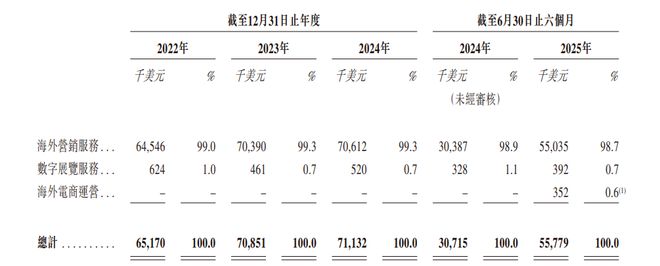
米多多赴港IPO,为跨境电商服务供应商,净利润连续两年亏损
Ge Long Hui· 2025-12-15 11:07
Core Viewpoint - The article discusses the increasing trend of Chinese companies expanding into overseas markets, highlighting the role of marketing services providers like Midoor in facilitating this process through localized content and data-driven optimization [1][17]. Company Overview - Midoor Group Co., Ltd. is positioned as the fifth largest cross-border e-commerce service provider in China, focusing on developing digital solutions for clients to reach overseas consumers via platforms like Google, TikTok, Meta, and Amazon [1][4]. - The company has three main business segments: overseas marketing services, overseas e-commerce operations, and digital exhibition services, with overseas marketing services contributing over 98% of its revenue during the reporting period [4][9]. Financial Performance - Midoor's revenue has shown growth, with figures of approximately $65.17 million in 2022, $70.85 million in 2023, and projected revenues of $71.13 million for 2024 and $55.78 million for the first half of 2025. However, the company has reported net losses for two consecutive years [9][10]. - The adjusted net profit figures for the same periods were $164.1 million in 2022, -$1.64 million in 2023, -$0.16 million in 2024, and -$1.99 million in the first half of 2025 [9][10]. Market Dynamics - The cross-border e-commerce marketing services market in China is expected to grow significantly, with a projected market size of $36.3 billion in 2024, expanding to $73.7 billion by 2029, reflecting a compound annual growth rate of 15.2% [10][11]. - Midoor's market share is relatively small at 0.5%, with the top five market participants holding approximately 36.5% of the market share in 2024 [14][16]. Business Strategy - Midoor aims to raise funds through its IPO to expand its global business coverage, focusing on localized marketing services, developing overseas e-commerce operations, and investing in marketing-related technology [19]. - The company has established a strong understanding of overseas platform rules and user behavior, which helps reduce trial-and-error costs for its clients [19].
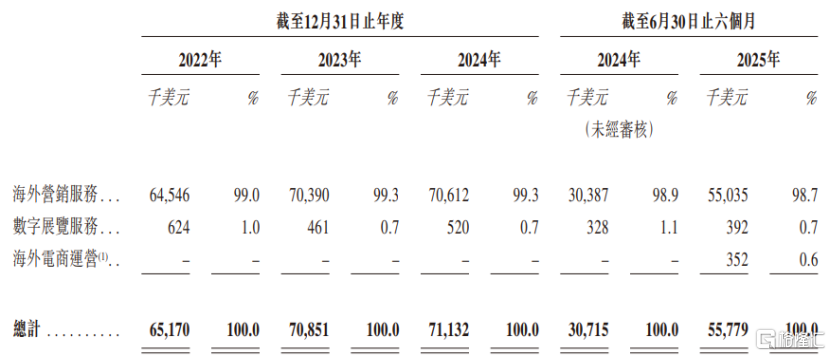
米多多递表港交所
Shen Zhen Shang Bao· 2025-12-10 23:48
Core Insights - Mido Group has submitted its listing application to the Hong Kong Stock Exchange, with CCB International as the sole sponsor [1] - The company is a leading and rapidly growing integrated service platform providing digital marketing and operational support for cross-border e-commerce businesses [1] - Mido Group is projected to be the fifth largest cross-border e-commerce service provider in China based on 2024 revenue [1] Revenue Composition - In the first half of 2025, Mido Group's revenue reached $5,578 million, up from $3,072 million in the same period last year, with a loss of $1,985 million [1] - The overseas marketing service is the core business line, generating $5,503.5 million, which accounts for 98.7% of total revenue [2] - The company also reported $35.2 million from overseas e-commerce operations (0.6%) and $39.2 million from digital exhibition services (0.7%) [2] Client Concentration - Mido Group has a high client concentration, with the top five clients accounting for 37.2% of revenue in the first half of 2025, down from 62.2% in 2022 [2] - The largest client contributed 10.5% of total revenue [2]
米多多冲刺港股IPO:今年上半年收入5577.9万美元 服务超千家客户“出海”
Zheng Quan Ri Bao Wang· 2025-12-10 04:46
Group 1 - The core viewpoint of the article is that Mido's Group is preparing for an IPO on the Hong Kong Stock Exchange, aiming to leverage its position in the rapidly growing cross-border e-commerce marketing services industry [1][3] - Mido's operates as a comprehensive service platform for cross-border e-commerce, providing digital marketing and operational support to clients selling products globally through major digital media platforms [1][2] - The cross-border marketing services market is projected to grow from $6.4 billion in 2020 to $14.3 billion by 2024, with a compound annual growth rate (CAGR) of 22.1%, and further to $30.5 billion by 2029, with a CAGR of 16.4% [1] Group 2 - Mido's has demonstrated strong financial performance, with revenue increasing from $65.17 million in 2022 to $71.13 million in 2024, and achieving $55.78 million in the first half of 2025, nearly doubling year-on-year [1][2] - The company is recognized as one of the top five cross-border e-commerce marketing service providers in China, with a comprehensive service offering and a large customer base, having over 1,000 overseas marketing service clients in the first half of this year [2] - The IPO is seen as a strategic milestone for Mido's, expected to enhance its capital position, improve governance and brand image, and expand its global business footprint, thereby creating long-term value for clients and society [3]