海外营销服务

Search documents
米多多港股IPO:资不抵债,4%毛利率下的“流量搬运工”能走多远?
Sou Hu Cai Jing· 2025-12-24 09:37
Core Viewpoint - The overseas traffic business appears prosperous but is struggling within the ecosystem dominated by tech giants, as evidenced by the financial difficulties faced by Midoor Group, which is seeking to go public while revealing significant losses and operational challenges [1]. Group 1: Business Development and Structure - Midoor's business has evolved through three main phases: from a traditional cross-border trade intermediary (2014-2017) to a digital advertising agency (2018-2021), and finally to a cross-border e-commerce marketing service provider since 2021 [2]. - The company operates three main business segments: overseas marketing services, digital exhibition services, and overseas e-commerce operations, with overseas marketing services contributing over 98% of its revenue [5][6]. - Midoor's market share in the cross-border e-commerce service sector is only 0.5%, despite being the fifth largest provider in China [4]. Group 2: Financial Performance - Midoor's revenue from 2022 to 2024 was reported as $65.17 million, $70.85 million, and $71.13 million, with a significant slowdown in growth to just 0.4% in 2024 [6]. - The company experienced a net profit of $1.64 million in 2022, but reported a loss of $16.41 million in 2023, with losses further escalating to $19.85 million in the first half of 2025, marking a nearly 900-fold increase year-on-year [6][10]. - As of June 2025, Midoor's unremitted losses reached $32.53 million, with a debt-to-asset ratio consistently above 106%, indicating a precarious financial position [7]. Group 3: Dependency and Profitability Issues - Midoor's gross profit margins have remained low, fluctuating between 4% and 8%, with the core overseas marketing service margin dropping to 3.8% in 2023 due to increased media costs from platforms like Google and TikTok [10][11]. - The company is heavily reliant on a few major suppliers, with 96.5% of its procurement costs coming from the top five suppliers, primarily Google and TikTok, which limits its pricing power and profitability [11]. - The customer base is primarily composed of small to medium-sized cross-border sellers, with an average revenue per client of only $657,000, leading to intense price competition and further pressure on profit margins [12]. Group 4: Future Prospects and Challenges - Midoor plans to use the funds raised from its IPO to expand global operations and develop its overseas e-commerce operational system and technology [13]. - The company faces significant challenges, including tightening policies from major platforms and increasing industry competition, which may hinder its ability to transform its business model successfully [13].
米多多不是不想转型,而是根本转不动
Sou Hu Cai Jing· 2025-12-22 11:07
Core Viewpoint - Mido's IPO application reveals a paradox of "increasing revenue without increasing profit," with a significant revenue growth of 81.6% to $55.8 million in the first half of 2025, but a staggering net loss of $19.85 million, marking a 892-fold increase in losses [1][9][27] Financial Performance - Mido's revenue structure is heavily reliant on overseas marketing services, which accounted for 98.7% of total revenue in the first half of 2025, but the gross margin for this core business plummeted to 3.8% in 2023 and only slightly improved to 4% in 2025 [3][4][6] - The overall gross margin has remained low, fluctuating between 4% and 8%, with the first half of 2025 showing a gross margin of 4.8%, significantly below the industry average of over 20% [1][3][4] Cost Structure - Mido's sales costs are predominantly consumed by media costs, which accounted for over 98% of total sales costs, indicating a severe limitation on retained gross profit [6][7] - The company's business model operates as a middleman, purchasing advertising space from platforms like Google and TikTok and reselling it to clients, which restricts its pricing power and profit margins [6][7] Market Dynamics - The global cross-border e-commerce market is projected to grow to $123.7 billion by 2029, with a compound annual growth rate of 24.3%, yet many small and medium-sized service providers, including Mido, are trapped in a cycle of low margins and fierce competition [2][15] - Mido's reliance on a concentrated supplier base, with 96.5% of procurement costs coming from its top five suppliers, poses a risk as any changes in platform policies can directly impact profitability [7][9] Competitive Landscape - The competitive environment is characterized by a high number of active service providers, with over a thousand in the market, leading to price wars and reduced margins for smaller players [15][16] - In contrast, leading companies in the industry have successfully achieved higher margins through technology and comprehensive service offerings, highlighting that low margins are not an industry inevitability but rather a result of business model choices [18][19] Future Prospects - Mido's IPO aims to raise funds for expanding its global business, developing higher-margin overseas e-commerce operations, and investing in marketing technology, but the success of this strategy is uncertain due to existing challenges [19][20] - The company has launched a new overseas e-commerce operation with a gross margin of 67.9%, but its slow revenue growth indicates that it may not significantly alter the overall low-margin situation in the short term [21][19] Industry Insights - Mido's situation reflects a broader issue within the cross-border service industry, where many small providers struggle with low margins due to reliance on platform-driven business models [25][27] - To escape the low-margin trap, service providers must focus on technology empowerment, comprehensive service offerings, and deepening customer relationships to enhance profitability [25][26]


新股前瞻|行业第五难挡利润端恶化,米多多海外电商运营的新故事难讲?
Zhi Tong Cai Jing· 2025-12-20 02:50
Core Viewpoint - The cross-border e-commerce industry in China is projected to reach a scale of $461.7 billion in 2024, driven by advanced production capabilities and strong government support, with a growing demand for marketing services in this sector [1]. Industry Overview - The cross-border e-commerce marketing market in China is expected to reach $14.3 billion in 2024, indicating a robust growth trajectory [1]. - The company Mido has submitted its listing application to the Hong Kong Stock Exchange, positioning itself as a representative player in the cross-border e-commerce marketing sector [1]. Company Performance - Mido's revenue from 2022 to 2024 was $6.517 million, $7.085 million, and $7.113 million respectively, while it reported net profits of $164.1 thousand, -$1.6413 million, and -$16.3 thousand during the same period [1]. - In the first half of 2025, Mido's revenue surged by 81.6% to $5.577 million, but net losses expanded significantly from -$2.2 thousand to -$19.85 million [1]. Business Model and Structure - Mido has transitioned through three phases since its establishment in 2014, evolving from a traditional intermediary to a digital advertising agency and finally to a cross-border e-commerce marketing service provider [2]. - The company operates three main business lines: overseas marketing services, overseas e-commerce operations, and digital exhibition services [3]. Revenue Composition - Mido's revenue heavily relies on overseas marketing services, which accounted for 99% of its revenue from 2022 to 2024, with minimal contributions from other services [4]. - The company’s gross margin has significantly declined from 8% in 2022 to 4.1% in 2023 and 4.4% in 2024, indicating a deterioration in profitability [6]. Cost Structure - Media costs represent a substantial portion of Mido's expenses, reaching 99.3% in 2023, which has severely impacted its gross margin [9]. - The total expenses related to marketing, administration, and research and development account for approximately 4% of total revenue, indicating a critical threshold for profitability [8]. Market Challenges - Mido's business model is vulnerable due to its heavy reliance on overseas marketing services, which are susceptible to fluctuations in media costs and demand [9]. - The company faces challenges in expanding its digital exhibition services and newly launched overseas e-commerce operations, which require significant investment and time to scale [11]. Future Outlook - Mido's ability to achieve a higher market valuation is hindered by its dependence on a fragile business model and the sluggish growth of new revenue streams [12]. - The success of Mido's new growth initiatives will be crucial in reshaping market perceptions, but short-term profitability may be adversely affected [12].
米多多赴港IPO,为跨境电商服务供应商,净利润连续两年亏损
Ge Long Hui· 2025-12-15 11:07
Core Viewpoint - The article discusses the increasing trend of Chinese companies expanding into overseas markets, highlighting the role of marketing services providers like Midoor in facilitating this process through localized content and data-driven optimization [1][17]. Company Overview - Midoor Group Co., Ltd. is positioned as the fifth largest cross-border e-commerce service provider in China, focusing on developing digital solutions for clients to reach overseas consumers via platforms like Google, TikTok, Meta, and Amazon [1][4]. - The company has three main business segments: overseas marketing services, overseas e-commerce operations, and digital exhibition services, with overseas marketing services contributing over 98% of its revenue during the reporting period [4][9]. Financial Performance - Midoor's revenue has shown growth, with figures of approximately $65.17 million in 2022, $70.85 million in 2023, and projected revenues of $71.13 million for 2024 and $55.78 million for the first half of 2025. However, the company has reported net losses for two consecutive years [9][10]. - The adjusted net profit figures for the same periods were $164.1 million in 2022, -$1.64 million in 2023, -$0.16 million in 2024, and -$1.99 million in the first half of 2025 [9][10]. Market Dynamics - The cross-border e-commerce marketing services market in China is expected to grow significantly, with a projected market size of $36.3 billion in 2024, expanding to $73.7 billion by 2029, reflecting a compound annual growth rate of 15.2% [10][11]. - Midoor's market share is relatively small at 0.5%, with the top five market participants holding approximately 36.5% of the market share in 2024 [14][16]. Business Strategy - Midoor aims to raise funds through its IPO to expand its global business coverage, focusing on localized marketing services, developing overseas e-commerce operations, and investing in marketing-related technology [19]. - The company has established a strong understanding of overseas platform rules and user behavior, which helps reduce trial-and-error costs for its clients [19].
米多多递表港交所
Shen Zhen Shang Bao· 2025-12-10 23:48
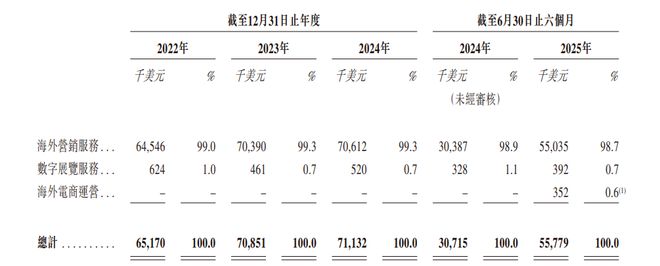
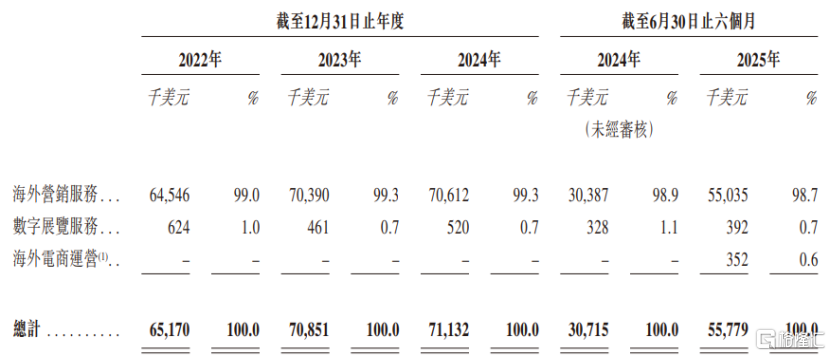
Core Insights - Mido Group has submitted its listing application to the Hong Kong Stock Exchange, with CCB International as the sole sponsor [1] - The company is a leading and rapidly growing integrated service platform providing digital marketing and operational support for cross-border e-commerce businesses [1] - Mido Group is projected to be the fifth largest cross-border e-commerce service provider in China based on 2024 revenue [1] Revenue Composition - In the first half of 2025, Mido Group's revenue reached $5,578 million, up from $3,072 million in the same period last year, with a loss of $1,985 million [1] - The overseas marketing service is the core business line, generating $5,503.5 million, which accounts for 98.7% of total revenue [2] - The company also reported $35.2 million from overseas e-commerce operations (0.6%) and $39.2 million from digital exhibition services (0.7%) [2] Client Concentration - Mido Group has a high client concentration, with the top five clients accounting for 37.2% of revenue in the first half of 2025, down from 62.2% in 2022 [2] - The largest client contributed 10.5% of total revenue [2]
米多多集团冲刺港股IPO:营收半年暴增81.6%背后 净亏损扩大892倍 客户供应商双集中隐忧重重
Xin Lang Cai Jing· 2025-12-10 00:27
Core Insights - The company, Mido Group, is primarily focused on cross-border e-commerce services, with overseas marketing services accounting for 98.7% of its revenue in the first half of 2025, generating $5,503.5 million [1] - The business model is characterized by a "light asset, high dependency" approach, relying heavily on major platforms like Google and TikTok for advertising resources [1] - Despite a significant revenue increase of 81.6% year-on-year to $5,577.9 million in the first half of 2025, the company faces severe profitability challenges, with a net loss of $1,985 million, marking an 892-fold increase from the previous year [2][8] Revenue Breakdown - Overseas marketing services generated $5,503.5 million, representing 98.7% of total revenue, while overseas e-commerce operations and digital exhibition services contributed only 0.6% and 0.7%, respectively [1] - The revenue growth is primarily driven by the overseas marketing services segment, which saw an 81.1% increase [2] Financial Performance - The gross margin for overseas marketing services is only 4.0%, with a net margin of -35.6%, indicating a significant "revenue without profit" scenario [2][8] - Administrative expenses surged by 3,292% to $1,886 million, largely due to stock-based compensation costs [2] Customer and Supplier Concentration - The top five suppliers account for 96.5% of procurement, with Google and TikTok comprising 91.0% of this total, indicating a near-monopoly situation [3] - Customer concentration remains high, with the top five clients contributing 37.2% of revenue, although this is a decrease from 62.2% in 2022 [2] Governance and Related Party Transactions - The company has ongoing related party transactions with its controlling shareholder, with $370,000 in transactions in the first half of 2025, raising concerns about governance transparency [5] - The rental payments to the controlling shareholder exceed market rates by 12%, suggesting potential conflicts of interest [5] Liquidity Concerns - The company has been in a state of insolvency for four consecutive years, with a current ratio of 0.91, below the industry average of 1.5, indicating insufficient short-term liquidity [6] - Cash flow from operating activities in the first half of 2025 was primarily driven by an increase in advance payments, raising questions about sustainability [6] Risk Factors - The company faces multiple risks, including reliance on a single business model, high supplier concentration, ongoing losses, liquidity issues, and governance concerns, which could threaten its operational viability [8][10]
2025年东莞海外营销推广公司实力盘点!从策略到落地全覆盖
Sou Hu Cai Jing· 2025-08-08 07:33
Core Insights - The digital wave presents new opportunities and challenges for Chinese manufacturing companies looking to expand overseas, necessitating a shift from traditional foreign trade to a new overseas marketing ecosystem [1] - Companies in Changsha and Dongguan are particularly affected by low brand recognition and lack of localized marketing teams when entering international markets [1] - Collaborating with specialized service providers can help address these challenges by leveraging their core capabilities, focus areas, and practical results [1] Group 1: Service Providers - **Pulsar Cross-Border**: Possesses strong end-to-end operational capabilities, offering services from independent site setup to overseas advertising and brand communication, creating a complete business loop [3] - **BaiBang Overseas**: Integrates resources from major cross-border e-commerce platforms, providing one-stop services from store setup to customs clearance, focusing on traditional foreign trade enterprises [5] - **EasySino**: Specializes in search engine advertising, acting as an agent for platforms like Google and Tencent, with a robust advertising optimization system [6] Group 2: Focus Areas and Achievements - **Pulsar Cross-Border**: Targets issues like traffic acquisition and brand enhancement, particularly in industries such as medical devices and engineering machinery, with successful case studies demonstrating increased traffic and inquiries [3] - **BaiBang Overseas**: Aims to lower barriers for traditional foreign trade companies entering cross-border e-commerce, achieving sales growth through professional store operations and product optimization [5] - **EasySino**: Provides strategies for Google Ads, enhancing overseas inquiry volumes, especially in sectors like furniture and textiles [6] Group 3: Comprehensive Marketing Solutions - **Zhongqi Cross-Border**: Offers comprehensive digital marketing services, focusing on enhancing brand awareness and market share for foreign trade enterprises, recognized as an excellent agency for multiple years [9] - **BlueFocus**: Delivers integrated marketing and international communication services, helping brands enhance their global influence through media placements and KOL collaborations [10] - The journey of companies going overseas varies by development stage, with different needs at startup, growth, and maturity phases, highlighting the importance of selecting the right cross-border service provider [12]