
斯泰度塔单抗注射液(新替妥)

Search documents
泰诺麦博三年多亏15亿 实控人背数十亿“对赌”压力
Zhong Guo Jing Ji Wang· 2025-12-10 06:43
Core Viewpoint - The company Tianomab is facing significant challenges as it attempts to go public on the STAR Market, with its core product's actual sales falling short of expectations, raising concerns about its financial viability and future growth prospects [1][3][4]. Group 1: Company Overview - Tianomab was established in 2015 and focuses on innovative biopharmaceuticals, particularly blood product alternatives [3]. - The company's core product, Staitodab monoclonal antibody injection (marketed as Xintimab), was approved for sale in China in February 2023 [3]. - As of the date of the report, Tianomab is in the process of conducting a Phase III clinical trial for another key product, TNM001 [3]. Group 2: Financial Performance - From 2022 to the first quarter of 2025, Tianomab has incurred cumulative losses of 1.567 billion yuan [5]. - The company has invested heavily in research and development, with total R&D expenses amounting to 1.275 billion yuan during the same period [5]. - Sales expenses during the reporting period totaled approximately 75.43 million yuan, despite only one product being commercialized by 2025 [5]. Group 3: Sales Performance - For the period from March to September, the expected sales for Staitodab were 56,800 units, but actual sales reached only 43,500 units, resulting in a completion rate of 76.67% for the self-operated team [4]. - External promotional teams had an even lower performance, with expected sales of 40,100 units but only achieving 2,600 units, leading to a completion rate of 6.42% [4]. - Overall, the combined expected sales were 96,900 units, while actual sales were only 46,100 units, resulting in a completion rate of 47.6% [4]. Group 4: Financial Liabilities and Risks - The company's current liabilities have been on the rise, with figures of 134 million yuan, 116 million yuan, and 285 million yuan reported, reaching 254 million yuan by the first quarter of 2025 [7]. - The liquidity ratios have significantly declined, with the current ratio dropping from 6.19 to 3.29 and the quick ratio from 6.02 to 3.06 [7]. - The company has a potential buyback obligation that could amount to several billion yuan if its IPO application is rejected, posing a substantial financial risk to the controlling shareholder [8].
泰诺麦博科创板IPO藏隐忧
Bei Jing Shang Bao· 2025-11-25 16:40
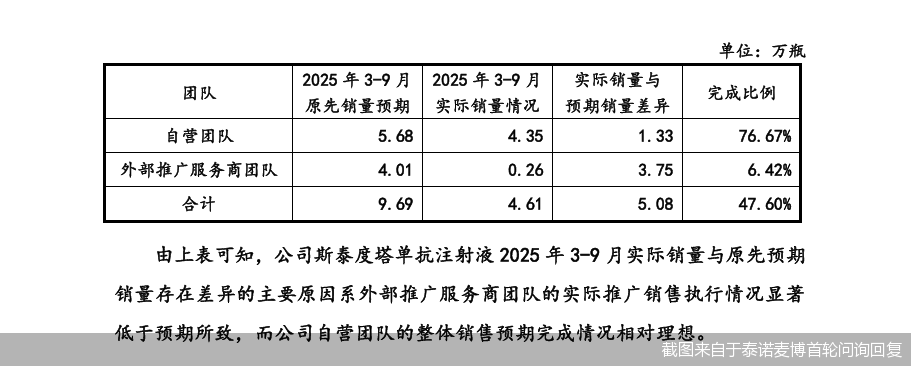
Core Viewpoint - Zhuhai Tainuo Maibo Pharmaceutical Co., Ltd. (Tainuo Maibo) has become a market focus as the first company to apply for listing under the fifth set of standards of the Sci-Tech Innovation Board after its restart, but its actual sales performance of its core product, Staitouta Monoclonal Antibody, has fallen short of expectations, completing only 47.6% of projected sales [1][2]. Company Overview - Tainuo Maibo was established in 2015 and focuses on innovative biopharmaceuticals aimed at global markets, particularly in blood product alternatives [2]. - The company's core product, Staitouta Monoclonal Antibody (trade name: Xintuituo), was approved for sale in China in February, while another key product, TNM001, is undergoing Phase III clinical trials [2]. Sales Performance - From March to September, the self-operated team expected to sell 56,800 bottles of Staitouta, but only sold 43,500 bottles, achieving 76.67% of the target. The external promotion team expected to sell 40,100 bottles but only sold 2,600, achieving 6.42% of the target. Overall, the total expected sales were 96,900 bottles, with actual sales at 46,100 bottles, resulting in a completion rate of 47.6% [2][3]. Reasons for Sales Shortfall - The company attributed the shortfall in sales to underestimating the time required for non-medical insurance drug hospital access and the high pricing of the drug at its current stage. Additionally, the external promotion team needed more time to understand and convey the product's advantages [3]. Sales Team and Expenses - Despite the underperformance in sales, Tainuo Maibo has a high sales expense, with projected sales expenses of 3.89 million, 12.42 million, and 35.11 million for 2022, 2023, and 2024 respectively. In Q1 of this year, sales expenses reached 24 million [4]. - As of the end of Q1, the company had 350 sales personnel, representing 45.63% of its total workforce of 767 employees, indicating a significant investment in building a sales team [4]. Financial Health - The company's debt-to-asset ratio has significantly increased, with figures of 16.54%, 28.19%, 58.96%, and 56.5% for 2022, 2023, and Q1 of this year respectively. This ratio is higher than the average of comparable companies [5][6]. - The increase in the debt-to-asset ratio is attributed to increased spending on drug research and commercialization team building, leading to a decrease in cash reserves [6][7]. Future Outlook - Tainuo Maibo believes that despite the rising debt-to-asset ratio, it remains within the overall range of comparable companies and does not face significant repayment pressure. The company anticipates that cash inflows will increase with the sales growth of Staitouta and the upcoming launch of TNM001 [7].
核心产品销量不及预期一半,泰诺麦博科创板IPO暗藏“隐忧”
Bei Jing Shang Bao· 2025-11-25 12:31
Core Viewpoint - Zhuhai Tainuo Maibo Pharmaceutical Co., Ltd. (Tainuo Maibo) has become a market focus as the first company to apply for listing under the fifth set of standards for the Science and Technology Innovation Board (STAR Market) after its restart. The company disclosed its first round of inquiry responses, revealing that the actual sales of its core product, Staidotat Monoclonal Antibody, fell short of expectations, achieving only 47.6% of the projected sales volume [1][4][5]. Sales Performance - As of September 30, the actual sales of Staidotat Monoclonal Antibody were 4.61 million bottles, compared to an expected 9.69 million bottles, resulting in a completion ratio of 47.6% [5][6]. - The self-operated team had an expected sales volume of 5.68 million bottles but achieved only 4.35 million bottles (completion ratio of 76.67%), while the external promotion service team expected 4.01 million bottles but only sold 0.26 million bottles (completion ratio of 6.42%) [5][6]. Financial Overview - Tainuo Maibo's sales expenses are significant, with projected sales expenses of 3.89 million, 12.42 million, and 35.11 million for the years 2022 to 2024, respectively. In the first quarter of this year, sales expenses reached 24 million [7][8]. - The company reported a net loss of approximately 4.29 billion, 4.46 billion, and 5.15 billion for the years 2022 to 2024, with a net loss of about 1.77 billion in the first quarter of this year [8]. Debt and Financial Health - The asset-liability ratio of Tainuo Maibo has significantly increased, with ratios of 16.54%, 28.19%, 58.96%, and 56.5% for the years 2022 to 2025 Q1. This ratio is higher than the average of comparable companies [10][11]. - The increase in the asset-liability ratio is attributed to increased spending on drug research and commercialization team building, alongside a decrease in cash reserves [12]. IPO and Fundraising - Tainuo Maibo aims to raise 1.5 billion for new drug research projects, expansion of antibody production bases, and to supplement working capital, with allocations of 830 million, 330 million, and 340 million, respectively [9].

科创板“第五套”首单受理“破冰” 非药企案例有望落地
2 1 Shi Ji Jing Ji Bao Dao· 2025-08-04 11:32
Group 1: Company Overview - Zhuhai Tainomai Bo Pharmaceutical Co., Ltd. (Tainomai Bo) has submitted its IPO application, marking a significant step for the fifth listing standard on the Sci-Tech Innovation Board [1] - The company was established in 2015 and its core product, Staitouta Monoclonal Antibody Injection (New Taituo), is the world's first recombinant anti-tetanus toxin monoclonal antibody drug [2] - Staitouta is recognized as a breakthrough therapy and has been included in the priority review process by the Chinese drug regulatory authority [2] Group 2: Product Details - Staitouta is expected to reduce reliance on human blood products for passive immunity against tetanus, with approval for sale in China anticipated by February 2025 [3] - The drug addresses a significant public health threat, as tetanus has a mortality rate close to 100% without medical intervention and remains high even with modern medical care [3] - Traditional passive immunization methods require complex procedures, while Staitouta offers a simplified administration process [4] Group 3: Financial Performance - Despite the product's potential, Tainomai Bo's revenue remains limited, with reported revenues of 4.34 million RMB in 2022, 0 in 2023, and 1.51 million RMB in 2024, with only 16,930 RMB in Q1 2025 [5] - The company has incurred significant losses, with net profits of approximately -4.29 billion RMB in 2022 and -1.77 billion RMB in Q1 2025, leading to a cumulative loss of 1.02 billion RMB by March 2025 [5] Group 4: Market Position and Competition - Tainomai Bo's pricing strategy for Staitouta is a concern, as it lacks a competitive edge compared to tetanus human immunoglobulin, which is covered by medical insurance and has significantly lower prices [6][8] - The company is developing multiple antibody candidates to mitigate reliance on a single product, including TNM001, which is in Phase III clinical trials [9] Group 5: Industry Trends - The introduction of the fifth listing standard on the Sci-Tech Innovation Board is expected to attract more companies, including those outside the biopharmaceutical sector [10] - The market for RSV treatments is projected to reach $12.8 billion globally by 2030, indicating a competitive landscape for Tainomai Bo's products [9] - Other non-pharmaceutical companies are also preparing to apply for the fifth listing standard, indicating a growing interest in diverse sectors [11][12]
“第五套”重启的首单科创板IPO来了
Hua Er Jie Jian Wen· 2025-07-31 15:31
Group 1 - The core point of the article is the acceptance of Zhuhai Tainuo Maibo Pharmaceutical Co., Ltd.'s IPO application under the Sci-Tech Innovation Board, marking a significant milestone for companies meeting the fifth listing standard [1][2]. - Tainuo Maibo's IPO is based on the fifth listing standard, which requires a minimum market value of 4 billion yuan and approval for core products from relevant authorities [2][3]. - The company has reported minimal revenue from technology transfer, with losses exceeding 1.4 billion yuan over three years, but its core product "New Tizhuo" has been approved for commercialization [3][4]. Group 2 - "New Tizhuo" is the world's first recombinant monoclonal antibody drug for emergency prevention of tetanus after exposure to trauma, which could reduce reliance on human blood-derived products [4][5]. - The scarcity of blood products in China, due to regulatory restrictions since 2001, enhances the commercial prospects for "New Tizhuo" [6]. - Tainuo Maibo's IPO fundraising plan allocates 340 million yuan for working capital, significantly higher than similar projects, indicating a positive signal for the innovative medical industry [7].
消费与医疗周报:中国药械企业的全球化进阶之路
Huafu Securities· 2025-03-03 10:58
Group 1 - The report highlights that all six sub-sectors of the pharmaceutical index recorded negative returns, indicating poor performance in the recent week [2][10]. - According to Roland Berger's "China Industry Trends 2025 Report," the Chinese pharmaceutical and medical device industry is accelerating its globalization, with exports of Western medicines and devices experiencing double-digit growth in the first half of 2024 [3][8]. - Leading companies are overcoming international barriers through strategies such as mergers and acquisitions to integrate channel resources, precisely matching target markets, and breaking through key procurement nodes [3][9]. Group 2 - In the first half of 2024, the export value of Western medicine products reached nearly $4.4 billion, with a year-on-year growth of approximately 10%, while medical device exports amounted to $4.2 billion, growing by 12% [8]. - Notable performances from leading companies include BeiGene's main product, Zebrutinib, achieving global sales of $1.3 billion in 2023, with $1.13 billion in sales in the first half of 2024, marking a year-on-year increase of 122% [8]. - Mindray Medical's overseas revenue in the first half of 2024 was 7.91 billion yuan, up 18.1% year-on-year, while United Imaging's overseas revenue reached 930 million yuan, growing by 29.9% [8]. Group 3 - The report identifies three successful strategies for leading Chinese pharmaceutical and medical device companies in their international expansion: innovative pathways, deep market demand exploration, and resource breakthroughs [9]. - The Chinese government's commitment to promoting domestic pharmaceutical and medical device companies to enter international markets is underscored by the issuance of regulatory reform opinions aimed at enhancing high-quality development [9][19]. - The medical imaging equipment market is showing signs of recovery after two years of downturn, with significant sales growth in ultrasound devices, CTs, and other imaging technologies [17][19]. Group 4 - In 2024, China approved 48 innovative drugs for market entry, an increase of 8 from the previous year, reflecting a significant boost in the country's pharmaceutical innovation capabilities [21]. - The report notes that the National Medical Products Administration has approved a record number of innovative medical devices, with 65 new approvals in 2024, indicating a growing trend in innovation within the medical device sector [20][21].