
新型疫苗

Search documents
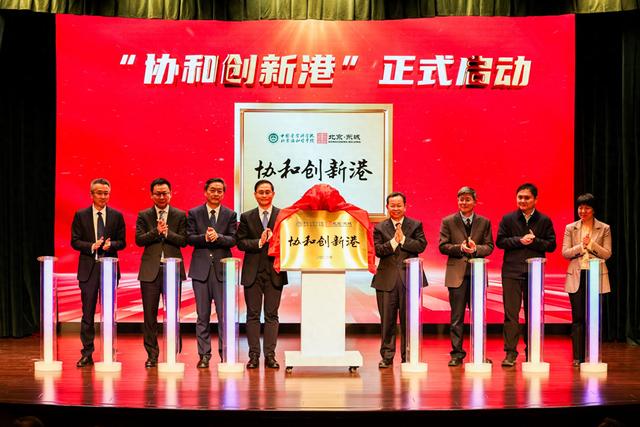
北京协和医学院携手东城打造“协和创新港”
Xin Lang Cai Jing· 2026-02-05 17:12
Core Viewpoint - The "Xiehe Innovation Port" project aims to create a comprehensive ecosystem for innovation in the medical field, focusing on drug development, vaccines, high-end medical devices, and AI in healthcare, with a target investment of 4 billion yuan [1][2] Group 1: Project Overview - The "Xiehe Innovation Port" is initiated by the Chinese Academy of Medical Sciences and Peking Union Medical College in collaboration with the Dongcheng District government [1] - A cooperation agreement was signed to establish a transformation fund with a target scale of 4 billion yuan [1] - Nine partners, including major health and pharmaceutical companies, have expressed intent to collaborate on the project [1] Group 2: Development Goals - The project focuses on creating a closed-loop ecosystem that encompasses "original innovation - clinical validation - results transformation - industrial landing" [2] - It aims to cultivate dozens of high-tech enterprises by 2030 and form a biopharmaceutical industry cluster [2] - The Dongcheng District will provide comprehensive support, including space and policy resources, to facilitate the project's development [2]
推动创新药物从实验室到生产线,北京协和医学院携手东城打造协和创新港
Xin Lang Cai Jing· 2026-02-02 10:52
Group 1 - The "Xiehe Innovation Port" project was officially launched on February 2, with a cooperation agreement signed between the Chinese Academy of Medical Sciences Peking Union Medical College and the Dongcheng District government [2][3] - The project aims to focus on key areas such as innovative drugs, new vaccines, high-end medical devices, and artificial intelligence in healthcare, creating a benchmark innovation platform that integrates achievement transformation, industry incubation, resource docking, talent cultivation, and professional services [6] - The cooperation agreement includes five core components: provision of physical space and supporting services by Dongcheng District, special support policies, establishment of an integrated platform for technology breakthroughs and achievement transformation, creation of a talent cultivation base, and a governance model ensuring efficient operation [6][7]

云南:力争到2027年生物医药产业营收达3500亿元
Ke Ji Ri Bao· 2026-01-19 08:23
Core Insights - Yunnan Province has issued an action plan to accelerate the construction of a modern industrial system, focusing on the biopharmaceutical industry as a key strategic emerging industry, aiming for an industry revenue of 350 billion yuan by 2027 [1] Group 1: Industry Growth and Revenue - During the 14th Five-Year Plan, Yunnan's biopharmaceutical industry has seen steady revenue growth, increasing from 275.1 billion yuan in 2021 to 323.2 billion yuan in 2024, with an average annual growth rate exceeding 6.5% [1] - The industry has established a complete industrial chain for natural medicines and a biopharmaceutical research and production system focused on vaccines [1] Group 2: Technological Advancements and Innovations - Significant technological breakthroughs include the successful development and mass production of genetically edited donor pigs for organ transplantation, and the approval of two Class I new drugs for clinical trials [2] - Research on dengue virus isolation has been recognized as one of the "Top Ten Advances in Life Sciences in China" for 2024, and ultrasound-guided interventional therapy has been designated as a global promotion project by the United Nations [2] Group 3: Future Development Strategies - The 15th Five-Year Plan will focus on advancing core technologies in biopharmaceuticals, including new vaccines, antibody drugs, and gene therapy, while accelerating new product development [2] - Yunnan aims to integrate healthcare with biopharmaceuticals, exploring active components from highland plants and animals to develop new raw materials and products [2] - The province is also planning to promote the industrialization of biomanufacturing, cell therapy, and xenogeneic organ transplantation, expanding the application of biotechnology across various fields [2]
长春“十五五”规划建议:经济增速跑赢全国平均水平,经济总量迈上万亿元台阶
Zheng Quan Shi Bao Wang· 2026-01-06 07:40
Core Insights - Changchun's economic development during the 14th Five-Year Plan period has shown steady growth, with GDP increasing and a modern industrial system being established, focusing on traditional industries' transformation and emerging industries' rapid growth [1][2] Group 1: Economic Development - The GDP of Changchun is on a stable growth trajectory, with a significant improvement in comprehensive strength and a modern industrial system being constructed [1] - The city aims to achieve high-quality development during the 15th Five-Year Plan, with economic growth expected to outpace the national average and total economic output reaching over one trillion yuan [1][2] Group 2: Traditional Industry Optimization - Changchun plans to enhance traditional industries by implementing advanced manufacturing cluster cultivation, focusing on the transformation of the automotive, equipment manufacturing, and agricultural product processing sectors [3] - The automotive industry is shifting towards new energy and intelligent networking, supporting the "All in" strategy of China FAW, and developing a world-class automotive manufacturing cluster [3] Group 3: Emerging Industry Growth - The city will promote high-quality development in emerging industries such as optoelectronics, biomedicine, and green energy, establishing a "leading + supporting" industrial cluster [4] - Changchun aims to become a hub for optoelectronic materials and devices, enhancing its brand as "Changchun Optics Valley" [4] Group 4: New Industry Tracks - The city is focusing on seven new industry tracks, including high-end medical equipment, aerospace, and digital economy, to accelerate development in these areas [5] - Efforts will be made to develop humanoid robotics and advanced materials, with a focus on overcoming key technological challenges [5] Group 5: Service Industry Development - Changchun is set to enhance the quality and efficiency of its service industry, promoting the integration of modern services with advanced manufacturing and agriculture [6] - The city will develop its ice and snow economy, logistics systems, and improve the quality of life services [6] Group 6: Infrastructure Development - A modern infrastructure system will be constructed, focusing on the integration of various networks and the advancement of new infrastructure [7] - The city will prioritize the development of transportation and energy infrastructure to enhance resource allocation and safety [7]
不少于30亿元!合肥高新区设立“合成生物专项基金”
合成生物学与绿色生物制造· 2025-09-17 09:50
Core Viewpoint - Hefei High-tech Zone aims to become a significant hub for the synthetic biology industry, focusing on innovation in four key areas: biomaterials, biomedicine, bio-agriculture, and bio-foods [2][3]. Group 1: Development Plan - The "Implementation Plan for Synthetic Biology Industry Development" was officially released, emphasizing the importance of resource aggregation and promoting high-end, green development in the industry [2]. - A special fund of no less than 3 billion yuan will be established to support the industrialization of major achievements, alongside collaboration with financial institutions to innovate financial products [2]. Group 2: Industry Foundation - The synthetic biology industry in Hefei High-tech Zone has established a solid foundation, featuring a dual-driven model of "enterprises + platforms" [2]. - Over 30 core enterprises have been cultivated, including Anke Bio, Zhifei Longkema, and Zhaoke Pharmaceutical, covering critical areas such as antibody drugs and new vaccines [2]. Group 3: Future Goals - By 2027, the plan aims to nurture more than 10 enterprises with a production value exceeding 100 million yuan, at least 3 enterprises with over 500 million yuan, and 1 enterprise surpassing 1 billion yuan [3]. - The goal is to gather no less than 50 enterprises in the synthetic biology industry chain, with a total production value exceeding 10 billion yuan [3].



63家!中国生物制造500+代表性企业榜单(京津冀篇), 建议收藏!
合成生物学与绿色生物制造· 2025-07-31 13:10
Core Insights - The article highlights the strategic development and policy support for the synthetic biology manufacturing industry in the Beijing-Tianjin-Hebei region, emphasizing its collaborative advantages and global competitiveness potential [2][3]. Policy Support and Innovation Mechanisms - Significant policy support has been established, creating a collaborative innovation mechanism among the three regions [4]. - The regions have formed a gradient layout: R&D in Beijing, pilot testing in Tianjin, and industrialization in Hebei [3]. Regional Industrial Layout - Beijing serves as the innovation source, while Tianjin focuses on industrial transformation and manufacturing, particularly in the Binhai New Area, which is developing a "Biomanufacturing Valley" [5]. - Hebei is positioned for low-cost production and supporting industries, with a focus on self-sufficient industrial chains [6]. Financial and Research Support - A joint basic research cooperation project will be established by 2025, with individual project funding up to 600,000 yuan to support synthetic biology manufacturing [8]. - Beijing's action plan aims to accelerate innovation in synthetic biology, with a maximum support of 50 million yuan to cultivate three listed companies by 2026 [8]. Industry Growth Targets - Hebei's Shijiazhuang aims for the biomanufacturing industry revenue to exceed 150 billion yuan by 2025, focusing on gene synthesis and biobased materials [8]. - The industry scale in Yizhuang is expected to surpass 120 billion yuan by 2027, with policies supporting cutting-edge sectors [8]. Upcoming Events and Initiatives - The Fourth Synthetic Biology and Green Biomanufacturing Conference will be held from August 20-22, 2025, in Ningbo, focusing on AI and biomanufacturing, green chemistry, and new materials [17][19]. - The conference will feature various forums and discussions aimed at advancing the industry and showcasing technological achievements [17][19].
中国医药企业破浪扬帆加速全球化
Zhong Guo Chan Ye Jing Ji Xin Xi Wang· 2025-07-10 23:25
Core Viewpoint - The Chinese pharmaceutical industry is experiencing positive changes driven by policy optimization and innovation, with a focus on internationalization and high-quality development [2][3]. Group 1: Industry Development - China's pharmaceutical industry has become a global leader in the production of active pharmaceutical ingredients (APIs) and small to medium-sized medical devices, playing an increasingly important role in the global pharmaceutical landscape [1][2]. - The industry is transitioning from exporting intermediates and APIs to a comprehensive export of innovative products, marking a significant shift in the internationalization of Chinese pharmaceuticals [2][3]. Group 2: Policy and Regulatory Environment - Recent reforms in drug and medical device regulation have enhanced the safety and effectiveness of products while stimulating innovation within the industry [4][5]. - The acceleration of drug review and approval processes, along with China's membership in the International Council for Harmonisation (ICH), has created a "fast track" for innovative drugs to enter international markets [2][3]. Group 3: Market Strategies and Internationalization - Companies are encouraged to adopt differentiated and refined market entry strategies by analyzing regional market characteristics, disease profiles, payment capabilities, and competitive landscapes [3][4]. - Successful case studies highlight the importance of collaboration, local production, and building partnerships to penetrate target markets effectively [5]. Group 4: Challenges and Future Directions - Despite the progress, the industry faces various internal and external challenges that require modernization of the regulatory system and governance capabilities to ensure high-quality development [3][5]. - The industry must maintain confidence and focus on enhancing innovation capabilities and quality control to navigate complex international environments and competition [5].


医药与生物制造专题抢先看:合成生物+医药,能否成为下一个经济增长极?
合成生物学与绿色生物制造· 2025-04-22 04:04
近年来,合成生物学技术迭代更新迅猛,与生物医药产业深度融合,在 药物研发、疾病诊疗和绿色可 持续生产 等关键领域展现出巨大潜力与广阔市场空间。在疾病诊断方面,合成生物学为早期、精确诊 断提供了创新思路与技术支撑;在疾病治疗方面,基于合成生物学原理的细胞疗法、细菌疗法、新型疫 苗和生物医学材料等前沿成果不断涌现,为患者带来新希望。据相关数据显示,2023年全球合成生物学 市场规模已突破 170亿美元 ,其中医疗健康领域约 64亿美元 ,占比近 40% 。未来合成生物学在医疗健 康领域的应用规模有望持续攀升,预计到2028年将达到 133亿美元 。随着基因编辑、高通量测序、生物 信息学和人工智能等技术的不断进步,合成生物学在医药领域的应用场景将不断拓展,为医药产业的转 型升级提供强大动力。 2025第二届合成生物制造创新发展大会 将于 2025年5月22-23日 在 上海浦东喜来登由由大酒店 盛大启 幕。本次大会以" 合成新'基'遇,智造赢未来 "为主题,邀请全球生物制造领域的专家、企业家和科研 机构,聚焦合成生物技术在 医药、食品、化妆品、新材料、AI方向 的应用,共同探讨生物制造技术的 发展趋势、市场机遇与挑 ...