日元汇率

Search documents
日本前央行行长黑田东彦呼吁加息、收紧财政政策
Hua Er Jie Jian Wen· 2026-02-25 08:11
Core Viewpoint - Former Bank of Japan Governor Haruhiko Kuroda emphasizes the need for continued interest rate hikes and tighter fiscal policies as Japan's economic conditions improve significantly [1][3]. Group 1: Monetary Policy - Kuroda predicts that the Bank of Japan may raise interest rates approximately twice each year in 2026 and 2027, gradually moving the current policy rate towards a neutral level [1]. - He suggests that the current policy rate of 0.75% could be increased to around 1.5% to 1.75% over the next few years, given the robust economic growth and rising wage levels [3]. - Kuroda highlights that the macroeconomic environment has shifted from deflation and a strong yen to inflation and a weak yen, necessitating a tightening of both fiscal and monetary policies [3]. Group 2: Fiscal Policy - Kuroda expresses concern over Prime Minister Fumio Kishida's expansionary fiscal policies, including significant government spending and a two-year suspension of the 8% sales tax on food, which he believes could exacerbate inflationary pressures [4]. - He warns that increasing government spending solely to alleviate living costs may be counterproductive, potentially leading to higher bond yields [4]. Group 3: Currency and Exchange Rates - Kuroda notes that the current level of the yen may be "slightly weak" based on Japan's recent economic growth, price trends, and economic competitiveness [7]. - He acknowledges that while foreign exchange interventions can influence the yen's value in the short term, their long-term effectiveness is uncertain [7]. Group 4: Communication Strategy - Kuroda supports a more subdued communication strategy for the Bank of Japan, contrasting with the aggressive approach during his tenure, as the current environment does not require such drastic measures [9]. - He agrees with the current Governor Kazuo Ueda's approach of maintaining subtlety and ambiguity in policy statements, which is deemed appropriate during this transitional period [9].

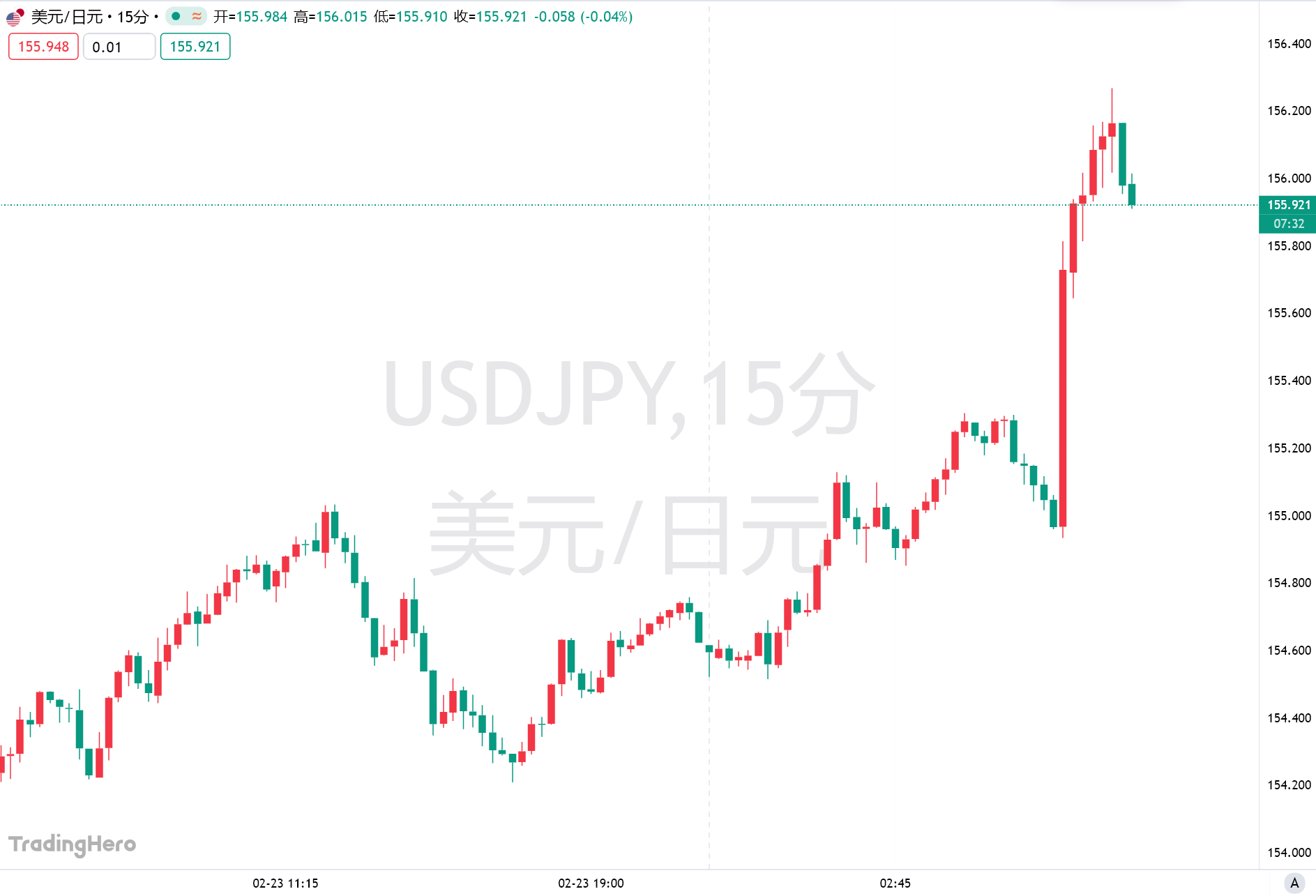
日媒曝高市早苗对加息“面露难色”,日元急跌,央行4月行动生变数?
Jin Shi Shu Ju· 2026-02-24 09:02
Core Viewpoint - Japanese Prime Minister Fumio Kishida expressed reservations about further interest rate hikes during a recent meeting with Bank of Japan Governor Kazuo Ueda, potentially complicating the central bank's timeline for monetary policy adjustments [1][3]. Group 1: Government and Central Bank Relations - Kishida's stance indicates a more dovish position compared to the previous November meeting, emphasizing the need for close cooperation between the central bank and the government to achieve a sustainable 2% inflation target alongside wage increases [3]. - The meeting was described by Ueda as an exchange of opinions on economic and financial developments, with no specific monetary policy requests made by Kishida [3][4]. Group 2: Market Reactions and Expectations - Investors were surprised by Kishida's reported reluctance to support interest rate hikes, which increased the perceived risk of the Bank of Japan delaying its tightening policy [4]. - Following Kishida's party's overwhelming victory in the House of Representatives elections, the yen had previously strengthened as investors anticipated clearer policy direction and reduced fiscal risks [4]. Group 3: Future Projections and Speculations - If Kishida were to propose a cap on interest rates at 0.75%, it would be more dovish than market expectations, potentially leading to yen weakness and rising Japanese government bond yields [5]. - Current swap trading indicates a 59% probability of the Bank of Japan raising interest rates before the April meeting, with many economists now predicting a hike as early as April due to ongoing currency weakness and its inflationary effects [6].
【NIFD季报】美元指数走势变数加大 人民币有望温和升值——2025年年
Sou Hu Cai Jing· 2026-02-19 08:42
Core Insights - The report discusses the fluctuations in the US dollar index and the potential for a moderate appreciation of the Chinese yuan, projecting the yuan's exchange rate against the dollar to fluctuate between 6.7 and 7.1 in 2026 [2][50]. Global Foreign Exchange Market Overview - From December 31, 2024, to February 4, 2026, the US dollar index depreciated by 10%, from 108.48 to 97.65 [16][10]. - Major currencies globally appreciated against the dollar, with the Swedish krona, Swiss franc, euro, British pound, Canadian dollar, and Japanese yen appreciating by 18.7%, 14.3%, 14%, 9.1%, 5.0%, and 0.2% respectively [16][10]. US Dollar Index Analysis - The dollar index is expected to maintain a slow downward trend in 2026, projected to fluctuate between 93 and 100 [20][26]. - The depreciation in 2025 was influenced by multiple factors, including new trade tariffs, the Federal Reserve entering a rate-cutting cycle, and rising risks associated with US Treasury credit and liquidity [20][24]. Euro Exchange Rate Analysis - The euro appreciated by 14% against the dollar from December 31, 2024, to February 4, 2026, with the exchange rate moving from 1.0353 to 1.1806 [32][10]. - The euro's appreciation exceeded fundamental support, and it is expected to exhibit two-way fluctuations in 2026 [32][10]. Japanese Yen Exchange Rate Analysis - The dollar to yen exchange rate showed a V-shaped trend, with the yen depreciating by 11.4% from April 21, 2025, to February 4, 2026 [35][10]. - The yen's fundamental support is expected to remain weak in 2026, with potential for appreciation if internal policies improve and external conditions stabilize [35][41]. Chinese Yuan Exchange Rate Analysis - The yuan appreciated by 3.3% against the dollar from December 31, 2024, to February 4, 2026, with the middle rate moving from 7.1884 to 6.9533 [43][10]. - The yuan's exchange rate is supported by a weak dollar index, domestic economic policies, and a stable current account surplus, with expectations for moderate appreciation in 2026 [45][47].

日本执政联盟副主席警告不要对日本央行政策进行政治干预
Xin Lang Cai Jing· 2026-02-16 02:35
Core Viewpoint - The Japanese government must avoid intervening in monetary policy and focus on building a robust economy to withstand potential future interest rate hikes [1][6]. Group 1: Economic Policy and Taxation - The ruling coalition plans to support economic growth through fiscal policy rather than pressuring the Bank of Japan to delay interest rate hikes, which could help curb the disorderly depreciation of the yen [2][8]. - Japan currently imposes an 8% consumption tax on food and a 10% tax on other goods. Following a historic election victory, Prime Minister Sanna Takashi reiterated the commitment to postpone the food consumption tax for two years to alleviate the rising cost of living for households [3][8]. - This tax postponement could lead to a significant fiscal gap, worsening Japan's already fragile fiscal situation. The government aims to implement this policy by the fiscal year 2026, with discussions on timing and funding sources ongoing [3][8]. Group 2: Foreign Exchange Reserves - The potential use of Japan's $1.4 trillion foreign exchange reserves as a source of fiscal revenue has been highlighted, which could allow the government to fund tax policies without issuing new government bonds [3][8]. - The surplus in foreign exchange reserves is considered a non-tax revenue source, making it a viable option for financing fiscal measures [3][8]. Group 3: Interest Rates and Market Reactions - The Bank of Japan's decision on interest rates should be independent of political influence, as stated by Yoshimura Hirofumi, who emphasized that the government should not overly interfere in the details of monetary policy [1][7]. - The market is closely monitoring the weak yen situation, with expectations that the Bank of Japan may raise interest rates again before April, despite the recent rebound of the yen following the election [4][9]. - The yen's depreciation benefits export companies but raises living costs for residents, creating a complex economic scenario [5][10].
日经指数盘中突破58000点,专家警告涨势与基本面严重脱节
Jin Shi Shu Ju· 2026-02-12 06:10
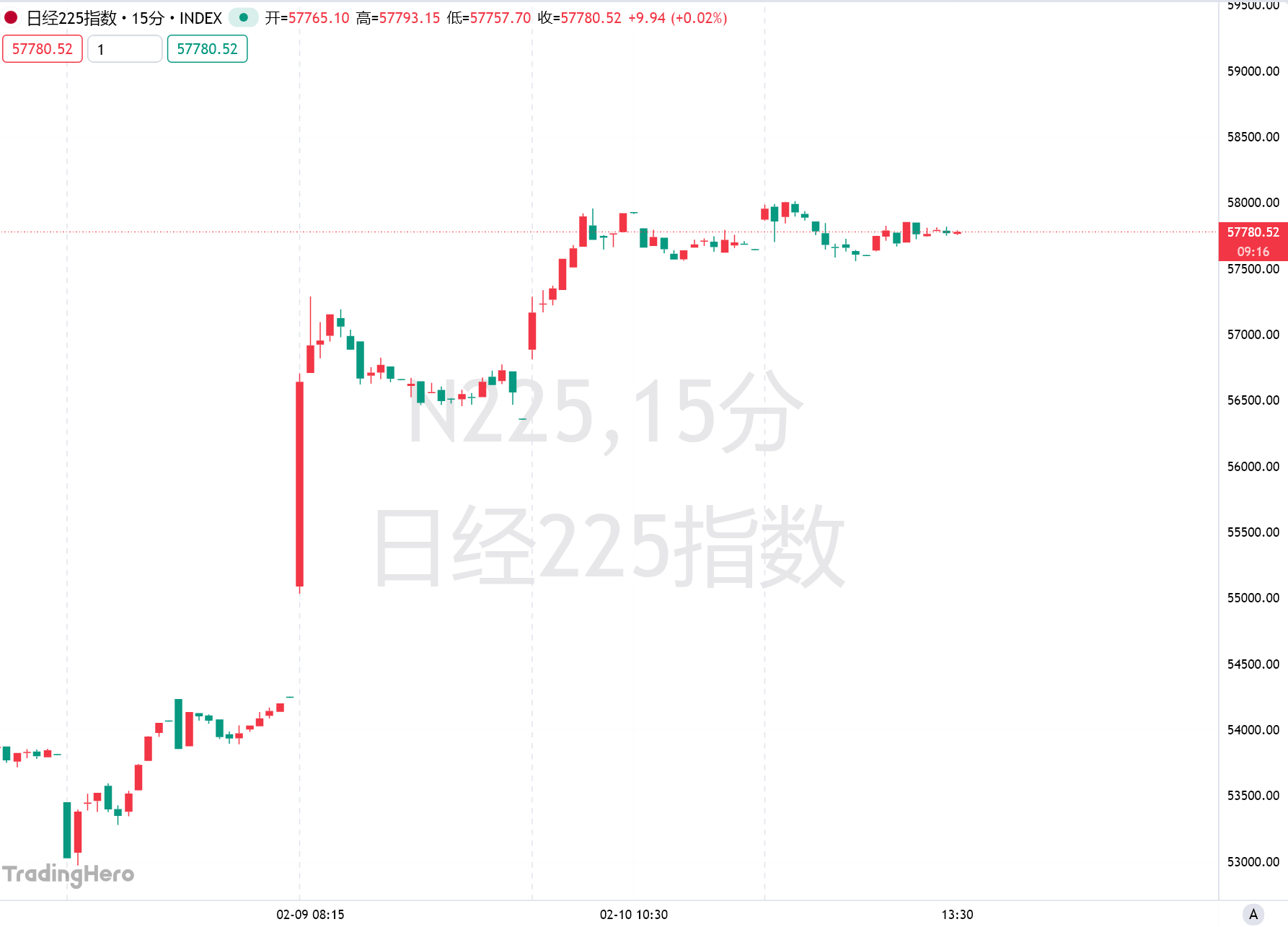
Market Performance - The Japanese stock market continues to rise, reaching a historical high, driven by renewed confidence in domestic politics and the government's economic agenda [1][3] - The Nikkei 225 index surpassed 58,000 points for the first time, with a year-to-date increase of 15% [1][3] Political Influence - The market rally is largely attributed to the political optimism following Prime Minister Sanae Takaichi's overwhelming victory in the House of Representatives elections [3] - Investors are anticipating larger fiscal spending, tax cuts, and a more aggressive economic agenda as a result of this political support [3] Economic Discrepancies - Analysts warn that the stock market's enthusiasm may be ahead of the clarity regarding policy funding sources, indicating a growing disconnect between stock prices and economic fundamentals [3][4] - Japan's economy contracted by 0.4% quarter-on-quarter for the three months ending in September, marking the first contraction in six quarters, with an annualized decline of 1.8% [4] Debt Concerns - Japan is noted to have the highest debt levels globally, with a projected debt-to-GDP ratio nearing 230% by 2025, raising concerns about the sustainability of increased fiscal spending [5] Market Drivers - The current market dynamics are driven by sentiment, liquidity, and narrative rather than fundamental economic strength [6] - The global AI investment wave has also positively impacted the Japanese stock market, although this connection makes it sensitive to fluctuations in global tech enthusiasm and exchange rate volatility [7][8] Currency Impact - The depreciation of the yen has historically benefited export-oriented manufacturing companies, but this effect may diminish as the yen's value is perceived to be excessively low [9][10] - The yen has depreciated approximately 3.67% against the dollar over the past six months [11] Government Intervention - Japan has indicated potential market intervention if the yen continues to depreciate, with concerns raised by the Finance Minister regarding unilateral yen depreciation [12] Future Outlook - Despite current vulnerabilities, structural reforms in corporate governance, capital efficiency, and shareholder returns are expected to provide sustainable growth momentum [15] - Some asset management firms believe that the overall fundamentals of Japanese companies still have support, contingent on the realization of reform expectations [15][16] - There is a warning that if the pace of improvements slows, there could be downside risks to the market [17]
日本股市屡创新高 但这波涨势或许“十分脆弱”
Xin Lang Cai Jing· 2026-02-11 07:28
Group 1: Market Performance and Political Influence - The Japanese stock market, represented by the Nikkei 225 index, has recently reached record highs, surpassing 56,000, 57,000, and approaching 58,000 points, primarily driven by the "Kishida trade" following Prime Minister Kishida's overwhelming election victory [1][6] - The Nikkei index has increased approximately 15% year-to-date, with political optimism being a significant pillar of this rally, as investors anticipate expanded spending, tax cuts, and a more aggressive economic agenda [1][6] - Analysts warn that the market's enthusiasm has outpaced the clarity of policy funding sources, indicating a growing disconnect between the stock market and economic fundamentals [1][6] Group 2: Economic Indicators and Debt Concerns - Japan's economy contracted by 0.4% quarter-on-quarter for the first time in six quarters, with an annualized decline of 1.8% reported in November [1][6] - The International Monetary Fund indicates that Japan has the highest debt levels globally, with a projected debt-to-GDP ratio nearing 230% by 2025, suggesting that increased fiscal spending may exacerbate the debt burden [7][8] Group 3: Currency and Global Market Sensitivity - The Japanese yen has depreciated significantly, with a reported decline of approximately 3.67% against the US dollar over the past six months, which has implications for the stock market as many companies rely on exports [10][11] - Moody's economist Stefan Angrick notes that the current market valuation is driven by global stock trends, making it sensitive to fluctuations in technology enthusiasm and currency movements [10][11] Group 4: Future Outlook and Structural Reforms - Despite concerns about market sustainability, experts believe that recent structural reforms in Japan, particularly in corporate governance and shareholder returns, provide a foundation for continued growth [12][13] - Asset management firms assert that the overall fundamentals of Japanese companies remain supportive, provided that expectations for reforms are met [13] - There is a cautionary note that if the pace of reforms slows, it could lead to downside risks for the market [14]
日元兑美元上涨逾1% 零售数据拖累美元整体走弱
Xin Lang Cai Jing· 2026-02-10 15:42
Group 1 - The core viewpoint is that weaker-than-expected U.S. retail sales data has led to a significant appreciation of the Japanese yen against the U.S. dollar, exceeding 1% [1][3] - The USD/JPY pair fell by 1.1% to a daily low of 154.22, marking the lowest intraday level since January 30, with the yen outperforming all G10 currencies [1][4] - The Bloomberg Dollar Spot Index decreased by 0.1%, while the USD/NOK fell by 1% to 9.4770, and the USD/CHF dropped by 0.4% to 0.7629 [1][4] Group 2 - The yield on the 10-year U.S. Treasury bond declined by 6 basis points to 4.14% [2][5]
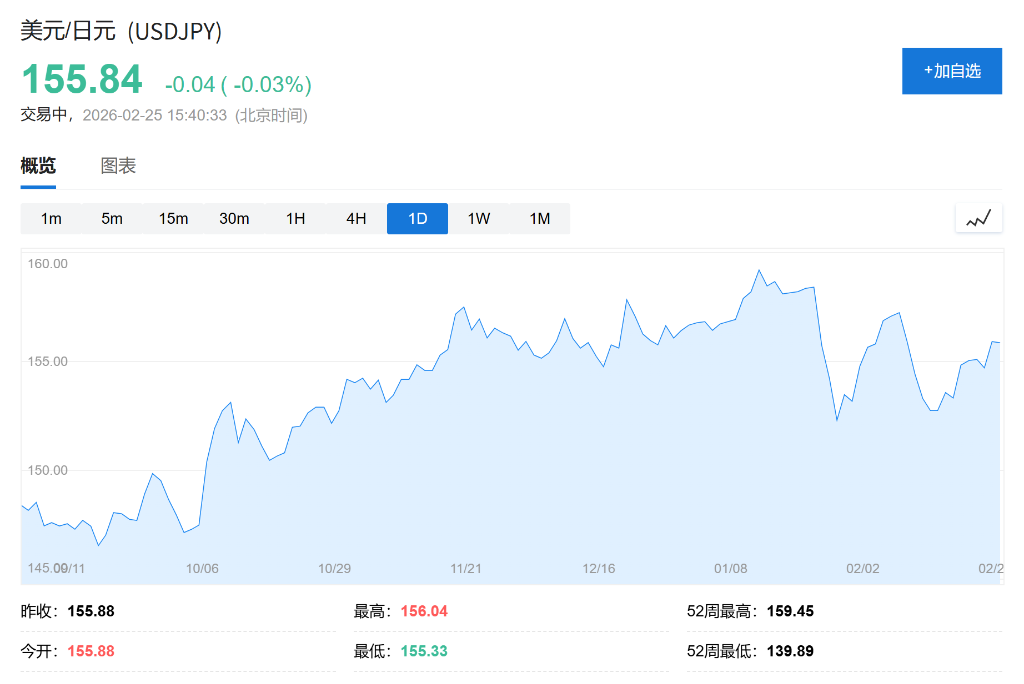
日元跌超0.7%,逼近157日元
Mei Ri Jing Ji Xin Wen· 2026-02-04 21:27
Core Viewpoint - The US dollar strengthened against the Japanese yen, closing at 156.91 yen, marking a 0.74% increase during the trading session on February 4 [1] Group 1 - The trading range for the US dollar against the Japanese yen was between 155.70 and 156.94 yen throughout the day [1] - The dollar exhibited a continuous upward trend during the trading session [1]
日元走低 此前日本首相高市早苗的言论令政府干预的猜测降温
Xin Lang Cai Jing· 2026-02-02 00:48
Core Viewpoint - The recent comments by Japanese Prime Minister Sanae Takaichi suggest that a weaker yen could provide significant opportunities for export-oriented industries, particularly benefiting the automotive sector against U.S. tariffs [1][2]. Group 1: Currency Movement - The yen depreciated by 0.5% against the dollar, reaching 155.51 yen per dollar, erasing about half of the gains made in the previous week [1]. - Market speculation about potential coordinated intervention by Japanese and U.S. authorities to support the yen has diminished following Takaichi's remarks [1]. Group 2: Economic Implications - Takaichi emphasized the need to build an economy capable of withstanding fluctuations in exchange rates, indicating that the government is not overly concerned about the current yen exchange rate [2]. - According to Felix Ryan, a foreign exchange strategist at ANZ, the recent comments imply that a weak yen may be advantageous for certain sectors of the Japanese economy, and he does not expect the dollar-yen exchange rate to fall below 150 by 2026, even if the dollar weakens again [2].
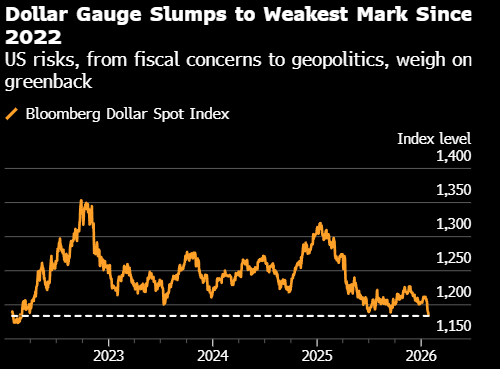
纽约汇市:美元跌至2022年以来最弱 欧元、英镑走高
Xin Lang Cai Jing· 2026-01-27 21:40
Core Viewpoint - The Bloomberg Dollar Index has fallen to its lowest level in nearly four years, driven by a rebound in the yen and uncertainties surrounding a potential government shutdown, leading to a weaker dollar that has strengthened the euro and pound to their highest levels since 2021 [1][4]. Group 1: Dollar Index and Currency Movements - The Bloomberg Dollar Index dropped 0.8%, falling below 1180 points, marking its lowest level since March 2022 [1][4]. - The USD/JPY pair decreased by 1% to 152.57, the lowest since October 30 [7]. - The euro rose by 0.9% to 1.1990, the highest since 2021, while the pound increased by 0.8% to 1.3791, also the strongest since 2021 [7]. Group 2: Market Sentiment and Economic Indicators - Concerns about potential government intervention in the currency market to support the yen and the rising likelihood of a government shutdown have intensified the dollar's downward trend, according to UBS strategist Vassili Serebriakov [1][4]. - The consumer confidence index fell to 84.5 in January, the lowest level since May 2014, as reported by the World Large Enterprises Association [4]. - The short-term options premium benefiting from the weaker dollar has expanded to the highest level since Bloomberg began collecting this data in 2011 [5]. Group 3: Central Bank Actions - Federal Reserve officials are widely expected to keep interest rates unchanged, with close attention on Chairman Powell's press conference following the policy decision [1][4]. - Japan's Finance Minister, after the G7 meeting, stated that they would coordinate closely with U.S. authorities to take appropriate action against currency fluctuations if necessary [7].