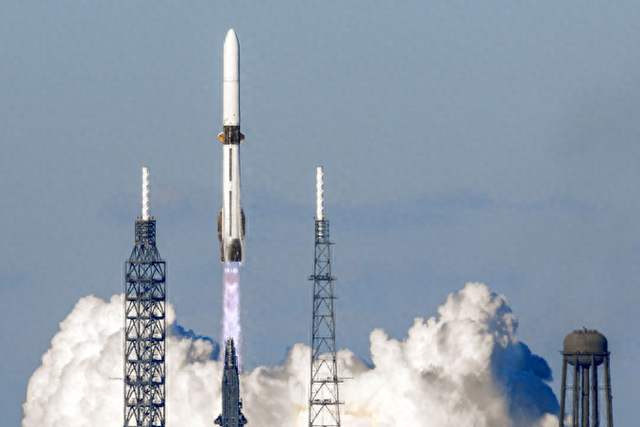
新格伦重型运载火箭

Search documents
商业航天,正在改写太空探索格局
Xin Lang Cai Jing· 2026-02-23 00:08
Core Viewpoint - The commercial space industry is rapidly evolving, with significant advancements from companies like SpaceX and Blue Origin, as well as increasing competition from other nations, particularly China and Europe, aiming to secure a leading position in the space economy [1][3][4]. Group 1: Developments in Commercial Space - SpaceX has submitted an application to the FCC to launch up to 1 million satellites to create an "orbital data center" [1] - Blue Origin successfully recovered its "New Glenn" heavy-lift rocket, becoming the second private company after SpaceX to master vertical recovery technology for orbital rockets [1] - The global commercial space sector is characterized by a competitive landscape where the U.S. maintains a strong lead due to early industry advantages and systematic policy support [3] Group 2: U.S. Leadership in Commercial Space - Since the introduction of the Commercial Space Launch Act in 1984, the U.S. has encouraged private sector participation in space through top-level design and policy guidance [3][9] - SpaceX's Starlink system has launched over 9,000 satellites, providing communication services to more than 5 million users across over 100 countries [3] - The U.S. government has implemented policies to streamline the approval process for commercial space projects, significantly reducing the time required for project approvals [9][12] Group 3: Global Competition and Emerging Players - China's commercial space sector is experiencing a "golden development period," supported by national strategies and achieving significant breakthroughs in rocket and satellite manufacturing [4] - By 2025, China aims to complete 50 launches, accounting for 54% of global space launches, with 25 of those being commercial rocket launches [4] - European companies are collaborating to create a unified aerospace entity to compete with U.S. market dominance, focusing on satellite internet and commercial launch vehicles [6][8] Group 4: Factors Supporting U.S. Commercial Space Growth - The U.S. commercial space industry benefits from a unique public-private partnership model that injects continuous funding into the sector [11][12] - The government supports key technology development through various financial instruments, ensuring funding for long-term, high-risk projects [12] - American companies adopt a rapid iteration and optimization approach in technology development, exemplified by SpaceX's development cycle for the Falcon 9 rocket [13][15]

亚马逊创始人贝索斯重出江湖创办AI公司,担任联席CEO
Sou Hu Cai Jing· 2025-11-18 01:45
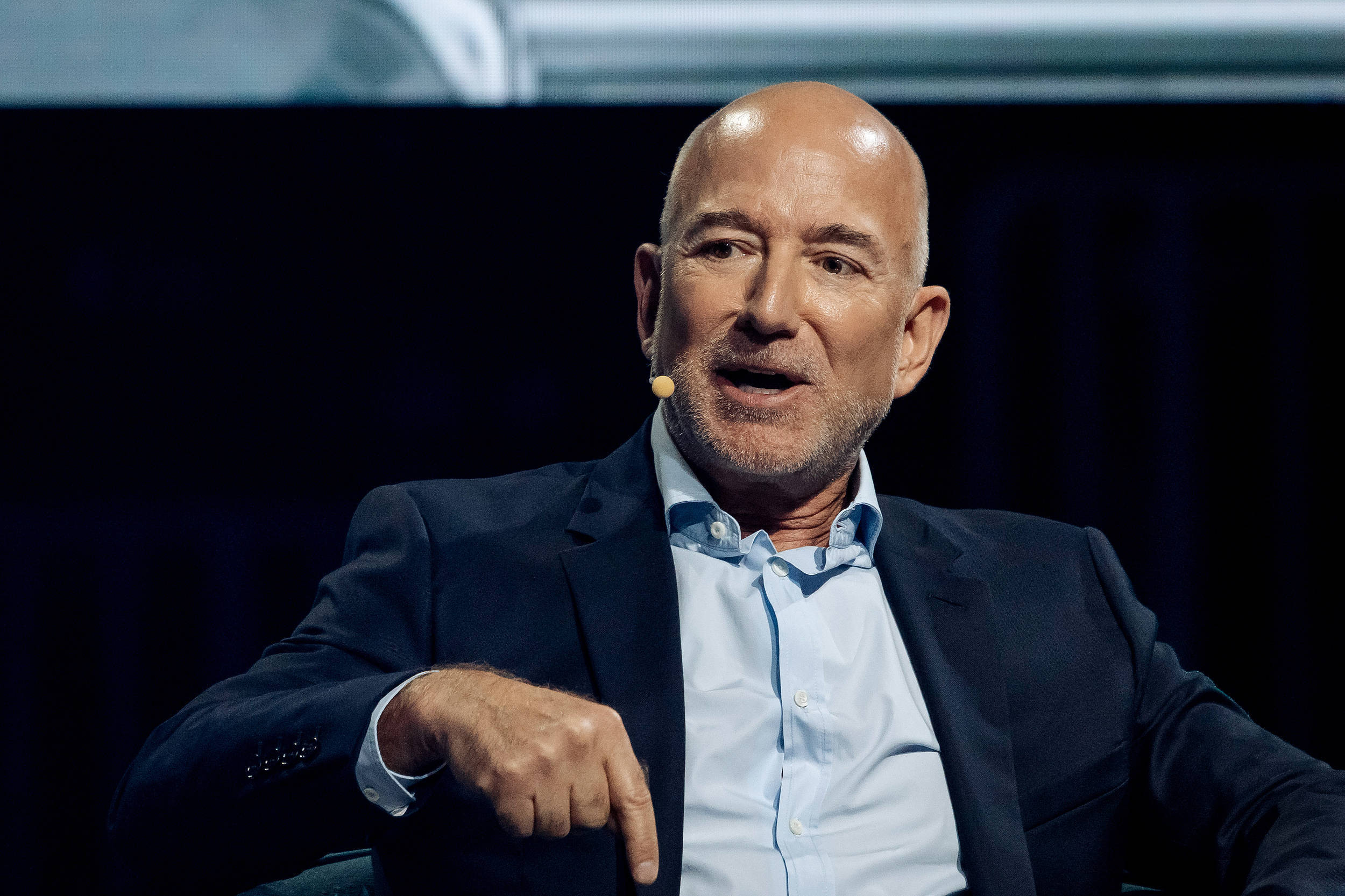
Core Insights - Jeff Bezos is personally entering the AI startup wave by co-founding a company named "Project Prometheus," where he will serve as co-CEO [1] - The startup has secured $6.2 billion in funding, making it one of the best-funded early-stage companies globally [1] - Project Prometheus will focus on AI applications in engineering and manufacturing across sectors such as computing, aerospace, and automotive [1] Funding and Team - The $6.2 billion funding includes contributions from Bezos himself, highlighting his commitment to the venture [6] - Nearly 100 employees have been recruited, including top researchers from leading AI firms like OpenAI, DeepMind, and Meta [1] - Vik Bajaj, a physicist and chemist with experience at Google X, is the other co-CEO of the startup [1] Competitive Landscape - Elon Musk, CEO of Tesla and SpaceX, commented on Bezos's new venture, suggesting it is a copycat move [2][6] - Bezos's Blue Origin recently launched the "New Glenn" heavy-lift rocket, indicating ongoing competition in the commercial space sector [9] - Amazon, founded by Bezos, is also preparing to invest significantly in AI infrastructure, with plans for a $15 billion bond issuance [9]

美股大幅收低,道指暴泻近800点;特朗普:美国政府“停摆”损失了1.5万亿美元
Sou Hu Cai Jing· 2025-11-14 03:53
Market Overview - The US stock market experienced a significant decline on Thursday, with the three major indices recording their largest single-day drop in over a month, primarily led by AI giants [2] - The Dow Jones Industrial Average fell by 797.6 points, closing at 47,457.22, a decrease of 1.65%; the S&P 500 dropped by 1.66% to 6,737.49; and the Nasdaq Composite plummeted by 2.29% to 22,870.36 [2] - Major tech stocks faced pressure, with declines across the "seven giants," including a 6.64% drop in Tesla and a 3.58% decrease in Nvidia [2] Company-Specific Developments - Cisco saw a 4.6% increase in stock price after raising its full-year revenue and profit forecasts due to sustained demand for networking equipment [3] - Disney's stock plummeted by 7.8% as the company warned of potential long-term issues related to its distribution dispute with YouTube TV, raising concerns about the pressure on its traditional television business [3] Commodity Prices - As of November 13, international oil prices rose, with WTI crude oil futures increasing by $0.20 to $58.69 per barrel, a rise of 0.34%, and Brent crude oil futures up by $0.30 to $63.01 per barrel, a gain of 0.48% [4] - COMEX gold futures fell by $19.10, or 0.45%, settling at $4,194.5 per ounce [4] Institutional Activity - On November 13, 35 stocks appeared on the institutional trading list, with 21 showing net buying and 14 showing net selling [14] - The top three stocks with net institutional buying were Haibo Sichuang, Tianci Materials, and Wanrun New Energy, while the top three with net selling were Tianji Shares, Yongtai Technology, and Fangzheng Electric [14][15]




“新格伦”火箭搭载火星探测器升空 第一级实现海上回收
Xin Lang Cai Jing· 2025-11-14 02:21
Core Viewpoint - Blue Origin successfully launched its reusable "New Glenn" heavy-lift rocket, sending NASA's Mars probe into space, marking a significant achievement in space exploration and technology [1] Group 1: Launch Details - The "New Glenn" rocket was launched from Cape Canaveral Space Force Station in Florida at approximately 15:55 Eastern Time on the 13th [1] - The first stage of the rocket achieved its first successful recovery at sea, landing on a recovery ship in the Atlantic Ocean [1] - The second stage, carrying the ESCAPADE Mars probes, continued its journey to the designated orbit after separation from the first stage [1] Group 2: Mission Components - The ESCAPADE mission includes two Mars probes designed for escape and plasma acceleration and dynamics studies [1] - In addition to the Mars probes, the "New Glenn" rocket also carried a technology demonstration device from a U.S. satellite communications company to support NASA's communication services project [1]
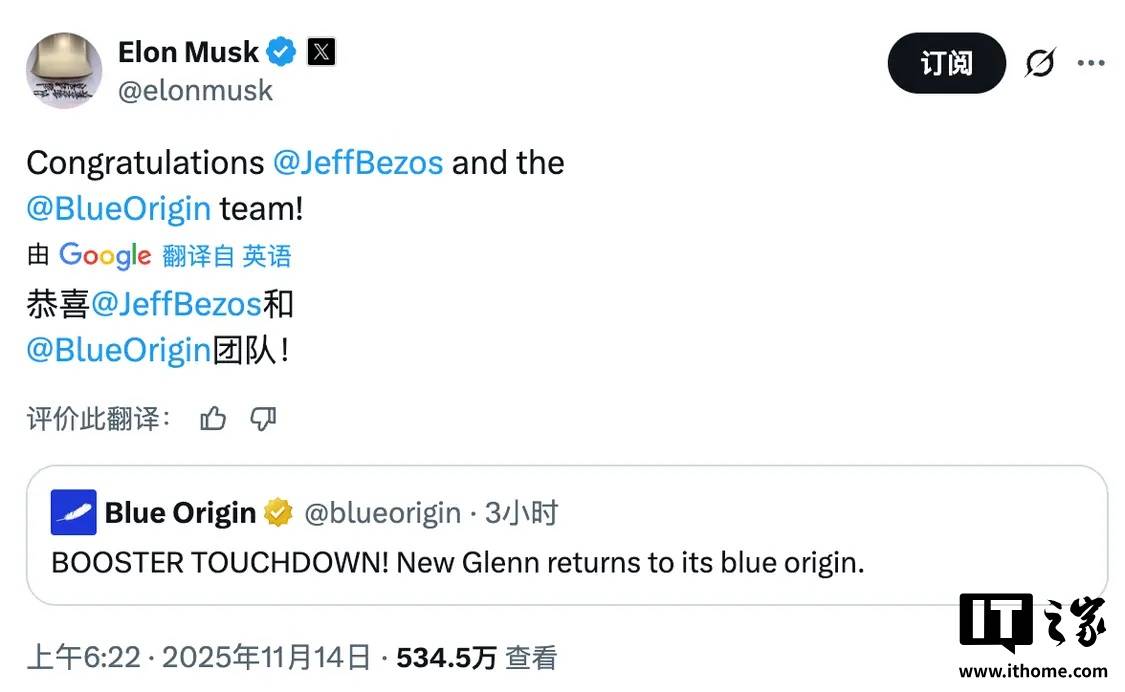
蓝色起源首次成功回收火箭,SpaceX 马斯克祝贺贝索斯
Sou Hu Cai Jing· 2025-11-14 01:12
Core Points - Blue Origin successfully launched the reusable "New Glenn" heavy-lift rocket, carrying a NASA Mars probe, on November 13 [1] - Elon Musk congratulated Jeff Bezos and the Blue Origin team on this achievement [1] Group 1: Launch Details - The launch occurred at 15:55 EST, with the rocket's first stage and boosters successfully recovered [2] - After the first and second stages separated, the second stage continued to its designated orbit with the Mars probe "ESCAPADE" [2] - The first stage landed as planned on a recovery ship platform in the Atlantic Ocean [2] Group 2: Previous Launch Attempts - The first flight of "New Glenn" took place in January, achieving partial success as the second stage reached orbit, but the first stage exploded during its return [3] - The company had initially planned a second launch in "late spring," but the schedule faced multiple delays [3]