新能源汽车三电系统

Search documents
【联合发布】2026年2月新能源汽车三电系统洞察报告
乘联分会· 2026-03-24 08:42
Key Insights - The article discusses the current state and trends in the Chinese electric vehicle (EV) market, highlighting a decline in production and sales due to policy and consumer sentiment impacts, while emphasizing the need for product innovation and policy support to stimulate demand [5][7]. Group 1: Market Performance - In January-February 2026, China's EV production reached 1.604 million units, a year-on-year decrease of 13.7%, with a cumulative penetration rate of 39.9% [5]. - The market is undergoing structural adjustments, with a notable shift towards high-end and intelligent vehicles, but overall sales are declining [7]. - In February 2026, the market shares for different vehicle types were: Cars at 34.0% (down 17.2 percentage points), SUVs at 54.9%, MPVs at 4.7%, trucks at 4.0%, and buses at 2.4% [11]. Group 2: Battery Market Dynamics - In February 2026, the installed capacity of EV batteries was 27.3 GWh, a year-on-year decrease of 19.2%, while the cumulative growth rate for the first two months was 37.4% [17]. - The average battery capacity per vehicle was 62.0 kWh, reflecting a year-on-year increase of 29.2%, with major contributors being Xiaomi, BYD, and Tesla [17]. - In terms of battery cell types, square cells accounted for 97.8%, cylindrical cells for 1.9%, and pouch cells for 0.2% [18]. Group 3: Leading Battery Manufacturers - In February 2026, the top three battery manufacturers held a market share of 76.5%, with the top ten accounting for 95.8%. CATL led with a 52.7% share, followed by BYD and LG [20]. - LG experienced a significant year-on-year growth of 293.7%, driven by increased Tesla sales [20]. Group 4: Drive Motor Supply Chain - In February 2026, the top ten drive motor suppliers accounted for 62.4% of the market, with a decline in supply volume observed across all major players [23]. - The leading supplier, Fudi Power, saw a 55.5% decrease in supply volume, while Tesla's supply remained stable [24]. Group 5: Solid-State Battery Development - Solid-state battery technology is categorized by electrolyte types, including sulfide, oxide, polymer, and composite electrolytes, each with distinct advantages and industrial progress [33][34]. - The core advantages of solid-state batteries include enhanced safety, performance breakthroughs, and adaptability across various applications [35]. - The development of solid-state batteries is expected to progress through three stages: semi-solid state leading from 2024-2026, full solid state breakthroughs from 2027-2030, and cost parity post-2030 [39][40].




【联合发布】2025年12月新能源汽车三电系统洞察报告
乘联分会· 2026-01-20 13:41
Group 1: Market Overview - The Chinese new energy vehicle (NEV) market continues to experience rapid growth, with a production volume of 16.524 million units in 2025, representing a year-on-year increase of 25.1% and a cumulative penetration rate of 47.5% [5][7] - The market is driven by policy support, product innovation, and export growth, contributing to a high-quality development direction [7] Group 2: Market Structure - By December 2025, the market share of cars (CAR) was 37.5%, down 6.1 percentage points year-on-year, while SUVs and MPVs accounted for 48.7% and 4.2%, respectively [11] - The truck market share increased to 6.0%, and the bus market share was 3.6%. The truck segment saw a significant year-on-year growth of 113.7% [11] Group 3: Battery Installation Trends - The installed capacity of NEV power batteries reached 92.0 GWh in December 2025, marking a year-on-year growth of 31.9% [17] - The average battery capacity per vehicle was 62.5 kWh, up 23.2% year-on-year, with BYD, Tesla, and Xiaomi being the main contributors to the installed capacity [17] Group 4: Battery Cell Structure - In 2025, square battery cells accounted for 98.1% of the market, while cylindrical and soft-pack cells made up 1.4% and 0.4%, respectively [18] - Lithium iron phosphate (LFP) batteries are becoming the mainstream choice in the NEV sector due to their cost, safety, and technological advantages [18] Group 5: Battery Supplier Market Share - By December 2025, the top three battery companies held a market share of 74.2%, with CATL leading at 49.8% [20] - Companies like Zhongxin Innovation and LG showed significant year-on-year growth rates of 83.7% and 104.4%, respectively [20] Group 6: Drive Motor Supplier Trends - The top ten drive motor suppliers accounted for 62.5% of the market share, with most companies experiencing a month-on-month increase in supply [22] Group 7: Fast Charging Battery Technology - Fast charging batteries represent a systemic engineering approach focused on ultra-high charging rates, impacting materials, structure, thermal management, and system integration [30] - The core value of fast charging technology lies in redefining the refueling experience for electric vehicles, extending beyond just fast charging [32] - Current challenges in scaling fast charging technology include various systemic issues [36] - Chinese battery companies have established a leading competitive position globally in the fast charging sector, with distinct technological paths [40]
【联合发布】2025年10月新能源汽车三电系统洞察报告
乘联分会· 2025-11-20 08:41
Core Insights - The Chinese new energy vehicle (NEV) market continues to experience rapid growth, with a production volume of 12.67 million units from January to October 2025, representing a year-on-year increase of 28.1% and a cumulative penetration rate of 46.4% [5][7]. Market Trends - The NEV market is driven by policy support, product innovation, and export growth, contributing to a high-quality development trajectory [7]. - By September 2025, the market share of cars (CAR) was 45.1%, a decrease of 1.7 percentage points year-on-year, while SUVs and MPVs accounted for 43.9% and 3.6%, respectively [11]. Vehicle Segmentation - The passenger vehicle segment saw significant growth, with sedans increasing by 15.1% and SUVs by 15.7%. The MPV market experienced a substantial increase of 39.3%, while commercial vehicles, particularly trucks, saw a remarkable growth of 94.6% [11]. Battery Market Dynamics - In September 2025, the installed capacity of NEV power batteries reached 73.7 GWh, marking a year-on-year growth of 39.9% [17]. - The average battery capacity per vehicle was 53.0 kWh, reflecting a year-on-year increase of 17.3% [17]. - BYD, Tesla, and Xiaomi emerged as the leading contributors to the power battery installation volume [17]. Battery Cell Structure - As of September 2025, square cells accounted for 98.6% of the battery cell configuration, while cylindrical and soft-pack cells represented 1.0% and 0.4%, respectively [18]. - Lithium iron phosphate (LFP) batteries are gaining market share due to their safety, cost-effectiveness, and longevity, with expectations to maintain dominance in the mid-to-low-end vehicle segment [18]. Battery Supplier Landscape - The top three battery manufacturers held a market share of 72.2%, with CATL leading at 42.1%. The top ten manufacturers accounted for 95.4% of the market [20]. - Companies like Zhongxin Innovation and Ruipu Lanjun showed significant growth rates of 102.0% and 143.2%, respectively [20]. Electric Drive Motor Supply - By September 2025, the top ten electric drive motor suppliers accounted for 62.7% of the market share, with all companies experiencing a month-on-month increase in supply [22]. Sodium-Ion Battery Development - Sodium-ion battery technology is rapidly advancing, with key advantages including excellent low-temperature performance, fast charging capabilities, high intrinsic safety, and cost/resource benefits [33]. - Applications for sodium-ion batteries include home energy storage, large-scale energy storage, two-wheeled vehicles, electric vehicles, and backup power systems [35]. - Major companies like CATL, Zhongke Haina, and BYD are accelerating the development of sodium-ion battery products [38].

2025年中国汽车产品质量表现研究结果发布,三电系统质量整体向好
Zhong Guo Jing Ji Wang· 2025-09-26 07:04
Core Insights - The 2025 China Automotive Product Quality Performance Research (AQR) highlights the importance of quality in the integration of intelligent features and safety in vehicles [1][2] - The automotive industry is entering a phase of stock competition, with a significant increase in consumer demand for differentiated, personalized, and intelligent products [2][3] - The overall quality level in the automotive industry is declining, despite improvements in core component quality [4][5] Industry Trends - The global automotive market is shifting towards stock competition, with China's electric vehicle penetration expected to exceed 70% by 2030 [2] - Domestic brands are anticipated to capture over 65% of the market share by 2030, driven by their alignment with consumer preferences [2] - The introduction of solid-state batteries and advancements in AI technology are expected to accelerate the transition to intelligent vehicles [2] Quality Performance - The market quality performance score for 2025 is 27.19, reflecting a 23% increase from 2024, indicating a decline in overall industry quality [4] - Both fuel and electric vehicles have seen a decrease in market quality performance, with rising complaints from fuel vehicle users and new issues emerging for electric vehicles [5] - User satisfaction regarding product experience has fluctuated, with negative impacts from intelligent cockpit and driving systems on brand recommendation [5] User Experience Insights - The concept of "experience quality" has been introduced, revealing a sharp increase in user experience-related issues [3] - The gap between official range ratings and actual user experiences in electric vehicles is a core pain point, necessitating a user-centric evaluation system [2][3] - Companies are urged to understand real user scenarios and integrate engineering development with user feedback to enhance product performance [5][6] Company Strategies - Huawei emphasizes a safety-first approach in its quality strategy, integrating digital management and advanced technologies to enhance manufacturing capabilities [6] - Xiaomi's quality strategy focuses on a comprehensive management approach from design to after-sales service, aiming to create a robust quality defense system [6]
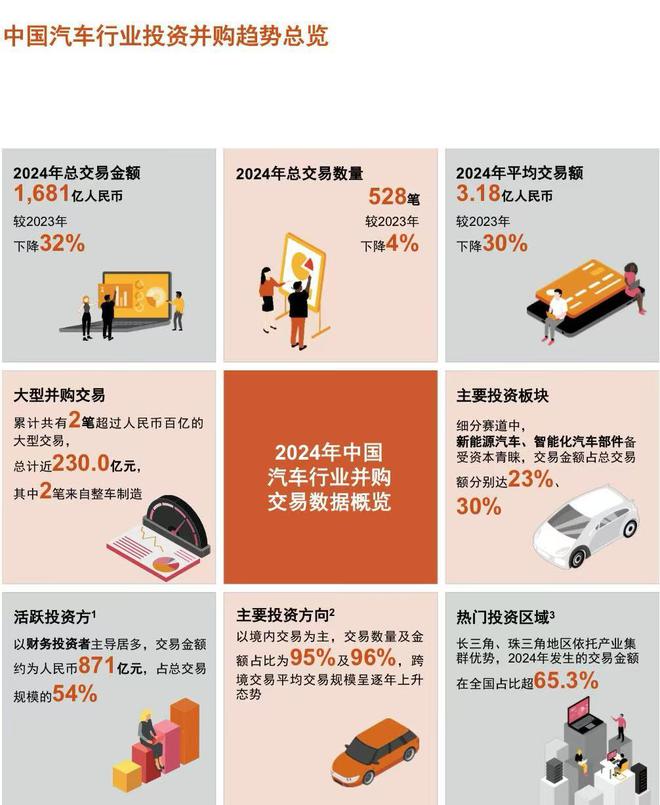
2024年中国汽车并购额缩水32%至1681亿元 普华永道称中国车企仍需紧抓“智电”优势
Zhong Guo Jing Ying Bao· 2025-05-09 14:13
Core Insights - In 2024, the total merger and acquisition (M&A) transaction value in China's automotive industry is projected to be approximately 168.1 billion yuan, with 528 transactions, representing a decline of 32% in value and 3.6% in volume compared to 2023 [3][4] - Despite the overall decline, strategic investments and acquisitions accounted for 53% of transactions, indicating a shift towards strategic considerations among industry investors [3][4] M&A Activity Overview - The report indicates that there were 2 transactions exceeding 10 billion yuan in 2024, totaling nearly 23 billion yuan, all from vehicle manufacturing [4] - In the sub-sectors, new energy vehicles and intelligent automotive components attracted significant capital, accounting for 23% and 30% of total transaction value, respectively [4] Transaction Trends - The automotive M&A activity has seen a shift from large and giant transactions to smaller ones, with small and medium-sized transactions gaining prominence [5] - In 2024, small and medium-sized transactions accounted for a significant portion of the total M&A activity, while large and giant transactions saw a noticeable decline [5] - The automotive parts sector dominated the M&A landscape with 404 transactions worth over 105.9 billion yuan, representing 63% of the total M&A value [5] Vehicle Manufacturing Insights - The vehicle manufacturing sector experienced a substantial decline in M&A activity, with 54 transactions totaling 47.8 billion yuan, a nearly 52% drop from the previous year [6] - The commercial vehicle sector emerged as a new focal point for investment, with a 64% increase in M&A transaction value due to the growing demand for new energy commercial vehicles [6] Strategic Investment Focus - There is a notable increase in strategic investments and acquisitions, driven by large enterprises and financial investors' long-term optimism towards new energy and intelligent connected markets [6] - The report highlights a cautious approach towards startups, with transaction frequency remaining stable compared to the previous year [6] Domestic vs. Foreign Investment - Domestic transactions dominated the M&A landscape, accounting for over 92% of the total transaction value and 93% of the total number of transactions [6] - Foreign investment interest in the domestic market has decreased due to global economic uncertainties and the maturity of the domestic new energy vehicle market [7] Global Market Dynamics - Chinese automotive companies are actively exploring overseas markets, particularly in Southeast Asia and Europe, to enhance their supply chain and gain valuable experience [7][8] - The report emphasizes the need for Chinese automotive companies to build a clear brand identity that represents national image while navigating global market complexities [10][11] Technological Advancements - Despite a slowdown in overall M&A activity, certain frontier technology sectors, such as automotive-grade chips and autonomous driving systems, remain active and attract investor interest [9] - The report notes that 34 new companies in the automotive sector went public in 2024, with a focus on smart components and electric vehicle systems [9] Standardization and Evaluation - The establishment of a national automotive evaluation system is deemed crucial for guiding domestic industry development and enhancing global competitiveness [12]