新能源狭义乘用车

Search documents
乘联分会:1月新能源狭义乘用车零售量约为80万,渗透率约 44.4%
Huan Qiu Wang Zi Xun· 2026-01-23 04:10
Core Viewpoint - The retail market for narrow passenger cars in January is estimated at approximately 1.8 million units, showing a month-on-month decline of 20.4% but a year-on-year increase of 0.3% [1] Group 1: Market Performance - The retail volume of new energy vehicles is expected to be around 800,000 units, with a penetration rate of approximately 44.4% [1] - The first week of January saw weak market performance with an average daily retail of 30,000 units, reflecting declines both year-on-year and month-on-month [1] - The second week showed slight recovery with average daily retail increasing to 50,000 units, with a narrowing decline [1] - By the third week, the market began to recover slowly, with average daily retail expected to reach 57,000 units due to the implementation of trade-in subsidies [1] - The fourth week is projected to see a significant increase in daily retail, potentially reaching 120,000 units, driven by completed subsidy policies and enhanced first-time purchase demand [1] Group 2: Future Projections - The passenger car market is expected to reach a new high in 2025, with total retail sales of narrow passenger cars projected at 23.745 million units [1] - Retail sales of new energy narrow passenger cars are anticipated to be 12.809 million units, representing a year-on-year growth of 17.6% [1] - The penetration rate for new energy vehicles is expected to reach 53.9% by the end of 2025 [1]
乘联分会:预计1月狭义乘用车零售总市场为180万辆左右 新能源渗透率达44.4%
智通财经网· 2026-01-22 22:45
Core Viewpoint - The retail market for narrow passenger vehicles in January is projected to be around 1.8 million units, reflecting a month-on-month decline of 20.4% but a slight year-on-year increase, with new energy vehicle sales expected to reach approximately 800,000 units and a penetration rate of 44.4% [1][2] Group 1: Manufacturer Sales Trends - Most manufacturers have a neutral to optimistic sales outlook for January, with major manufacturers, accounting for nearly 80% of total market sales, setting retail targets that are flat or slightly increased compared to the same period last year [2] - The narrow passenger vehicle retail market size for January is estimated at 1.8 million units, with a month-on-month decrease of 20.4% and a year-on-year increase of 0.3% [2] Group 2: Weekly Sales Trends - The market showed weak performance at the beginning of January due to the halving of the vehicle purchase tax subsidy, with an average daily retail of 30,000 units in the first week, reflecting declines both year-on-year and month-on-month [3] - Retail activity slightly recovered in the second week, with an average daily retail of 50,000 units, and further improved in the third week to an estimated 57,000 units as local trade-in subsidies began to take effect [3] - By the fourth week, with the implementation of subsidy policies and increased first-time purchase demand, the market is expected to regain growth momentum, with daily retail projected to reach 120,000 units [3] Group 3: Market Transition and Policy Impact - The Chinese economy is showing resilience and vitality, with total retail sales of consumer goods exceeding 50 trillion yuan, growing by 3.7% year-on-year, and the used car trade-in policy has significantly impacted the market, with over 11.5 million vehicles traded in [4] - A new round of trade-in subsidies for 2026 has been initiated, which is expected to provide stable support for the automotive market throughout the year [4] - The market is currently in a critical transition period due to policy changes, particularly the adjustment of new energy vehicle purchase tax subsidies from full exemption to a 50% reduction, leading to increased consumer hesitation and lower market heat in January [4]
乘联分会:12月新能源狭义乘用车零售量预计为138万左右,渗透率预计可达60%
Huan Qiu Wang Zi Xun· 2025-12-20 04:40
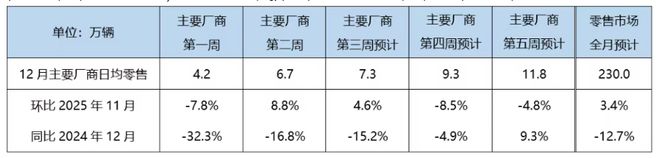
Group 1 - The core viewpoint of the report indicates that the retail market for narrow passenger vehicles in December is estimated to be around 2.3 million units, reflecting a month-on-month growth of 3.4% but a year-on-year decline of 12.7% [1] - The expected retail volume for new energy vehicles in December is approximately 1.38 million units, with a penetration rate projected to reach 60% [1] - The report highlights that the initial week of December saw a significant drop in daily retail sales to 42,000 units, a year-on-year decrease of 32.3% and a month-on-month decrease of 7.8% [2][3] Group 2 - In the second week, leveraging the "Double Twelve" promotion, daily retail sales increased to 67,000 units, showing a year-on-year decline of 16.8% but a month-on-month increase of 8.8% [2] - The third week is expected to maintain a daily retail volume of 73,000 units due to ongoing order deliveries, while the fourth week anticipates a rise to 93,000 units as consumer sentiment weakens [3] - The fifth week is projected to see daily retail sales climb to 118,000 units, influenced by a low base from the previous year, resulting in a year-on-year growth of 9.3% despite a month-on-month decline of 4.8% [3]

乘联会:8月乘用车零售预计约194万辆 新能源渗透率或达56.7%新高
Zhi Tong Cai Jing· 2025-08-23 07:38
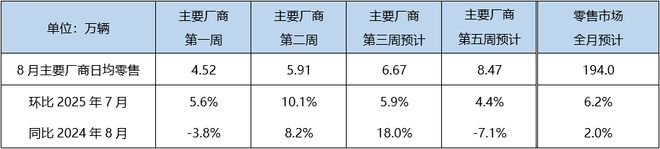
Group 1 - The core viewpoint of the articles indicates that the Chinese passenger car market is showing signs of stabilization and growth in August, with a projected retail volume of approximately 1.94 million units, reflecting a month-on-month increase of 6.2% and a year-on-year increase of 2.0% [1][3][4] - The penetration rate of new energy vehicles (NEVs) is expected to reach 56.7% in August, with retail sales estimated at around 1.1 million units [1][3] - The market experienced a temporary slowdown in July due to seasonal factors and the transition period of the vehicle replacement policy, but the release of new subsidy funds has contributed to a return to normal market operations [1][2][6] Group 2 - The first week of August saw a slight decline in daily retail volume to 45,200 units, but this improved significantly in the following weeks due to the restoration of subsidies, with daily sales reaching 66,700 units by the third week [4][5] - The implementation of local stimulus policies and the resumption of the vehicle replacement subsidy program have positively influenced market conditions, leading to a more stable pricing environment and improved consumer confidence [2][6] - The overall market dynamics indicate a gradual recovery, with regional consumption patterns being effectively adjusted to mitigate market fluctuations [6]