新能源汽车购置税补贴

Search documents
乘联分会:预计1月狭义乘用车零售总市场为180万辆左右 新能源渗透率达44.4%
智通财经网· 2026-01-22 22:45
Core Viewpoint - The retail market for narrow passenger vehicles in January is projected to be around 1.8 million units, reflecting a month-on-month decline of 20.4% but a slight year-on-year increase, with new energy vehicle sales expected to reach approximately 800,000 units and a penetration rate of 44.4% [1][2] Group 1: Manufacturer Sales Trends - Most manufacturers have a neutral to optimistic sales outlook for January, with major manufacturers, accounting for nearly 80% of total market sales, setting retail targets that are flat or slightly increased compared to the same period last year [2] - The narrow passenger vehicle retail market size for January is estimated at 1.8 million units, with a month-on-month decrease of 20.4% and a year-on-year increase of 0.3% [2] Group 2: Weekly Sales Trends - The market showed weak performance at the beginning of January due to the halving of the vehicle purchase tax subsidy, with an average daily retail of 30,000 units in the first week, reflecting declines both year-on-year and month-on-month [3] - Retail activity slightly recovered in the second week, with an average daily retail of 50,000 units, and further improved in the third week to an estimated 57,000 units as local trade-in subsidies began to take effect [3] - By the fourth week, with the implementation of subsidy policies and increased first-time purchase demand, the market is expected to regain growth momentum, with daily retail projected to reach 120,000 units [3] Group 3: Market Transition and Policy Impact - The Chinese economy is showing resilience and vitality, with total retail sales of consumer goods exceeding 50 trillion yuan, growing by 3.7% year-on-year, and the used car trade-in policy has significantly impacted the market, with over 11.5 million vehicles traded in [4] - A new round of trade-in subsidies for 2026 has been initiated, which is expected to provide stable support for the automotive market throughout the year [4] - The market is currently in a critical transition period due to policy changes, particularly the adjustment of new energy vehicle purchase tax subsidies from full exemption to a 50% reduction, leading to increased consumer hesitation and lower market heat in January [4]
【乘联分会论坛】1月狭义乘用车零售预计180.0万辆,新能源预计80.0万辆
乘联分会· 2026-01-22 14:19
Core Viewpoint - The article discusses the performance and outlook of the Chinese passenger car market, highlighting the impact of policy changes and consumer behavior on sales trends in early 2026 [2][3][6]. Group 1: 2025 Market Review - In December 2025, the retail sales of narrow passenger cars reached 2.261 million units, a year-on-year decrease of 14.0% but a month-on-month increase of 1.6% [2]. - For the entire year of 2025, narrow passenger car retail sales hit a record high of 23.745 million units, with new energy vehicles (NEVs) accounting for 12.809 million units, representing a year-on-year growth of 17.6% and a penetration rate of 53.9% [2]. Group 2: January 2026 Market Outlook - January 2026 is expected to see a slight year-on-year increase in sales due to the release of pent-up demand from consumers returning home for the Spring Festival, despite uncertainties in the market [3]. - The national scrapping subsidy has been implemented, but the reduction in purchase tax has created a certain degree of overspending effect, leading to cautious consumer sentiment [3]. Group 3: Manufacturer Sales Trends - Most manufacturers have a neutral to optimistic sales outlook for January, with major manufacturers aiming for retail targets that are flat or slightly increased compared to the same period last year [4]. - The estimated retail market size for narrow passenger cars in January is around 1.8 million units, reflecting a month-on-month decrease of 20.4% but a year-on-year increase of 0.3% [4]. Group 4: Weekly Sales Trends - The car market started weak in early January due to the halving of the purchase tax subsidy, with daily retail sales averaging 30,000 units in the first week [5]. - Sales improved slightly in the second week, with daily retail reaching 50,000 units, and further recovery is expected in the following weeks as old-for-new subsidies are implemented [5]. Group 5: Transition to Normalization - The Chinese economy showed resilience in 2025, with total retail sales of consumer goods exceeding 50 trillion yuan, growing by 3.7% year-on-year [6]. - The old-for-new policy has significantly boosted sales, with over 2.6 trillion yuan in related sales and benefiting over 360 million people, including more than 11.5 million cars [6]. - The transition period in early 2026 is marked by a shift from strong policy stimulation to reliance on product strength and normalized consumption patterns, with the penetration rate for NEVs expected to hit a temporary low [6].


“新国补+车企限时促销”点燃2026年开年车市
Mei Ri Jing Ji Xin Wen· 2026-01-06 12:40
Core Viewpoint - The introduction of the "New National Subsidy" policy for 2026 has led to a surge in consumer interest and promotional activities among various automotive brands, aiming to stimulate sales in the electric vehicle market. Group 1: Consumer Behavior and Market Response - Many consumers are waiting for the "New National Subsidy" to finalize their vehicle purchases, as evidenced by increased foot traffic in showrooms during the New Year holiday [1] - Sales personnel report a significant rise in daily customer visits, with some stores exceeding a thousand visitors [1] - Automotive brands are launching various promotional strategies, including tax subsidies and cash discounts, to attract buyers [1] Group 2: Promotional Strategies by Automotive Brands - Several brands, including Zhiji and Extreme Kr, are offering vehicle purchase tax subsidies, with amounts reaching up to 12,000 yuan [2] - Zhiji's promotional campaign requires customers to place orders by January 3 to benefit from tax subsidies, highlighting the urgency of the offer [2] - Extreme Kr is also providing tax subsidies ranging from 7,000 to 12,000 yuan for its vehicles [2] Group 3: Price Adjustments and Market Strategy - BMW has announced price reductions for several models, with the i7M70L seeing a decrease of 301,000 yuan, while the iX1eDrive25L's price dropped by 71,900 yuan, reflecting a strategic response to market demand [4][5] - BMW emphasizes that these price adjustments are not a price war but a strategic move to align with customer needs and market dynamics [5] - The adjustments in pricing are expected to enhance the competitiveness of BMW's offerings in the market [5] Group 4: Policy Changes and Implications - The 2026 policy changes include a reduction in the vehicle purchase tax from full exemption to a 5% rate, which is expected to impact consumer purchasing behavior [6][7] - The new subsidy structure shifts from fixed amounts to a percentage of the vehicle price, maintaining the upper limits for subsidies [7] - The maximum subsidy for scrapping old vehicles is set at 20,000 yuan, while the maximum for replacing vehicles is 13,000 yuan [7] Group 5: Regional Implementation of Subsidy Policies - Various regions, including Jiangxi and Hebei, have begun implementing the new subsidy policies, allowing consumers to apply for up to 20,000 yuan in subsidies [9][10] - The central government has allocated 62.5 billion yuan for the first batch of subsidies, aimed at supporting the "old for new" vehicle replacement program [10] - The "old for new" policy has significantly contributed to the growth of the domestic automotive market, with over 1.15 million vehicles replaced in 2025 alone [10] Group 6: Future Market Outlook - The automotive industry is expected to experience positive growth in the first quarter of 2026, driven by the new policies and consumer incentives [11] - The government aims to promote green consumption and support the development of the automotive industry chain, including second-hand vehicles and new consumption models [11]
零跑首超7万辆“再拔头筹” 蔚来、小米均突破4万辆大关
Mei Ri Jing Ji Xin Wen· 2025-11-04 13:20
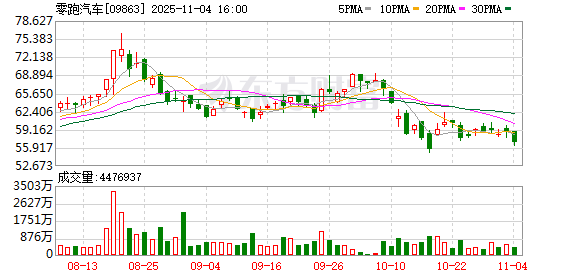
Core Insights - Multiple electric vehicle brands reported strong sales performance during the traditional sales peak in October, with significant year-on-year growth across the board [2][3][5]. Group 1: Company Performance - Leap Motor achieved a record delivery of 70,300 vehicles in October, marking an 84% year-on-year increase, and a total of 465,800 vehicles delivered from January to October [2]. - Xpeng Motors delivered 42,000 vehicles in October, a 76% year-on-year increase, with a total of 355,200 vehicles delivered in the first ten months, representing a 190% increase [2][3]. - NIO delivered 40,400 vehicles in October, a 92.6% year-on-year increase, with a focus on increasing production capacity to meet demand [3]. - Li Auto reported 31,800 vehicle deliveries in October, with a total cumulative delivery of 1,462,800 vehicles as of October 31, 2025 [4]. - Xiaomi Auto also surpassed 40,000 deliveries in October, facing challenges in production capacity and long delivery times for certain models [3]. Group 2: Market Trends - The overall retail market for passenger vehicles in October is expected to reach 2.2 million units, with electric vehicles projected to account for 1.32 million units, achieving a penetration rate of 60% [5]. - The current policy allows for a tax exemption on electric vehicles until 2025, with a planned reduction in the tax rate starting in 2026 [6]. - The market is expected to see continued growth driven by vehicle trade-in policies and the introduction of new models, with electric vehicle penetration anticipated to reach new highs [6].


新能源汽车“银十”热销 多家车企交付量破纪录
Zheng Quan Shi Bao· 2025-11-02 17:57
Core Insights - October is traditionally a peak sales month for the automotive market, with record-breaking deliveries of new energy vehicles (NEVs) reported by several companies for October 2025 [1][2] - The penetration rate of NEVs is expected to reach approximately 60% in October, marking a historical high [1] - Companies like XPeng, NIO, and Li Auto have reported significant increases in their delivery volumes, with XPeng achieving a record delivery of 42,000 vehicles in October, a 190% year-on-year increase [1][2] Group 1 - The retail market for narrow passenger vehicles in October is estimated to reach around 2.2 million units, with NEV retail volume expected to be about 1.32 million units [1] - BYD's NEV sales in October reached 441,700 units, with a cumulative sales figure of 3.70 million units for the first ten months, reflecting a year-on-year growth of approximately 14% [2] - The export of Chinese automobiles has been on the rise, with 5.71 million units exported in the first three quarters of the year, a 21% increase year-on-year, and NEV exports reaching 2.32 million units, a 52% increase [2] Group 2 - The implementation of vehicle replacement subsidies has significantly boosted the automotive market, with over 10 million applications for the subsidy by October 22, 2025 [2] - The recent launch of new models since September is expected to inject new growth momentum into the market, with NEV market growth anticipated to accelerate [3] - The fuel vehicle market is expected to remain relatively stable, while the penetration rate of NEVs is projected to reach new heights [3]

多家新能源汽车品牌公布“银十”销量:零跑首超7万辆“再拔头筹”,蔚来、小米均破4万辆大关
Mei Ri Jing Ji Xin Wen· 2025-11-01 08:30
Group 1 - The core point of the article highlights the strong performance of various electric vehicle brands during the traditional sales peak in October, with significant year-on-year growth in delivery numbers [1][3][4] - Leap Motor achieved a record delivery of 70,300 vehicles in October, marking an 84% increase year-on-year, and has delivered a total of 465,800 vehicles from January to October, maintaining its position as the top seller among new car manufacturers for eight consecutive months [1] - Xpeng Motors delivered 42,000 vehicles in October, a 76% year-on-year increase, and a total of 355,200 vehicles in the first ten months, reflecting a 190% growth [3] - NIO also surpassed 40,000 deliveries in October, with a total of 40,400 vehicles delivered, showing a 92.6% year-on-year increase [3] - Li Auto reported 31,800 deliveries in October, with a cumulative total of 1,462,800 vehicles delivered by the end of October 2025 [4][5] Group 2 - The article notes that several brands are focusing on increasing production capacity to meet delivery demands, with NIO expecting a 70% increase in production capacity in November compared to October [3] - Xiaomi Auto reported over 40,000 deliveries in October, emphasizing the need to enhance production capacity due to long delivery cycles for certain models [3] - The article discusses various promotional strategies, including tax subsidies and limited-time purchase incentives introduced by several brands to stimulate sales [4][6] - The overall market for electric vehicles is projected to reach 1.32 million units in October, with a penetration rate expected to rise to 60%, potentially setting a new historical high [5][8]
乘联分会:预计10月狭义乘用车零售220万辆 新能源渗透率有望升至60%
智通财经网· 2025-10-26 11:25
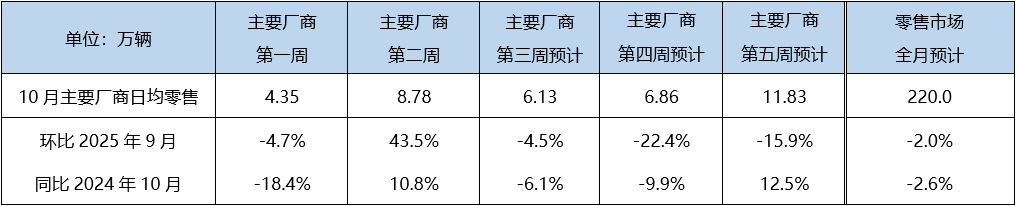
Core Insights - The narrow passenger car retail market in October is expected to reach approximately 2.2 million units, reflecting a month-on-month decrease of 2.0% and a year-on-year decrease of 2.6% [1][3] - New energy vehicle (NEV) retail is projected to be around 1.32 million units, with a penetration rate anticipated to rise to about 60% [1][3] - The market is entering the traditional "Silver October" sales peak, driven by the National Day holiday's customer attraction effect and year-end policy adjustments [1] Market Performance - In September, the narrow passenger car retail market achieved 2.244 million units, showing a year-on-year growth of 6.4% and a month-on-month growth of 11.2% [2] - NEV retail in September reached 1.299 million units, with a year-on-year increase of 15.7% and a month-on-month increase of 16.5%, resulting in a penetration rate of 57.8% [2] Manufacturer Sales Outlook - Most manufacturers maintain an optimistic sales outlook for October, with major manufacturers setting retail targets that are largely stable month-on-month [3] - The anticipated retail market size for narrow passenger cars in October is around 2.2 million units, with NEV retail expected to reach 1.32 million units [3] Weekly Sales Trends - The first week of October saw daily retail of 43,500 units, a year-on-year decrease of 18.4% and a month-on-month decrease of 4.7% due to the holiday effect [4] - The second week experienced a surge in daily retail to 87,800 units, reflecting a year-on-year increase of 10.8% and a month-on-month increase of 43.5% [4] - The overall monthly retail forecast remains at 2.2 million units, with varying weekly performances influenced by holiday dynamics and policy adjustments [4] Market Structure and Consumer Behavior - Post-holiday, there has been a slight seasonal recovery in terminal discounts, indicating a stable overall market operation [5] - As of October 22, 2025, over 10 million applications for the vehicle replacement subsidy have been submitted, significantly impacting the market in the first three quarters [5] - The market is expected to be supported by continued vehicle scrappage and the upcoming decline in NEV purchase tax subsidies, which may drive early purchasing behavior [5]
【乘联分会论坛】10月狭义乘用车零售预计220.0万辆,新能源预计132.0万辆
乘联分会· 2025-10-24 14:28
Core Viewpoint - The automotive market in September showed strong performance driven by the traditional sales peak and the "old-for-new" policy, with significant growth in both overall and new energy vehicle (NEV) sales [2][4]. Group 1: September Market Review - In September, the retail sales of narrow-sense passenger vehicles reached 2.244 million units, a year-on-year increase of 6.4% and a month-on-month increase of 11.2% [2]. - Retail sales of new energy narrow-sense passenger vehicles totaled 1.299 million units, with a year-on-year growth of 15.7% and a month-on-month growth of 16.5%, achieving a penetration rate of 57.8% [2]. Group 2: October Market Outlook - October is expected to enter the traditional "Silver October" sales peak, with the National Day holiday's customer gathering effect and year-end policy adjustment expectations driving initial consumer demand [3]. - However, the impact of the "old-for-new" subsidy policy is expected to weaken, leading to potential pressure on market growth in the latter half of the month [3]. Group 3: Manufacturer Sales Trends - Most manufacturers are optimistic about October sales, with major manufacturers setting retail targets that are stable month-on-month. The narrow-sense passenger vehicle retail market is expected to reach around 2.2 million units, a month-on-month decrease of 2.0% [4]. - New energy vehicle retail sales are projected to be around 1.32 million units, with a penetration rate potentially reaching 60%, which would be a historical high [4][8]. Group 4: Weekly Sales Trends - The first week of October saw daily retail sales of 43,500 units, a year-on-year decrease of 18.4% and a month-on-month decrease of 4.7% [5]. - The second week experienced a surge in daily retail sales to 87,800 units, a year-on-year increase of 10.8% and a month-on-month increase of 43.5% [5]. - The third week saw a decline in daily retail sales to 61,300 units, with a year-on-year decrease of 6.1% and a month-on-month decrease of 4.5% [5]. - The fourth week is expected to stabilize with daily retail sales of 68,600 units, a year-on-year decrease of 9.9% and a month-on-month decrease of 22.4% [5]. - The fifth week is projected to see an increase in daily retail sales to 118,300 units, a year-on-year increase of 12.5% but a month-on-month decrease of 15.9% [5]. Group 5: Market Structure Differentiation - After the National Day holiday, terminal discounts have shown a seasonal slight recovery, with the overall automotive market operating smoothly [7]. - The "old-for-new" subsidy policy has significantly impacted the market, with over 10 million applications for subsidies by October 22, 2025 [7]. - The market is expected to be supported by continued vehicle scrappage and the upcoming end-of-year tax subsidy adjustments for new energy vehicles, which may drive pre-purchase demand [7].