狭义乘用车

Search documents
【乘联分会论坛】3月狭义乘用车零售预计170.0万辆,新能源预计90.0万辆
乘联分会· 2026-03-20 08:52
Core Viewpoint - The Chinese passenger car market experienced a significant seasonal decline in February 2026, with retail sales dropping 25.4% year-on-year and 33.1% month-on-month, while the penetration rate for new energy vehicles (NEVs) was 44.9% [2]. Group 1: Market Overview - In March 2026, the market is expected to gradually recover as the post-holiday consumption phase continues, with a forecasted retail market size of approximately 170,000 units, reflecting a month-on-month increase of 64.5% but a year-on-year decrease of 12.4% [4][5]. - The retail sales of NEVs are projected to reach around 900,000 units in March, with a penetration rate of approximately 52.9% [4][7]. Group 2: Weekly Sales Trends - The first week of March saw weak market performance with an average daily retail of 31,000 units, a year-on-year decline of 23.6%. However, the second week showed improvement with daily sales rising to 45,000 units, reducing the year-on-year decline to 19.5% [5][6]. - By the third week, daily retail is expected to reach 47,000 units, with the decline narrowing to 14.5%. The fourth week is anticipated to see a significant increase in daily sales to 93,000 units, driven by manufacturer promotions and new vehicle launches [5][6]. Group 3: Consumer Behavior and Market Dynamics - The overall retail sales of consumer goods in China grew by 2.8% year-on-year in January-February 2026, but automotive retail sales fell by 7.3%, indicating a weaker recovery in the automotive sector compared to the broader market [7]. - The market is witnessing a structural shift, with increasing consumer preference for NEVs, while the fuel vehicle market remains under pressure due to high discounts and rising fuel costs, which have hindered expected recovery trends [7].


汽车行业点评:车企一季报有挑战,建议关注三条主线机会
Ping An Securities· 2026-01-24 15:31
Investment Rating - The industry investment rating is "Outperform the Market" which indicates that the industry index is expected to perform better than the market by more than 5% over the next six months [3]. Core Insights - The automotive market in the first quarter faces uncertainties, with upstream cost pressures challenging the performance of automakers' quarterly reports. The retail sales of passenger vehicles in China are projected to reach 23.744 million units in 2025, a year-on-year increase of 3.8% [1]. - The domestic automotive market is transitioning with policy changes, including a shift in the new energy vehicle purchase tax from full exemption to a 50% reduction, which may lead to consumer hesitation. The first quarter of 2026 is expected to experience pressure on automotive consumption due to these factors [1]. - The focus for 2026 is on "quality improvement" in the automotive sector, with policies favoring mid-to-high-end market models to alleviate low-level price competition. The total automotive market growth is expected to slow down, with a projected increase of only 1% year-on-year [1]. - Overseas markets are anticipated to stabilize automakers' sales and profits in 2026, with companies like BYD and Geely planning significant growth in international sales. BYD expects to sell 1.5 million units overseas, while Geely aims for a 50%-80% increase in its overseas sales [1]. - The automotive industry is witnessing a transformation in business models due to advancements in technology, particularly in intelligent driving and robotics. The commercial viability of L3 autonomous driving is expected to progress significantly by 2026, with companies like Tesla and Xpeng leading the charge [2]. Summary by Sections Market Outlook - The retail sales of narrow passenger vehicles are expected to be around 1.8 million units in January 2026, a decrease of 20.4% month-on-month, with new energy vehicle sales reaching approximately 800,000 units, achieving a penetration rate of 44.4% [1]. - The total automotive sales in China for 2026 are projected to be 34.75 million units, including 7.4 million for export, reflecting a slight year-on-year increase of 1% [1]. Policy and Market Dynamics - The automotive market is currently in a transitional phase with policy adjustments, particularly regarding the "old-for-new" vehicle replacement program, which is expected to support consumption in 2026 [1]. - The focus on "quality improvement" in 2026 aims to shift consumer demand towards higher-end models, reducing the prevalence of price wars in the industry [1]. Investment Opportunities - Three main investment opportunities are identified for 2026: 1. Overseas expansion, focusing on companies with strong international market foundations such as Chery, Great Wall, BYD, SAIC, and Geely [2]. 2. The commercialization of intelligent driving and AI business models, with recommendations for companies like Xpeng, Seres, Li Auto, and Horizon Robotics [2]. 3. High-end market positioning, with a focus on companies like Seres, Xiaomi, Li Auto, and Chery, while also suggesting attention to Jianghuai Automobile [2].
乘联分会:1月狭义乘用车零售预计180万辆 新能源80万辆
Cai Jing Wang· 2026-01-24 02:36
Group 1 - The core viewpoint of the article indicates that the retail market for narrow passenger vehicles in January is expected to be around 1.8 million units, reflecting a month-on-month decrease of 20.4% and a year-on-year slight increase [1] - Among the total, the retail sales of new energy vehicles are projected to reach approximately 800,000 units, resulting in a penetration rate of 44.4% [1]
乘联分会:1月新能源狭义乘用车零售量约为80万,渗透率约 44.4%
Huan Qiu Wang Zi Xun· 2026-01-23 04:10
Core Viewpoint - The retail market for narrow passenger cars in January is estimated at approximately 1.8 million units, showing a month-on-month decline of 20.4% but a year-on-year increase of 0.3% [1] Group 1: Market Performance - The retail volume of new energy vehicles is expected to be around 800,000 units, with a penetration rate of approximately 44.4% [1] - The first week of January saw weak market performance with an average daily retail of 30,000 units, reflecting declines both year-on-year and month-on-month [1] - The second week showed slight recovery with average daily retail increasing to 50,000 units, with a narrowing decline [1] - By the third week, the market began to recover slowly, with average daily retail expected to reach 57,000 units due to the implementation of trade-in subsidies [1] - The fourth week is projected to see a significant increase in daily retail, potentially reaching 120,000 units, driven by completed subsidy policies and enhanced first-time purchase demand [1] Group 2: Future Projections - The passenger car market is expected to reach a new high in 2025, with total retail sales of narrow passenger cars projected at 23.745 million units [1] - Retail sales of new energy narrow passenger cars are anticipated to be 12.809 million units, representing a year-on-year growth of 17.6% [1] - The penetration rate for new energy vehicles is expected to reach 53.9% by the end of 2025 [1]
乘联分会:1月狭义乘用车零售预计180.0万辆
Zhong Guo Qi Che Bao Wang· 2026-01-23 04:06
Core Viewpoint - The automotive market is expected to see a slight year-on-year increase in January due to the release of pent-up demand from first-time buyers, despite uncertainties in the terminal market caused by the reduction of purchase tax subsidies and the gradual implementation of trade-in subsidies across provinces [1] Group 1: Market Performance - January is projected to be the last complete sales month before the late Spring Festival, with more working days compared to the same period last year [1] - The retail market is expected to reach 1.8 million units in January, reflecting a month-on-month decline of 20.4% but a slight year-on-year increase of 0.3% [1] Group 2: Sales Trends - The automotive market started weakly in early January, with an average daily retail of 30,000 units, showing declines both year-on-year and month-on-month [1] - The second week saw a slight recovery in terminal heat, with average daily retail increasing to 50,000 units, although still down year-on-year and month-on-month [1] - By the third week, as trade-in subsidies began to be implemented, market heat slowly picked up, with expected daily retail reaching 57,000 units [1] - In the fourth week, with the implementation of subsidy policies and increased first-time buyer demand, daily retail is expected to surge to 120,000 units [1]
乘联分会:预计1月狭义乘用车零售总市场为180万辆左右 新能源渗透率达44.4%
智通财经网· 2026-01-22 22:45
Core Viewpoint - The retail market for narrow passenger vehicles in January is projected to be around 1.8 million units, reflecting a month-on-month decline of 20.4% but a slight year-on-year increase, with new energy vehicle sales expected to reach approximately 800,000 units and a penetration rate of 44.4% [1][2] Group 1: Manufacturer Sales Trends - Most manufacturers have a neutral to optimistic sales outlook for January, with major manufacturers, accounting for nearly 80% of total market sales, setting retail targets that are flat or slightly increased compared to the same period last year [2] - The narrow passenger vehicle retail market size for January is estimated at 1.8 million units, with a month-on-month decrease of 20.4% and a year-on-year increase of 0.3% [2] Group 2: Weekly Sales Trends - The market showed weak performance at the beginning of January due to the halving of the vehicle purchase tax subsidy, with an average daily retail of 30,000 units in the first week, reflecting declines both year-on-year and month-on-month [3] - Retail activity slightly recovered in the second week, with an average daily retail of 50,000 units, and further improved in the third week to an estimated 57,000 units as local trade-in subsidies began to take effect [3] - By the fourth week, with the implementation of subsidy policies and increased first-time purchase demand, the market is expected to regain growth momentum, with daily retail projected to reach 120,000 units [3] Group 3: Market Transition and Policy Impact - The Chinese economy is showing resilience and vitality, with total retail sales of consumer goods exceeding 50 trillion yuan, growing by 3.7% year-on-year, and the used car trade-in policy has significantly impacted the market, with over 11.5 million vehicles traded in [4] - A new round of trade-in subsidies for 2026 has been initiated, which is expected to provide stable support for the automotive market throughout the year [4] - The market is currently in a critical transition period due to policy changes, particularly the adjustment of new energy vehicle purchase tax subsidies from full exemption to a 50% reduction, leading to increased consumer hesitation and lower market heat in January [4]
乘联分会:预计1月狭义乘用车零售180万辆左右
Zheng Quan Shi Bao Wang· 2026-01-22 14:37
Core Insights - The retail market for narrow passenger vehicles in January is expected to reach approximately 1.8 million units, reflecting a month-on-month decline of 20.4% but a year-on-year increase of 0.3% [1] - The retail sales of new energy vehicles are projected to be around 800,000 units, with a penetration rate of about 44.4% [1] Market Performance - The total retail market for narrow passenger vehicles is estimated at 1.8 million units for January, indicating a significant month-on-month decrease [1] - Year-on-year, the market shows a slight growth of 0.3%, suggesting resilience despite the monthly decline [1] New Energy Vehicle Segment - New energy vehicle sales are anticipated to reach 800,000 units, highlighting a strong demand in this segment [1] - The penetration rate of new energy vehicles stands at approximately 44.4%, indicating a growing acceptance among consumers [1]
【乘联分会论坛】1月狭义乘用车零售预计180.0万辆,新能源预计80.0万辆
乘联分会· 2026-01-22 14:19
Core Viewpoint - The article discusses the performance and outlook of the Chinese passenger car market, highlighting the impact of policy changes and consumer behavior on sales trends in early 2026 [2][3][6]. Group 1: 2025 Market Review - In December 2025, the retail sales of narrow passenger cars reached 2.261 million units, a year-on-year decrease of 14.0% but a month-on-month increase of 1.6% [2]. - For the entire year of 2025, narrow passenger car retail sales hit a record high of 23.745 million units, with new energy vehicles (NEVs) accounting for 12.809 million units, representing a year-on-year growth of 17.6% and a penetration rate of 53.9% [2]. Group 2: January 2026 Market Outlook - January 2026 is expected to see a slight year-on-year increase in sales due to the release of pent-up demand from consumers returning home for the Spring Festival, despite uncertainties in the market [3]. - The national scrapping subsidy has been implemented, but the reduction in purchase tax has created a certain degree of overspending effect, leading to cautious consumer sentiment [3]. Group 3: Manufacturer Sales Trends - Most manufacturers have a neutral to optimistic sales outlook for January, with major manufacturers aiming for retail targets that are flat or slightly increased compared to the same period last year [4]. - The estimated retail market size for narrow passenger cars in January is around 1.8 million units, reflecting a month-on-month decrease of 20.4% but a year-on-year increase of 0.3% [4]. Group 4: Weekly Sales Trends - The car market started weak in early January due to the halving of the purchase tax subsidy, with daily retail sales averaging 30,000 units in the first week [5]. - Sales improved slightly in the second week, with daily retail reaching 50,000 units, and further recovery is expected in the following weeks as old-for-new subsidies are implemented [5]. Group 5: Transition to Normalization - The Chinese economy showed resilience in 2025, with total retail sales of consumer goods exceeding 50 trillion yuan, growing by 3.7% year-on-year [6]. - The old-for-new policy has significantly boosted sales, with over 2.6 trillion yuan in related sales and benefiting over 360 million people, including more than 11.5 million cars [6]. - The transition period in early 2026 is marked by a shift from strong policy stimulation to reliance on product strength and normalized consumption patterns, with the penetration rate for NEVs expected to hit a temporary low [6].

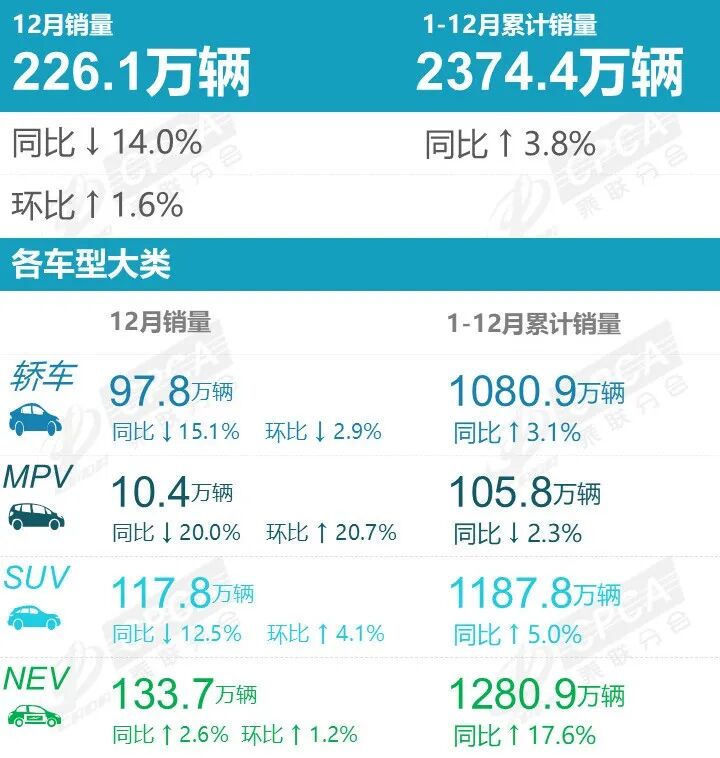
中国汽车流通协会:2025年12月国内狭义乘用车市场零售销量达226.1万辆 同比下降14.0%
Zhi Tong Cai Jing· 2026-01-12 12:11
Core Insights - The domestic narrow passenger car market in China saw a retail sales volume of 2.261 million units in December 2025, representing a year-on-year decline of 14.0% but a month-on-month increase of 1.6%. Cumulatively, the sales for the year reached 23.744 million units, marking a year-on-year growth of 3.8% [1]. Market Overview - December 2025 successfully achieved the growth expectations set for the "14th Five-Year Plan" in the automotive market. Despite a challenging environment with significant regulatory measures, the highlights were observed in the new energy vehicle (NEV) market and export market. The expiration of the tax exemption policy for NEVs at the end of December was expected to stimulate demand, although the depletion of subsidy funds across provinces limited the purchasing momentum [2]. Manufacturer Performance - December 2025 - BYD Auto led the sales with 414,784 units, experiencing a month-on-month decrease of 12.7% and a year-on-year decline of 18.6%, holding a market share of 14.9% [4]. - Geely Auto sold 236,817 units, down 23.7% month-on-month but up 12.7% year-on-year, with a market share of 8.5% [4]. - Chery Auto reported sales of 234,736 units, a month-on-month decrease of 10.6% and a year-on-year decline of 19.1%, capturing 8.4% of the market [4]. - Tesla China saw an increase in sales to 97,171 units, up 12.1% month-on-month and 3.6% year-on-year, with a market share of 3.5% [4]. Annual Manufacturer Performance - 2025 - For the entire year of 2025, BYD Auto sold 4.545 million units, a year-on-year increase of 6.9%, securing a market share of 15.4% [5]. - Geely Auto's sales reached 3.025 million units, reflecting a significant year-on-year growth of 39.0% and a market share of 10.2% [5]. - Chery Auto achieved sales of 2.698 million units, up 7.3% year-on-year, with a market share of 9.1% [5]. - Tesla China sold 851,732 units, down 7.1% year-on-year, holding a market share of 2.9% [5]. NEV Market Performance - December 2025 - In December 2025, BYD Auto led the NEV wholesale sales with 414,784 units, down 12.7% month-on-month and 18.6% year-on-year, capturing 26.5% of the market [8]. - Geely Auto followed with 154,264 units, a month-on-month decrease of 17.9% but a year-on-year increase of 38.7%, holding 9.9% market share [8]. - Tesla China sold 97,171 units, marking a month-on-month increase of 12.1% and a year-on-year increase of 3.6%, with a market share of 6.2% [8]. NEV Annual Performance - 2025 - For the year 2025, BYD Auto sold 4.545 million NEVs, a year-on-year increase of 6.9%, with a market share of 29.7% [9]. - Geely Auto's NEV sales reached 1.688 million units, reflecting a remarkable year-on-year growth of 90.0% and a market share of 11.0% [9]. - Changan Auto sold 937,460 NEVs, up 40.7% year-on-year, with a market share of 6.1% [9].




乘联分会:预计12月狭义乘用车零售230万辆 新能源零售138万辆
智通财经网· 2025-12-19 08:57
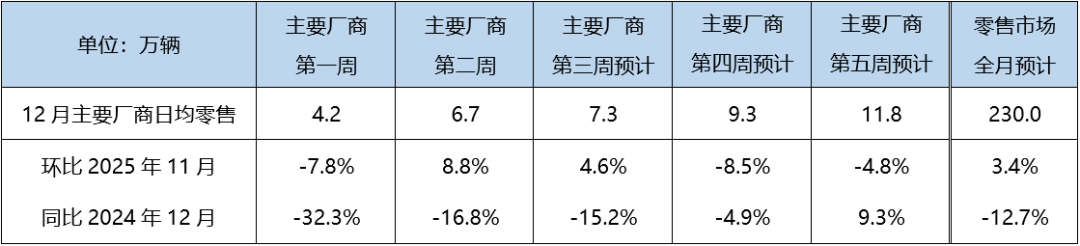
Core Viewpoint - The automotive market in December is expected to show a slight month-on-month increase in retail sales, but a significant year-on-year decline, with a focus on the impact of policy changes and market dynamics [1][3][6] Group 1: Market Performance - The retail market for narrow passenger vehicles in December is projected to reach approximately 2.3 million units, reflecting a month-on-month increase of 3.4% but a year-on-year decrease of 12.7% [1][3] - Retail sales of new energy vehicles (NEVs) are expected to be around 1.38 million units, with a penetration rate of 60% [1][3] Group 2: Monthly Market Review - In November, retail sales of narrow passenger vehicles totaled 2.225 million units, marking a year-on-year decline of 8.1% and a month-on-month decrease of 1.1% [2] - NEV retail sales in November reached 1.321 million units, showing a year-on-year growth of 4.2% and a month-on-month increase of 3.0%, with a market penetration rate of 59.3% [2] Group 3: Weekly Sales Trends - The first week of December saw an average daily retail of 42,000 units, a year-on-year decline of 32.3% and a month-on-month decrease of 7.8% [4][5] - The second week experienced a recovery with an average daily retail of 67,000 units, a year-on-year decline of 16.8% but a month-on-month increase of 8.8% [4][5] - The average daily retail is expected to rise to 118,000 units in the fifth week, reflecting a year-on-year increase of 9.3% but a month-on-month decrease of 4.8% [4][5] Group 4: Policy and Market Dynamics - The automotive market is transitioning to a normalized seasonal operation as multiple consumer stimulus policies are being phased out [6] - The adjustment of the new energy vehicle purchase tax subsidy from full exemption to half exemption is anticipated to influence consumer behavior, although no significant "last-minute rush" effect has been observed [6] - Several automakers have introduced "tax coverage plans" to stabilize consumer expectations amid policy changes, which may lead to some demand being postponed [6] - The industry is moving towards a more rational competitive environment, with new guidelines aimed at curbing irrational competition and promoting value-based competition [6]