
无人城配车

Search documents
喜相逢集团涨近8% 与阿里巴巴菜鸟集团达成战略合作 共推城市配送数智化升级
Zhi Tong Cai Jing· 2025-09-22 06:15
Core Viewpoint - The strategic partnership between Alibaba's Cainiao Group and Xixiangfeng Group aims to enhance urban logistics through digitalization and automation, focusing on cost reduction and efficiency improvements in delivery services [1] Company Summary - Xixiangfeng Group's stock rose nearly 8%, reaching HKD 10.7 with a trading volume of HKD 69.34 million following the announcement of the partnership [1] - The collaboration will explore various dimensions including consumer experience optimization, asset management, and financing leasing [1] Industry Summary - According to a report by China Securities, there were 14.59 million urban delivery vehicles in China in 2022, with an estimated annual replacement space of approximately 2.92 million for unmanned delivery vehicles [1] - If the penetration rate of unmanned vehicles reaches 9.5% by 2030, the market space for hardware and software in this sector is projected to reach CNY 37.34 billion [1] - The promotion of unmanned technology is seen as a definitive industry trend, supported by technological maturity, cost reduction, and favorable policies [1]
1 万台,无人城配规模之战打响了
3 6 Ke· 2025-07-29 12:50
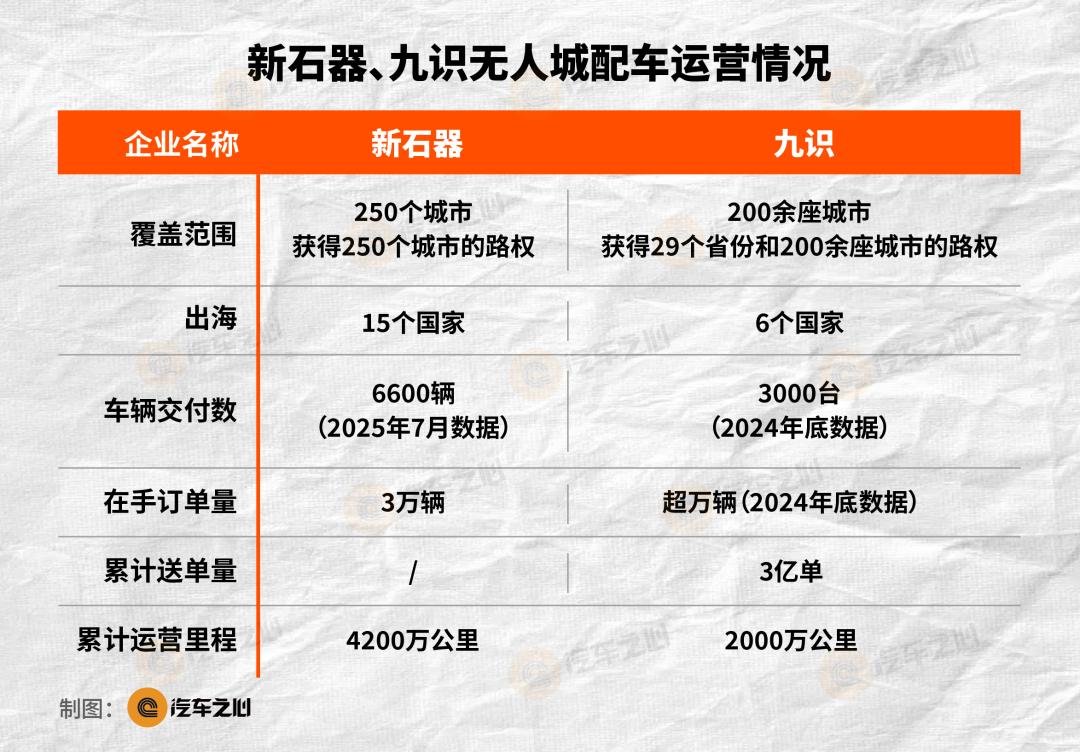
Core Insights - The article discusses the rapid growth and commercialization of autonomous delivery vehicles in China, particularly focusing on companies like New Stone and NineSight, which are leading the charge in this sector [1][2][3] Market Overview - As of 2024, over 6,000 autonomous delivery vehicles have been deployed in China, significantly outpacing the nearly 3,000 Robotaxi vehicles [2] - The market for autonomous delivery vehicles in China grew from 4 billion to 6.5 billion yuan between 2022 and 2023, with a compound annual growth rate exceeding 62%, and is projected to reach 17 billion yuan in 2024 [2] Company Performance - New Stone and NineSight are the first companies to reach the milestone of 10,000 units in production, with New Stone delivering over 6,600 vehicles and NineSight over 5,000 vehicles as of July 2024 [2][3] - New Stone's monthly delivery rate has increased tenfold compared to the previous year, with April 2024 alone surpassing the total deliveries for the entire year of 2024 [2] Competitive Landscape - The article highlights that major players like JD, Meituan, and Cainiao, which initially led the development of autonomous delivery vehicles, are lagging in scaling production compared to New Stone and NineSight [3][4] - New Stone and NineSight have developed strong capabilities in technology maturity, cost control, and operational maintenance, which are critical for achieving large-scale production [5][6] Technological Advancements - Both companies have achieved L4 level autonomous driving capabilities, allowing them to operate in various road conditions and scenarios [5] - New Stone's vehicles can reduce transportation costs from 0.15 yuan per delivery to 0.06 yuan, while NineSight's vehicles can lower costs from 0.17 yuan to 0.1 yuan [9][11] Product Strategy - New Stone and NineSight have diversified their product lines to cater to different transportation needs, offering various models that can handle different load capacities and road conditions [12][14] - New Stone focuses on large clients for bulk sales, while NineSight emphasizes small and medium-sized customers and niche markets [15][16] Financial Backing - Both companies have secured significant funding, with New Stone raising 1 billion yuan in February 2024 and NineSight raising 100 million USD in April 2024, which supports their technology development and production capabilities [16] Industry Challenges - The article notes that achieving the 10,000-unit milestone is a critical point for the industry, as it signifies a transition from small-scale validation to large-scale application [17][18] - The competition is expected to intensify as companies strive to optimize costs, enhance technology, and expand customer bases [27][28] Future Outlook - The next milestone for the industry is projected to be the sale of 100,000 units, with the potential for significant market transformation [42][43] - The article emphasizes the need for patience and observation as the industry navigates through its growth phase and faces challenges in technology validation and business model verification [44][45]

激光雷达:AEBS新规催化标配预期,割草机+无人城配快速放量
2025-06-12 15:07
Summary of Key Points from Conference Call Industry and Company Involved - The conference call focuses on the **LiDAR (Light Detection and Ranging)** technology industry, particularly its applications in the automotive sector and emerging markets like smart lawn mowers and unmanned urban delivery vehicles. Core Insights and Arguments 1. **Impact of AEBS Regulations**: The release of the AEBS (Advanced Emergency Braking System) regulation draft is expected to catalyze the adoption of LiDAR in L2 and below vehicles, enhancing basic safety and perception functions [3][12][10]. 2. **Market Growth in Smart Lawn Mowers**: The demand for LiDAR in smart lawn mowers and unmanned urban delivery is rapidly increasing, with expected shipment volumes to expand significantly by 2025, potentially reaching a market size of **5 to 6 billion** [5][17]. 3. **High Potential in LiDAR Market**: The global automotive-grade LiDAR market is projected to cultivate companies with a market value of **hundreds of billions** of RMB, although current valuations of leading companies like Hesai and RoboSense do not fully reflect their growth potential [6][9]. 4. **Concentration of Supply and Demand**: The supply side is highly concentrated with strong certainty, while the pricing and valuation have not yet fully captured the accelerating demand, indicating a high potential for returns [8][7]. 5. **Trends in LiDAR Technology**: LiDAR technology is trending towards downscaling, diffusion, and high-end applications, with prices rapidly decreasing, making it more accessible for various vehicle types [4][14][16]. 6. **Unmanned Delivery Vehicles**: The use of LiDAR in unmanned delivery vehicles (RoboVan) is justified by significant cost savings in last-mile delivery, with potential reductions in delivery costs by **67%** [19][20]. 7. **Growth of Unmanned Freight Vehicles**: The unmanned freight vehicle market is expanding quickly, with major companies planning substantial deliveries in 2025, indicating a market potential of **200 to 400 billion** [21][23]. 8. **Technological Advancements**: The latest models of unmanned freight vehicles are equipped with multiple LiDAR units, with costs decreasing significantly, enhancing their commercial viability [22][23]. 9. **Future Market Dynamics**: The future of the unmanned delivery vehicle market is promising, with a focus on cost control and the need for stricter automotive-grade requirements as speeds increase [24][25]. Other Important but Possibly Overlooked Content 1. **LiDAR's Role in Technology**: LiDAR is crucial for simulating human interaction with the environment, serving as a key technology in various sectors including smart driving and safety monitoring [2]. 2. **Market Penetration of LiDAR in Smart Lawn Mowers**: The penetration rate of LiDAR in smart lawn mowers is expected to rise significantly, with a notable increase from **10% to 30%** in just one year [18]. 3. **Regulatory Changes**: The shift of AEBS from a recommended to a mandatory standard will require M1 and N1 class vehicles to install AEBS systems, directly impacting the adoption of LiDAR technology [12]. 4. **Long-term Investment Opportunities**: Companies like Hesai and RoboSense are positioned for long-term growth, with the potential for significant returns in the high-risk, high-reward segments of the market [26].