无铁芯电机

Search documents
未知机构:中国人形机器人从伟创电气看行业进展CITI的观点-20260121
未知机构· 2026-01-21 02:00
Summary of Key Points from the Conference Call Industry Overview - The focus is on the humanoid robot industry, specifically developments related to Weichuang Electric (688698.SS) and its supply chain involvement with U.S. humanoid robot manufacturers [1][1]. Company Insights - Weichuang Electric is a supplier of variable frequency drives, servo motors, and programmable logic controllers (PLCs) [1][1]. - The company has recently supplied various components such as rotary joint modules, coreless motors, frameless motors, and dexterous hand components to Chinese humanoid robot manufacturers [1][1]. - Weichuang Electric has successfully entered the supply chain of leading U.S. humanoid robot manufacturers by providing micro motors for dexterous hands [1][1]. Management's Key Points - Management expressed greater confidence in the mass production progress of U.S. humanoid robot manufacturers compared to Chinese clients, citing a more rigorous product development process [1][1]. - The capacity demand from the U.S. client is expected to increase tenfold by 2027, from 1,000 units per week in 2026 [1][1]. Strategic Partnerships - Weichuang Electric is collaborating with Rongtai Electric (603119.SS) to develop dexterous hand solutions for U.S. clients [4][4]. - Due to client requirements for all components to be produced outside of China, Weichuang announced plans to establish a joint venture with Rongtai in Thailand [5][5]. Production Requirements - The latest version of the humanoid robot requires each hand to have 22 degrees of freedom (DoF), totaling 44 micro motors for both hands [5][5]. - The U.S. client has requested that Weichuang prepare production capacity by the first half of 2026, aligning with recent industry research findings [5][5]. - Initial production targets are set to support the manufacturing of 1,000 humanoid robots per week, with potential demand increasing to 10,000 units per week by 2027 [5][5]. Valuation Insights - The target price for Hengli Hydraulic (601100.SS) is set at 135.0 CNY, based on a 52x expected P/E ratio for 2026, which is 2.0 standard deviations above its average P/E since 2021 [5][5]. - The target price for Railway Drive (688017.SS) is set at 233 CNY, based on a 233x expected P/E ratio for 2026, reflecting a stronger-than-expected profit recovery and increasing exposure to the humanoid robot business [8][8]. Risks - Key downside risks for Hengli Hydraulic include weak demand for excavator and non-excavator components, reduced profitability due to diminished economies of scale at the ball screw and Mexico plant, and lower-than-expected gross margin improvements from favorable product mix changes [6][6][7]. - For Railway Drive, risks include a slowdown in automation market growth, intensified competition from both domestic and international brands due to industry consolidation, rising raw material costs eroding gross margins, and lower-than-expected contributions from humanoid robots and other emerging applications [9][9].

大摩再次调研人形机器人产业链:核心零部件及专业机器人企业将率先受益
Zhi Tong Cai Jing· 2025-11-19 15:57
Core Insights - Morgan Stanley's recent research indicates that humanoid robots have transitioned from the R&D phase to the delivery validation phase, with a significant scaling milestone expected in 2026, although work efficiency and technological convergence remain key challenges [3][4]. Industry Trends - The delivery of humanoid robots is set to increase significantly, with major companies establishing expansion targets for 2026. For instance, UBTECH anticipates delivering 500 humanoid robots in 2025, generating approximately 400 million yuan in revenue, with a further increase to 2000-3000 units in 2026 [3][4]. - The total number of humanoid robots with practical work capabilities is projected to exceed 10,000 units by 2026, with component manufacturers also expected to benefit significantly [3][4]. Application Feedback - Despite a notable increase in success rates for humanoid robots (e.g., UBTECH achieving a 99% success rate in box handling tasks), their efficiency remains at only 30%-60% of human capabilities. The development cycle for new task models is lengthy, making application scenario validation a critical factor for industry growth in 2026 [4][5]. Technological Exploration - Companies in the humanoid robot industry are actively testing new technological pathways, but no unified standards have emerged. Key areas of focus include innovations in hardware (e.g., harmonic reducer materials, drive solutions) and software (e.g., large model applications limited by edge computing capabilities) [5][6]. Key Company Dynamics - **UBTECH (9880.HK)**: Plans to release the Walker S3 version in the first half of 2026, featuring the NVIDIA Thor chip. The company aims to improve task completion times and efficiency, with a projected 4-6 times increase in delivery volume by 2026 [6][7]. - **Zhaowei Electromechanical (003021.SZ)**: A leader in the dexterous hand sector, with a product matrix that includes modular and customized solutions. The company expects significant revenue growth in its dexterous hand business from 20-30 million yuan in 2025 to 100 million yuan in 2026 [7][8]. - **Fortior (1304.HK)**: Focuses on innovative motor and sensor technologies, including coreless motors and rotary transformers. The company aims to enhance market share in the robotics sector while maintaining stable profit margins [8][9]. - **Youibot**: As a leader in industrial mobile robots, it targets revenue of 550-600 million yuan in 2026, with growth driven by increased market penetration and expansion into new fields [9].


2025 机器人大会干货出炉,高盛最新解读,点名这些股票
Zhi Tong Cai Jing· 2025-08-19 11:39
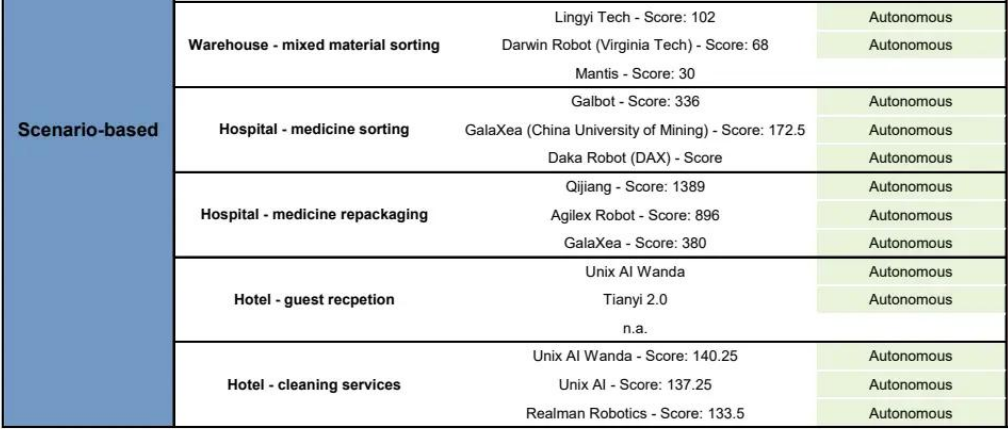
Core Insights - Goldman Sachs observed significant advancements in robot autonomy and generalization capabilities during the World Humanoid Robot Games (WHRG) held in Beijing, indicating potential positive impacts on related stock performances [1][2]. Group 1: Robot Performance and Capabilities - The Tian Gong Ultra robot demonstrated improved autonomous control in running events, reducing run times by 20% compared to remote-controlled performances [2]. - The competition highlighted the need for complex multi-robot collaboration and team intelligence, particularly in soccer events [5]. - Top-performing robots showcased the ability to autonomously complete tasks with high precision, outperforming remote-controlled robots by 50% in scoring [6]. Group 2: Industry Trends and Applications - The WHRG featured over 500 humanoid robots from 280 teams across 16 countries, emphasizing the global interest in humanoid robotics [3]. - The event served as a test for hardware robustness and durability, with specific focus on motor control and battery management [4]. - Scene-based activities underscored the industry's interest in practical applications of humanoid technology, with a trend towards designing products that are commercially viable in the near term [6]. Group 3: Company Insights - Lingyi Tech's robots demonstrated high accuracy and efficiency in material handling tasks, completing operations in 1 minute and 13 seconds with a 95% accuracy rate [7]. - Goldman Sachs holds a positive outlook on companies focusing on autonomous operations, indicating potential growth in the humanoid robotics sector [12]. - Companies like Sanhua Intelligent Controls are expected to see significant revenue growth in humanoid robotics actuators, with projected CAGR of 19% for revenue and net profit from 2025 to 2030 [13].