
微型电机

Search documents
人形板块回调后的布局机遇-机器人掘金电话会议
2026-03-16 02:20
Summary of Key Points from the Conference Call on Humanoid Robotics Sector Industry Overview - The humanoid robotics sector has experienced a significant pullback of 20%-25% after a prior increase of 2-4 times, indicating a potential left-side entry point for investments as current valuations have absorbed pessimistic expectations [1][2] - The upcoming Tesla V3 launch in April 2026 is anticipated to be a core catalyst, showcasing advancements in dexterous hands and AI, which could revise market expectations from 1 million units to a potential 2-5 million units in the long term [1][2] Core Insights and Arguments - The investment paradigm for 2026 is expected to shift towards differentiation, prioritizing companies with confirmed supply chains for V3 and those with customer barriers and deep applications in downstream scenarios, such as Hangzhou Forklift Group and Yongchuang Intelligent [1] - Ampelron is identified as a leader in force sensors, with the V3 version's unit value projected to rise to 12,000 yuan, corresponding to a market size of 12 billion yuan for 1 million robots; the company's target market cap is estimated between 16 billion to 30 billion yuan [1][7] - Zhaowei Electromechanical is highlighted for its core role in the Tesla and Figure supply chains, with expected profits of 400-500 million yuan in 2026, driven by over 30% growth in automotive and AI home business [1][9] Market Dynamics and Sentiment - The humanoid robotics sector has faced a significant correction due to three main factors: crowded trading, pessimistic market sentiment regarding the industry's bottlenecks, and a shift in investment focus towards faster-return themes like North American power shortages and commercial aerospace [2][3] - Historical data suggests that the sector typically experiences pullbacks of 20%-25%, which has been reached, indicating limited further downside potential [2] - The market sentiment is expected to shift from extreme pessimism to neutrality or even optimism if short-term catalysts emerge, particularly around Tesla's V3 release [3][4] Potential Catalysts - Key short-term catalysts include the release of Tesla's V3 video and the actual production figures for 2026, with three potential market reactions based on the V3 release outcomes: 1. Exceeding expectations could lead to a rapid shift in sentiment and an upward revision of long-term unit expectations [3] 2. Meeting expectations would likely stabilize the market and reinforce confidence in Tesla's production capabilities [3] 3. Falling short of expectations could maintain downward pressure on the sector, although the long-term outlook remains positive [4] Investment Focus for 2026 - The investment focus for 2026 is expected to diverge from the previous two years, with a greater emphasis on companies that are confirmed suppliers for V3 and those with high barriers to entry in sensor technology [4][5] - Companies with strong customer orders and performance capabilities, particularly those already engaged with Tesla, are prioritized [5][6] - The importance of data and application scenarios is emphasized, with companies like Hangzhou Forklift Group and Yongchuang Intelligent being highlighted for their understanding of downstream applications [5][6] Company-Specific Insights - Ampelron's sensor business is projected to grow significantly, with a conservative estimate of 11 billion yuan in option value for its humanoid robotics segment, alongside a solid valuation for its core sensor business [7][8] - Zhaowei Electromechanical is noted for its strong positioning in the Tesla supply chain, with a projected profit of 400-500 million yuan in 2026, driven by its innovative automotive components [9][10] Conclusion - The humanoid robotics sector is viewed as a promising investment opportunity, particularly for companies like Zhaowei Electromechanical and Ampelron, which possess strong fundamentals and growth potential in the context of the upcoming technological advancements and market recovery [10]



国盛证券:首予德昌电机控股“买入”评级 AIDC液冷+机器人开启成长新曲线
Zhi Tong Cai Jing· 2026-03-05 01:26
Core Viewpoint - Guosheng Securities initiates coverage on DCH Holdings (00179) with a "Buy" rating, highlighting the company's leadership in the motor industry and its benefits from the growth in automotive intelligence and diversification into AIDC liquid cooling and humanoid robotics [1] Group 1: Globalization and Business Structure - The company is enhancing its global presence with a strategy of "acquiring core assets + divesting non-core businesses," aiming for a footprint across "4 continents and 20 countries" [1] - The focus is on two main business segments: automotive products and industrial products, with micro motors as the primary offering, including automotive micro motors, chassis motors, and thermal management motors [1] - The company is strategically positioning itself in the robotics sector and exploring the AIDC liquid cooling market, developing a diversified product matrix [1] Group 2: Micro Motor Market Growth - The automotive micro motor market is expanding due to the increasing penetration of intelligent vehicles, with the number of micro motors in electric vehicles expected to exceed hundreds compared to traditional fuel vehicles [2] - The global automotive micro motor market is projected to reach approximately 160.2 billion yuan by 2032, with a CAGR of 4% from 2026 to 2032 [2] - The company holds the second-largest market share in micro motors globally and has established partnerships with major clients such as Bosch, Continental, and Volkswagen [2] Group 3: AIDC Liquid Cooling and Humanoid Robotics - AIDC liquid cooling is gaining traction due to its low energy consumption, high heat dissipation, and low noise, becoming a mainstream solution for high-performance computing scenarios [3] - The Chinese liquid cooling server market is expected to reach 16.2 billion USD by 2029, with a CAGR of 47% over five years [3] - The company is actively developing humanoid robotics, with products designed for high torque density, reliability, and compact integration, and has partnered with Shanghai Mechanical and Electrical to focus on humanoid robot joint modules [3]

国盛证券:首予德昌电机控股(00179)“买入”评级 AIDC液冷+机器人开启成长新曲线
智通财经网· 2026-03-05 01:26
Core Viewpoint - Guosheng Securities initiates coverage on DCH Holdings (00179) with a "Buy" rating, highlighting the company's benefits from the growth in automotive motor value due to vehicle intelligence and its expansion into AIDC liquid cooling and humanoid robotics sectors, which will support future business growth [1] Group 1: Globalization and Business Structure - The company is enhancing its global presence through a strategy of "acquiring core assets + divesting non-core businesses," aiming for a "4 continents, 20 countries" layout [1] - The focus is on two main product categories: automotive products and industrial products, with micro motors as the primary products, including vehicle micro motors, chassis motors, and thermal management motors [1] - The company is strategically positioning itself in the robotics sector and exploring the AIDC liquid cooling market, developing a diversified product matrix [1] Group 2: Micro Motor Market Growth - The acceleration of vehicle intelligence is expanding the application scenarios for micro motors, with the number of micro motors in electric vehicles increasing to over a hundred compared to traditional fuel vehicles [2] - The global automotive micro motor market is projected to reach approximately 160.2 billion yuan by 2032, with a CAGR of 4% from 2026 to 2032 [2] - The company holds the second-largest market share globally for micro motor products and has established partnerships with major clients such as Bosch, Continental, and Volkswagen, making it difficult for new entrants to replace them [2] Group 3: AIDC Liquid Cooling and Humanoid Robotics - Liquid cooling is becoming a mainstream solution for high-performance computing scenarios due to its low energy consumption, high heat dissipation, and low noise advantages [3] - The Chinese liquid cooling server market is expected to reach 16.2 billion USD by 2029, with a CAGR of 47% over five years [3] - The company's thermal management pump technology is versatile, and its liquid cooling pumps are expected to benefit from surging downstream demand [3] - The humanoid robotics sector is anticipated to enter mass production, with the company actively investing in this area, offering products such as high-torque density rotary joints and high-precision linear joints [3] - The company has partnered with Shanghai Mechanical and Electrical to establish Dongjie Zhikong, focusing on the complete joint module field for humanoid robots [3]
三月配置建议:关注顺周期主线
GOLDEN SUN SECURITIES· 2026-03-05 01:18
1. Report Industry Investment Ratings - **Dechang Motor Holdings (00179.HK)**: "Buy" rating [8] - **H&H International Holdings (01112.HK)**: "Buy" rating [11] - **Hesai (HSAI.O)**: "Buy" rating [12] - **Hundsun Technologies (600570.SH)**: "Buy" rating [13] - **Jiemei Technology (002859.SZ)**: "Buy" rating [14] 2. Core Views of the Reports Macro Reports - **PMI Report**: The current economy is in a state of "weak reality" with large downward pressure due to insufficient domestic demand and weak confidence. The 2026 GDP target is expected to be 4.5 - 5%, indicating proactive policies. Short - term attention should be paid to policy, data, and external factors, and the economic momentum and credit expansion in Q2 are also crucial [2] - **RMB Exchange Rate Report**: The central bank's exchange - rate regulation is in the liquidity management stage with sufficient policy tools. The probability of direct intervention is low. The RMB exchange - rate increase is mainly due to corporate centralized foreign exchange settlement, and the medium - term exchange rate depends on fundamentals and the US dollar index. The 2026 USD/CNY exchange - rate central value is likely to be between 6.8 - 7.1 [3] Financial Engineering Report - **March Allocation Suggestion**: The economic six - cycle model has retreated to stage 6 of monetary expansion, but the recent decline may be a short - term disturbance. PPI has been rising since July last year, which is beneficial for the cycle sector. The cycle sector's景气指数 has entered the expansion range, and seven industries, mainly pro - cyclical, have shown RS>90 signals and should be focused on [4] Company - Specific Reports - **Dechang Motor Holdings**: The company has a global layout with dual -主业 of automotive and industrial products. It is前瞻ively positioned in the robot and AIDC liquid - cooling markets. It is expected to benefit from the growth of the automotive motor market and the development of new businesses. The归母净利润 from 2026 - 2028 is estimated to grow year - on - year [8] - **H&H International Holdings**: The company's performance has reached an inflection point and is continuously improving. ANC, BNC, and PNC businesses have shown growth. The company is on the path of recovery, and its performance and valuation are expected to resonate [11] - **Hesai**: The company's lidar delivery volume in 2025 exceeded 1.6 million units. It leads in multiple application scenarios such as ADAS, lawn mower robots, and mapping. The shipment volume, revenue, and profit from 2025 - 2027 are expected to increase [12] - **Hundsun Technologies**: The company's 2025 annual report performance met expectations. With a focus on core business and continuous cost control, it is expected to accumulate growth momentum. The revenue and profit from 2025 - 2027 are estimated [13] - **Jiemei Technology**: The company plans to acquire 100% of the equity of Changsha Aifusi, which is expected to achieve synergies with its semiconductor business. The demand for passive components is rising, and the company's product price increase is imminent. The revenue and profit from 2025 - 2027 are expected to grow [14] 3. Summary by Related Catalogs Industry Performance - **Top Five Industries**: The top five industries in terms of performance include Petroleum & Petrochemicals (1 - month: 19.0%, 3 - month: 41.3%, 1 - year: 59.8%), Comprehensive (1 - month: 12.6%, 3 - month: 31.7%, 1 - year: 85.6%), Coal (1 - month: 9.9%, 3 - month: 15.5%, 1 - year: 33.4%), Steel (1 - month: 6.2%, 3 - month: 16.0%, 1 - year: 33.2%), and Utilities (1 - month: 5.3%, 3 - month: 6.9%, 1 - year: 18.4%) [1] - **Bottom Five Industries**: The bottom five industries are Media (- 11.1% in 1 - month, 4.5% in 3 - month, 21.6% in 1 - year), Commerce & Retail (- 9.2% in 1 - month, - 3.6% in 3 - month, 4.4% in 1 - year), Food & Beverage (- 8.2% in 1 - month, - 6.4% in 3 - month, - 8.6% in 1 - year), Non - Banking Finance (- 7.1% in 1 - month, - 0.7% in 3 - month, 7.3% in 1 - year), and Real Estate (- 7.1% in 1 - month, - 3.5% in 3 - month, 0.9% in 1 - year) [1] Company - Specific Analysis Dechang Motor Holdings (00179.HK) - **Business Layout**: It has a "4 - continent, 20 - country" global layout, focusing on automotive and industrial products, mainly micro - motors. It is also involved in the robot and AIDC liquid - cooling markets [6] - **Market Opportunities**: The automotive motor market is growing due to technological updates. The company has a high market share in micro - motors, strong competitiveness in chassis motors and thermal management motors. The AIDC liquid - cooling and humanoid robot markets also have great potential [7][8] - **Financial Forecast**: The estimated归母净利润 for 2026 - 2028 is 2.8/3.0/3.3 billion US dollars, with year - on - year growth of 8%/6%/9% [8] H&H International Holdings (01112.HK) - **Business Performance**: In 2025, the company's revenue had low - double - digit growth. ANC, BNC, and PNC businesses all showed growth, and the adjusted profit indicators also improved [10][11] - **Financial Forecast**: The expected net profit for 2025 - 2027 is 4.2/5.8/7.1 billion yuan, with year - on - year growth of 886.3%/38.2%/22.3% [11] Hesai (HSAI.O) - **Business Performance**: In 2025, the lidar delivery volume exceeded 1.6 million units, with 1.4 million ADAS lidar units and over 200,000 units in the robot category. The ATX product's first - year delivery exceeded 1 million units [11] - **Financial Forecast**: The estimated lidar shipment volume from 2025 - 2027 is about 1.62/2.5/3.41 million units, revenue is about 3.09/4.51/5.92 billion yuan, GAAP归母净利润 is about 0.4/0.62/0.99 billion yuan, and non - GAAP归母净利润 is about 0.53/0.8/1.23 billion yuan [12] Hundsun Technologies (600570.SH) - **Business Performance**: In 2025, the estimated归属上市公司股东的净利润 was 1.229 billion yuan, a year - on - year increase of 17.83%, and the estimated扣非后归母净利润 was 1.005 billion yuan, a year - on - year increase of 20.45% [12] - **Financial Forecast**: The expected revenue from 2025 - 2027 is 5.786/6.205/6.898 billion yuan, and the归母净利润 is 1.229/1.398/1.582 billion yuan [13] Jiemei Technology (002859.SZ) - **Business Layout**: The company plans to acquire 100% of Changsha Aifusi, which is expected to achieve synergies with its semiconductor business. The demand for passive components is rising, and product price increases are expected [13][14] - **Financial Forecast**: The expected total revenue from 2025 - 2027 is 2.151/2.645/3.207 billion yuan, with year - on - year growth of 18.4%/23.0%/21.3%, and the expected归母净利润 is 0.254/0.362/0.526 billion yuan, with year - on - year growth of 25.7%/42.6%/45.1% [14]



德昌电机控股(00179.HK):车用电机龙头 AIDC液冷+机器人开启成长新曲线
Ge Long Hui· 2026-03-04 21:12
Core Viewpoint - The company is enhancing its global presence through a strategy of acquiring core assets and divesting non-core businesses, focusing on automotive and industrial products, particularly micro motors, while also investing in robotics and AIDC liquid cooling markets [1][2]. Group 1: Automotive Products - The company is the second largest globally in micro motor products, with established partnerships with major clients like Bosch, Continental, and Volkswagen, making it difficult for new entrants to replace them [2]. - The automotive micro motor market is expected to grow significantly, with projections indicating a global market size of approximately 160.2 billion yuan by 2032, driven by the increasing integration of micro motors in electric vehicles [1][2]. - The company has a strong competitive edge in chassis motors, with over 70% market share in online control braking held by foreign companies, but it is gaining ground through continuous R&D investments [2]. Group 2: Thermal Management - The global market for thermal management is projected to reach 85-90 billion USD by 2030, with the company's products being highly competitive due to their efficient, reliable, and low-power designs [2]. - Major clients in the thermal management sector include leading automotive manufacturers such as Volkswagen, Ford, BMW, Geely, and BYD [2]. Group 3: AIDC Liquid Cooling and Robotics - The AIDC liquid cooling market is expected to grow rapidly, with a projected market size of 16.2 billion USD in China by 2029, reflecting a CAGR of 47% over five years [2]. - The company's liquid cooling pump technology offers advantages such as high efficiency, energy savings, and long lifespan, positioning it well to benefit from increasing downstream demand [2]. - In the robotics sector, the company is actively developing humanoid robots, focusing on high torque density and reliability in joint modules, with a partnership with Shanghai Mechanical and Electrical to specialize in humanoid robot joint modules [2]. Group 4: Financial Projections - The company is expected to benefit from the growth in automotive intelligence, with projected net profits of 280 million, 300 million, and 330 million USD for the fiscal years 2026-2028, reflecting growth rates of 8%, 6%, and 9% respectively [3].
维宏股份20260304
2026-03-04 14:17
Summary of Weihong Co., Ltd. Conference Call Company Overview - **Company**: Weihong Co., Ltd. (维宏股份) - **Industry**: Robotics and Industrial Control Systems Key Points Industry and Market Dynamics - March 2023 is expected to see significant catalysts with the release of Tesla's "T" and the V3 humanoid robot, particularly focusing on the dexterous hand, which is the most challenging engineering aspect [2][3] - The robotics sector is currently experiencing a pullback due to global risk aversion, but valuations are now at a relatively attractive level [3] Financial Performance and Projections - For 2024, Weihong is projected to achieve revenue of approximately 470 million CNY and a profit of 66 million CNY, with a long-term gross margin maintained above 50% [2][4] - The company anticipates a significant increase in micro motor shipments, with expectations of 300,000 to 500,000 units by 2026, potentially capturing a 20% market share in the domestic market [2][9] Product and Service Offerings - Weihong's core products include integrated motion controllers, motion control cards, and servo drivers, with a focus on industrial control system integration [4] - The company has a strong presence in laser cutting (20% market share, second in the country) and is the market leader in the engraving sector [5] Competitive Positioning - Weihong's acquisition of Hanm Electronics allows it to enter the humanoid robot motor sector, enhancing its capabilities in both drive control and motor integration [6][10] - The company’s competitive advantage lies in its ability to integrate drive control with motor capabilities, which is crucial for the high precision required in dexterous hand applications [10][19] Research and Development - Weihong invests heavily in R&D, with a research expense ratio of approximately 25%, and over half of its workforce dedicated to R&D [12][26] - The company has developed proprietary CAD/CAM software to enhance its technological moat [2][12] Customer Base and Market Strategy - Hanm Electronics has a strong customer base, including leading firms in automotive, consumer electronics, and semiconductors, with nearly 10 major clients in the dexterous hand sector [7][8] - The company aims to provide high integration modules that reduce system integration workload for clients, appealing to those with limited in-house capabilities [35][36] Future Outlook - The market is expected to see a shift from outsourcing motors to outsourcing small modules and potentially entire dexterous hand assemblies, indicating a trend towards greater supply chain specialization [37] - The ASP for dexterous hand motors is estimated at around 10,000 CNY, while the module ASP is approximately 30,000 CNY, suggesting significant business elasticity for Weihong [38] Risks and Considerations - The company faces competition from established players in the robotics and automation sectors, including both domestic and international firms [21][20] - The overall market sentiment is cautious, but the upcoming catalysts in March may provide a rebound opportunity for the stock [39] This summary encapsulates the key insights from the conference call, highlighting Weihong's strategic positioning, financial outlook, and market dynamics within the robotics industry.

德昌电机控股(00179):车用电机龙头,AIDC液冷+机器人开启成长新曲线
GOLDEN SUN SECURITIES· 2026-03-04 11:05
Investment Rating - The report initiates coverage with a "Buy" rating for the company [3][6]. Core Insights - The company is a leading player in the automotive motor sector, focusing on both automotive and industrial applications, and is expanding into the AIDC liquid cooling and robotics markets to drive future growth [3][16]. - The automotive micro-motor market is expected to grow significantly, with a projected global market size of approximately 160.2 billion yuan by 2032, reflecting a CAGR of 4% from 2026 to 2032 [2]. - The company has established a strong customer base, including major clients like Bosch, Continental, and Volkswagen, which enhances its market position and reduces the threat from new entrants [2][3]. Company Overview - The company has a global presence across four continents and twenty countries, achieved through strategic acquisitions and divestitures, focusing on core automotive and industrial products [3][19]. - The company has been in operation since 1959, initially in the toy industry, and has since expanded into the automotive sector, establishing a significant footprint in various international markets [16][19]. Financial Performance - The company’s revenue is projected to grow from 3.814 billion USD in 2024 to 4.265 billion USD in 2028, with a CAGR of 8.9% [5]. - The net profit attributable to the parent company is expected to increase from 229 million USD in 2024 to 328 million USD in 2028, reflecting a growth rate of 8.9% [5]. - The company’s gross margin is expected to improve from 22.3% in 2024 to 24.3% in 2028, indicating enhanced profitability [12][45]. Market Trends - The report highlights the accelerating penetration of electric and intelligent vehicles, which is driving the demand for micro-motors in various automotive applications [47]. - The AIDC liquid cooling market is projected to reach 16.2 billion USD by 2029, with a CAGR of 47%, indicating a significant growth opportunity for the company’s liquid cooling products [3][19]. Product Segmentation - The company’s automotive product portfolio includes electric power steering motors, electric parking brake motors, and various actuators, which are critical for modern vehicle functionalities [27]. - The industrial product segment includes components for heating and ventilation, power and gas metering, and electric bicycles, contributing to a diversified revenue stream [27]. Strategic Initiatives - The company is actively investing in robotics and AIDC liquid cooling technologies, positioning itself for future growth in these emerging markets [3][19]. - A joint venture with Shanghai Mechanical and Electrical Co. aims to develop high-performance robotic components, further enhancing the company’s capabilities in the robotics sector [3][16].
银轮股份:具身智能板块明确“1+4+N”产品布局,部分品类已配套供货,部分处于开发阶段
2 1 Shi Ji Jing Ji Bao Dao· 2026-02-11 10:01
Core Viewpoint - The company has defined a "1+4+N" product layout for its embodied intelligence sector, indicating a strategic approach to product development and customer collaboration [1] Group 1: Product Layout - The "1" in the layout represents the understanding and cognition of the entire machine system [1] - The "4" includes four key modules: rotary joint module, actuator module, dexterous hand module, and thermal management module [1] - The "N" signifies supporting components such as motor modules, micro motors, body structural parts, and heat exchangers [1] Group 2: Customer Collaboration - The company has established partnerships with several leading clients, indicating a strong market presence [1] - Some product categories are already in supply, while others are still in the development phase [1]

金力传动筹备上市:吕志峰、张丹丹夫妇控股40.8%,都是专科学历
Sou Hu Cai Jing· 2026-01-23 01:02
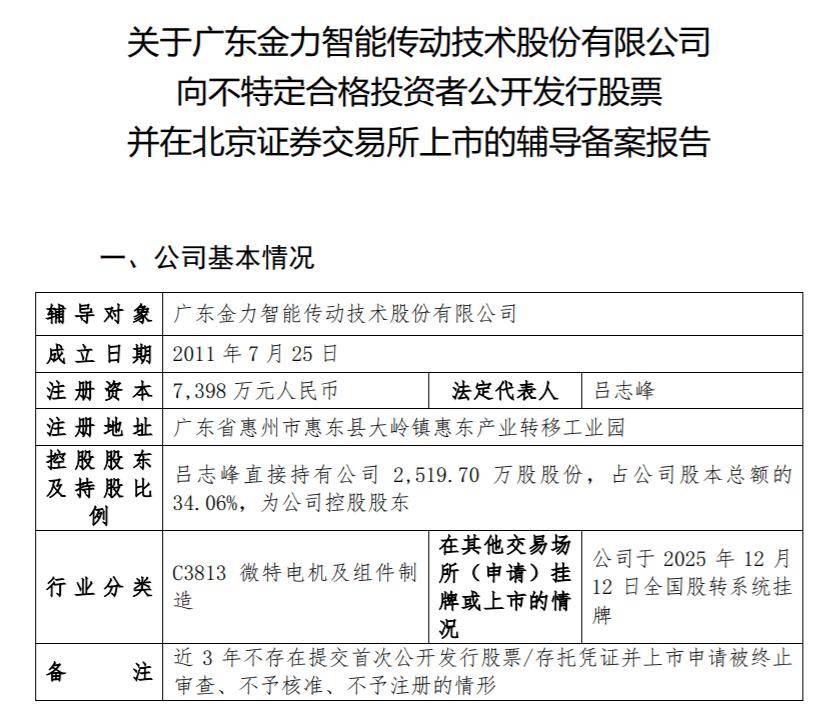
Core Viewpoint - Guangdong Jinli Intelligent Transmission Technology Co., Ltd. (referred to as "Jinli Transmission") has initiated an IPO counseling process with the Guangdong Securities Regulatory Bureau, aiming for listing on the Beijing Stock Exchange, with CITIC Securities as the counseling institution [1]. Company Overview - Jinli Transmission was established on July 25, 2011, and primarily engages in the research, production, and sales of micro motors and micro transmission systems, with applications mainly in the field of intelligent cleaning service robots [1]. - The company is headquartered in Huizhou, Guangdong Province, China [1]. Shareholding Structure - The controlling shareholder of Jinli Transmission is Lv Zhifeng, who directly holds 25.197 million shares, accounting for 34.06% of the total share capital [4]. - Lv Zhifeng's spouse, Zhang Dandan, directly holds 150,000 shares (0.20%) and also controls an additional 4.86 million shares (6.57%) through a partnership [5]. - Together, Lv Zhifeng and Zhang Dandan control 40.83% of the company's shares, making them the actual controllers [5]. Financial Performance - For the fiscal years 2023, 2024, and the first four months of 2025, the company's operating revenues were 301.43 million yuan, 597.43 million yuan, and 239.03 million yuan, respectively, indicating significant growth [2]. - The net profits for the same periods were 11.49 million yuan, 63.99 million yuan, and 19.14 million yuan, respectively, showcasing a substantial increase in profitability [2]. - The company's gross profit margins were reported at 17.79%, 23.60%, and 21.01% for the years 2023, 2024, and the first four months of 2025, respectively [2]. - The total assets as of December 31, 2023, were 493.93 million yuan, with total equity of 340.10 million yuan [2]. Management Background - Lv Zhifeng has extensive experience in the industry, having held various managerial positions since 2001, including roles in other companies before becoming the chairman of Jinli Transmission in July 2016 [6]. - Zhang Dandan has also held significant positions, including being the executive partner of a partnership and the supervisor of the company's general office since July 2016 [7][8].

未知机构:中国人形机器人从伟创电气看行业进展CITI的观点-20260121
未知机构· 2026-01-21 02:00
Summary of Key Points from the Conference Call Industry Overview - The focus is on the humanoid robot industry, specifically developments related to Weichuang Electric (688698.SS) and its supply chain involvement with U.S. humanoid robot manufacturers [1][1]. Company Insights - Weichuang Electric is a supplier of variable frequency drives, servo motors, and programmable logic controllers (PLCs) [1][1]. - The company has recently supplied various components such as rotary joint modules, coreless motors, frameless motors, and dexterous hand components to Chinese humanoid robot manufacturers [1][1]. - Weichuang Electric has successfully entered the supply chain of leading U.S. humanoid robot manufacturers by providing micro motors for dexterous hands [1][1]. Management's Key Points - Management expressed greater confidence in the mass production progress of U.S. humanoid robot manufacturers compared to Chinese clients, citing a more rigorous product development process [1][1]. - The capacity demand from the U.S. client is expected to increase tenfold by 2027, from 1,000 units per week in 2026 [1][1]. Strategic Partnerships - Weichuang Electric is collaborating with Rongtai Electric (603119.SS) to develop dexterous hand solutions for U.S. clients [4][4]. - Due to client requirements for all components to be produced outside of China, Weichuang announced plans to establish a joint venture with Rongtai in Thailand [5][5]. Production Requirements - The latest version of the humanoid robot requires each hand to have 22 degrees of freedom (DoF), totaling 44 micro motors for both hands [5][5]. - The U.S. client has requested that Weichuang prepare production capacity by the first half of 2026, aligning with recent industry research findings [5][5]. - Initial production targets are set to support the manufacturing of 1,000 humanoid robots per week, with potential demand increasing to 10,000 units per week by 2027 [5][5]. Valuation Insights - The target price for Hengli Hydraulic (601100.SS) is set at 135.0 CNY, based on a 52x expected P/E ratio for 2026, which is 2.0 standard deviations above its average P/E since 2021 [5][5]. - The target price for Railway Drive (688017.SS) is set at 233 CNY, based on a 233x expected P/E ratio for 2026, reflecting a stronger-than-expected profit recovery and increasing exposure to the humanoid robot business [8][8]. Risks - Key downside risks for Hengli Hydraulic include weak demand for excavator and non-excavator components, reduced profitability due to diminished economies of scale at the ball screw and Mexico plant, and lower-than-expected gross margin improvements from favorable product mix changes [6][6][7]. - For Railway Drive, risks include a slowdown in automation market growth, intensified competition from both domestic and international brands due to industry consolidation, rising raw material costs eroding gross margins, and lower-than-expected contributions from humanoid robots and other emerging applications [9][9].
