
易方达卫星ETF

Search documents
A股ETF开年火热,32只主题ETF涨超20%
3 6 Ke· 2026-01-15 12:03
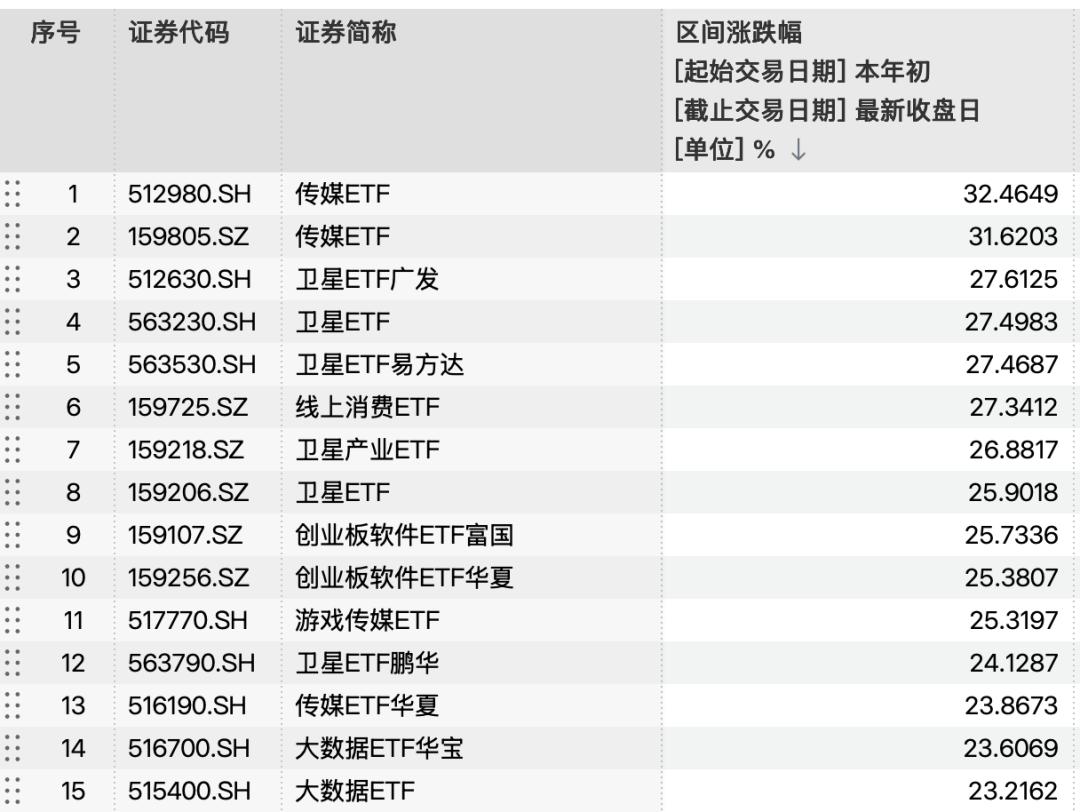
Core Viewpoint - The A-share market has experienced a "spring surge" at the beginning of 2026, with ETFs showing significant growth and a rare trend of "limit-up" occurrences in multiple products [1][5]. Group 1: ETF Market Overview - The total scale of ETFs in the market has increased from 6 trillion yuan to 6.24 trillion yuan, a growth of over 2245.82 billion yuan since the beginning of the year [2][3]. - Stock ETFs have been the main contributors to this growth, with an increase of over 2000 billion yuan, surpassing the 4 trillion yuan mark, reaching 4.05 trillion yuan [2][3]. - In contrast, bond ETFs have seen a decline of 761.53 billion yuan, and money market ETFs have decreased by 196.98 billion yuan [2]. Group 2: Performance of ETFs - The net value performance of various industry-themed ETFs has significantly outperformed major indices, with the media, satellite, and defense sectors showing notable gains [3][4]. - As of January 14, 2026, the media sector ETFs, such as the GF Media ETF and Penghua Media ETF, have recorded increases of 32.46% and 31.62%, respectively [4]. - Satellite-themed ETFs have also performed well, with the GF Satellite ETF leading with a 27.61% increase [3][4]. Group 3: Fund Flow Dynamics - There is a clear divergence in fund flows, with broad-based ETFs like the CSI A500 experiencing a net outflow of nearly 180 billion yuan, while thematic ETFs in sectors like non-ferrous metals and cross-border investments are attracting capital [7][8]. - The trend of passive investment is increasing, with more investors shifting from public funds to thematic ETFs, indicating a growing interest in sector-specific investments [7][9]. Group 4: Institutional Activity - Institutional investors are actively participating in the ETF market, with public funds moving away from homogeneous competition to focus on niche themes, resulting in the approval of 14 new ETF products since the beginning of 2026 [9]. - Leading fund management companies, such as Huaxia Fund, have seen significant growth in ETF management scale, surpassing 1 trillion yuan, indicating a trend towards increased concentration in the ETF management industry [9].

卫星产业站上风口 相关ETF持续“吸金”
Shang Hai Zheng Quan Bao· 2026-01-11 21:52
Group 1 - The satellite industry is experiencing strong performance, with related ETFs attracting significant capital inflows, indicating substantial mid-to-long-term investment value due to policy support, technological breakthroughs, and market demand [1][2] - As of January 7, 2025, the Yongying Satellite ETF and the China Merchants Satellite Industry ETF have each received over 1 billion yuan in net inflows this year, while the Fortune Satellite ETF and the E Fund Satellite ETF have attracted 965 million yuan and 385 million yuan respectively [1] - The total net inflows for the Yongying Satellite ETF since Q4 2025 amount to 5.257 billion yuan, with the China Merchants Satellite Industry ETF and the Fortune Satellite ETF receiving 1.627 billion yuan and 1.22 billion yuan respectively [1] Group 2 - The strong performance of the satellite sector is attributed to multiple factors, including key technological breakthroughs, clear national strategies, sustained industrial demand, and active market recognition [2] - The Ministry of Industry and Information Technology supports new models like "mobile direct satellite" applications, aiming for over 10 million satellite communication users by 2030 and issuing satellite internet licenses to multiple operators [2] - The commercial space sector is expected to see a surge in IPOs following the revision of the fifth set of standards on the Sci-Tech Innovation Board, which includes commercial aerospace [2] Group 3 - Institutions are particularly focused on companies' future strategies in the commercial aerospace sector, with companies like Unisoc highlighting their advancements in products for this strategic area [3] - The successful launch of the Zhuque-3 rocket is seen as a critical solution to the long-standing issue of insufficient heavy-lift capacity in China's commercial aerospace, potentially accelerating satellite communication network deployment [3] - The satellite industry is anticipated to enter a new development phase driven by strong policy support and ongoing industrial progress, presenting mid-to-long-term investment opportunities [3]


两大赛道,猛烈“吸金”
Shang Hai Zheng Quan Bao· 2026-01-09 04:51
Group 1: Non-ferrous Metals Sector - The non-ferrous metals sector has seen significant inflows into ETFs, with notable funds like Wanji Industrial Non-ferrous ETF surpassing 10 billion yuan in scale [1][3] - As of January 7, 2026, major non-ferrous metal ETFs received substantial net inflows: Southern Non-ferrous Metal ETF (2.39 billion yuan), Huaxia Non-ferrous Metal ETF (1.44 billion yuan), and Dachen Non-ferrous ETF (0.93 billion yuan) [3] - Factors driving the non-ferrous metals sector include improved supply-demand dynamics and the global trend of "re-industrialization," alongside geopolitical tensions affecting resource supply [1][4] Group 2: Commercial Aerospace Sector - The commercial aerospace sector has also attracted significant investment, with the Yongying Satellite ETF rising by 6.2% and leading the market [5][6] - As of January 7, 2026, the Yongying Satellite ETF and the Zhaoshang Satellite Industry ETF each gained over 1 billion yuan in net inflows since the beginning of the year [6] - The commercial aerospace sector is expected to accelerate in 2026, driven by policy support, IPOs of leading companies, and heightened strategic value due to geopolitical factors [6]